Integrated Physical Science C165 WGU,
Top Exam Questions with answers, rated
A+
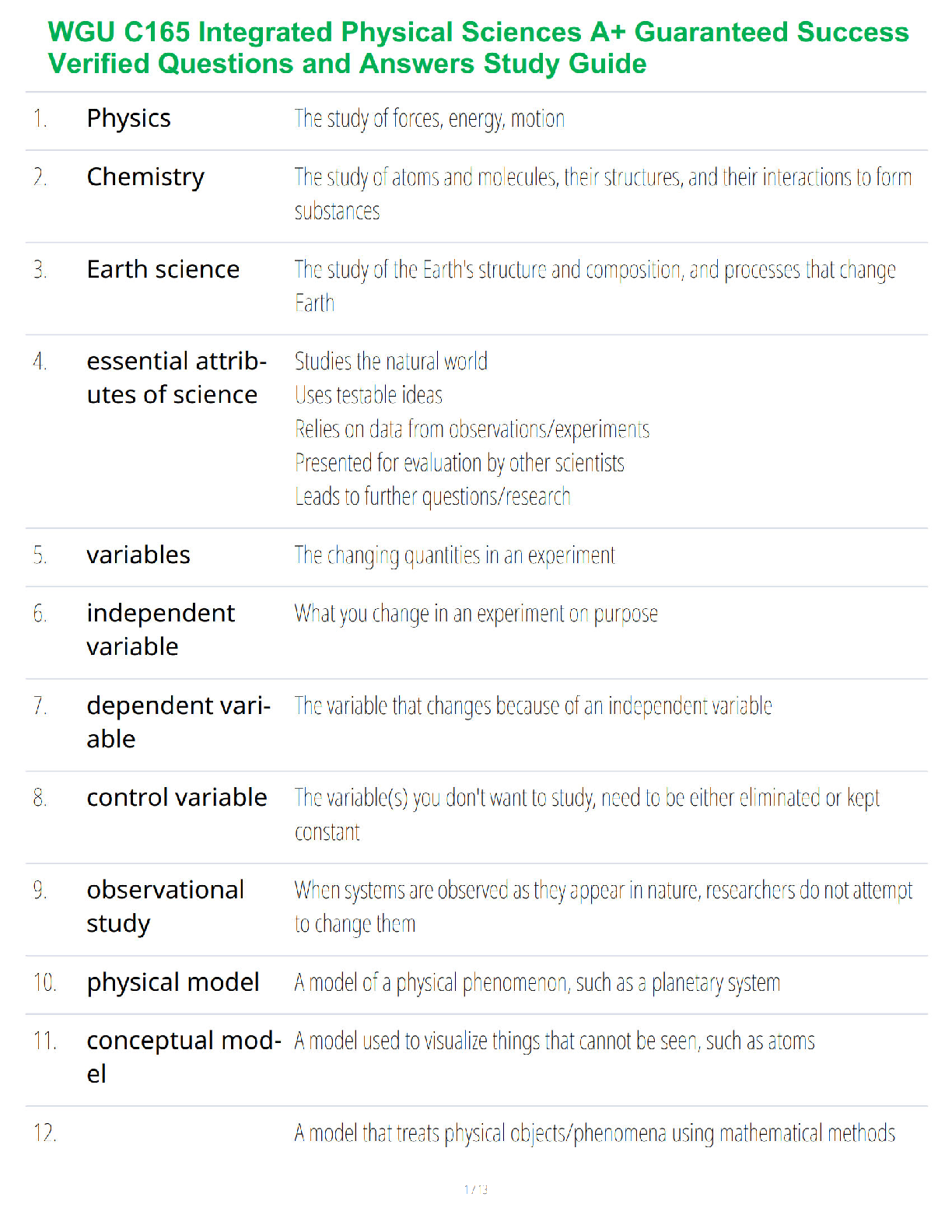
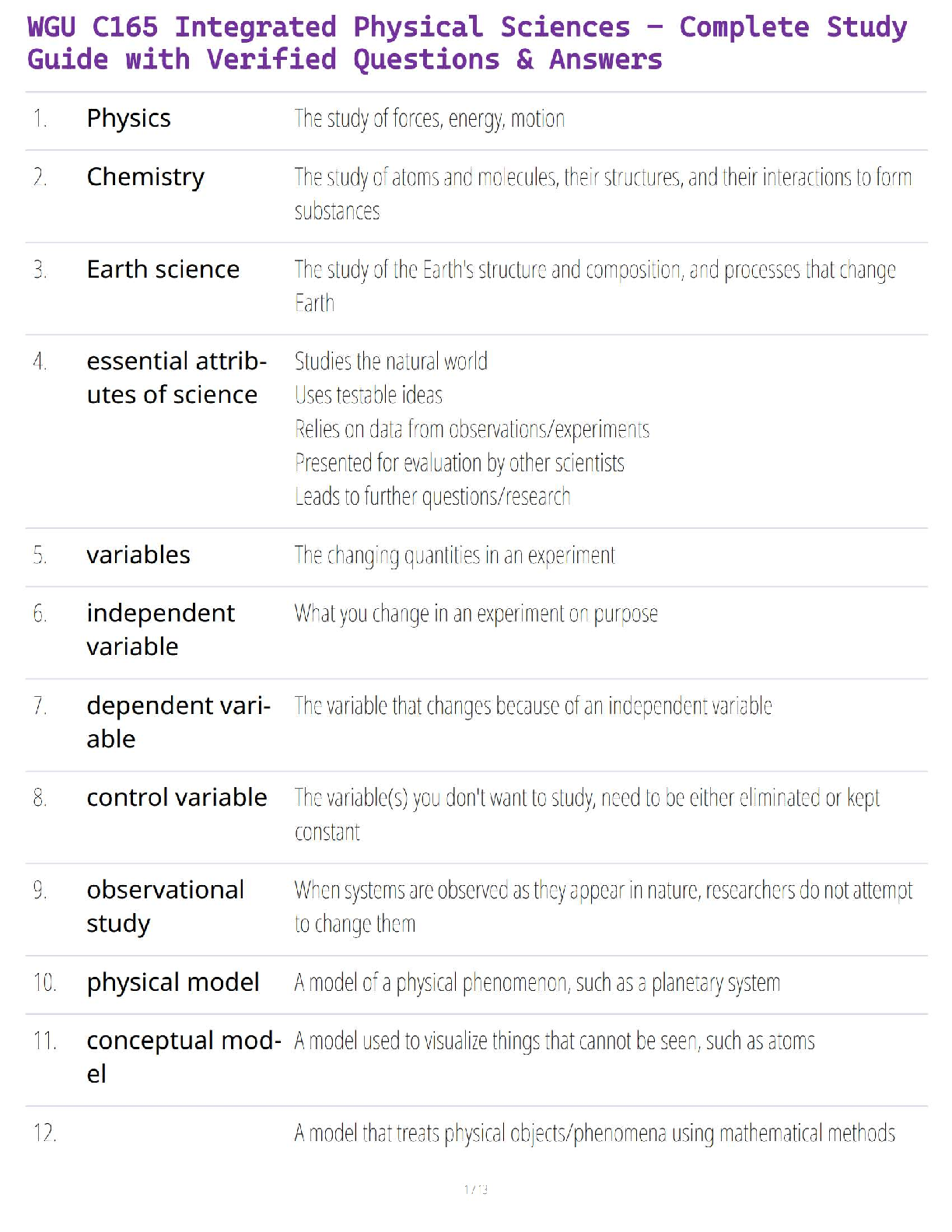
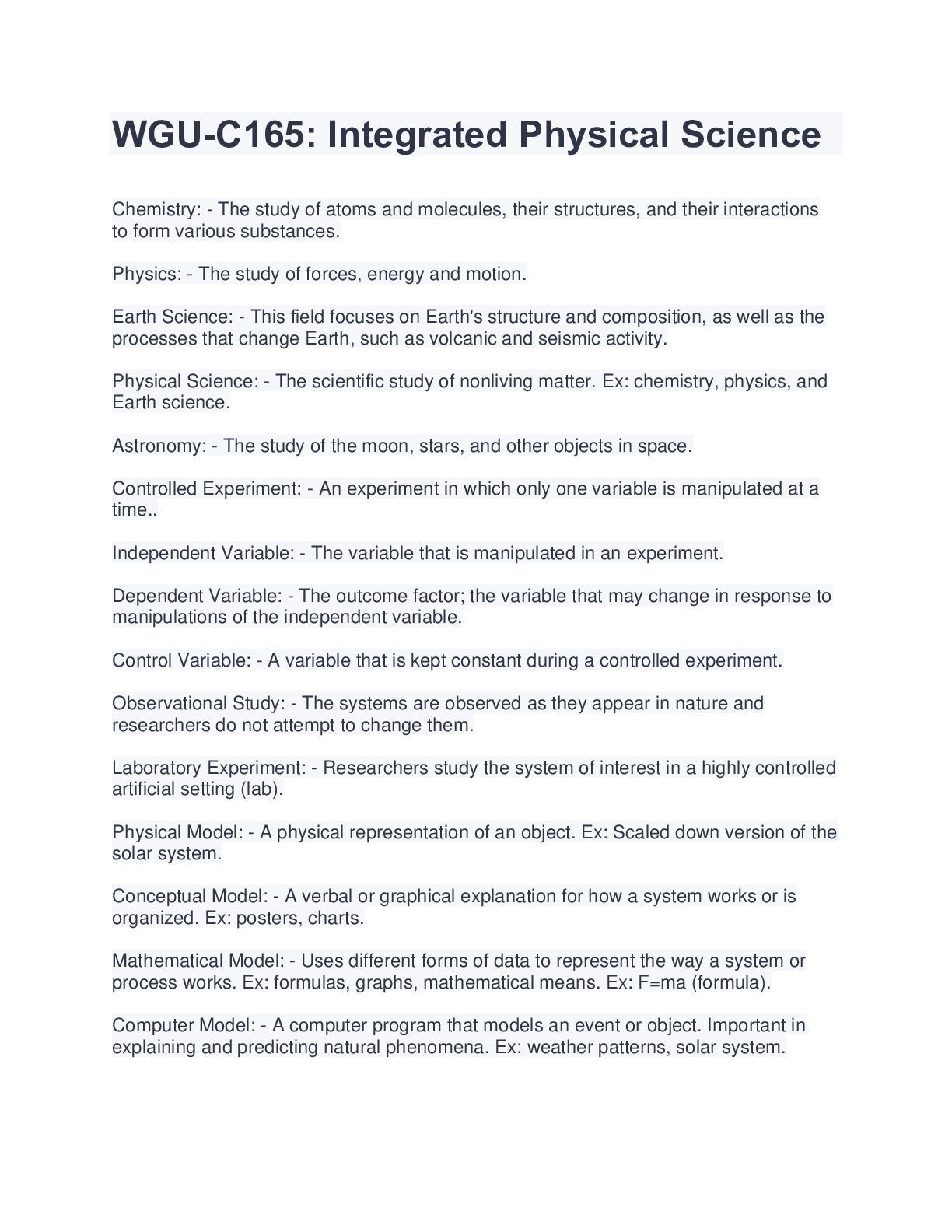
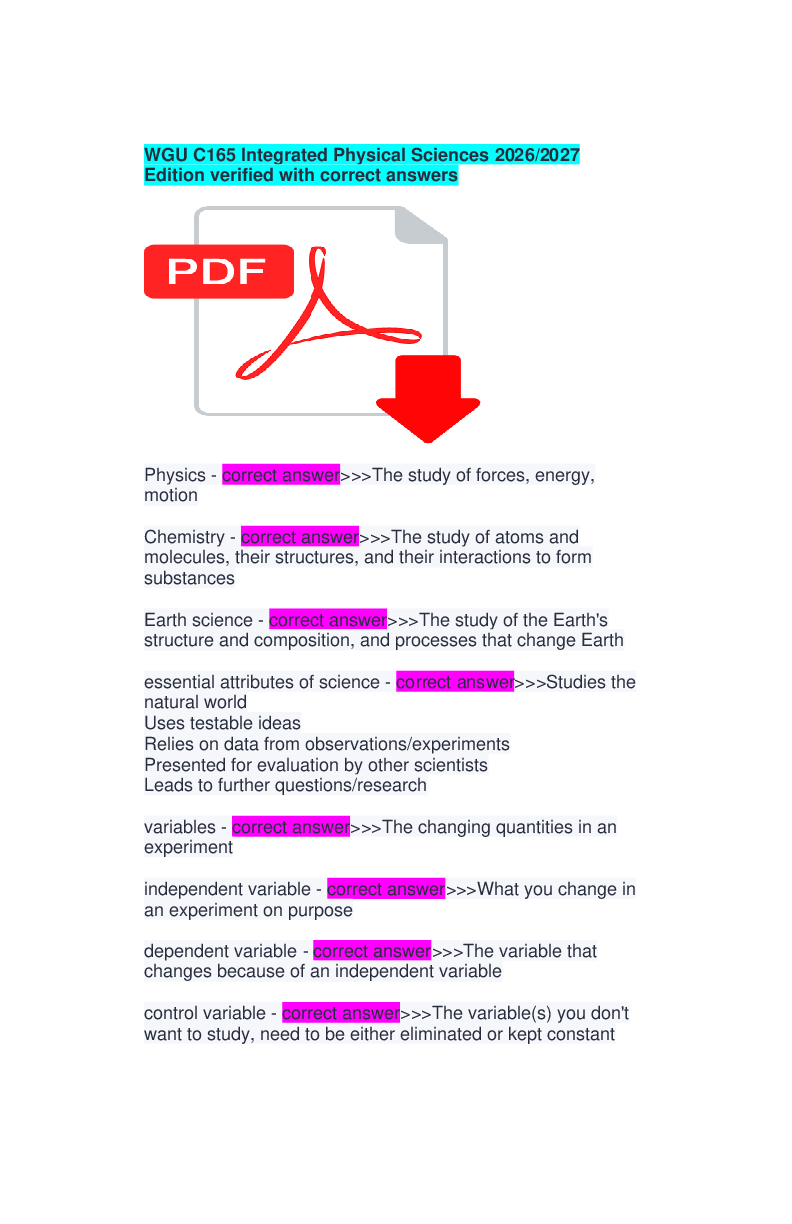
physics - ✔✔-the study of forces, energy, motion
Chemistry - ✔✔-study of atoms and molecules, their structures, and their interactions
...
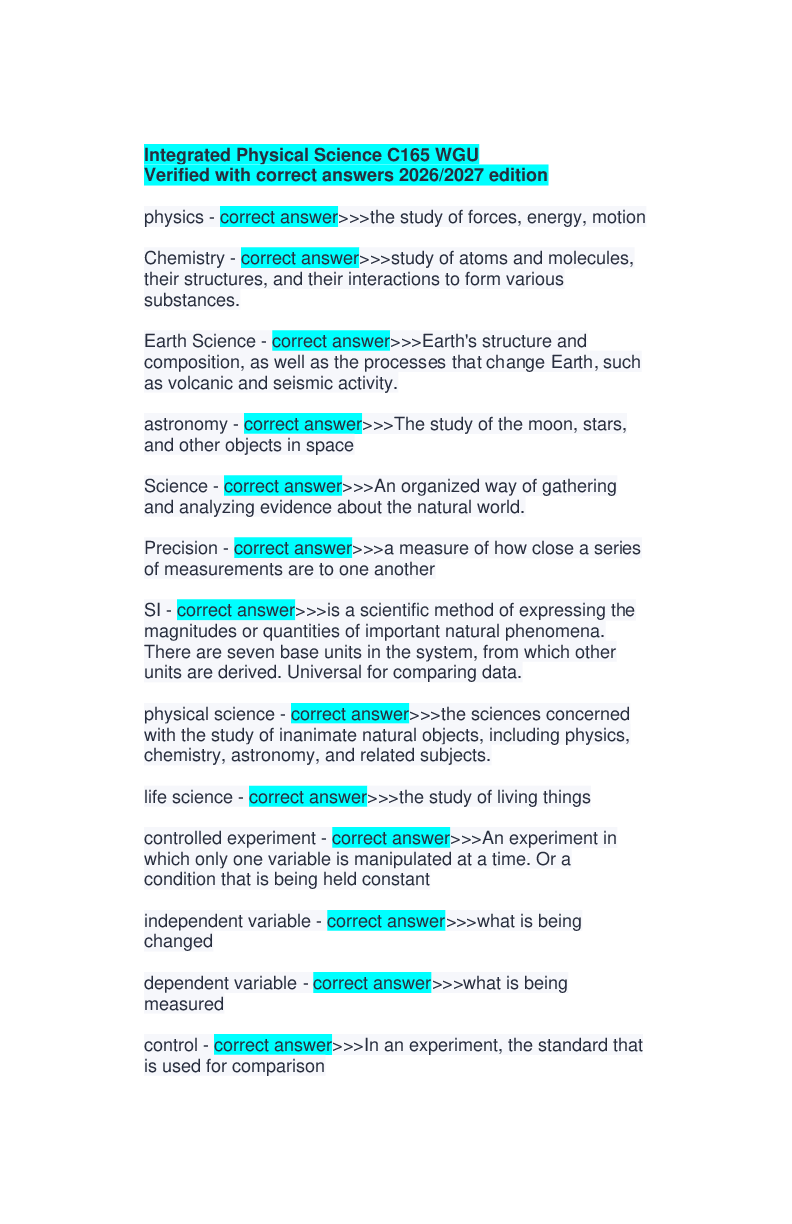
Integrated Physical Science C165 WGU,
Top Exam Questions with answers, rated
A+
physics - ✔✔-the study of forces, energy, motion
Chemistry - ✔✔-study of atoms and molecules, their structures, and their interactions to form various
substances.
Earth Science - ✔✔-Earth's structure and composition, as well as the processes that change Earth, such
as volcanic and seismic activity.
astronomy - ✔✔-The study of the moon, stars, and other objects in space
Science - ✔✔-An organized way of gathering and analyzing evidence about the natural world.
Precision - ✔✔-a measure of how close a series of measurements are to one another
SI - ✔✔-is a scientific method of expressing the magnitudes or quantities of important natural
phenomena. There are seven base units in the system, from which other units are derived. Universal for
comparing data.
physical science - ✔✔-the sciences concerned with the study of inanimate natural objects, including
physics, chemistry, astronomy, and related subjects.
life science - ✔✔-the study of living things
controlled experiment - ✔✔-An experiment in which only one variable is manipulated at a time. Or a
condition that is being held constant
independent variable - ✔✔-what is being changed
dependent variable - ✔✔-what is being measured
control - ✔✔-In an experiment, the standard that is used for comparison
Observational experiment or study - ✔✔-studies attempt to understand cause-and-effect relationships.
However, unlike experiments, the researcher is not able to control (1) how subjects are assigned to
groups and/or (2) which treatments each group receives. ... Therefore, a sample survey is an example of
an observational study.
field study - ✔✔-a research investigation carried out in a naturally occurring setting
laboratory study - ✔✔-Research done in a laboratory
Physical Model - ✔✔-A physical representation of an object. Prototypes and appearance models are
physical models.
conceptual model - ✔✔-a verbal or graphical explanation for how a system works or is organized
mathematical model - ✔✔-one or more equations that represent the way a system or process works
Hypothesis - ✔✔-A testable prediction, often implied by a theory
Theory - ✔✔-A hypothesis that has been tested with a significant amount of data. Explains why
something happened.
Law - ✔✔-A law in science is a generalized rule to explain a body of observations in the form of a verbal
or mathematical statement. Scientific laws (also known as natural laws) imply a cause and effect
between the observed elements and must always apply under the same conditions. Explains how it
happened not why.
Observation - ✔✔-Information obtained through the senses.
evidence - ✔✔-proof
Data - ✔✔-Facts and statistics collected together for reference or analysis
Big Bang Theory - ✔✔-Cosmological model that explains the sudden development of the universe
through expansion from a hot, dense state.
plate tectonics - ✔✔-A theory stating that the earth's surface is broken into plates that move.
atomic theory - ✔✔-a theory that states that all matter is composed of tiny particles called atoms.
gram - ✔✔-a metric unit of mass equal to one thousandth of a kilogram.
meter - ✔✔-The meter is the basic unit of length in the SI system of units. ... The previous definition of
the meter was one ten-millionth of the distance from the geographic north pole to the equator,
measured over the earth's surface in a circle running through Paris, France.
second - ✔✔-SI base unit for time
Celsius - ✔✔-Metric unit for measuring temperature; On this scale water freezes at zero and boils at
100.
Kelvin - ✔✔-The SI base unit of temperature
liter - ✔✔-Basic unit of volume in the metric system
Metric Prefixes - ✔✔-Giga, Mega, Kilo, deci, centi, milli, micro, nano
derived unit - ✔✔-A unit defined by a combination of base units
direct relationship - ✔✔-a relationship in which one variable increases with an increase in another
variable
inverse relationship - ✔✔-a relationship in which one variable decreases when another variable
increases
Speed - ✔✔-The distance an object travels per unit of time
Velocity - ✔✔-Speed in a given direction
Acceleration - ✔✔-the rate at which velocity changes over time; an object accelerates if its speed,
direction, or both change
distance - ✔✔-The length of a path between two points
Displacement - ✔✔-Distance and direction of an object's change in position from the starting point.
Balance force - ✔✔-Equal forces acting on one object in opposite direction. These forces then give a 0
net force, causing the object to stay in place.
unequal force - ✔✔-unbalanced forces cause a change in motion; speed. and/or direction. When two
forces act in the same direction on an object, the net force is. equal to the sum of the two forces. When
two unequal forces act in opposite directions.
net force - ✔✔-The combination of all forces acting on an object
Newton's First Law - ✔✔-An object at rest stays at rest and an object in motion stays in motion with the
same speed and in the same direction unless acted upon by an unbalanced force.
Mass - ✔✔-the amount of matter in an object
Inertia - ✔✔-The tendency of an object to resist a change in motion
Newton's Second Law - ✔✔-Force equals mass times acceleration
Newton's Third Law - ✔✔-For every action there is an equal and opposite reaction
Friction - ✔✔-A force that opposes motion between two surfaces that are in contact
Gravity - ✔✔-Gravity is the force by which a planet or other body draws objects toward its center. The
force of gravity keeps all of the planets in orbit around the sun.
gravitational force - ✔✔-an attractive force that acts between any two objects
Momentum - ✔✔-the force or speed with which something moves
law of conservation of momentum - ✔✔-One of the most powerful laws in physics is the law of
momentum conservation. ... For a collision occurring between object 1 and object 2 in an isolated
system, the total momentum of the two objects before the collision is equal to the total momentum of
the two objects after the collision.
work - ✔✔-Force exerted on an object that causes it to move
Energy - ✔✔-the ability to do work
potential energy - ✔✔-Energy that is stored and held in readiness
kinetic energy - ✔✔-the energy an object has due to its motion
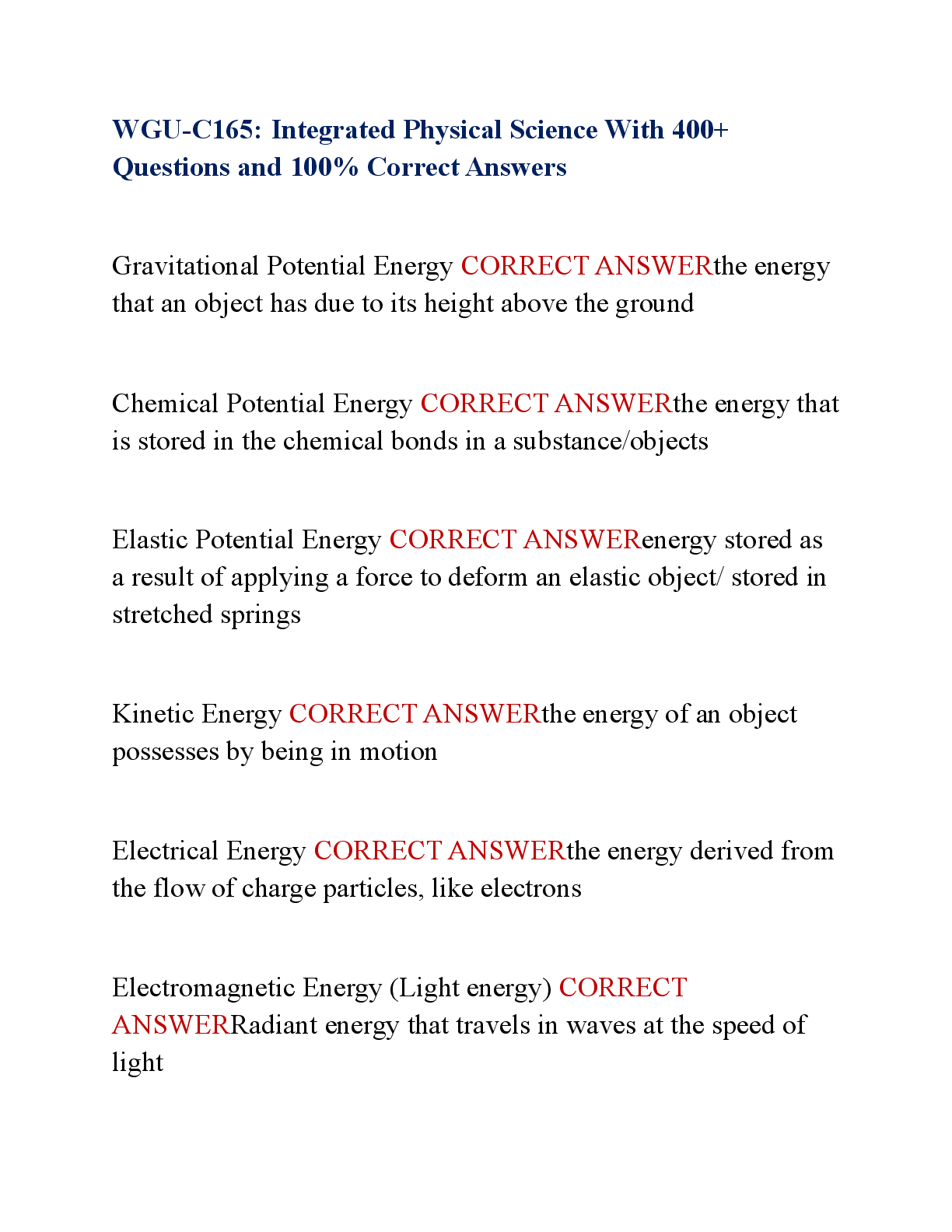
gravitational potential energy - ✔✔-Energy stored by objects due to their position above Earth's surface.
chemical potential energy - ✔✔-the energy stored in the chemical bonds of a substance
elastic potential energy - ✔✔-the energy of stretched or compressed objects
electrical energy - ✔✔-The energy of electric charges
electromagnetic energy - ✔✔-Electromagnetic energy is a term used to describe all the different kinds
of energies released into space by stars such as the Sun. These kinds of energies include some that you
will recognize and some that will sound strange
thermal energy - ✔✔-Heat energy
Law of Conservation of Energy - ✔✔-the law that states that energy cannot be created or destroyed but
can be changed from one form to another
wave - ✔✔-A disturbance that transfers energy from place to place
oscillation - ✔✔-the act or state of swinging back and forth with a steady, uninterrupted rhythm
Equilibrium - ✔✔-A state of balance
medium - ✔✔-The material through which a wave travels is called a
Gases (air), liquids, solids
mechanical wave - ✔✔-A wave that requires a medium through which to travel
electromagnetic waves - ✔✔-A form of energy that can move through the vacuum of space.
transverse wave - ✔✔-A wave that moves the medium in a direction perpendicular to the direction in
which the wave travels
longitudinal wave - ✔✔-A wave in which the vibration of the medium is parallel to the direction the
wave travels. Compresse
[Show More]


.png)