CPHQ Certification, Exam Questions and
answers, 100% Accurate, rated A+
Triple Aim - ✔✔-1. Ensure quality of care for individual
2 Improve health of the population
3. Control costs
Critical components of a leadershi
...
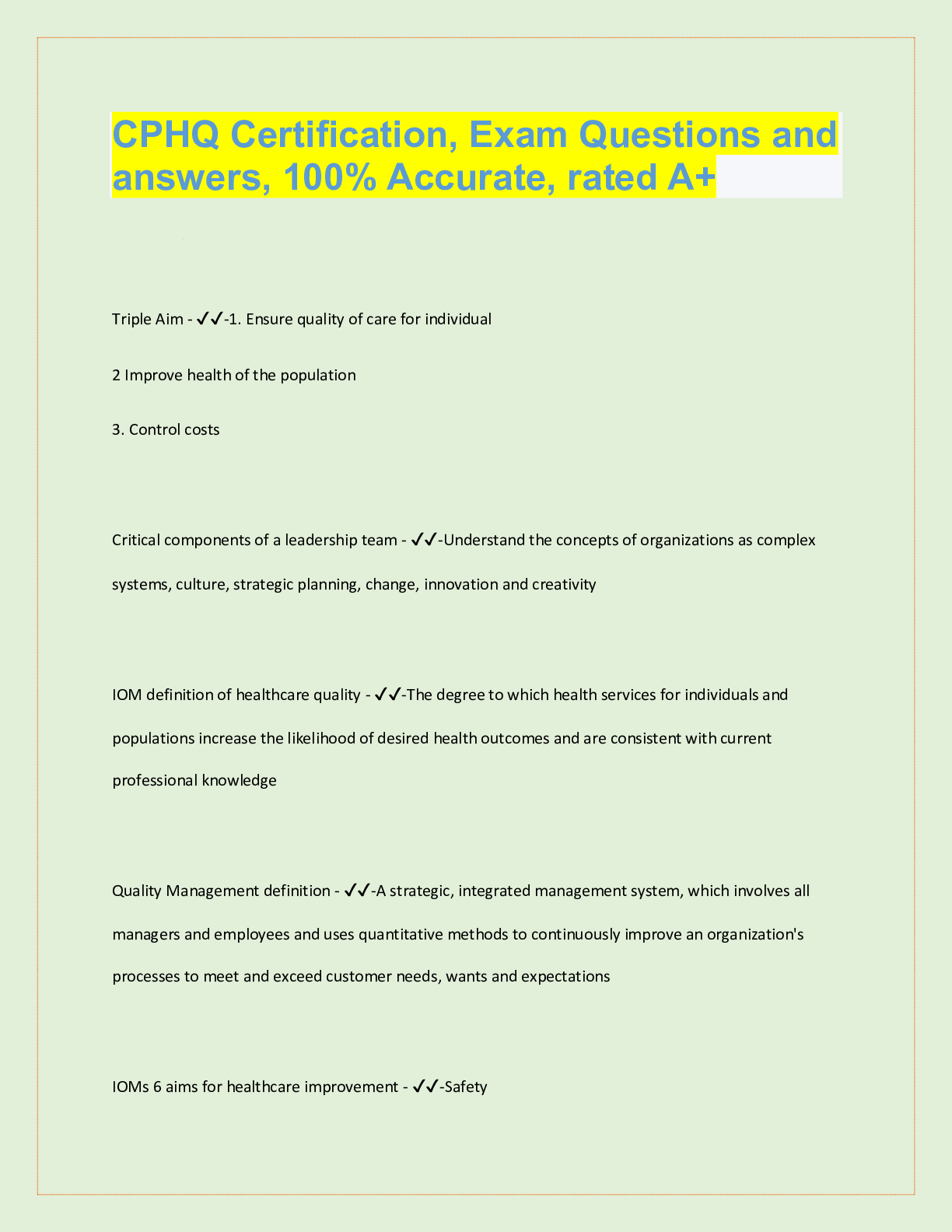
CPHQ Certification, Exam Questions and
answers, 100% Accurate, rated A+
Triple Aim - ✔✔-1. Ensure quality of care for individual
2 Improve health of the population
3. Control costs
Critical components of a leadership team - ✔✔-Understand the concepts of organizations as complex
systems, culture, strategic planning, change, innovation and creativity
IOM definition of healthcare quality - ✔✔-The degree to which health services for individuals and
populations increase the likelihood of desired health outcomes and are consistent with current
professional knowledge
Quality Management definition - ✔✔-A strategic, integrated management system, which involves all
managers and employees and uses quantitative methods to continuously improve an organization's
processes to meet and exceed customer needs, wants and expectations
IOMs 6 aims for healthcare improvement - ✔✔-Safety
Effectiveness (avoid overuse and underuse)
Patient-centeredness - ensure patient values guide all clinical decisions
Timeliness - reduce waits and sometimes harmful delays
Efficiency - avoiding waste
Equity - providing care that does not vary in quality with respect to personal characterisitics, ethnicity,
geographic location or socioeconomic status
system definition - ✔✔-A regularly interacting or independent group of items forming a unified whole
Benefits of system thinking - ✔✔-Aiding in identifying and understanding the big picture
Facilitating the identification of major components
Identifying important relationships and providing proper perspective
Avoiding excessive attention to a single part
Allowing for a broad-scope solution
Fostering integration
Providing a basis for redesign
Healthcare organizations are ... - ✔✔-Complex Adaptive Systems (CASs)
Making change in one process or dept naturally requires changes in other processes, functions and
depts. Effectiveness is dependent on alignment of parts of the system.
InterRelationships (between individuals is a critical component of the model)
Not linear
Characteristics of leaders in CASs - ✔✔-Value persons and relationships
Use loose coupling
Complicate or link
Diversify
Make sense
Think about the future
Are collaborative
Listen and learn
Are adaptable
Offer alternatives
Characteristics of Leaders in CASs - ✔✔-Value persons and relationships
Use loose coupling
Complicate or link
Diversify
Make sense
Think about the future
Are collaborative
Listen and learn
Are adaptable
Offer alternatives
Characteristics of Leaders in traditional systems - ✔✔-Value positions
Use tight structuring
Simplify
Socialize
Make decisions
Do planning based on forecasting
Are controlling, in charge
Know
Are self-preserving
Repeat the past
True or False
The HCQP assists organization leaders and employees in understanding the principles and common
frameworks for healthcare quality strategies. - ✔✔-True
Which evidence based framework model for studying systems is best? - ✔✔-Donabedian
Baldrige Performance Excellence
Any, as long as the manager uses it to properly recognize, understand and anticipate how the parts of
the system interact as a whole
Who is the founder of the quality assurance field and the first to describe an approach to assessing
quality through a systems framework? - ✔✔-Avedis Donabedian
Donabedian's framework - ✔✔-Focus on structures (resources available for care delivery) processes
(involves the care, how diagnoses and treated) and outcomes (results of the care, increased satisfaction,
decreased morbidity, improved QOL) for patient care evaluation
Limitations of the Donabedian framework - ✔✔-Very basic and does not sufficiently describe
interrelationships
What is a required component of quality performance? - ✔✔-Interrelationships
Baldrige Performance Excellence Framework - ✔✔-Displays principles of quality management and shows
interrelationships among factors relating to structure, process and outcome
6 elements of Baldrige Performance Excellence Framework - ✔✔-Important connection between
Leadership and Results
Leadership triad: leadership, strategic planning and customer focus
Results triad: results, workforce focus and operations focus
What are key components of a foundation for effective organizational management? (Baldrige) - ✔✔-
Measurement, analysis and knowledge management
Rules for the 21st-Century Healthcare system (from IOM's report Crossing the Quality Chasm) - ✔✔-
Preference is given to professional roles over the system
Care is customized according to patient needs and values
The patient is the source of control
Knowledge is shared and information flows freely
Decision making is evidence based
Safety is a system priority
Transparency is necessary
The system anticipated needs
Waste is continuously decreased
Cooperation among clinicians is a priority
What is necessary for high reliability performance? - ✔✔-Strong leadership and skilled management
Leadership - ✔✔-Coping with change by developing a vision and aligning the subsystems of the
organization. Ability to influence an individual or group toward achievement of goals. Determines the
correct direction or path.
Management - ✔✔-Coping with complexity through planning and budgeting; setting goals; organizing,
staffing and creating a structure to foster goal attainment; setting up mechanisms for monitoring and
controlling results. Doing the correct things to stay on the path.
True or False
Change is not so much about overcoming resistance as it is about creating attraction. - ✔✔-True
Different leadership styles - ✔✔-Autocratic
Participative
Empowering
Transactional
Transformational
autocratic leadership - ✔✔-Directive and controlling. Employees have little discretionary power in their
work
Participative leadership - ✔✔-Allows employees some degree of autonomy in completing their work
while maintaining some control of the group and the decision-making process; seeks input from
employees and serves as facilitator
Empowering leadership - ✔✔-Shares power and decision making with employees; enabling others by
providing the necessary resources and support
Transactional leadership - ✔✔-Views the leader-follower relationship as a process of exchange where
compliance or performance is achieved through the process of giving rewards and punishment
Transformational leadership - ✔✔-Able to inspire others to change expectations and motivations to
work toward common goals
5 important general principles of exemplary leaders - ✔✔-1. Challenge the system
2. Inspire a shared vision
3. Enable others to act
4. Mode the way
5. Encourage the heart
Challenge the system - ✔✔-Question status quo and lead the way as an early adopter of innovation;
recognize good ideas and demonstrate a willingness to stretch and grow to improve quality of care;
adoption of core values as a learning organization
Ask what should be instead of accepting what is!
Inspire a Shared Vision - ✔✔-For change to be a success, provide and influence others to share vision;
develop a strong culture for QPI; requires more than just telling others what needs to be done;
communicates vision in a manner that causes others to embrace it
Enable others to act - ✔✔-Share decision making and power in a way that enables others to move
toward the direction of the vision. Share power and enable by having appropriate structural design and
the appropriate resources to support quality management initiatives
Model the Way - ✔✔-Model desired behaviors as a role model. Actions speak louder than words. "On�stage behavior"
Encourage the Heart - ✔✔-A critical component. Recognize the contributions that employees make and
celebrate the core values and victories. Reward desired behaviors.
Framework for Leadership for Improvement (5 steps - IHI) - ✔✔-1. Set direction: mission, vision and
strategy.
2. Establish the foundation.
3. Build will.
4. Generate ideas.
5. Execute change.
NQF endorsed safe practice of Leadership Structures and Systems (4 elements) - ✔✔-1. Awareness
structures and systems
2. Accountability structures and systems
3. Structures and systems
4. Action structures and systems
Accountability structures and systems - ✔✔-- enable leaders to establish accountability to governing
body, senior mgmt, mid-level mgmt, physician leaders and frontline staff
Patient safety program
Patient safety officer
Direct organization-wide leadership accountability
Interdisciplinary patient safety committee
External reporting activities
Structures and systems-driving ability - ✔✔-- allows leaders to assess the capacity, resources and
competence necessary to implement change in culture and patient safety performance
Patient safety budgets
People systems
Quality systems
Technical systems
Action structures and systems - ✔✔-- enable leaders to take direct and appropriate action
QPI programs
Regular actions of governance, including confirmation of values, basic teamwork training and
governance board competence in patient safety
Regular actions of senior administrative leadership, including commitment of time to patient safety;
culture measurement, feedback and interventions; basic teamwork training and team interventions;
identification and mitigation of risks and hazards
Regular actions of unit, service line, departmental and mid-level mgmt leaders
Regular actions with respect to independent medical leaders
Awareness structures and systems - ✔✔-- provide leaders with continuous information about potential
risks, hazards and performance gaps that may contribute to patient safety issues
Identification of risks and hazards
Culture mgmt, feedback and intervention
Direct patient input
Governance board and senior mgmt briefings and meetings
Organization Structural elements of Infrastructure for Quality and Safety - ✔✔-Governing body
structures - ultimate responsibility for quality of care, either full responsibility or delegates
Operational structures - manage the coordination of quality and improvement efforts
Teams - work on 1 or more targeted improvement opportunities
HCQP role is to evaluate the effectiveness of various structures, paying close attention to alignment,
coordination and communication
3 categories of team membership (IHI) - ✔✔-1. Clinical leadership representation
2. Technical expertise
3. Day to day leadership
+ a project sponsor or champion with executive authorities and serve as a liaison to other areas and
senior mgmt
Who bears ultimate responsibility for the setting of policy, financial and strategic direction and quality of
care and service provided? - ✔✔-Organization's governing body or board of trustees
6 categories of responsibilities for governing body - ✔✔-Organization
Public policy and external relationships
Strategic planning
Resource management
Human resource development
Education and research
5 core leadership activities to drive improvement (IHI Framework for leadership for improvement) - ✔✔-
1. Establish the mission, vision and strategy
2. Establish the foundation
3. Build will
4. Generate ideas
5. Execute change
6 key areas of patient safety (Byers and White) - ✔✔-Structure
Environment
Equipment and Technologies
Processes
People
Leadership and culture
6 basic elements that influence quality (Evans and Dean) - ✔✔-1. Focus on processes
2. Recognition of internal customers
3. Reduction of hierarchy
4. Creation of a team-based organization
5. Use of steering committee
6. Development of an agile organization
Mission - ✔✔-Organization's purpose or reason for existing. Answers why are we here?, whom do we
serve?, what do we do
[Show More]