CSEP-CEP Practical Exam Questions
with accurate answers, rated A+
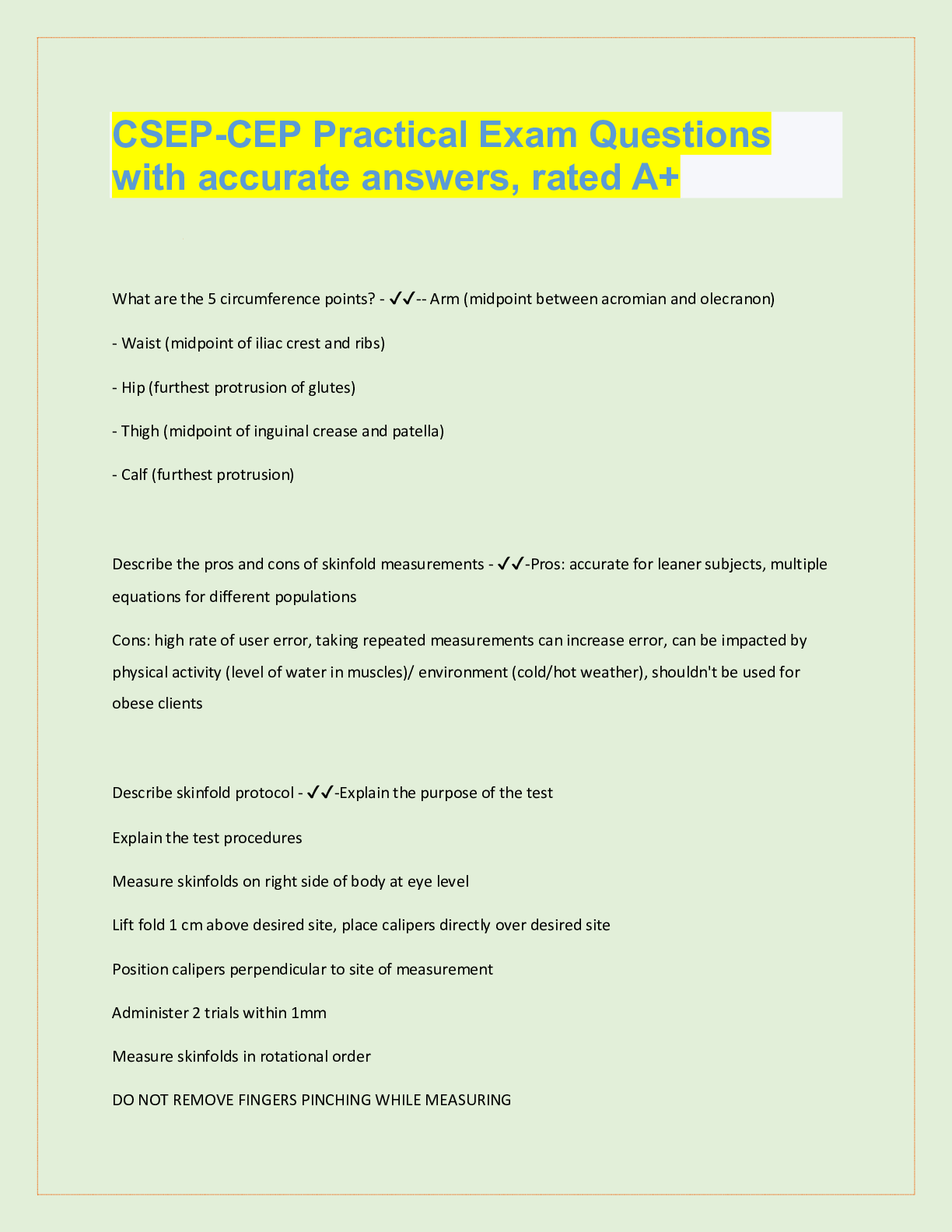
What are the 5 circumference points? - ✔✔-- Arm (midpoint between acromian and olecranon)
- Waist (midpoint of iliac crest and ribs)
- Hip (furthest
...
CSEP-CEP Practical Exam Questions
with accurate answers, rated A+
What are the 5 circumference points? - ✔✔-- Arm (midpoint between acromian and olecranon)
- Waist (midpoint of iliac crest and ribs)
- Hip (furthest protrusion of glutes)
- Thigh (midpoint of inguinal crease and patella)
- Calf (furthest protrusion)
Describe the pros and cons of skinfold measurements - ✔✔-Pros: accurate for leaner subjects, multiple
equations for different populations
Cons: high rate of user error, taking repeated measurements can increase error, can be impacted by
physical activity (level of water in muscles)/ environment (cold/hot weather), shouldn't be used for
obese clients
Describe skinfold protocol - ✔✔-Explain the purpose of the test
Explain the test procedures
Measure skinfolds on right side of body at eye level
Lift fold 1 cm above desired site, place calipers directly over desired site
Position calipers perpendicular to site of measurement
Administer 2 trials within 1mm
Measure skinfolds in rotational order
DO NOT REMOVE FINGERS PINCHING WHILE MEASURING
What are the 7 skinfold sites? - ✔✔-- Tricep (midpoint of acromian and olecranon)
- Bicep (belly of bicep)
- Scapula (3cm inferior)
- Waist (3cm superior of iliac crest)
- Stomach (3cm lateral and 1cm inferior of belly)
- Thigh (midpoint of inguinal crease and prox patella)
- Calf (widest medial point)
Describe the pros and cons of bioelectrical impedance - ✔✔-Pros: easy to use, fairly reliable, quick
results
Cons: can be impacted by client age, water level, cannot be used with people with pacemakers
Describe the pros and cons of DEXA - ✔✔-Pros: very reliable, can highlight fat distribution
Cons: movement may disrupt image, expensive, exposure to radiation
Describe the process of taking BP - ✔✔-1. Locate and palpate radial pulse
2. Close valve and increase pressure to 70 mmHg
3. Slowly increase pressure further until pulse disappears
4. Position earpieces of stethoscope in line with auditory canals
5. Place diaphragm of stethoscope over brachial pulse
6. Close valve and increase pressure to 20-30 mmHg above systolic estimate
7. Release pressure slowly
8. Note pressure of first Korotkoff sound (systolic)
9. Note measurement of Phase V diastolic pressure
10. Continue deflating cuff for at least 10 mmHg.
11. Continue listening for further sounds
12. Record Systolic and Diastolic values
13. Repeat and compare to 1st trial
14. Correctly classify resting blood pressure
What are the stages of BP? - ✔✔-Normal - <120/<80
Prehypertension - 120-139/80-89
Stage 1- 140-159/90-99
Stage 2 - > 160/100
Hypertensive crisis >180/110
Describe the normal and abnormal HR response to exercise - ✔✔-Normal: increase in HR depending on
what type of exercise
Abnormal: sudden increase in HR, increase in HR with no increase in CO
Describe the normal and abnormal BP response to exercise - ✔✔-Normal: increase in systolic BP and a
slight increase in diastolic BP
Abnormal: no increase in BP, severe hypotension post exercise, large increase in DBP
What is mean arterial pressure? - ✔✔-Average pressure in arteries during one cardiac cycle (65-110)
5 lead EKG - ✔✔-Green - right lower ribs
White - right inferior to clavicle
Black - left inferior to clavicle
Red - left lower ribs
Brown - 4th intercostal space
Signs of an MI on a ECG? - ✔✔-Downsloping ST segment and pathologic Q waves
What are the segments of the EKG? - ✔✔-QRS complex - ventricular depolarization
P - atrial depolarization
T - ventricular repolarization
ST segment - time between ventricular depolarization and repolarization
Length of: QRS complex, PR interval, QT interval, RR interval - ✔✔-PR - 0.12-0.2
QRS - 0.08-0.1
QT - 0.4-0.43
RR - 0.6-1
What are some normal ECG changes during exercise? - ✔✔-Decreased R-R interval
P wave magnitude increase
Decreased PR interval
What are the time frames of the boxes on an ECG? - ✔✔-Small box is 0.04 seconds
Big box is 0.2 seconds
Describe the process of Spirometry - ✔✔-1. Breathe normally
2. Inspire completely and rapidly with a pause of ≤2 s at TLC
3. Expire with max effort until no air can be expelled while maintaining upright posture
4. Inspire with maximal effort until completely full
5. Repeat instructions as necessary, coaching vigorously
6. Repeat for a minimum of 3 maneuvers, usually no more than 8 for adults
Contraindications for Spirometry - ✔✔-- MI/eye/sinus/ear surgery within 1-week
- Uncontrolled hypertension
- Significant arrhythmia
- Recent concussion
- Late term pregnancy
- Syncope related to expiration/coughing
- Avoid vaping/smoking/exercise within 1 hour
- Avoid intoxicants 8 hours prior
What is FVC? - ✔✔-Forced vital capacity, total volume the patient can force ably exhale in one breath
What is FEV1? - ✔✔-Forced expiratory volume in 1 second
What is the difference between the 2 largest values in Spirometry testing? - ✔✔-FVC - <0.150L
FEV1 - <0.150L
What can the client not do during Spirometry testing? - ✔✔-Cannot cough during expiration
Normal breaths per minute - ✔✔-12-16
What are the cut points for: TLC, RV, ERV, IRV, TV? - ✔✔-TLC: 6L
RV: 1.2L
ERV: 0.7-1.2L
IRV: 1.9-3.3L
TV: 0.5L
Tidal volume and size - ✔✔-Amount of air moving in and out of lungs in a normal breath (500mL)
Inspiratory reserve volume and size - ✔✔-Amount of air that can be inhaled following a normal
inhalation (1900-3200mL)
Expiratory reserve volume and size - ✔✔-Amount of air that can be forcefully exhaled after a normal
breath (700-1000mL)
Residual volume and size - ✔✔-Air remaining in lungs that prevents collapse (1200mL)
Forced vital capacity - ✔✔-Volume of gas that can be exhaled as forcefully and rapidly as possible after a
maximal inspiration
Vital capacity - ✔✔-TV + IRV + ERV
Inspiratory capacity - ✔✔-TV + IRV
Functional Residual Capacity - ✔✔-RV + ERV
What is the order of fitness tests that should be used? - ✔✔-Non-fatiguing tests
Agility tests
Max power tests
Sprint tests
Local muscular endurance tests
Anaerobic tests
Aerobic tests
What are some common functional fitness tests? - ✔✔-8 foot up and go
30 second arm curl
Grip strength
10 m walk test
1 foot balance
6 minute walk test
What are some contraindications of performing an exercise stress test? - ✔✔-Acute MI (4 days)
Unstable angina
Brady/tachycardia or other abnormal rhythms
Acute myo/pericarditis
What are some reasons for stopping an exercise test? - ✔✔-HR exceeds 85% of age predicted max
Abnormal heart rhythms or response to exercise
Tester feels the need to stop
Patient feels the need to stop
Patient feels dizzy, lightheaded, faint
Hypertensive crisis (220/115) or abnormal response to exercise
What is the anaerobic threshhold? - ✔✔-Point where the body switches from aerobic to anaerobic
metabolism
How to identify the anaerobic threshhold? - ✔✔-Blood lactate levels (will suddenly spike)
RER level (>1.1 is maximal effort)
Ventilatory threshhold (increases rapidly compared to O2 consumption)
Give examples of anaerobic capacity tests - ✔✔-Wingate test
300 yard shuttle
RAST
60 yard shuttle
What is the ventilatory threshold? - ✔✔-Point where ventilation rises rapidly compared to O2 consumed
VCO2/VO2 - ✔✔-- ventilation of CO2 and O2, can be used to estimate anaerobic threshold
- CO2 will peak past O2 at threshold
What is O2 saturation? - ✔✔-Comparison of O2 saturated hemoglobin vs total hemoglobin in blood
95-99%
What is the VO2 reserve method? - ✔✔-Similar to the heart rate reserve method
Correlates well with HRR
VO2 reserve = ((VO max - resting VO2) x % of target) + resting VO2
What is the HRR method? - ✔✔-Karvonen method
HRR = ((MHR - RHR) x training %) + RHR
Used to determine intensity
Describe the Bruce Protocol - ✔✔-- 3 minute stages that increase in grade and speed; goal is to achieve
steady state HR
- Completed when stopping criteria is met
Measure - HR / RPE every minute
BP at end of each stage
Scored - minutes of completion
Describe the Balke Protocol - ✔✔-- 1-minute stages of constant speed that increase in grade (3mph F /
3.3mph M)
- Completed when stopping criteria is met
Measure - HR / RPE every minute
BP at end of each stage
Scored - minutes of completion
Describe the Ebbling Treadmill test - ✔✔-- 4 min warm up at 0% / 3-4 mph
- 4 min walk at 5% and self-selected speed
- 4 min cool down at 0%, should reach SSHR in last min
Measure - HR and Speed every minute
Scoring - Speed, age, SSHR in equation for VO2 max
Describe the YMCA test - ✔✔-1st set - 0.5kp (25W) 3 min
2nd, 3rd, 4th sets of 3 min are determined from HR from 1st set
Should be within 10bpm of 85% max at 4th stage (if not, add 0.5kp for 3 min)
Cool down at 0.5kp 3 min
Measure - HR during every minute
Scoring - Uses weight / HR / load to estimate VO2 max
Describe the mCAFT - ✔✔-- Starting stage determined using client's age
- Step up and down steps using audio cadence
- Stopped when client can no longer keep cadence or criteria are met
Measure - HR at end of stage
Scoring - Uses last level completed to predict VO2 max
Describe the 1 mile walk - ✔✔-- 3 min warm up at moderate pace
- Walk 1 mile as quickly as possible
Measure - HR at end of test, time taken to complete test
Scoring - Uses weight, age and time completed to estimate VO2
What is a MET? - ✔✔-Oxygen cost of an activity
3.5 mL/kg/min
What is RPE? - ✔✔-Rate of perceived exertion
Used to quantify how many reps are left in the tank
Describe 1RM, when it's used and why it's used - ✔✔-How much weight can be lifted for 1 rep
Commonly used for compound lifts (squat, bench)
Helps with load and rep prescription
Requires high technique and experienced lifters
What does a muscular strength test assess - ✔✔-Amount of force that can be produced
Provide examples of muscular strength tests - ✔✔-1RM squat, bench
Grip strength
What does a muscular power test assess? - ✔✔-Assesses how quickly high force can be produced
Give examples of power tests - ✔✔-Vertical jump
1RM power clean
Standing long jump
What does a muscular endurance test assess - ✔✔-Amount of force that can be maintained over a
period of time
Provide examples of muscular endurance tests - ✔✔-Push ups
Chin ups
Plank
Single leg stance
Grip strength protocol - ✔✔-Grip taken between fingers and palm of hand
Hold dynamometer in line with forearm at level of the thigh, away from body
Exhale while squeezing
2 trials per hand
Scoring - max combined value of each hand
Sit and reach protocol - ✔✔-Feet flat against flexometer; must not extend beyond crossboards
Inner edge of soles 6" apart
Knees fully extended
Hold position for two seconds
Lower head to max distance
Repeat test twice
Scoring - Highest value reached on flexomete
[Show More]