MTTC Practice Questions & Answers,
100% Accurate, rated A+. Latest
updates.
Which of the following would be considered an example of language according to principle of
combinability?
A. Your car's 'check engine'
...
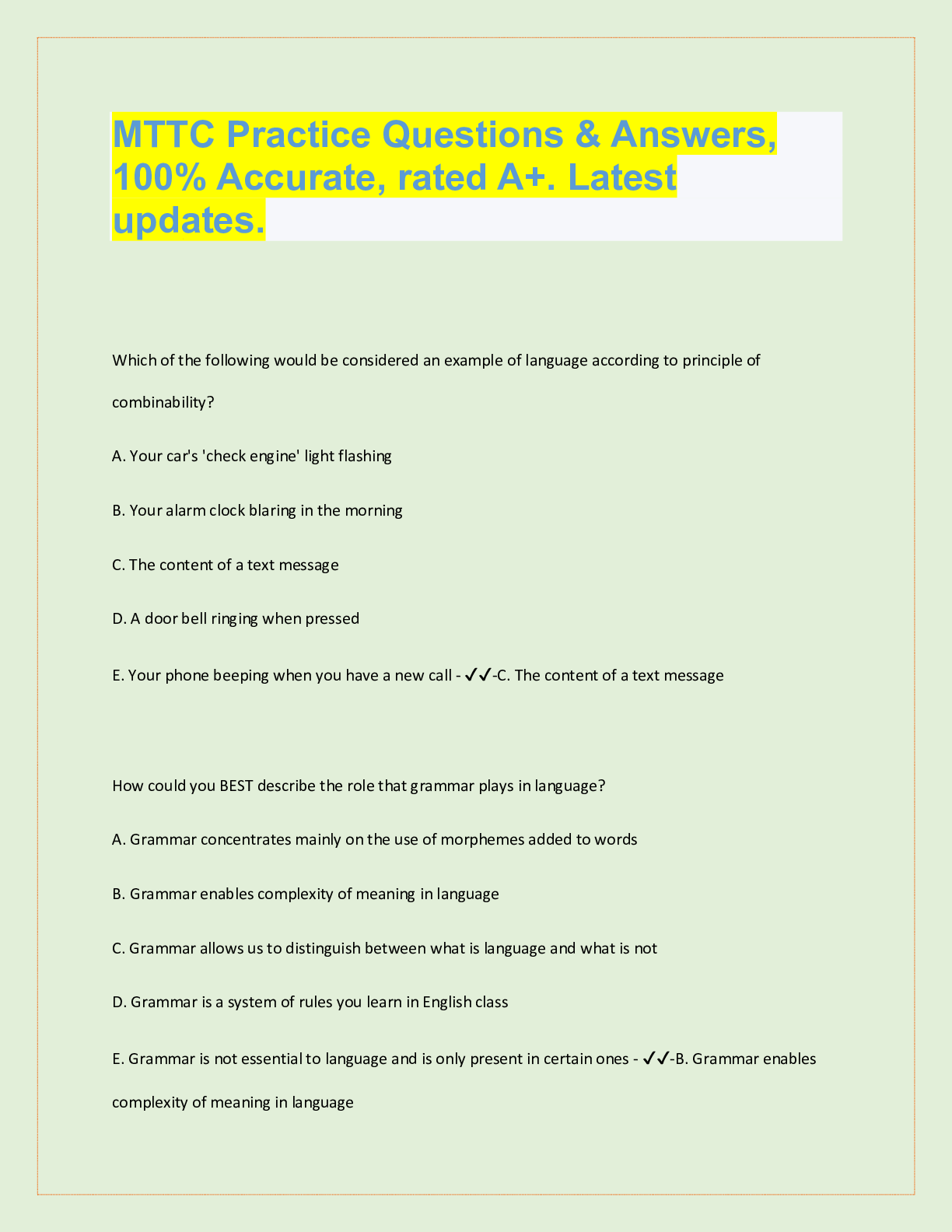
MTTC Practice Questions & Answers,
100% Accurate, rated A+. Latest
updates.
Which of the following would be considered an example of language according to principle of
combinability?
A. Your car's 'check engine' light flashing
B. Your alarm clock blaring in the morning
C. The content of a text message
D. A door bell ringing when pressed
E. Your phone beeping when you have a new call - ✔✔-C. The content of a text message
How could you BEST describe the role that grammar plays in language?
A. Grammar concentrates mainly on the use of morphemes added to words
B. Grammar enables complexity of meaning in language
C. Grammar allows us to distinguish between what is language and what is not
D. Grammar is a system of rules you learn in English class
E. Grammar is not essential to language and is only present in certain ones - ✔✔-B. Grammar enables
complexity of meaning in language
Which of the following BEST explains why the alarm calls made by vervet monkeys should not be
considered language?
A. They include just one call for a variety of dangers
B. They can't be combined to produce additional meanings
C. They have only phonemes and not morphemes
D. They demonstrate a complex and interchangeable variety of calls
E. They are made up of only a few words and modifiers - ✔✔-B. They can't be combined to produce
additional meanings
An example of a morpheme is
A. the 'de-' in 'deconstruct'
B. an 'e' that makes the 'a' in 'lake' have a long sound
C. the 'y' in 'by'
D. an adjective like 'yellow'
E. the sound made by 'ch' - ✔✔-A. the 'de-' in 'deconstruct'
2. Vowels and consonants are examples of
A. suffixes
B. morphemes
C. semantics
D. phonemes
E. prefixes - ✔✔-D. phonemes
Which statement correctly compares the function of Broca's area and Wernicke's area?
A. Broca's area is involved with understanding and Wernicke's area with production.
B. Broca's area is involved with acquisition and Wernicke's area with distinguishing phonemes.
C. Broca's area is involved with production and Wernicke's area with understanding.
D. Broca's area is involved with universal grammar and Wernicke's area with acquisition.
E. Broca's area is involved with distinguishing phonemes and Wernicke's area with universal grammar. -
✔✔-C. Broca's area is involved with production and Wernicke's area with understanding.
Which of the following is an argument against Noam Chomsky's theory of universal language?
A. Scientists have found that children go through five stages in language acquisition.
B. Researchers have found many grammatical features shared across different languages.
C. Children may not begin to use complex sentences until 25 months or older.
D. The Pirahã people speak a language that doesn't follow usual language rules.
E. Babies are able to tell the difference between Hindi sounds that are not found in English. - ✔✔-D. The
Pirahã people speak a language that doesn't follow usual language rules.
A seven month old baby repeatedly babbles 'bababa' and 'dadada'. This is an example of
A. the development of Wernicke's area.
B. a baby's use of phonemes from his native language.
C. a baby's first speech like sounds.
D. overextending the meaning of words.
E. universal grammar at work. - ✔✔-B. a baby's use of phonemes from his native language.
The holophrastic stage refers to the time when
A. babies recognize and point to named objects.
B. babies can use a few words and understand many more.
C. babies develop a broad vocabulary.
D. start babbling repetitive syllables.
E. babies begin uttering speech-like sounds. - ✔✔-B. babies can use a few words and understand many
more.
Overextending language is when a baby
A. uses a single word to mean many different things.
B. begins to advance beyond his or her expected language level.
C. begins to fall behind his or her expected language level.
D. uses many different words for a single thing.
E. begins to use many words he or she doesn't yet understand. - ✔✔-A. uses a single word to mean
many different things.
Why should student work be displayed on the walls?
A. Provides motivation for students to do their best work
B. Creates a sense of pride for the students
C. Provides visual examples of good work
D. All of the above - ✔✔-D. All of the above
What area of the classroom is often overlooked as useful space for displaying important information?
A. The shelves
B. The tables
C. The desks
D. The walls - ✔✔-D. The walls
Which meeting area is not important to include in a literacy classroom?
A. Literacy center tables
B. Class meeting area with large rug
C. Guided reading table
D. Math game area - ✔✔-D. Math game area
An organized classroom creates a space where students feel
A. Productive
B. Comfortable
C. Motivated
D. All of the above - ✔✔-D. All of the above
Which of the following should be present in a classroom library?
A. Pillows and bean bag chairs
B. Books of various genres, levels, and topics
C. Labeled book bins
D. All of the above - ✔✔-D. All of the above
In which system will students sometimes respond to their teacher's native language questions by
speaking in their second language?
A. systems that use both
B. systems that outlaw the use of the native language
C. systems that encourage use of the native language
D. all of these are correct - ✔✔-A. systems that use both
How are students expected to learn the definitions of words in systems which do not allow for use of a
student's native language?
A. through hand gestures or using pen and paper, either with teachers or in student groups
B. word translations are provided on the board at the beginning of the class in which they are used.
C. translation on their own time with books given to them at the beginning of the year
D. through making word associations and definitions from words they already know in their second
language - ✔✔-D. through making word associations and definitions from words they already know in
their second language
Fluent speaking is often most quickly achieved through systems that _____.
A. allow the use of the native language
B. use a third language for reference
C. outlaw the use of the native language
D. allow some use of the native language - ✔✔-C. outlaw the use of the native language
In which of the following systems is direct translation encouraged?
A. systems that allow the use of native language
B. systems created by Dictionary companies
C. systems that do not allow the use of native language
D. systems that allow some use of the native language - ✔✔-A. systems that allow the use of native
language
Some systems call for a widespread use of a student's native language. These types of systems
emphasize _____.
A. speaking skills
B. recognizing cognates
C. hearing skills
D. grammar - ✔✔-D. grammar
By what age can most children be considered fully intelligible?
A. 6 months
B. 2-3 years
C. 1 year
D. 4-5 years - ✔✔-D. 4-5 years
By what age will most children have acquired the ability to speak their first word?
A. 1 year old
B. 1 month old
C. 6 months old
D. 1 day old - ✔✔-A. 1 year old
Between 1 and 2 years old what skills do most children gain?
A. Can use most vowels
B. All of the answers are correct
C. Can ask questions by raising intonation at the end of sentences
D. Vocabulary expands to be considered roughly 65% intelligible - ✔✔-B. All of the answers are correct
What is the first major phonological skill developed?
A. Rhyme manipulation
B. Word awareness
C. Understanding rhyme and alliteration
D. Syllable awareness - ✔✔-B. Word awareness
What is phonology?
A. Having proper grammar and spelling
B. Being able to produce sounds
C. The study of telephones
D. The systematic organization of sounds into language - ✔✔-D. The systematic organization of sounds
into language
What concept might be taught well through a word sort?
A. How to remember sight words
B. How to spell polysyllabic words
C. How to distinguish between the ''t'' sound and the ''d'' sound
D. How to decode consonant blends - ✔✔-C. How to distinguish between the ''t'' sound and the ''d''
sound
What is a sight word?
A. A word that is phonetically regular
B. A word with only three letters
C. A word that is so complex, students must memorize it
D. A word that appears frequently - ✔✔-D. A word that appears frequently
What game is good for teaching sight words?
A. Bingo
B. Flash cards
C. Memory
D. All answers are correct - ✔✔-D. All answers are correct
What is phonological awareness?
A. Remembering sight words
B. Understanding how words fit together in a sentence
C. Understanding how sounds fit together in words
D. Reading fluently and with expression - ✔✔-C. Understanding how sounds fit together in words
Which students might especially benefit from multisensory mapping?
A. Students who love writing
B. Students with dyslexia
C. Strong readers
D. Good athletes - ✔✔-B. Students with dyslexia
Which strategy includes making sure that a teacher is nearby to support development?
A. context clues
B. word identification
C. word recognition
D. guide practice - ✔✔-D. guide practice
What's the best strategy for readers to increase word recognition?
A. cueing strategies
B. spelling words out
C. analyzing text
D. repeated reading - ✔✔-D. repeated reading
Which is TRUE about spelling skills?
A. they are based on the alphabetic system
B. it is a method of transferring speech to print
C. students need to understand letters and sounds to be successful
D. all of these are true - ✔✔-D. all of these ar
[Show More]