NCAC II Exam Preview of examinable
sections. 100% Coverage. Rated A
Family Structure - ✔✔-Alcoholic marries an enabler, the first child is the Hero... they are usually perfect
"see we are good" The second child is t
...
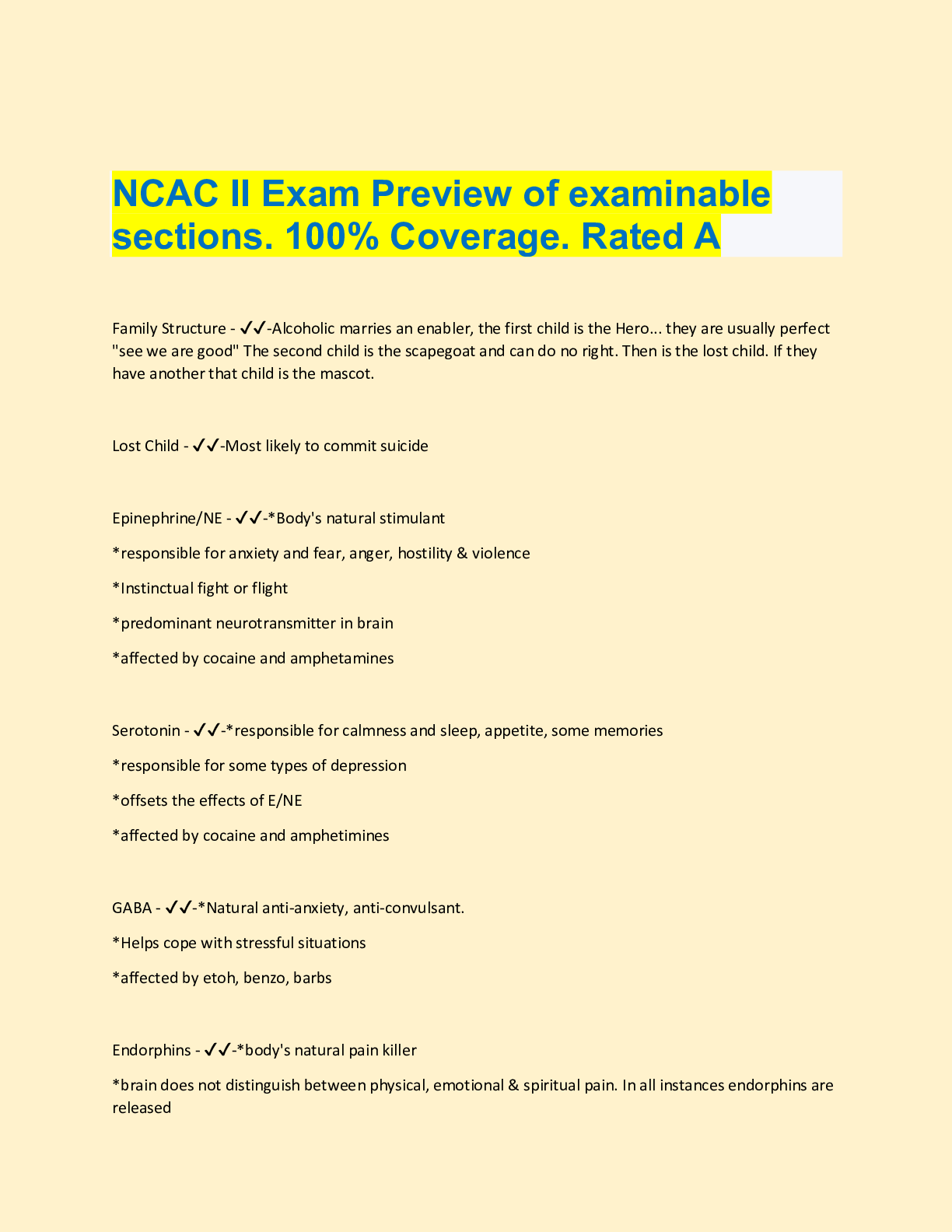
NCAC II Exam Preview of examinable
sections. 100% Coverage. Rated A
Family Structure - ✔✔-Alcoholic marries an enabler, the first child is the Hero... they are usually perfect
"see we are good" The second child is the scapegoat and can do no right. Then is the lost child. If they
have another that child is the mascot.
Lost Child - ✔✔-Most likely to commit suicide
Epinephrine/NE - ✔✔-*Body's natural stimulant
*responsible for anxiety and fear, anger, hostility & violence
*Instinctual fight or flight
*predominant neurotransmitter in brain
*affected by cocaine and amphetamines
Serotonin - ✔✔-*responsible for calmness and sleep, appetite, some memories
*responsible for some types of depression
*offsets the effects of E/NE
*affected by cocaine and amphetimines
GABA - ✔✔-*Natural anti-anxiety, anti-convulsant.
*Helps cope with stressful situations
*affected by etoh, benzo, barbs
Endorphins - ✔✔-*body's natural pain killer
*brain does not distinguish between physical, emotional & spiritual pain. In all instances endorphins are
released
*More pain receptor sites than pleasure receptor sites.
* We remember painful events more vividly our our brains are designed to avoid these situations.
*Increase in endorphins vis exercise, laughter, meditations, sleep, food, healthy relationships/sex &
music
*Affected by opiates, soma & etoh
Dynorphin - ✔✔-Form of endorphin that is released at childbirth. 700x stronger than morphine. Helps
offset fatigue, forget the intensity of the pain, bonds mother and child.
Acetylcholine - ✔✔-*Memory, Movement, Motivation, New Learning (learning in general)
*Depletion results in alzheimers symptoms
*Affected by THC
Anandamide - ✔✔-Similar to aceylcholine.
*Memory, New Learning specific, calmness, controlling movement
*Affected by THC
Glutamate - ✔✔-*Memory
*Duck tape of the brain... regenerates and mimics other neurotransmitters to fill the gaps for the ones
that have been damaged
*Anti Convulsant
Dopamine - ✔✔-*Pleasure (located in the pleasure pathway)
*every drug mimics or releases dopamine
*cocaine and other stimulates actually block the re-uptake of dopamine so that it increases the
dopamine response
*etoh & opiates enhance dopamine release that would otherwise block/inhibit dopamine secreting
neurons.
*Schizophrenia is noted to be too much dopamine in the brain
*too few dopamines mimic parkinsons
*Affected by all drugs but mostly meth.
Methamphetimine high - ✔✔-most resembles schizophrenia
Meth withdrawal - ✔✔-mimics parkinsons
Meth results in the release of so much dopamine - ✔✔-that it can take YEARS for the person to learn to
feel pleasure again.
PIP (phenylimide Indoleamine Pyrimidine) - ✔✔-*responsible for feeling of true care/love
*affects various parts of the brain at one time
*decreases after about 3 years bc the brain cannot sustain the same level of intensity. The passion sorta
burns out.
*PIP changes to endorphins after decades in a relationship
Adverse Effects of substances are usually seen - ✔✔-in those with ADHD or Bipolar w
Korsacoff Wenicke Syndrome - ✔✔-After prolonged alcohol abuse, the person is unable to walk steadily
(like walking in sand), eyes twitch back and forth
State Dependent Learning - ✔✔-Learn when high on THC, does not remember when sober, does
remember when under the influence of THC later.
Pharmacology - ✔✔-Branch of science that examines how psychoactive substances taken to alter bodily
functions or enhance bodily functions interact with the brain and body
Psychoactive Substance - ✔✔-any drug that affects the CNS and alters consciousness and or perceptions
physiological effects - ✔✔-physical signs
psychological effects - ✔✔-alterations in perception or judgment caused by substance.
chemical interaction - ✔✔-physiological and psychological effects of 2 or more substances administered
at the same time
withdrawal - ✔✔-signs and symptoms that occur when an indiv that is physically dependent on a
substance discontinues its use.
treatment applications - ✔✔-method of detox, stabilization & maintenance
tolerance - ✔✔-after repeated admin. a given dose of a substance produces a decreased effect or
conversely with increased/larger doses must be administered to get the effect observed with the
original dose
dependence - ✔✔-known as addictions, a behavioral pattern of compulsive substance use characterized
by consistent involvement with the use of a substance, securing of its supply and a high tendency to
relapse after withdrawal.
detoxification - ✔✔-eliminating the substance from your body
*The first step in sobriety and treatment
Levels of Psychoactive Substance Use - ✔✔-Recreational- Circumstantial-Intensified Use- cCompulsive
Use
cross tolerance - ✔✔-the ability of pharmacologically similar substances to substitute for one another in
relation to tolerance and prevention of withdrawal (ie using hydrocodone when heroin isn't available)
Schedule I - ✔✔-No medical Use, cannot be dispensed by a prescriber. Severe dependence, high
potential for abuse
Schedule II - ✔✔-Severe dependence, high potential for abuse.
Some accepted medical use, but with severe restrictions
Schedule III - ✔✔-Moderate or low physical dependence OR high psychological dependence. Moderate
potential for abuse
Has accepted medical uses and can be dispensed by authorized prescriber
Schedule IV - ✔✔-Limited physical or psychological dependence. Low abuse potential. accepted medical
use.
Schedule V - ✔✔-limited dependence, very low potential for abuse, medcial use
Methods of Administration - ✔✔-*orally (inhale or ingested)
*nasally (longest acting)
*IM
*IV (most instense)
*subcutaneously
*topically
*sublingually
*rectally
Blood Brain Barrier - ✔✔-series of cells that prevent certain chemicals from reaching the brain
metabolites - ✔✔-by-product of the liver breaking substances down that can be eliminated
metabolism - ✔✔-body getting rid of the substance. elimination
CNS - ✔✔-brain and spinal cord
PNS - ✔✔-all neurons outside the CNS
CNS is made of - ✔✔-Reticular Activating System: Awake/Asleep
Limbic System: feelings
Basal Ganglia: fine motor skills
Limbic System is made of - ✔✔-Cerebral Cortex: voluntary motor skills, sensory input
Hypothalamus: Liaison between CNS & PNS
PNS is - ✔✔-the Autonomic Nervous System (unconscious bodily functions) which is sympathetic
nervous system *increases breathing, etc) and parasympathetic (decreases)
Neurotransmitters are either - ✔✔-inhibitory or excitatory
Agonist - ✔✔-psychoactive substance binds to neurons and elicits a reaction as if it were a
neurotransmittor
Antagonist - ✔✔-substance binds and prevents other neurotransmitters form binding to that neuron
CNS depressants - ✔✔-Alcohol, barbituates, benzos
Short term effects of depressants - ✔✔-impaired coordination, slurred speech, staggered gait,
drowsiness, muscle relaxation, slowing of breath, slowing of HR, dizziness, sedation, loss of memory,
euphoria, impaired judgement, decreased inhibition, decreased fear, confusion, irritability, paranoia,
Pathological Intoxication - ✔✔-Unusual reaction to depressants. The person becomes agitated and
belligerent after only small doses
habituation - ✔✔-repetition of behaviors until hey are a habit.
Legal limit of alcohol in 21+ in most states - ✔✔-.08
Toxic alcohol levels - ✔✔-.4
Cirrhosis - ✔✔-swollen, scarred or dead liver tissue
Stages of alcohol dependence - ✔✔-Early: escaping from social situations, sneaking to drink, feelings of
guilt, difficulty stopping & preoccupation
Middle: Loss of control, impaired social relationships, changes in drinking patterns, temp sobriety,
morning drinking, neglect of health needs.
Late: drink in order to function, binges, wi
[Show More]