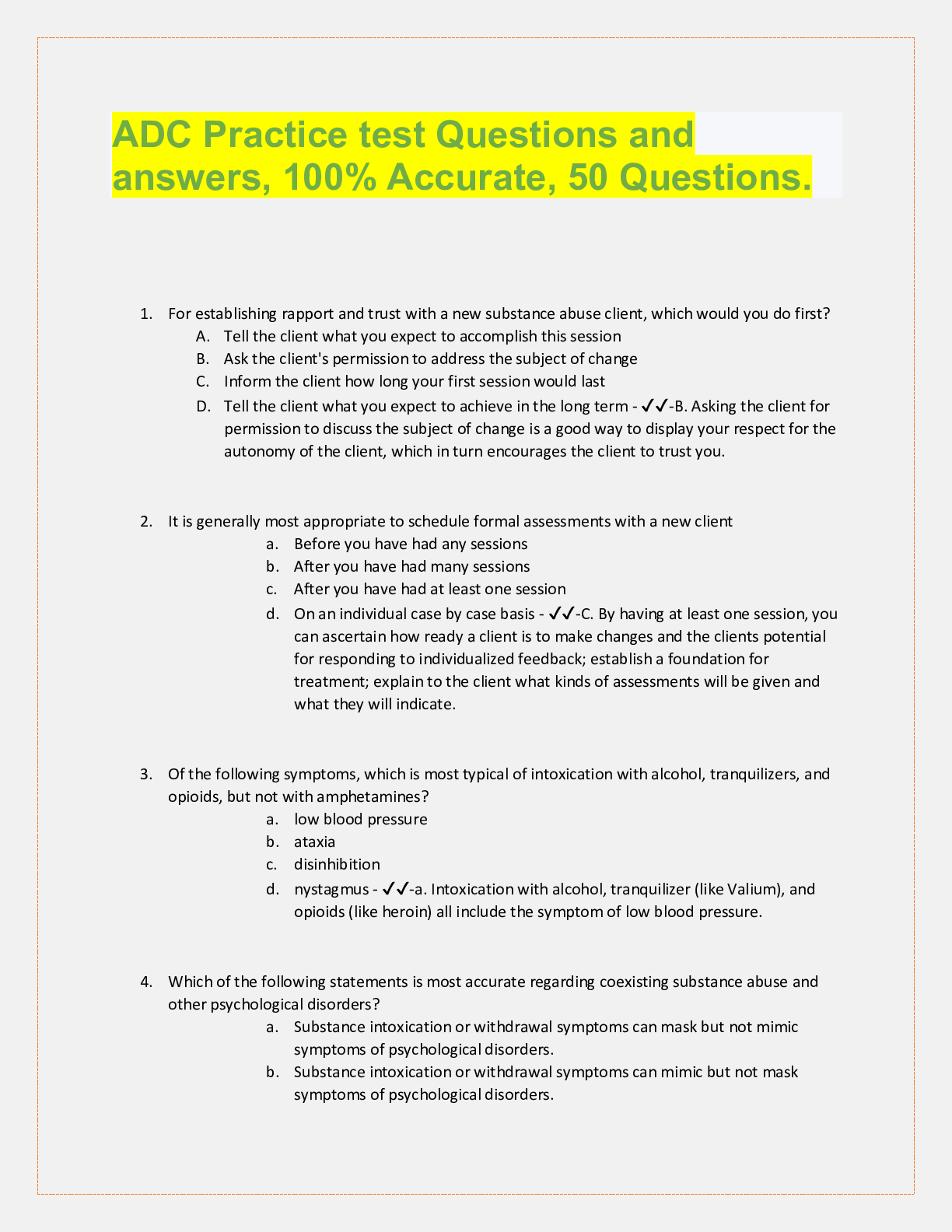
ADC Practice test Questions and
answers, 100% Accurate, 50 Questions.
1. For establishing rapport and trust with a new substance abuse client, which would you do first?
A. Tell the client what you expect to accomplis
...
ADC Practice test Questions and
answers, 100% Accurate, 50 Questions.
1. For establishing rapport and trust with a new substance abuse client, which would you do first?
A. Tell the client what you expect to accomplish this session
B. Ask the client's permission to address the subject of change
C. Inform the client how long your first session would last
D. Tell the client what you expect to achieve in the long term - ✔✔-B. Asking the client for
permission to discuss the subject of change is a good way to display your respect for the
autonomy of the client, which in turn encourages the client to trust you.
2. It is generally most appropriate to schedule formal assessments with a new client
a. Before you have had any sessions
b. After you have had many sessions
c. After you have had at least one session
d. On an individual case by case basis - ✔✔-C. By having at least one session, you
can ascertain how ready a client is to make changes and the clients potential
for responding to individualized feedback; establish a foundation for
treatment; explain to the client what kinds of assessments will be given and
what they will indicate.
3. Of the following symptoms, which is most typical of intoxication with alcohol, tranquilizers, and
opioids, but not with amphetamines?
a. low blood pressure
b. ataxia
c. disinhibition
d. nystagmus - ✔✔-a. Intoxication with alcohol, tranquilizer (like Valium), and
opioids (like heroin) all include the symptom of low blood pressure.
4. Which of the following statements is most accurate regarding coexisting substance abuse and
other psychological disorders?
a. Substance intoxication or withdrawal symptoms can mask but not mimic
symptoms of psychological disorders.
b. Substance intoxication or withdrawal symptoms can mimic but not mask
symptoms of psychological disorders.
c. If a client has abstained from using substances for long enough time, it will
invalidate psychological testing.
d. Counselors/programs not trained to assess clients for coexisting psychological
disorders should refer clients. - ✔✔-D. If a counselor is not qualified or trained
to assess for the presence of coexisting psychological disorders in a client with
substance abuse, the counselor should refer the client to qualified mental
health clinicians or program for the psychological portion of the assessment.
5. When preparing a summary assessment of a client for a court judge, which of the following
should come last?
a. the reason for the assessment and who ordered it
b. tests given and how their results were interpreted
c. straightforward presentation of the data collected
d. assessor clinical impression and recommendations - ✔✔-d. All summary
assessments, even condensed reports prepared for judges, should include at
least 3 clearly divided parts: Introduction, methodology, interpretation
6. When giving a new client feedback about assessment results, which of these should you do
first?
a. Ask the client whether s/he had any problems with testing.
b. Encourage the client to ask any questions s/he may have.
c. Express your appreciation for the clients effort in responding.
d. Ask the client how the testing affected his/her perceptions. - ✔✔-C. The first
thing you, the counselor, should do after a new client's initial assessments is
to acknowledge the client's efforts in responding to the tests and provide
reinforcement by stating your appreciation.
7. In planning a client's treatment based on assessment results, the client's problems, immediate
and longer-term goals, measureable objectives, and treatment methods should be:
a. decided by the therapist with the client's agreement.
b. decided through a mutual client-therapist agreement.
c. decided by the client with the therapists agreement.
d. decided for the client and the therapist by the clinic's agreement. - ✔✔-B. The
client and therapist should reach mutual agreements as to which problems
exist (or that the client is initially willing to acknowledge), immediate and
longer term therapy goals for the client; objectives for therapy to meet which
can be measured, and therapeutic methods to be used.
8. Assessment of a substance abuse client should best be:
a. initial and ongoing
b. done only initially
c. initially and finally
d. only as indicated - ✔✔-A. Assessments should be ongoing, to review,
evaluate, and adjust your treatment plan to meet your client's needs better
and/or to reflect changing client needs as treatment progresses.
9. A psychiatric social worker who is a LCSW and practicing psychotherapist has an initial interview
with a new client. The therapist observes affective symptoms suggesting the client may be
suicidal. She does not feel qualified to address this. What is her appropriate response to this
client?
a. Schedule therapy to prevent suicide
b. Refer the client to a psychiatrist
c. Inform the client of a suicide hotline
d. Refer the client to a support group - ✔✔-B. The most appropriate action with
a potentially suicidal client when the social worker is not qualified is to refer
the client to a more qualified psychiatrist.
10. For substance abuse clients from minority groups, culturally competent treatment is best
achieved through which of the following?
a. treatment clinics with multicultural staff
b. staff that completed a cultural workshop
c. serviced integrating community partners
d. treatment staff speaks client's languages - ✔✔-C. Since not all of the client's
needs can be met by one program or agency, experts find it more effective to
develop integrated services by referring clients to and collaborating with
various community partners that can provide the most effective and
appropriate help for each client's individual needs and cultural background
11. As the counselor of a client addicted to heroin, your activities include referring the client to a
vocational rehabilitation program to address deficient job skills. Which is true about your
referral regarding the client?
a. Referrals you make need not be explained to the client.
b. You should only explain your referrals if the client asks.
c. Explaining to a client hurts your therapeutic relationship.
d. You are obligated to explain your referrals to the client. - ✔✔-D. As the
counselor, you must explain any referrals you make on a client's behalf.
Explanation of any referral to the client, is considered a core function of the
substance abuse counselor.
12. Of the following, which is considered a key element of effective referrals?
a. independence
b. information
c. collaboration
d. competition - ✔✔-C. Experts consider collaboration among multiple agencies
serving the same client as the "cornerstone" of effective referral networks.
13. Which of the following is the most accurate statement about the mature of case management?
a. It consists of a process of referrals to independent agencies.
b. It gives continuity by providing a single contact point.
c. It gives responsibility for multiservice clients to all agencies.
d. It means the case manager's obligation is only to the client. - ✔✔-B. Case
management involves coordinating multiple services to the same client.
Rather than spreading responsibility for the client across multiple agencies,
case management consolidates the responsibility to the c
[Show More]