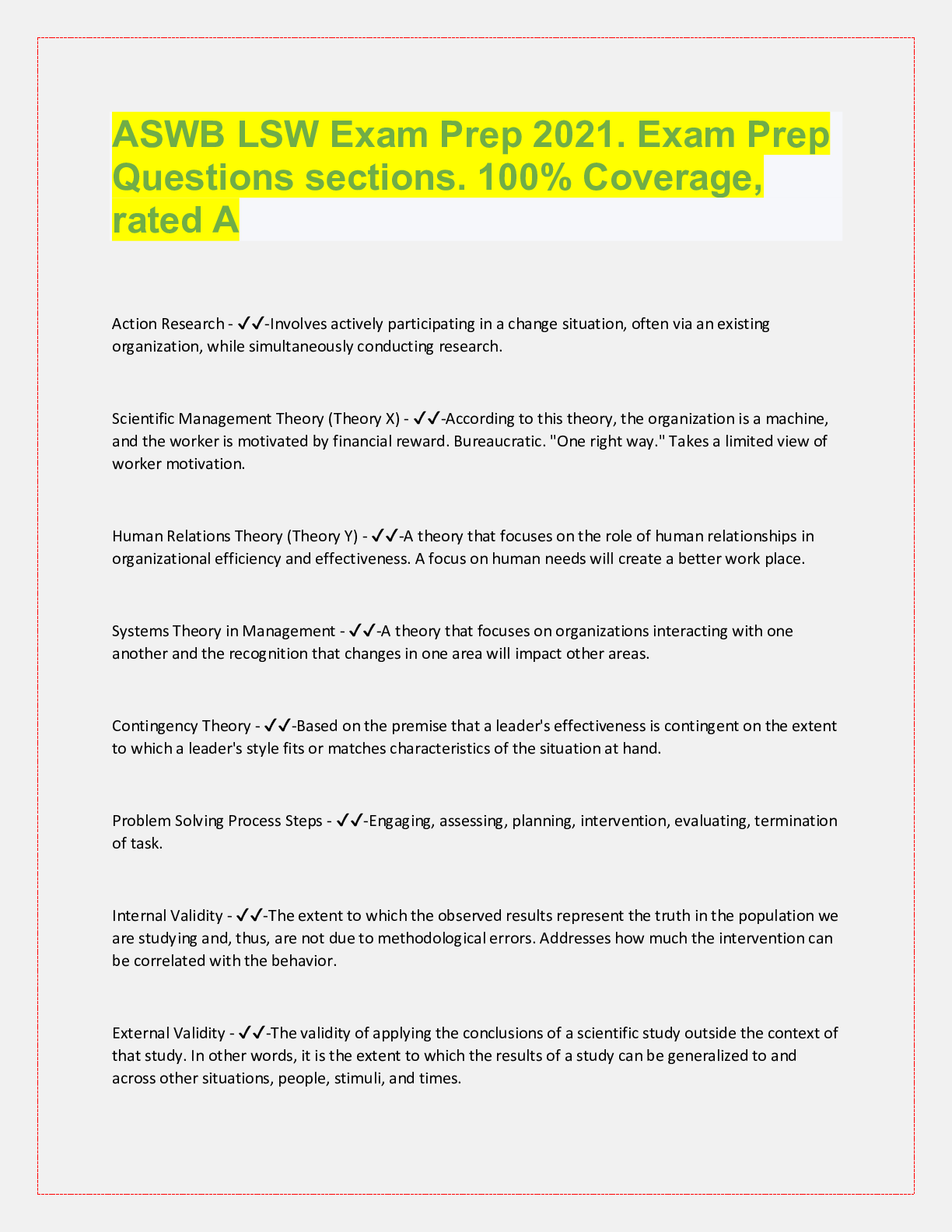
ASWB LSW Exam Prep 2021. Exam Prep
Questions sections. 100% Coverage,
rated A
Action Research - ✔✔-Involves actively participating in a change situation, often via an existing
organization, while simultaneously co
...
ASWB LSW Exam Prep 2021. Exam Prep
Questions sections. 100% Coverage,
rated A
Action Research - ✔✔-Involves actively participating in a change situation, often via an existing
organization, while simultaneously conducting research.
Scientific Management Theory (Theory X) - ✔✔-According to this theory, the organization is a machine,
and the worker is motivated by financial reward. Bureaucratic. "One right way." Takes a limited view of
worker motivation.
Human Relations Theory (Theory Y) - ✔✔-A theory that focuses on the role of human relationships in
organizational efficiency and effectiveness. A focus on human needs will create a better work place.
Systems Theory in Management - ✔✔-A theory that focuses on organizations interacting with one
another and the recognition that changes in one area will impact other areas.
Contingency Theory - ✔✔-Based on the premise that a leader's effectiveness is contingent on the extent
to which a leader's style fits or matches characteristics of the situation at hand.
Problem Solving Process Steps - ✔✔-Engaging, assessing, planning, intervention, evaluating, termination
of task.
Internal Validity - ✔✔-The extent to which the observed results represent the truth in the population we
are studying and, thus, are not due to methodological errors. Addresses how much the intervention can
be correlated with the behavior.
External Validity - ✔✔-The validity of applying the conclusions of a scientific study outside the context of
that study. In other words, it is the extent to which the results of a study can be generalized to and
across other situations, people, stimuli, and times.
Test-Retest Reliability - ✔✔-A method for determining the reliability of a test by comparing a test taker's
scores on the same test taken on separate occasions.
Interobserver Reliability - ✔✔-The degree to which two independent observers score the same
phenomenon.
Reliability and Validity - ✔✔-consistency; accuracy
Selectivity - ✔✔-Selectivity denotes benefits made available based on an individual need, usually
determined by a test of income.
Bowenian Family Therapy - ✔✔-Attempts to improve differentiation and the generational transmission
issues.
Strategic Family Therapy - ✔✔-Seeks to reduce symptoms through altering styles of feedback that is
thought to maintain the problem.
Structural Family Therapy - ✔✔-Examines roles and family organization.
Tolerance Training - ✔✔-Teaches a client how to be more accepting of people and how to remain calm
in frustrating situations.
Passivity Training - ✔✔-Teaches a client how to communicate what they really think or want.
Assertiveness Training - ✔✔-Teaches clients how to express their feelings without being angry and
confrontational and stand up for their rights in social situations.
Confidence Training - ✔✔-Teaches a client how to believe in themself and not feel defensive.
Interpretation (Technique) - ✔✔-Attempts to draw together behavioral patterns for deeper
understanding.
Clarification (Technique) - ✔✔-Seeks to reformulate a problem in a client's words.
Confrontation (Technique) - ✔✔-The direct addressing of a specific item in therapy.
Reframing or Relabeling (Technique) - ✔✔-Invites the client to use language to see problems in a
different way.
Type 1 Error (Statistical Hypothesis) - ✔✔-Occurs when one detects an effect that was not actually
present.
Type 2 Error (Statistical Hypothesis) - ✔✔-The failure to reject a null hypothesis that is false. The failure
to detect an effect that is actually present.
Preperation (Stages of Change Model) - ✔✔-People start to take small steps toward the behavior
change, and they believe changing their behavior can lead to a healthier life.
Precontemplation (Stages of Change Model) - ✔✔-A denial of issues or problems. Needs education on
issues.
Contemplation (Stages of Change Model) - ✔✔-Information is gathered and small changes may be
made. Does not commit to anything but willing to talk about it. Weighing pros and cons.
Action (Stages of Change Model) - ✔✔-Specific and concrete action toward a goal is accomplished.
Doing what it takes to change the behavior.
Maintenance (Stages of Change Model) - ✔✔-An effort to hold onto one's gains. Keeping up with the
behavior for a significant amount of time.
Relapse (Stages of Change Model) - ✔✔-May push the process stages earlier or stop it all together.
Functional Behavior Assessment Steps - ✔✔-Help client identify problem behaviors and discuss
interfering behaviors with client.
Identify the antecedents or events that control the clients behaviors.
Develop a hypothesis of the behavior.
Test the hypothesis.
Older Americans Act (OAA) of 1965 - ✔✔-Helps older Americans by providing grants to states, which are
then used by local programs to provide services and support.
Social Planning - ✔✔-Involves problem-solving and data-driven approaches that will recognize, establish,
and help organize services for identified groups. People centered, not place centered.
Historical Research Design - ✔✔-Uses secondary sources of evidence (official records, archives, diaries,
reports) to gather, validate and synthesize evidence from the past in order to refute or defend a
hypothesis.
Experimental Research Design - ✔✔-A way to answer scientific questions that test a hypothesis through
the use of carefully controlled steps (involves performing an experiment).
Cohort Research Design - ✔✔-Conducted over a period of time, involves members of society, and is
often used in applied social sciences and medical sciences.
Cross-Sectional Research Design - ✔✔-Provides a view of differences between a variety of people and
subjects.
Reliability (in psychological testing) - ✔✔-Indicates to what degree systematic errors within instruments
have reduced error. Attempts to measure how much interference the testing instrument itself poses
through flaws in the testing system.
Psychological Abuse - ✔✔-Emotional harm caused by threatening, frightening, isolating, intimidating,
humiliating, or insulting a person.
Psychological Neglect - ✔✔-Failing to provide basic social stimulation, to fulfill duties of care.
Material Abuse - ✔✔-In the context of elder abuse, the exploitation or use of resources.
Violation of Personal Rights - ✔✔-Denying right to privacy or right to make decisions regarding one's
own body or personal safety.
Solution Focused Therapy - ✔✔-Based on the assumption that small changes can lead to bigger
differences, that focusing on The present is of utmost importance, and that clients should pay attention
to solutions rather than problems.
The Miracle Question - ✔✔-A solution-focused technique that asks clients to imagine how their life
would be different if they woke up tomorrow and they no longer had their problem.
Cultural, Racial, and Ethnic Identity Conflict - ✔✔-Three stage model for the progress of cultural, racial,
and ethnic identity in adolescents. The progression begins with unexamined identity, in which there is
no real awareness or curiosity. The second is the search for cultural, racial, and ethnic identity, and the
third is the achievement of that identity.
Environmental Manipulation (Indirect Treatment) - ✔✔-Occurs when a social worker changes the clients
social conditions in order to relieve excessive strains or stress.
Positvist - ✔✔-Emphasizes the need for understanding the need for treatment as an approach to crime
prevention.
Act Utilitarianism - ✔✔-An approach that refers to government and private sector responsibility. A social
worker who is concerned with the immediate consequences associated with the client's case. Used
when a social worker has to balance the client's actions between it's moral rightness or moral
wrongness by calculating the actions overall consequences. (A social worker may use this approach if
one of their clients is committing Medicare fraud.)
Orientation Phase (community engagement) - ✔✔-Community engagement phase where members are
just getting to know each other.
Conflict Stage (community engagement) - ✔✔-Community engagement phase where expected minor
arguments and friction may occur, which do get resolved in time.
Emergence Stage (community engagement) - ✔✔-Community engagement phase where members begin
to agree on a course of action.
Reinforcement Stage (community engagement) - ✔✔-Community engagement phase where members
decide on and justify a decision.
Administrative Theory - ✔✔-The theory that focuses on identifying the right principles with which to
conduct management. Takes a limited view of worker motivation.
Webster's Bureaucratic Theory - ✔✔-Theory that addresses the need for hierarchy and appreciates the
complexity of workplace interactions. Takes a limited view of worker motivation.
Biopsychosocial Assessment - ✔✔-Descriptive summary of the client's life and history. Includes
information gathered from the client and collateral sources.
Mental Status Exam - ✔✔-Consists of the social worker's observation of the client. A snapshot of how
the client presented in that particular moment. Used to determine client's safety in that moment.
Crystallized Intelligence - ✔✔-One's accumulated knowledge and verbal skills; tends to increase with
age. Specific knowledge of facts and information.
Fluid Intelligence - ✔✔-Basic reasoning ability, memory capacity, and speed of information processing.
The ability to think in terms of abstract concepts and symbolic relationships.
Mutual Aid Group - ✔✔-A formed group of persons who utilize the support, encouragement, and
feedback from other persons in the group to work on certain problems they have in common. There is
no group leader to provide educational materials.
Partializing Technique - ✔✔-Make a large set of problems or issues more manageable by breaking them
down into a more manageable size. Helps avoid clients feeling overwhelmed so they can make progress.
Internal Consistency Reliability - ✔✔-Assesses whether the items on a test are related to one another.
Item Reliability - ✔✔-Does each item on a
[Show More]