CRC Exam Preparation. Pool Questions
and answers, Graded A+
Federal Employees Worker's Comp Act - ✔✔-1908 - Alternative to suing for work-related injuries
Smith-Hughes Act - ✔✔-1917- Provided Federal funding to state
...
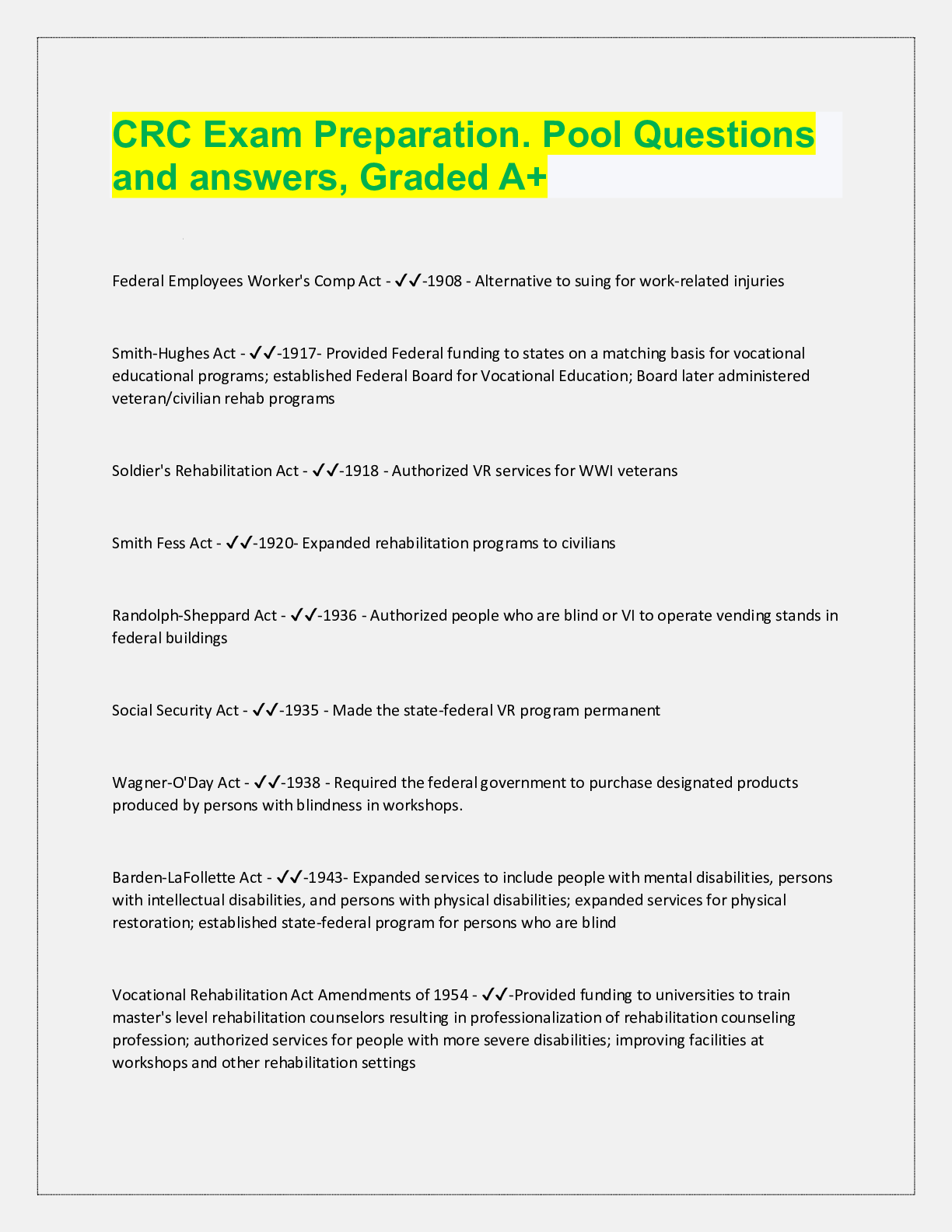
CRC Exam Preparation. Pool Questions
and answers, Graded A+
Federal Employees Worker's Comp Act - ✔✔-1908 - Alternative to suing for work-related injuries
Smith-Hughes Act - ✔✔-1917- Provided Federal funding to states on a matching basis for vocational
educational programs; established Federal Board for Vocational Education; Board later administered
veteran/civilian rehab programs
Soldier's Rehabilitation Act - ✔✔-1918 - Authorized VR services for WWI veterans
Smith Fess Act - ✔✔-1920- Expanded rehabilitation programs to civilians
Randolph-Sheppard Act - ✔✔-1936 - Authorized people who are blind or VI to operate vending stands in
federal buildings
Social Security Act - ✔✔-1935 - Made the state-federal VR program permanent
Wagner-O'Day Act - ✔✔-1938 - Required the federal government to purchase designated products
produced by persons with blindness in workshops.
Barden-LaFollette Act - ✔✔-1943- Expanded services to include people with mental disabilities, persons
with intellectual disabilities, and persons with physical disabilities; expanded services for physical
restoration; established state-federal program for persons who are blind
Vocational Rehabilitation Act Amendments of 1954 - ✔✔-Provided funding to universities to train
master's level rehabilitation counselors resulting in professionalization of rehabilitation counseling
profession; authorized services for people with more severe disabilities; improving facilities at
workshops and other rehabilitation settings
Vocational Rehabilitation Act Amendment of 1965 - ✔✔-Added extended evaluation to the vocational
rehabilitation process
Vocational Rehabilitation Act Amendments of 1973 - ✔✔-Expanded civil rights; mandated services for
people with severe disabilities; emphasized consumer involvement by requiring the IWRP; guaranteed
employment rights of persons with disabilities; ILC funded; eligibility-vocational objective.
Vocational Rehabilitation Act Amendments of 1954 - Section 501 - ✔✔-Affirmative action in federal
hiring. Mandates nondiscrimination by the federal government in its own hiring processes
Vocational Rehabilitation Act Amendments of 1954 - Section 502 - ✔✔-Architectural and transportation
barriers compliance. Ensures compliance on accessibility of buildings constructed with federal funds
Vocational Rehabilitation Act Amendments of 1954 - Section 503 - ✔✔-Affirmative action by federal
contract recipients. Requires affirmative action on the part of all businesses that receive contracts from
the federal government that exceed $2,500
Vocational Rehabilitation Act Amendments of 1954 - Section 504 - ✔✔-Equal opportunities; prohibits
the exclusion based on disability of otherwise qualified persons from participation in any program or
activity receiving federal financial assistance
Individuals with Disabilities Education Act (IDEA) 1975 - ✔✔-Mandated that all states must provide free,
public education for all disabled children between the ages of 3 and 21. Includes the rule of least
restrictive environment. Formerly Education for All Handicapped Children Act
Rehabilitation Act Amendments of 1978 - ✔✔-Mandated the provision of independent living services
Rehabilitation Act Amendments of 1984 - ✔✔-Mandated the establishment of client assistance
programs
Rehabilitation Act Amendments of 1986 - ✔✔-Added the provision of rehabilitation engineering services
and established supported employment as an acceptable goal for rehabilitation services
Rehabilitation Act Amendment of 1992 - ✔✔-Established consumer rehabilitation advisory council for
enhanced consumer input, research & business. Continued provisions for rehab technology. Eligibility
has to be established within 60 days of application. Advanced concepts of empowerment, self�determination, & informed choice. Rehab engineering, presumption of ability, improved minority
services
Rehabilitation Act Amendment of 1998 - ✔✔-Replaced the IWRP with Individualized Plan for
Employment (IPE) to support informed choice of individual in selection of IPE's employment outcome,
specific services, service providers, & the methods to procure the services; introduced new category of
service - provision of technical assistance and consultation to individuals to pursue self-employment,
telecommuting, or small business operation; & authorized to provide this service to facilitate transition
of students from school to post school activities, including employment
Americans with Disabilities Act - ✔✔-1990 - Prohibits discrimination of people with disabilities in
employment, transportation, public accommodations, & activities of state and local government.
Telecommunications relay established. Enables persons with disabilities to participate in all aspects of
society.
ADA - Title I - ✔✔-Employment: Employers with 15 or more employees may not discriminate against
qualified individuals with disabilities. Key terms: qualified person with disability, essential job functions,
reasonable accommodation, and undue hardship
ADA - Title II - ✔✔-Public services: Part I: Public bus systems: New buses must be accessible; paratransit
must be provided to persons unable to use fixed route bus services; new bus stations and alterations to
existing stations must be accessible. Part II: Public rail systems: new trains must be accessible; already
existing trains must have at least one accessible car; new train stations and alterations to existing
stations must be accessible
ADA - Title III - ✔✔-Public Accommodations: public accommodations (e.g. restaurants, hotels, stores,
parks, private schools, day-care centers) may not discriminate on the basis of disability. Public
accommodations must be accessible and provide auxiliary aids and services unless undue burden would
result.
ADA - Title IV - ✔✔-Telecommunications: Companies offering telephone service to the general public
must also offer telephone relay services (TDD) to those who need it
ADA - Title V - ✔✔-Miscellaneous: includes insurance issues, congressional inclusion, and amendments
to the Rehabilitation Act of 1973.
Goals of VR - ✔✔-inclusion, independence, empowerment, opportunity, quality of life, rehabilitation
Qualifying eligibility criteria for VR - ✔✔-(1) presence of a physical or mental impairment for which for
such an individual constitutes or results in a substantial impediment to employment; (2) the person with
a disability can benefit in terms of employment outcome from VR services.
Essential function - ✔✔-(1) the position exists to perform the function; (2) there are a limited number of
other employees available to perform the function, or among whom the function can be distributed (3)
A function is highly specialized, and the person in the position is hired for special expertise or ability to
perform it.
Reasonable accommodation - ✔✔-A modification or adjustment to a job, the work environment, or the
way things are usually done that enables a qualified individual with a disability to benefit from an equal
employment opportunity.
ADA: 3 areas of reasonable accommodation in employment - ✔✔-(1) to ensure equal opportunity in the
application process; (2) to enable a qualified individual with a disability to perform the essential
functions of the job; (3) to enable an employee with a disability to enjoy equal benefits and privileges of
employment
3 factors to consider in determining whether a person's impairment substantially limits a major life
activity - ✔✔-its nature and severity; how long it will last or is expected to last; its permanent or long�term impact, or expected impact
Undue hardship - ✔✔-an action that requires "significant difficulty or expense" in relation to the the size
of the employer, the resources available, and the nature of the operation.
CRC Code of Professional Ethics includes 12 enforceable standards: - ✔✔-(1) counseling relationship (2)
confidentiality, privileged communication, & privacy (3) advocacy and accessibility (4) professional
responsibility (5) relationships with other professionals (6) forensic & indirect services (7) evaluation,
assessment, & interpretation (8) teaching, supervision & training (9) research & publication (10)
technology and distance education (11) business practices (12) resolving ethical issues
Autonomy - ✔✔-to respect the rights of clients to be self-governing within their social and cultural
framework
Beneficence - ✔✔-to do good to others and to promote the well-being of clients
Fidelity - ✔✔-to be faithful, keep promises, and to honor the trust placed in rehabilitation counselors
Justice - ✔✔-to be fair in the treatment of all clients and to provide appropriate services to all
Nonmaleficence - ✔✔-To do no harm to others
Veracity - ✔✔-To be honest
Privacy - ✔✔-The right of the individual to choose for himself or herself the time and the circumstances
under which, and the extent to which, his or her beliefs, behaviors, and opinions are to be shared or
withheld from others.
Confidentiality - ✔✔-The ethical responsibility of the rehabilitation counselor to safeguard clients from
unauthorized disclosures of information given in the therapeutic relationship.
Baby boomer generation - ✔✔-Americans born between 1954-1964
Biomedical model of disability - ✔✔-This model defines disability as a pathology located within the
individual and is a deviation from the norm. Treatment is therefore focused solely on 'fixing' the
individual.
Environmental model of disability - ✔✔-The individual's environment may cause, define or exaggerate
the disability
Functional model of disability - ✔✔-The functions of the individual influence the disability
Sociopolitical model of disability - ✔✔-Proposes that disability is not a personal attribute, but caused by
society,and thus society should bear the responsibility for dealing with the disability. This model explains
that attitudes, economic, legal and policy barriers are the real reasons that people with disabilities have
difficulties participating as full members of society. Also known as IL model, or Minority Group Model
Self-advocacy - ✔✔-Refers to PWD taking control of their own lives, speaking up for themselves, being in
control of their own resources, and having the right to make life decisions without undue influence or
control from others.
WHO International Classification of Functioning - ✔✔-Contemporary, biophysical approach to defining
disability that considers the biomedical, environmental, functional, and social models in its explanation
of disability. This model conceptualizes disability to include five major areas: (a) body functions and
structures (b) activities (c) participation (d) personal and (e) environmental factors and proposes that
disability is an interaction between all these factors and cannot be defined in isolation from an
individual's context
Environmental barriers to rehabilitation - ✔✔-limited social support systems, restricted mobility and
transportation, architectural barriers, frequency and duration of hospitalizations, unavailable
institutional support (medical services, educational programs and technological supports, political and
religious groups) living conditions, availability of job opportunities, and inaccessibility of work sites
Adaptation - ✔✔-The dynamic process that a PWD experiences to achieve the final state of optimal
person-environment congruence known as adjustment.
Worldview - ✔✔-The framework of ideas and beliefs through which an individual interprets the world
and interacts with it based on their philosophy, values, emo
[Show More]