CRC Exam top Questions and answers,
rated A+
Assistive Technology - ✔✔-any item, piece of equipment, or product system, whether acquired
commercially off the shelf, modified, or customized that is used to increase,
...
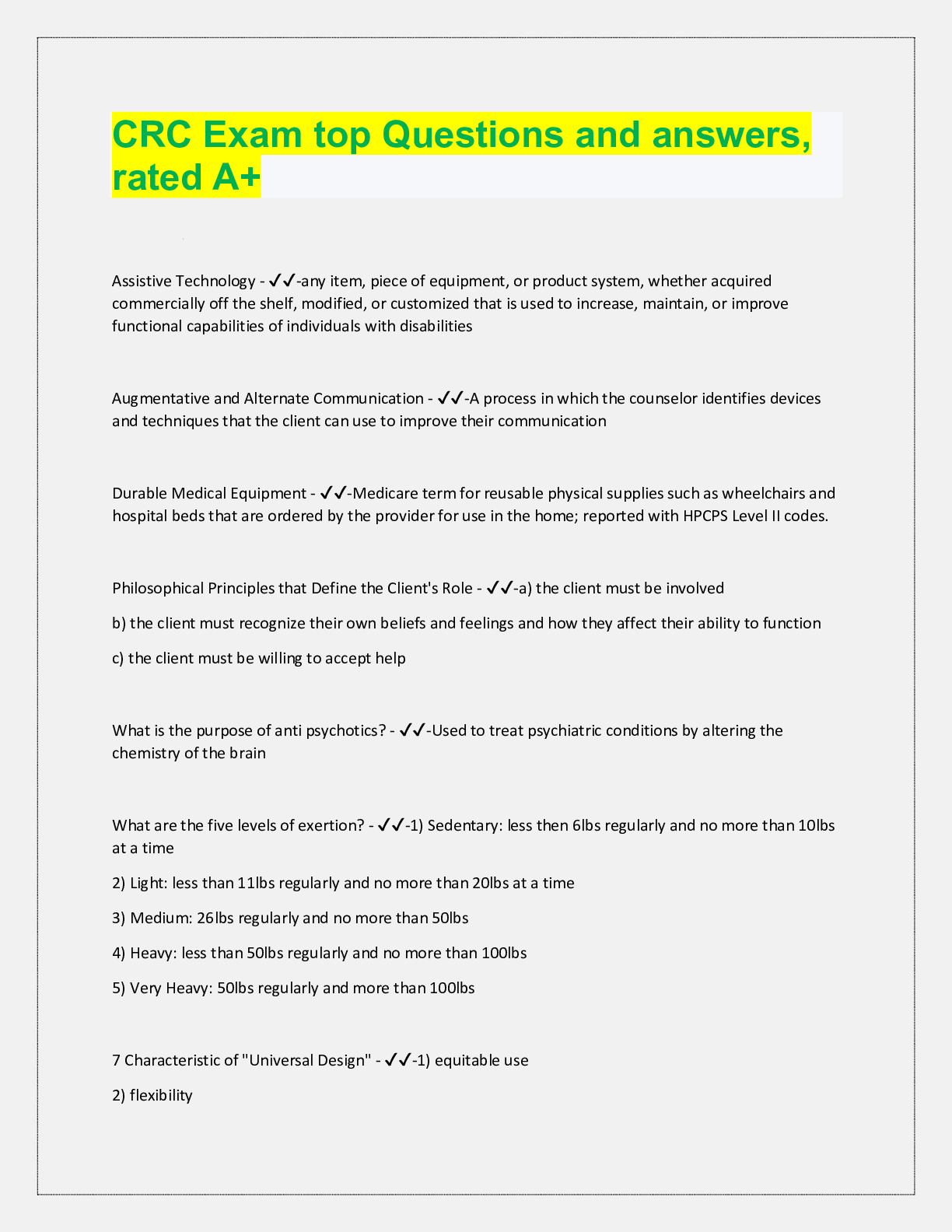
CRC Exam top Questions and answers,
rated A+
Assistive Technology - ✔✔-any item, piece of equipment, or product system, whether acquired
commercially off the shelf, modified, or customized that is used to increase, maintain, or improve
functional capabilities of individuals with disabilities
Augmentative and Alternate Communication - ✔✔-A process in which the counselor identifies devices
and techniques that the client can use to improve their communication
Durable Medical Equipment - ✔✔-Medicare term for reusable physical supplies such as wheelchairs and
hospital beds that are ordered by the provider for use in the home; reported with HPCPS Level II codes.
Philosophical Principles that Define the Client's Role - ✔✔-a) the client must be involved
b) the client must recognize their own beliefs and feelings and how they affect their ability to function
c) the client must be willing to accept help
What is the purpose of anti psychotics? - ✔✔-Used to treat psychiatric conditions by altering the
chemistry of the brain
What are the five levels of exertion? - ✔✔-1) Sedentary: less then 6lbs regularly and no more than 10lbs
at a time
2) Light: less than 11lbs regularly and no more than 20lbs at a time
3) Medium: 26lbs regularly and no more than 50lbs
4) Heavy: less than 50lbs regularly and no more than 100lbs
5) Very Heavy: 50lbs regularly and more than 100lbs
7 Characteristic of "Universal Design" - ✔✔-1) equitable use
2) flexibility
3) intuitiveness
4) low physical exertion
5) perceptible information
6) size & space
7) tolerance for error
Universal Design - ✔✔-design of products and environments to be usable by all people, to the greatest
extent possible, without the need for adaptations or specialized design.
Perceptible Information - ✔✔-Principle Universal Design; services or products are made to provide
information in a way that anyone can access despite abilities or limitations.
Size & Space - ✔✔-Principle Universal Design; a service or product is designed so anyone can use it,
interact with it despite limitations such as grip strength, moving, reaching, etc.
Tolerance for Error - ✔✔-Principle Universal Design; product or service is designed do that user mistakes
are hard to make
5 Principles of Ethical Behavior - ✔✔-1) Autonomy
2) Beneficence
3) Non-maleficence
4) Justice
5) Fidelity
Autonomy - ✔✔-independence; self-determination; right to personal choice
Beneficence - ✔✔-intending to do good and act in the best interest of the client
Nonmaleficence - ✔✔-do no harm
Justice - ✔✔-actin in a fair an impartial way towards all clients not letting "favorites" or biases influence
the service provided
Fidelity - ✔✔-faithfulness to one's promises or obligations; not making insincere statements or
impossible promises
Treatment Protocol for Alzheimer's - ✔✔-No cure but exercise, nutrition, physical therapy can help.
Need visual monitoring to stay safe and need frequent reminders and queues to reduce anxiety
Huntington's Disease - ✔✔-A genetic disorder that surfaces around age 30 causing anxiety and physical
weakness as well as psychiatric and cognitive issues
Muscular Dystrophy - ✔✔-An umbrella term for a degenerative muscle condition
Antidepressants - ✔✔-Used to treat clinical depression; typically work on the neurotransmitters
serotonin, nor-epinephrine, and/or dopamine
4 Etiologies of Medical Disorders - ✔✔-1) Congenital Defects
2) Degenerative Disorders
3) Acquired Disorders
4) Unknown Origin
Striated Muscle - ✔✔-controls voluntary movement
Smooth Muscle - ✔✔-Control involuntary movement
Cardiac Muscle - ✔✔-Comprises the heart
Physiatrists - ✔✔-A Dr with expertise in body mechanics
Orthopedists - ✔✔-A Dr who specializes in skeletal disorders
Tendons - ✔✔-a bodily tissue that connects a muscle to the joint
4 Categories of Rheumatoid Disease - ✔✔-1) Rheumatoid Arthritis
2) Spondylitis
3) Osteoarthritis
4) Osteoporosis
Rheumatoid Arthritis - ✔✔-an autoimmune disease that leads to inflammation of the joints and
surrounding tissues
Spondylitis - ✔✔-linked to genetics and affects more males than females; causes inflammation of joints
between the spinal bones, and joints between spine and pelvis, eventually causes the affected spinal
bones to join together.
Osteoarthritis - ✔✔-most common joint disorder, due to aging and "normal" wear and tear on a joint
Osteoporosis - ✔✔-he thinning of bone tissue and loss of bone density over time
When assessing functional capacity the two major components are... - ✔✔-a) Behavior: the client's past
and present actions
b) Level of skill: the difficulty of activities that the client can complete successfully
Equitable - ✔✔-Principle Universal Design: a product or services provides the same benefit to any user
Flexibility - ✔✔-Principle of Universal Design: a service or product is made to work in any reasonable
way
Intuitiveness - ✔✔-Principle of Universal Design; a product or service is made to be used with little or no
training
Low Physical Exertion - ✔✔-Principle of Universal Design: a product or service can be used comfortably,
easily and safely
Occupational Therapy - ✔✔-Restore, maintain, or teach skills of daily living and work; Focus on motor
skills and mental acuity
Physical Therapy - ✔✔-Restore, maintain and promote overall fitness;
Focus on strength, endurance, and range of motion
Therapeutic Recreation - ✔✔-Improve and maintain overall well-being: physical, mental and emotional;
Focus on using leisure/recreational activities to increase/maintain abilities
Speech Therapy - ✔✔-helps people with speech and language problems to speak more clearly.
Vocational Therapy - ✔✔-A special program designed to help those with a physical or mental
impairment to obtain, prepare for, engage in, or retain a job. Services are provided through the division
of vocational rehabilitation. This program is supported by federal and state funds.
Principles of Treatment Planning - ✔✔-a) Tailor treatment to the specific needs of client
b) Treat ALL factors that affect the overall well-being of the client
c) Ensure that treatment lasts as long as the client needs it
d) Give the client the information needed to create and implement the treatment plan
Functional Capacity - ✔✔-the ability to perform necessary tasks; what a person is actually capable of
doing
Functional Assessment Evaluation - ✔✔-(FCE): the assessing of client skills and the performance of
certain tasks
3 Types of Environmental Barriers - ✔✔-1) Architectural
2) Service
3) Societal
Interventions - ✔✔-any technique, strategy, or service that is intended to treat/diminish a specific
problem
Orthotics - ✔✔-medical term used to describe a device that helps a person move or supports their body
Philosophical principles that define the counselor's role - ✔✔-a) recognition of and focus on client's
strengths
b) recognition and development of client potential
c) working with others to provide necessary services
d) recognition that the client is part of a system (family/community) and that the system may affect the
rehabilitation process
e) ensure that the client continues to make progress towards goals
Steps of Strategic Planning - ✔✔-1) identification of goals
2) assessment of counselor ability to meet these goals
3) outlining of specific techniques that can be used to achieve
4) carry out the chosen intervention
5) evaluate progress on a continuous basis
Identified Patient - ✔✔-The family member whose symptoms or behaviors are stated by the family as
the reason for coming to therapy.
Third-Party Payment - ✔✔-Payments for healthcare services made by an insurance company or health
agency on behalf of the insured
Referral Fee - ✔✔-A fee paid for recommending or referring a potential client or customer
CPT - ✔✔-Current Procedural Terminology - a systematic medical listing and coding of procedures and
services.
Skills needed to coordinate services - ✔✔-1) communication- ability to transfer information
2) concatenation- ability to ensure the client has access to needed professionals
3) continuity- ability to ensure that all involved are working as a team
3 Types of Accommodation - ✔✔-1) Physical Accommodation- environmental
2) Resource Accommodation- a personal assistant
3) Equipment Accommodation- special tools
Solving Teamwork Problems - ✔✔-a) using conflict resolution techniques as problems arrive
b) re-evaluation and defining of individual team member roles
c) re-evaluation and redesigning of team goals
Conservation - ✔✔-Piaget learning concept that is acquired between the ages of 7-11 where a child
understands that volume, weight, and mass of an object stays the same even when the shape changes
Concrete Operational - ✔✔-The Piagetian stage for when children between the ages of 7-11 understand
conservation of matter
Kohlberg - ✔✔-Theory of Moral Development: three phases
Preconventional - ✔✔-Kohlberg's first phase: two parts- a child doing what is right to avoid punishment;
an older child doing what is right as way to avoid consequences and because it is in the interest of the
other
Maslow's Hierarchy of Needs - ✔✔-Pyramid of priority of needs
base to top: physiological needs, safety needs, social needs, esteem needs, self actualization
Pavlovian Methods in the Military - ✔✔-The use of transmarginal inhibition (TMI) techniques are used to
re-program solider responses to discomfort of pain, fear
Transmarginal Inhibition - ✔✔-An organism's response to overwhelming stimuli, first detailed by Pavlov
Steps of Work-Hardening - ✔✔-1) assessment of client's functional ability
2) Job analysis to discern the needed skills for employment
3) Identify options for employment
4) identification of specific accommodations, modifications &/or changes that will need to be made
Erik Erikson - ✔✔-Stages of Human Growth & Development: 8 stages that refer to how a person
interacts with their environment. Each stage is a "crisis" which needs to be resolved before a person can
successfully move to the next stage.
MBTI - ✔✔-Myers-Briggs Type Indicator: psychological test based in Junian theory; four categories
1) Extroversion - Introversion: Where do you prefer to focus your attention?: Where do you get your
energy?
2) Sensing - Intuition: How do you prefer to take in information?
3) Thinking - Feeling: How do you make decisions?
4) Judging - Perceiving: How do you deal with the outer world?
Purpose of Rehabilitation Services Administration - ✔✔-Division of the U.S. Department of Education's
Office of Special Education and Rehabilitation Services; meant to ensure that people with disabilities
have access to services needed to function and work and in daily life
Purpose of Office of Special Education Programs - ✔✔-Ensures that children with disabilities have access
to an education that is tailored for the specific needs
Temporary Assistance for Needy Families - ✔✔-TANF: helps low income families obtain basic resources
Describe "Insurance" - ✔✔-An organization agrees to cover the costs of the item insured in trade for
dues and fees
Purpose of State Workers' Compensation - ✔✔-An insurance program available to employers to cover
costs when a worker is hurt on the job
Skills for Job Retention - ✔✔-a) ability to prioritize
b) ability to function under pressure
c) effective communication
d) ability to make decisions
e) ability to problem solve
f) ability to be part of a team
1918 Smith Sears Act - ✔✔-Authorized Federal Board for Vocational Education to organize and offer
programs of vocational rehabilitation for veterans with disabilities. Employment as a result of vocational
rehabilitation training had to be a feasible possibility.
1920 Smith Fess Act - ✔✔-The civilian vocational rehabilitation [act] program. Counseling, training,
prosthetic appliance and job placement to physically disable from industrial injuries. Provided federal
funds to states on a 50-50 matching basis.
What year was NRA founded? - ✔✔-1925
1935 Social Security Act - ✔✔-established three types of federal provisions public assistance, social
insurance and health/welfare services; also established voc-rehab as a permanent program
1936 Randolph Sheppard Act - ✔✔-joblessness among the blind must be reduced through a robust
program to assist blind people in the establishment and operation of cafeteria, concessions, and vending
businesses on federal, state, municipal and potentially private property
1938 Wagner O'Day Act - ✔✔-Federal government will purchase items produced in Rehabilitation
Workshops
1943 Barden-Lafolette Act - ✔✔-made substantial changes in the federal/state program of
rehabilitation; broadened the program's financial provisions, offered a comprehensive definition of
vocational rehabilitation, expanded services to include physical restoration, and each state had to
submit a written plan for approval by the federal agency as to how federal/state dollars would be used;
expansion of services included on a limited basis person who were mentally handicapped and mentally
ill; fostered separate agencies for general rehabilitation and rehabilitation of person who were blind.
1954-1965 - ✔✔-"The Golden Years"
1954 Amendments-what did they do? - ✔✔-reshaped the roles of the federal and state government in
the rehabilitation program; established the basis for a working relationship between public and private
rehabilitation and expanded the role of the state agency; established funding sources for (1) college and
university training of rehabilitation professionals; (2) improvement and remodeling of rehabilitation
facilities; and (3) research and demonstration grants; increased federal funding to states (3 federal
dollars for each 2 dollars from the state); increased services to persons with mental retardation and
mental illness through items (2) and (3) above, along with agency expansion and improvement grants.
Rehabilitation Act of 1973 - ✔✔-Prohibits discrimination of hiring persons with disabilities by federal
agencies and federal contractors.
RA of 1973 Section 501 - ✔✔-focused on the federal government's hiring practices
RA of 1973 Section 502 - ✔✔-created the Architectural and Transportation Barriers Compliance Board
(ATBCB) to enforce standards set under the Architectural Barriers Act of 1968
RA of 1973 Section 503 - ✔✔-prohibited discrimination in employment on the basis of physical or
mental handicap on the part of businesses with federal contract or their subcontractors
RA of 1973 Section 504 - ✔✔-prohibited discrimination on the basis of physical and mental handicaps in
programs receiving federal funds; also established the Client Assistance Demonstration Projects (CAPS)
to provide assistance in informing and advising clients and applicants of all available benefits under the
Rehabilitation Act; emphasized priority of services for persons with the most severe handicap and the
development of the Individual Written Rehabilitation Plan (IWRP); established by statute the
Rehabilitation Services Administration.
1990 Americans with Disabilities Act - ✔✔-requires employers and public facilities to make "reasonable
accommodations" for people with disabilities and prohibits discrimination against these individuals in
employment.
1992 ADA Amendment - ✔✔-stressed respect for ind dignity, personal responsibility, self determination,
and pursuit of meaningful careers based on informed choice
1998 ADA Amendment - ✔✔-purpose is to empower ind w/ disabilities to maximize employment,
economic self-sufficiency, independence and inclusion and integration into society
2009 ADAAA Amendments - ✔✔-reiterate who is covered by the ADA civil rights protections. It revises
the definition of "disability" to more broadly encompass impairments that substantially limit a major life
activity. It also states that mitigating measures, including assisstive devices, auxiliary aids,
accommodations, medical therapies and supplies (other than eyeglasses and contact lenses) have no
bearing in determining whether a disability qualifies under the law. Changes also clarify coverage of
impairments that episodic or in remission when active, such as epilepsy or post traumatic stress
disorder, that can substantially limit a major life activity. These amendments took effect January 1,
2009.
Family Medical Leave Act - ✔✔-1993; Requires employers with 50 or more workers to grant up to 12
weeks of unpaid leave a year to allow workers to take time off to help care for a new baby or an ill
family member without fear of losing their jobs.
Uniformed Services Employment and Reemployment Rights Act - ✔✔-1994. It protects military
members for weekend duty, 2-week training periods, short term assignments and war theater
assignments
Workforce Investment Act - ✔✔-the federal government's effort to adapt workforce training system to
current economic conditions--- provides states with block grant programs that target adult education,
disadvantaged youth, and family literacy
The Ticket to Work & Workforce Incentives Improvement Act (TWWIIA) - ✔✔-1999--- increase individual
choice in obtaining vocational and employment services; provide increased health care coverage for
workers with a disability; and eliminate some of the disincentives to work. The law also created the
Medicaid Buy-In program which enables certain individuals to receive Medicaid coverage by paying a
premium.
Workers Compensation - ✔✔-A form of insurance paid by the employer providing cash benefits to
workers injured or disabled in the course of employment.
Health Insurance Portability and Accountability Act (HIPAA) 1996 - ✔✔-federal law that requires all
health care settings to ensure privacy and security of patient information. Also requires health insurance
to be accessible for working Americans and available when changing employment.
Genetic Information Nondiscrimination Act (GINA) - ✔✔-A 2008 Federal law that prohibits employers
from discriminating against applicants or employees on the basis of genetic information gleaned from
the individual or family members.
1917 Smith Hughes Act - ✔✔-established the Federal-State Program in vocational education; created a
Federal Board of Vocational Education with the authority and responsibility for vocational rehabilitation
of disabled veterans.
When was Veterans Bureau established? (VA) - ✔✔-1921
1932 President FDR - ✔✔-tried to keep it a secret that he had polio
1950-1967 - ✔✔-Reign of Mary Switzer
4 areas of concern in client-counselor relationship - ✔✔-1) Team approach to treatment planning
2) Monitoring to determine progress of plan
3) Development of realistic, attainable goals
4) Consideration of client resources: $$, transportation, and social support
Duty to Warn - ✔✔-The ethical responsibility to take appropriate action when there is knowledge of
impending danger.
Mandatory Ethical Guidelines - ✔✔-Rules that must be followed to avoid personal, legal, or criminal
troubles- sex w/ client, conflicts of interest, fees
Aspirational Ethical Guidelines - ✔✔-Moral compulsions to behave in a way that is perceived as moral
and proper
Advocacy - ✔✔-support; active pleading on behalf of someone or something
Empowerment - ✔✔-Feelings of intrinsic motivation, in which people perceive their abilities to have
impact and meaning and perceive themselves to be competent and capable of self-determination.
Statement of Disclosure - ✔✔-A written document that lets the client know about the procedures and
practices of the services they are to receive. Includes: billing, office hours, counselor credentials, and
confidentiality procedures
Is it ethical for a counselor to talk about a client with another professional? - ✔✔-Only if the reason for
talking to another professional is in the best interest of the client
4 Types of Advocacy Groups - ✔✔-1) single-disability/single-issue
2) single-disability/multi-issue
3) multi-disability/singel-issue
3) multi-disability/multi-issue
Haley - ✔✔-Strategic Therapy: developing of a specific strategy to treat a specific problem; use of
directives;the therapist takes responsibility for directly influencing clients
Restraining - ✔✔-Paradoxical intervention: emphasizing of the negative consequences of the new
behavior
Positioning - ✔✔-Paradoxical intervention: characterizing a negative behavior in an even more negative
way
Helping a family with a child in the hospital - ✔✔-1) re-evaluate current needs of the family; refer them
to additional services if needed
2) ensure the family understands the medical information and treatment protocol
3 goals of Behavioral Group Approach - ✔✔-1) develop social skills
2) teach the skills necessary to function in society
3) help teach the skills necessary to adapt to whatever the situation is
Salvador Minuchin - ✔✔-Structural Family Therapy: uses joining, enactment, boundary making, and
mimesis techniques
Joining - ✔✔-Structural Family Therapy intervention: therapists attempt at greeting and bonding with
family members
Enactment - ✔✔-Structural Family Therapy intervention: family members are asked to act out the
problem situation to bring insight into the family dynamic
Boundary Making - ✔✔-Structural Family Therapy intervention: individual member's roles are defined
Mimesis - ✔✔-Structural Family Therapy intervention: the therapist mimics the positive and negative
behavior patterns of individual family members
Advantages of Group Counseling - ✔✔-1) extension o
[Show More]