ICD-10-CM Components Questions and
answers, 100% Accurate, rated A+
ICD-10-CM - ✔✔-a coding system specifically used to identify diseases or injuries for which a patient is
being treated. Coding involves an alphanum
...
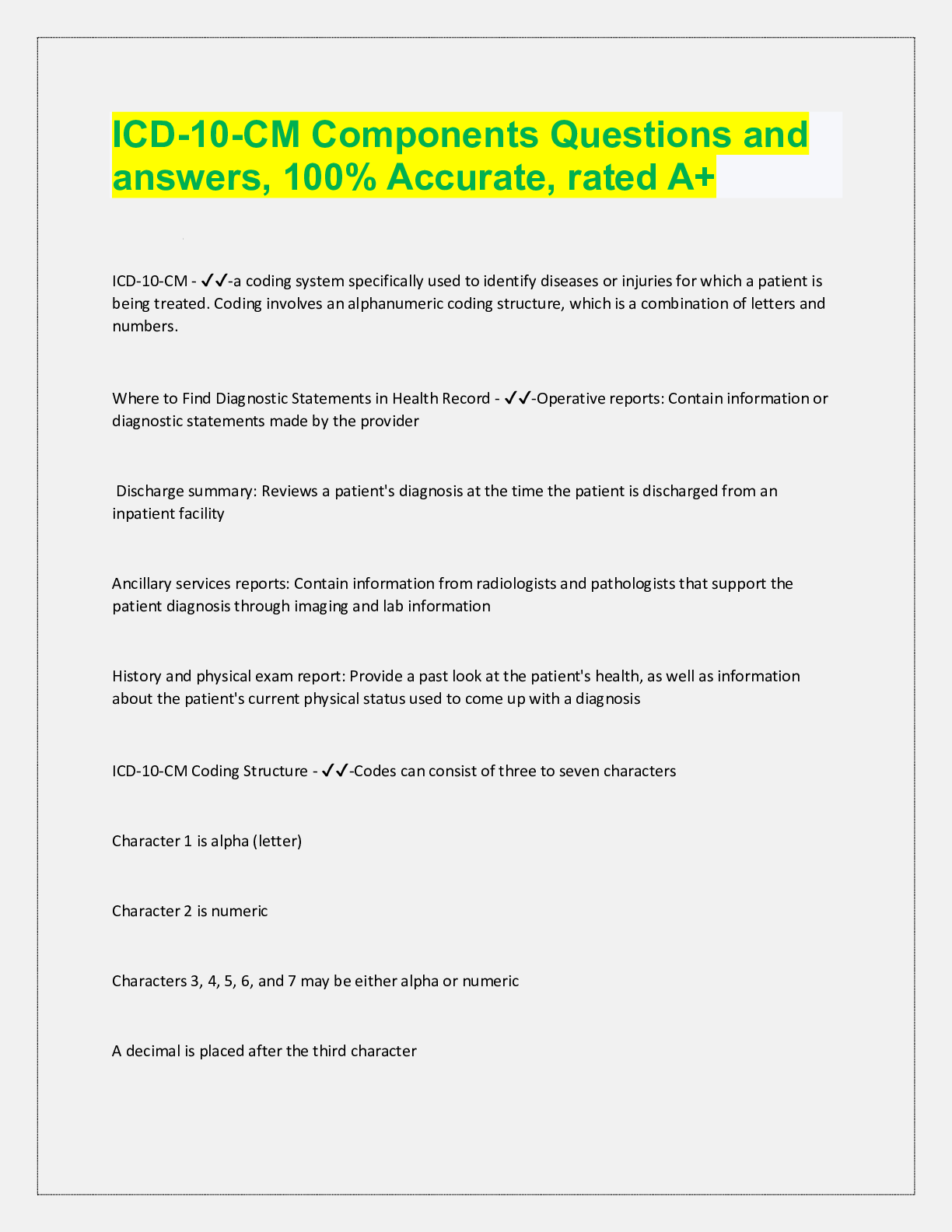
ICD-10-CM Components Questions and
answers, 100% Accurate, rated A+
ICD-10-CM - ✔✔-a coding system specifically used to identify diseases or injuries for which a patient is
being treated. Coding involves an alphanumeric coding structure, which is a combination of letters and
numbers.
Where to Find Diagnostic Statements in Health Record - ✔✔-Operative reports: Contain information or
diagnostic statements made by the provider
Discharge summary: Reviews a patient's diagnosis at the time the patient is discharged from an
inpatient facility
Ancillary services reports: Contain information from radiologists and pathologists that support the
patient diagnosis through imaging and lab information
History and physical exam report: Provide a past look at the patient's health, as well as information
about the patient's current physical status used to come up with a diagnosis
ICD-10-CM Coding Structure - ✔✔-Codes can consist of three to seven characters
Character 1 is alpha (letter)
Character 2 is numeric
Characters 3, 4, 5, 6, and 7 may be either alpha or numeric
A decimal is placed after the third character
Examples:
A18.01 (code for tuberculosis of the spine)
O9A.319 (code for physical abuse complicating pregnancy, unspecified semester)
S90.922A (code for unspecified superficial injury of left foot, initial encounter)
ICD-10-CM Characters 1, 2, 3 - ✔✔-The first three characters represent the code category, such as the
category in which the disease or injury belongs. An example of a category is Certain Infectious and
Parasitic Diseases.
ICD-10-CM Characters 4, 5, 6 - ✔✔-Characters 4, 5, and 6 represent the etiology, anatomic site, and
severity.
ICD-10-CM Character 7 - ✔✔-If a code has seven characters, the seventh character is also called the
"extension code." It is used mainly to define specific details of injury, poisoning, consequences of
external causes and pregnancy, childbirth, and puerperium (postpartum).
Main Terms (ICD-10-CM) - ✔✔-Represent the essence of the disease definition without any details
Appear in bold
Nonessential Modifiers (ICD-10-CM) - ✔✔-Serve as supplementary words or explanatory information
Are placed in parentheses
Do not affect the code assignment
Essential Modifiers (ICD-10-CM) - ✔✔-Terms that change the description of the diagnosis (in bold)
Indented one space to the right
Located under the main term
Subterms (ICD-10-CM) - ✔✔-Indented one space to the right
Found in alphabetic index and used for diagnoses
Located under the essential modifier
Used when all conditions exist
Table of Neoplasms (ICD-10-CM) - ✔✔-Lists neoplasms according to anatomic site
Neoplasms are further classified into six categories:
Malignant Primary
Malignant SecondaryCa [cancer] in situ
Benign
Uncertain Behavior
Unspecified Behavior
Table of Drugs and CHEMICALS (ICD-10-CM) - ✔✔-Is used to identify poisonings and external causes of
adverse effects
Uses six coding classifications:
Poisoning, Accidental (Unintentional)
Poisoning, Intentional Self-HarmPoisoning, Assault
Poisoning, Undetermined
Adverse
EffectUnderdosing
Tabular List (ICD-10-CM ) - ✔✔-The Tabular List is divided into 21 chapters. The titles of the chapters
indicate a group of diseases and injuries. Titles may also use etiology and body parts to group the codes.
All titles are followed by a code range. Here are a few examples:
Chapter 10: Diseases of the Respiratory System (J00-J99)Chapter 18: Symptoms, Signs and Abnormal
Clinical and Laboratory Findings, Not Elsewhere Classified (R00-R99)
Chapters are further divided into categories, called blocks. Each block has an assigned three-digit
character code. This three-digit code is the foundation of the ICD-10-CM coding structure. It is the first
set of three characters.
Place Card Holder (Tabular Convention ICD-10-CM) - ✔✔-The dummy placeholder "X" is used in two
ways:
As the fifth character in some six-character codes, which allows the code to be expanded on in the
future without interrupting the six-character structure.
As a placeholder for filling empty character spaces for the fourth, fifth, or sixth characters, when using a
seven-character code.
Example: V73.9XXA
The code V73.9 is provided and the coding requires an "A" in the seventh position. Therefore, the X's in
the fifth and sixth positions are inserted as placeholder characters.
Extension Codes (Tabular List Convention ICD-10-CM) - ✔✔-The seventh character is the extension code,
which provides more specific information about the condition.
For example:
"A" indicates initial encounter.
"D" indicates subsequent encounter.
"S" indicates sequela.
Example: S65.002D
The code represents a diagnosis of unspecified injury of ulnar artery at wrist and hand level of left arm,
subsequent encounter. The "D" designates the subsequent encounter.
Punctuation (Tabular List Convention ICD-10-CM) - ✔✔-The main forms of punctuation used for the
Tabular List include:
Braces: Enclose a series of terms, each of which is modified by the statement appearing to the right of
the brace. They help coders read and understand the codes.
Brackets: Enclose synonyms, alternative wording, or explanatory phrases. They help coders read and
understand code descriptions.
Example: B02 Zoster [herpes zoster]
Instructional Notation (Tabular List Convention ICD-10-CM) - ✔✔-Located right under the main term,
instructional notations are words that provide important coding instructions for accuracy. They let the
coder assign codes to a high level of specificity.
Examples of instructional notations are:
Includes: Indicates to the coder that certain conditions should be included in the code.
Example: K25 Gastric ulcer includes stomach ulcer
Excludes: Tells the coder to not code something or not include something.
Example: K25 Gastric ulcer excludes peptic ulcer
Code first: Indicates that the underlying condition must be coded first in the sequence.
Example: I41 Myocarditis in diseases classified elsewhere states to code first underlying disease, such as:
typhus (A75.0-A75.9)
Use additional code: Tells the coder to include the etiology code.
Example: I20 Angina pectoris states to use additional code to identify: tobacco use (Z72.0)
Chapters of Tabular List of Diseases and Injuries (ICD-10-CM) - ✔✔-Possible Diagnosis*
ICD-10-CM Code
1
Certain Infectious and Parasitic Diseases
A00-B99
Measles
B05.9
2
Neoplasms
C00-D49
Colon cancer
C18.9
3
Diseases of the Blood and Blood-Forming Organs and Certain Disorders Involving the Immune
Mechanism
D50-D89
Iron-deficient anemia
D50.9
4
Endocrine, Nutritional and Metabolic Diseases
E00-E89
Type I diabetes
E10
5
Mental, Behavioral and Neurodevelopmental Disorders
F01-F99
Dementia
F03
6
Diseases of the Nervous System
G00-G99
Parkinson's disease
G20
7
Diseases of the Eye and Adnexa
H00-H59
Glaucoma
H40.9
8
Diseases of the Ear and Mastoid Process
H60-H95
Otitis media, left ear
H60.92
9
Diseases of the Circulatory Syste
[Show More]