CDIP Practice Exam 1 Questions &
Answers, 100% Accurate, Graded A+
Assign code(s) for the following diagnosis: Congestive heart failure due to hypertension.
I10 Essential (primary) hypertension
I11.9 Hypertensive he
...
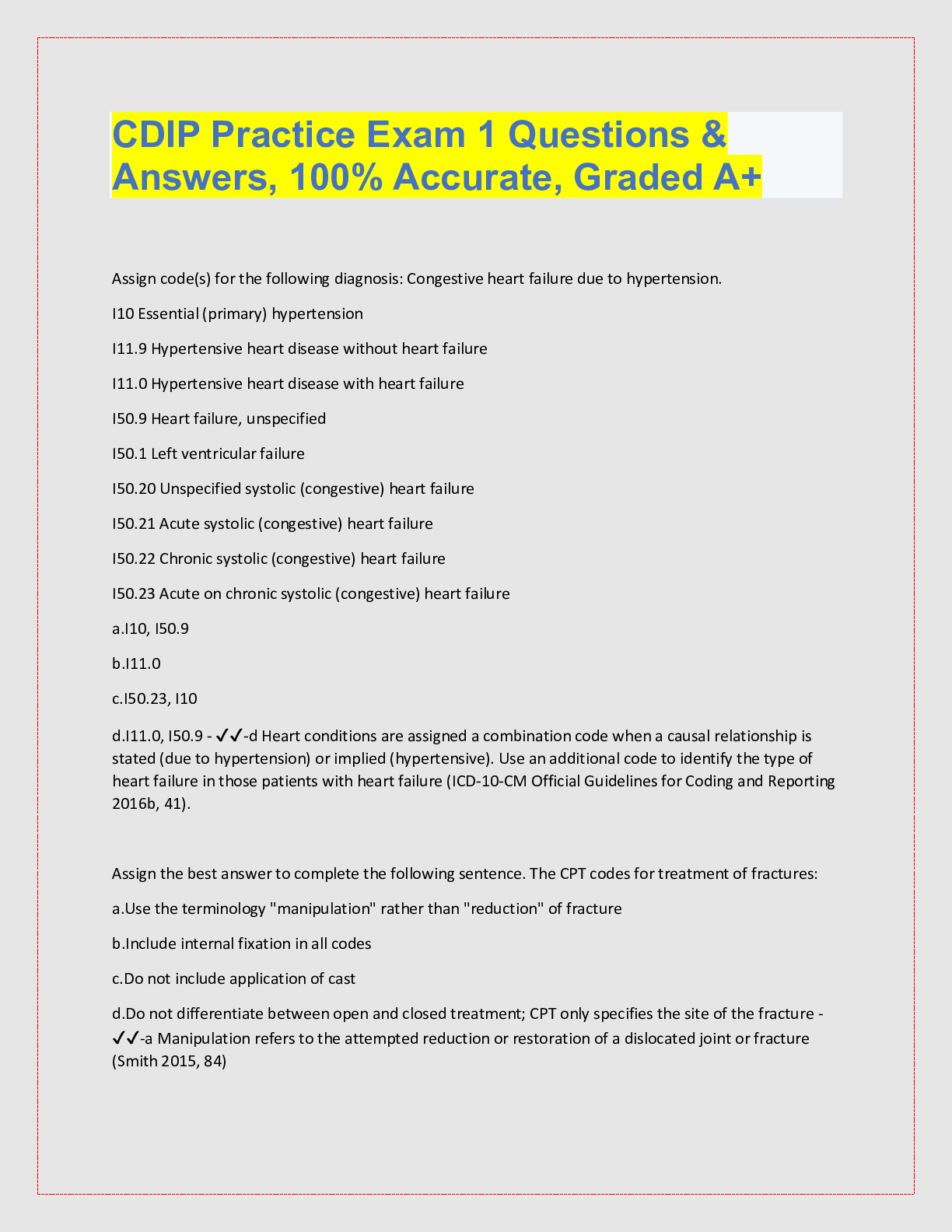
CDIP Practice Exam 1 Questions &
Answers, 100% Accurate, Graded A+
Assign code(s) for the following diagnosis: Congestive heart failure due to hypertension.
I10 Essential (primary) hypertension
I11.9 Hypertensive heart disease without heart failure
I11.0 Hypertensive heart disease with heart failure
I50.9 Heart failure, unspecified
I50.1 Left ventricular failure
I50.20 Unspecified systolic (congestive) heart failure
I50.21 Acute systolic (congestive) heart failure
I50.22 Chronic systolic (congestive) heart failure
I50.23 Acute on chronic systolic (congestive) heart failure
a.I10, I50.9
b.I11.0
c.I50.23, I10
d.I11.0, I50.9 - ✔✔-d Heart conditions are assigned a combination code when a causal relationship is
stated (due to hypertension) or implied (hypertensive). Use an additional code to identify the type of
heart failure in those patients with heart failure (ICD-10-CM Official Guidelines for Coding and Reporting
2016b, 41).
Assign the best answer to complete the following sentence. The CPT codes for treatment of fractures:
a.Use the terminology "manipulation" rather than "reduction" of fracture
b.Include internal fixation in all codes
c.Do not include application of cast
d.Do not differentiate between open and closed treatment; CPT only specifies the site of the fracture -
✔✔-a Manipulation refers to the attempted reduction or restoration of a dislocated joint or fracture
(Smith 2015, 84)
In CPT, if a patient has two lacerations of the arm that are repaired with simple closures, the coder
would assign:
a.Two CPT codes expressing each laceration repair
b.One CPT code for the largest laceration
c.One CPT code, adding the lengths of the lacerations together
d.One CPT code for the most complex closure - ✔✔-c When multiple wounds are repaired with the same
closure type (for example, simple), lengths of the wounds in the same classification and from all
anatomical sites that are grouped together into the same code descriptor should be added together
(Smith 2015, 67).
Patient admitted for laparoscopic repair of right diaphragmatic hernia. Assign the ICD-10-PCS procedure
code for this surgery.
0BQR4ZZ Repair right diaphragm, percutaneous endoscopic approach
0BQROZZ Repair right diaphragm, open approach
0BQS4ZZ Repair left diaphragm, percutaneous endoscopic approach
0BQSOZZ Repair left diaphragm, open approach
a.0BQR4ZZ
b.0BQR0ZZ
c.0BQS4ZZ
d.0BQS0ZZ - ✔✔-a Surgery is the only treatment for diaphragmatic hernias. ICD-10-PCS code 0BQR4ZZ,
is used for laparoscopic repair of diaphragmatic hernia (Garvin 2015, 192, 284)
When trying to determine if documentation is present to substantiate status asthmaticus, the coder
should review the record for what terms and phrases?
a.Intractable pneumonia
b.Refractory asthma and severe, intractable wheezing
c.Airway obstruction relieved by bronchodilators
d.Limited but pronounced wheezing - ✔✔-b Status asthmaticus is defined as continual wheezing in spite
of therapy (Leon-Chisen 2013, 230).
Gastrointestinal bleeding can manifest as:
a.Hematemesis, which indicates acute upper gastrointestinal hemorrhage
b.Petechia
c.Vomiting
d.Constipation, which indicates upper or lower gastrointestinal hemorrhage - ✔✔-a Gastrointestinal
bleeding manifests itself in several ways. These are hematemesis, melena, occult bleeding,
hematochezia (Leon-Chisen 2013, 244).
Which types of pacemaker devices have a unique ICD-10-PCS code.
a.Dual chamber rate responsive
b.Single chamber, single chamber rate responsive, and dual chamber
c.Multiple chamber
d.Multiple chamber rate responsive - ✔✔-b The three types of pacemakers are single chamber, single
chamber rate responsive, and dual chamber. A single chamber uses a single lead; a dual chamber
requires two leads, one in the atrium and one in the ventricle. The leads should also be coded (Leon�Chisen 2013, 416-418).
Mechanical ventilation codes require consideration of which of the following?
a.The time when a tracheal tube is inserted
b.The replacement of an endotracheal tube
c.The start time of endotracheal tube insertion followed by mechanical ventilation
d.Mechanical ventilation during surgery - ✔✔-c Codes for mechanical ventilation indicate whether the
patient was on mechanical ventilation for less than 24 hours, 24-96 consecutive hours and greater than
96 consecutive hours. The start time for calculating the duration begins with the start time of
endotracheal tube insertion as the best method, followed by mechanical ventilation or the time that a
patient who is on mechanical ventilation is admitted. The time ends with discontinuance of mechanical
ventilation (Leon-Chisen 2013, 239-240).
Abbreviations can be a source of patient safety issues due to misinterpretation and miscommunication.
Abbreviations in the health record:
a.Are not permitted by Joint Commission standards
b.Should have only one meaning
c.Enhance patient safety
d.Are critical to an electronic health record system - ✔✔-b The Joint Commission has established a
cautious quality approach to the use of abbreviations in all its accredited organizations. To comply,
every healthcare organization should strive to limit or eliminate the use of abbreviations by developing
an organizationspecific abbreviation list so that only those abbreviations approved by the organization
are used. When more than one meaning for an approved abbreviation exists, an organization should
choose only one meaning or context in which the abbreviation is to be used (Shaw and Carter 2014;
Brodnik et al. 2012, 180-181).
In ICD-10-PCS, what value is used if there is a character that does not apply to a given code?
a.X
b.Z
c.0
d.- - ✔✔-b All ICD-10-PCS codes must be seven characters, and a character cannot be left blank. If a
value does not exist for a given character, the Z is used as the value (Shaw and Carter 2014; Kuehn and
Jorwic 2013, 5).
Which symbol of punctuation is used in the Tabular List to enclose synonyms, alternative wording, or
explanatory phrases?
a.Parentheses
b.Brackets
c.Colon
d.Comma - ✔✔-a Punctuation is widely used in coding. Brackets are used in the Alphabetic Index to
identify manifestation codes as well as to enclose synonyms, alternative wording or explanatory
phrases. (ICD-10-CM Official Guidelines for Coding and Reporting 2016b, 8)
When the documentation in the medical record is insufficient to assign a more specific code, a _______
code is assigned.
a.MCC
b.CC
c.NOS
d.Unspecified - ✔✔-d When documentation in the record is not available to assign a more specific code,
an unspecified code is assigned (ICD-10-CM Official Guidelines for Coding and Reporting 2016b, 10)
A 30-year-old cerebral palsy patient was admitted with acute bronchitis, possible pneumonia. In
reviewing the diagnoses below what additionally will impact the patient's ICD-10 code assignment.
a.Spasticity
b.Quadriplegia
c.Both A and B
d.None of the above - ✔✔-c ICD-10 Cerebral palsy and other paralytic syndromes (G80-G83) has
additional specificity for spasticity as well as state of paralysis if any (AHIMA 2015, 23).
A 90-year-old female was determined to have a CVA with hemorrhage. The cause of the hemorrhage
was determined to be an embolism. What additionally could impact code assignment for the embolism
code?
a.Hematemesis
b.Hypertension
c.Site of the hemorrhage
d.Seizure - ✔✔-c ICD-10 includes the site of the of the hemorrhage for increased specificity.
If a patient undergoes a biopsy immediately before the definitive surgery for a frozen section, how
should this be coded with ICD-10-PCS codes?
a.The approach to the definitive surgery
b.Suture method
c.Exploratory surgery
d.Open biopsy and definitive surgery - ✔✔-d The open biopsy is performed prior to the definitive
surgery so that the pathologist can perform a frozen section of the tissue to determine malignancy.
Approaches, suturing, and closure are not coded separately. Exploratory surgery is not coded when
definitive surgery is performed (Leon-Chisen 2013, 92).
A patient was admitted with diminished responsiveness and hypotension. The patient has a history of
hypertension, CVA, CHF, and asthma. The patient suffered a cardiac arrest immediately following
admission. The documentation within the record should:
a.List hypotension as first-listed
b.Include the reason for the cardiac arrest
c.Include the date of the previous CVA
d.Type of hypotension - ✔✔-b Instructional notes in ICD-10-CM for cardiac arrest states "code first
underlying condition".
Causes of nonpressure ulcers of the lower limb include:
a.Varicose ulcers
b.Chronic venous hypertension
c.Diabetic ulcer
d.All of the above - ✔✔-d The causes of lower limb ulcers include Atherosclerosis of lower extremity,
Chronic venous hypertension, Diabetic ulcer, Postphlebitic syndrome, Postthrombotic syndrome,
Varicose ulcer, and Other as specified (AHIMA 2015, 38).
An 82-year-old female was walking and inadvertently twisted an ankle causing a minor fall. The patient
suffered a fracture of the tibia. The patient was treated and released. It was discussed with the patient
to take her hydrocodone as prescribed and continue her medications for osteoporosis, hypertension,
and calcium. This fracture:
a.is only a minor setback for the patient
b.has Core measures to meet for quality
c.is coded as pathologic with osteoporosis
d.is coded as a traumatic fracture - ✔✔-c Osteoporosis with current pathological fracture: A code from
category M80, not a traumatic fracture code, should be used for any patient with known osteoporosis
who suffers a fracture, even if the patient had a minor fall or trauma, if that fall or trauma would not
usually break a normal, healthy bone (ICD-10-CM Official Guidelines for Coding and Reporting 2016b,
51).
A patient presented with pain in the right foot; right big toe. On physical exam, the toe was noted to be
red and warm to touch. Laboratory findings show an elevated uric acid. The patient has a previous
medication history of colchicine. Which diagnosis below was most likely listed in the diagnostic
statement?
a.Arthritis of the right toe
b.Gout of the right toe
c.Cellulitis of the right toe
d.Elevated uric acid - ✔✔-b Gout inflammation of the joints. This is a metabolic disorder that in acute
cases can cause some joints swell up become very painful. Crystals of uric acid that build up mostly in
the joints cause the inflammation (NIH n.d.)
This 75-year-old patient has a history of Alzheimer's disease. She is admitted with hypertensive
encephalopathy with increased confusion. Her daughter states that she has noticed that she filled her
once a day antihypertensive prescription 14 days ago and it still contains the original 30 tablets. This
patient most likely could be queried for:
a.Overdosing
b.Underdosing
c.A drug interaction
d.Advancing Alzheimer's - ✔✔-b Using a prescribed medication less frequently than prescribed, in small
doses, or not using the medication as instructed should be documented as "underdosing" by the
provider (AHIMA 2015, 56)
A patient was admitted with elevated white blood cells at 15.7 in the presence of cough and shortness
of breath. Patient with a history of CHF on Lasix and COPD exhibiting symptoms of exacerbation with
pulmonary edema along with crackles in the bases on exam with underlying infectious process,
pneumonia. Chest x-ray shows left basilar infiltrate. The patient was started on antibiotic; azithromycin
with Rocephin added. Physician lists CHF, pneumonia, COPD. In this example, pneumonia is the:
a.Principal diagnosis
b.Secondary diagnosis
c.Query warranted
d.Not enough information for assignment of a principal - ✔✔-a The principal diagnosis is defined in the
Uniform Hospital Discharge Data Set (UHDDS) as "that condition established after study to be chiefly
responsible for occasioning the admission of the patient to the hospital for care." In this example,
pneumonia is the principal based on presenting signs, symptoms, workup, and treatment (ICD-10-CM
Official Guidelines for Coding and Reporting 2016b, 97)
Based on the example above, the other/secondary diagnosis(es) would be:
a.CHF, pneumonia
b.Pneumonia, COPD
c.CHF, COPD
d.COPD - ✔✔-c The CHF and COPD meet the definition for "other diagnoses" as additional conditions
that affect patient care in terms of requiring: clinical evaluation; or therapeutic treatment; or diagnostic
procedures; or extended length of hospital stay; or increased nursing care and/or monitoring (ICD-10-
CM Official Guidelines for Coding and Reporting 2016b, 100).
Following a cholecystectomy for gallstones, a patient developed intractable nausea and vomiting
requiring an observation stay. The principal diagnosis for this observation stay should be:
a.Gallstones
b.Nausea and Vomiting
c.Intractable nausea and vomiting
d.Postop nausea and vomiting - ✔✔-a Per Official Coding Guidelines, when a patient is admitted for
observation for a medical condition, assign a code for the medical condition as the first-listed diagnosis.
When a patient presents for outpatient surgery and develops complications requiring admission to
observation, code the reason for the surgery as the first reported diagnosis (reason for the encounter),
followed by codes for the complications as secondary diagnoses (ICD-10-CM Official Guidelines for
Coding and Reporting 2016b, 103).
The CDS performs case review after admission to obtain the:
a.Case Mix Index
b.Core Measure Score
c.working DRG
d.final DRG - ✔✔-c The CDS performs case review after admission to obtain the "working DRG." Goal
should be facility specific but usually 24-48 hours after admission (Hess 2015, 376).
A patient is being seen in the clinic for possible CHF. She has pedal edema and shortness of breath. The
physician's office note states rule out, CHF; shortness of breath. The patient's reported diagnosis for this
outpatient visit should be:
a.CHF
b.Rule out CHF
c.Shortness of breath
d.Shortness of breath and pedal edema - ✔✔-d The shortness of breath and pedal edema would be
reported for this outpatient visit. Do not code diagnoses documented as "probable," "suspected,"
"questionable," "rule out," or "working diagnosis" or other similar terms indicating uncertainty. Rather,
code the condition(s) to the highest degree of certainty for that encounter/visit, such as symptoms,
signs, abnormal test results, or other reason for the visit (ICD-10-CM Official Guidelines for Coding and
Reporting 2016b, 104).
A 32-year-old female had a liver transplant 2 years ago. She has been experiencing problems with her
kidneys with a GFR of 20 and Stage IV CKD. She is noted to have some jaundice. Based on this:
a.Query should be performed for complication of liver transplant
b.Query should be performed for rejection of liver transplant
c.Query should not be performed as there are no liver complications
d.No additional documentation needed for reporting - ✔✔-a It is noted that the patient has a previous
liver transplant and experiencing jaundice. If a transplant complication such as failure or rejection or
other transplant complication is documented, see section I.C. 19.g for information on coding
complications of a kidney transplant. If the documentation is unclear as to whether the patient has a
complication of the transplant, query the provider (ICD-10-CM Official Guidelines for Coding and
Reporting 2016b, 52).
When a patient is admitted for treatment of a secondary malignancy with an active primary site the
principal diagnosis should be:
a.The primary malignancy
b.The secondary malignancy
c.Either condition
d.Query should be performed - ✔✔-b When a patient is admitted because of a primary neoplasm with
metastasis and treatment is directed toward the secondary site only, the secondary neoplasm is
designated as the principal diagnosis even though the primary malignancy is still present (ICD-10-CM
Official Guidelines for Coding and Reporting 2016b, 23).
Assign the following diagnosis code: Permanent atrial fibrillation
I47.2 Ventricular tachycardia
I47.9 Paroxysmal tachycardia, unspecified
I48.0 Paroxysmal atrial fibrillation
I48.1 Persistent atrial fibrillation
I48.2 Chronic atrial fibrillation
a.I47.2
b.I47.0
c.I48.1
d.I48.2 - ✔✔-d In the ICD-10 alphabetic index, permanent atrial fibrillation is under the main term
chronic atrial fibrillation. Atrial fibrillation can be permanent and medicines or other treatments can't
restore normal heart rhythm (ICD-10-CM Official Guidelines for Coding and Reporting 2016b; NIH 2014).
The Glasgow Coma Scale includes evaluation of:
a.Eye opening response, verbal response, and motor response
b.Visual response, verbal response, and motor response
c.Eye opening response, verbal Response, and neurological response
d.None of the above - ✔✔-a The Glasgow Coma S
[Show More]