CCMA Certification study guide, Exam
Question with accurate answers, 100%
Accurate, graded A+
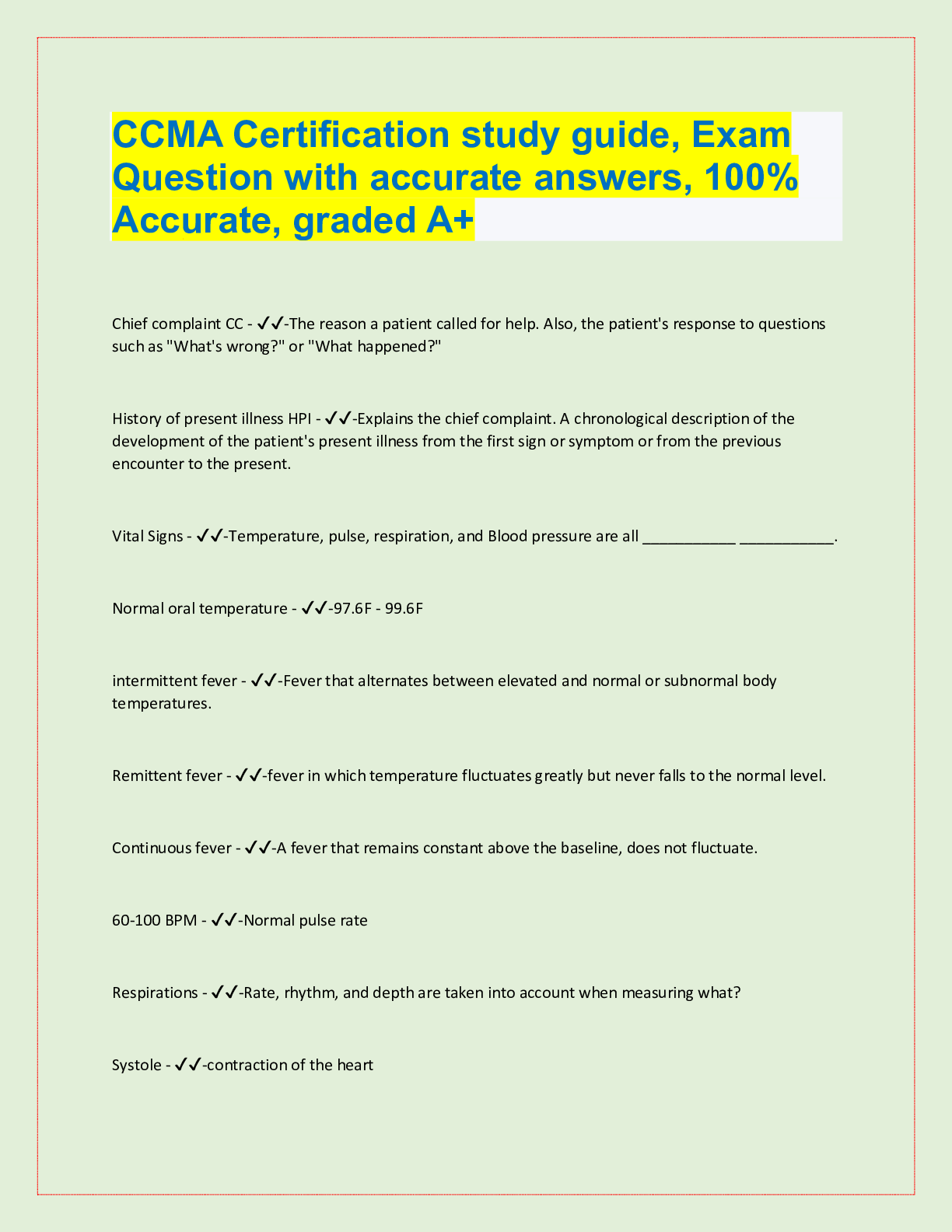
Chief complaint CC - ✔✔-The reason a patient called for help. Also, the patient's response to questions
such as "What's
...
CCMA Certification study guide, Exam
Question with accurate answers, 100%
Accurate, graded A+
Chief complaint CC - ✔✔-The reason a patient called for help. Also, the patient's response to questions
such as "What's wrong?" or "What happened?"
History of present illness HPI - ✔✔-Explains the chief complaint. A chronological description of the
development of the patient's present illness from the first sign or symptom or from the previous
encounter to the present.
Vital Signs - ✔✔-Temperature, pulse, respiration, and Blood pressure are all ___________ ___________.
Normal oral temperature - ✔✔-97.6F - 99.6F
intermittent fever - ✔✔-Fever that alternates between elevated and normal or subnormal body
temperatures.
Remittent fever - ✔✔-fever in which temperature fluctuates greatly but never falls to the normal level.
Continuous fever - ✔✔-A fever that remains constant above the baseline, does not fluctuate.
60-100 BPM - ✔✔-Normal pulse rate
Respirations - ✔✔-Rate, rhythm, and depth are taken into account when measuring what?
Systole - ✔✔-contraction of the heart
Diastole - ✔✔-relaxation of the heart
Anthropometric measurements - ✔✔-Measurement of height, (length rather than height is used in
infants because they cannot stand.), weight, BMI, head circumference in infants, waist to hip, % of body
fat.
Inspection - ✔✔-General appearance, state of nutrition, body habits, symmetry, pasture and gait,
speech.
palpation - ✔✔-to examine by touch
Percussion - ✔✔-physical examination method of tapping over the body to elicit vibrations and sounds
to estimate the size, border, or fluid content of a cavity such as the chest.
Ausculation - ✔✔-the act of listening to sounds arising within organs (as the lungs or heart) as an aid to
diagnosis and treatment.
OSHA - ✔✔-a government agency in the Department of Labor to maintain a safe and healthy work
environment
cardiopulmonary resuscitation - ✔✔-an emergency procedure for life support consisting of artificial
respiration and manual external cardiac compression
SHOCK - ✔✔-This is caused by inadequate blood flow to the heart and in turn to the rest of the body.
Symptoms of shock - ✔✔-Pale, cold, clammy skin
rapid, weak pulse
increased shallow breathing
expressionless face or staring eyes are all ____________ ___ _________.
First aid for Shock - ✔✔-maintain open airway for the victim, call for assistance, keep victim lying down
w/ head lower than rest of body; attempt to control bleeding or other cause of shock if known; keep
victim warm until help arrives
Portal of exit - ✔✔-Method in which a infectious agent leaves the reservoir. Ex: contact with body fluids
such as blood or saliva.
mode of transmission - ✔✔-contact, droplet, air, vehicles, or vectorborne
Portal of entry - ✔✔-A pathway by which the causative agent enters the host. The area in which a
microorganism enters the body. They may be cuts, lesions, injection sites, or natural body orifices.
Susceptible host - ✔✔-An individual who has little resistance to an infectious agent.
Disinfection - ✔✔-Process used to destroy microorganisms; destroys all pathogenic organisms except
spores, can only be used on inanimate objects. Will not be used for invasive procedures, and will not be
inserted into body orifices nor be used in sterile procedure.
Chemical sterilization - ✔✔-Uses the same chemical used for disinfection, but exposure time is longer.
Steam sterilization (Autoclave) - ✔✔-uses steam under pressure to obtain higher temperature (250-
254F) with exposure time of 20-40 minutes depending on item being sterilized.
hand washing - ✔✔-What is the most important means of preventing the spread of infection?
hand antisepsis - ✔✔-the removal & destruction of transient microorganisms using antimicrobial soaps.
PPE Personal protective equipment - ✔✔-mask, goggle, face shield, respirator
Intradermal Injection - ✔✔-ID; 15 degrees no aspiration; used for TB test, allergy test, and local
anesthetic
Intramuscular Injection - ✔✔-IM; 90 degress with aspiration
Subcutaneous Injection - ✔✔-SQ; 45 degress
pericardium - ✔✔-protective sac enclosing the heart composed of two layers with fluid between
Right atrium - ✔✔-The upper right chamber of the heart, where deoxygenated blood is received from
the vena cava and then sent to the right ventricle.
Right ventricle - ✔✔-the chamber on the right side of the heart that receives deoxygenated blood from
the right atrium and pumps it into the pulmonary trun
[Show More]