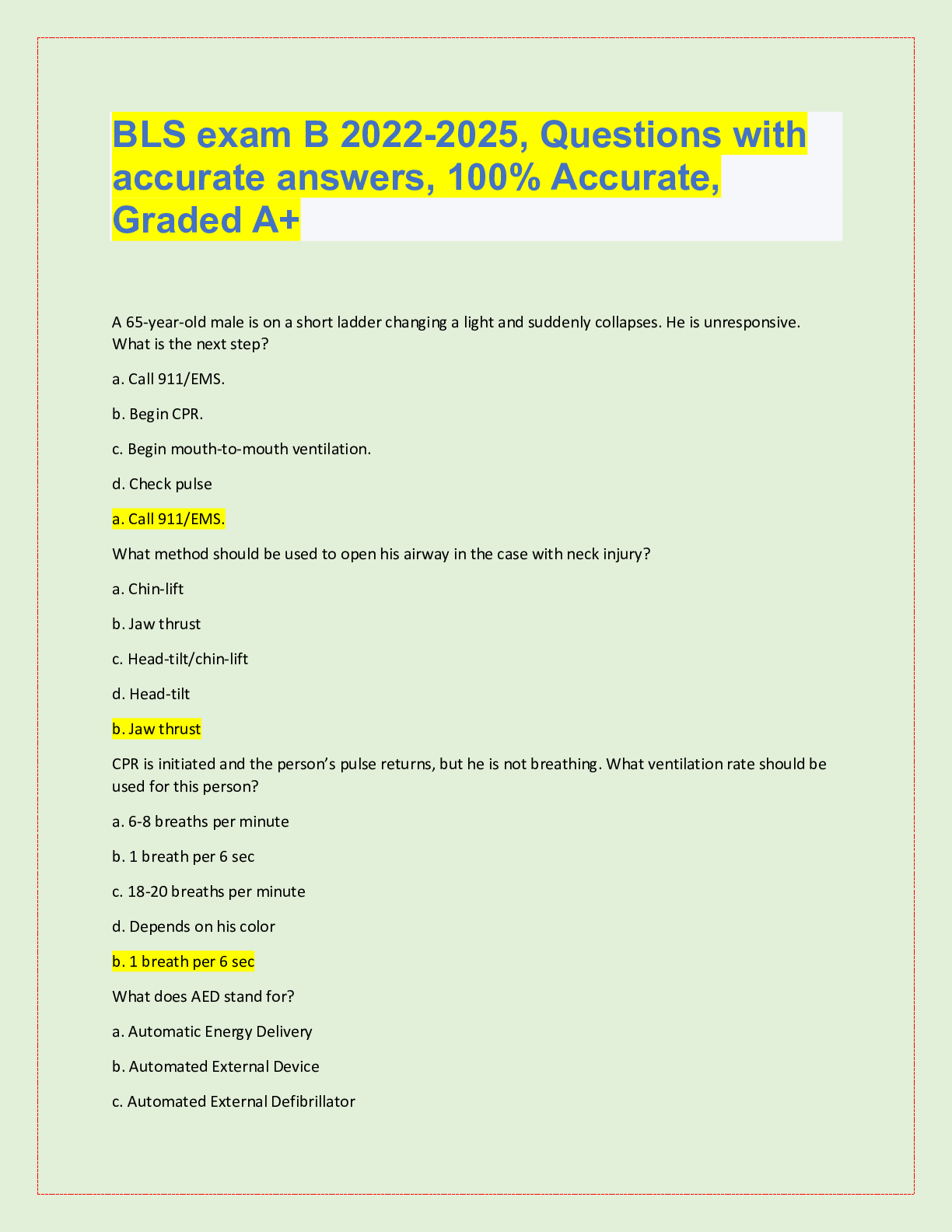
SERVSAFE Certification / Ohio Level 2.
Top Exam Question and answers, 100%
Accurate, graded A+
(Chapter 2) What are pathogens? - ✔✔-Microorganisms that can make you sick if you eat them/ by
producing toxins
Four
...
SERVSAFE Certification / Ohio Level 2.
Top Exam Question and answers, 100%
Accurate, graded A+
(Chapter 2) What are pathogens? - ✔✔-Microorganisms that can make you sick if you eat them/ by
producing toxins
Four types of pathogens that can contaminate food - ✔✔-Viruses
Bacteria
Parasites
Fungi
How does contamination occur? - ✔✔-Food handling (person to person, sneezing/vomiting onto food
contact surfaces)
Storing/cleaning incorrectly
Failure to spot signs of pests
Symptoms of a foodborne illness - ✔✔-Diarrhea
Vomiting
Fever
Nausea
Abdominal cramps
Jaundice (yellowing of eyes and skin)
Onset times depend on time of illness
"The Big Six" - ✔✔-Highly contagious, often found in feces, can cause severe illness
Shigella
Salmonella
Nontyphoidal Salmonella (NTS)
E-coli (STEC)
Hepatitis A
Norovirus
Bacteria characteristics - ✔✔-- Single celled living microorganisms
- Cannot be detected, found almost everywhere
- Some produce toxins
- Prevention measures are time and temperature
Conditions that bacteria need to grow (FATTOM) - ✔✔-Food
Acidity - little to no acid
Temperature - 41-135 degrees
Time
Oxygen
Moisture - water activity of 0.85+
Needs nutrients (carbs/proteins) to survive - mostly found in meat, poultry, dairy
What is a spore? - ✔✔-Bacteria can change into a spore to survive when they lack nutrients -
contaminate food in dirt, can resist heat and high temperature
Prevention measures - ✔✔-Controlling time and temp
Preventing cross contamination
Personal hygiene
Purchasing from reputable suppliers
Bacillus Cereus gastroenteritis - ✔✔-- Spore forming bacteria found in dirt
- Can produce two toxins
- Diarrhea - from veg, meat, milk
- Vomiting - from cooked rice dish
Salmonellosis - ✔✔-- Severity of symptoms depends on person's immune system and amount of
bacteria eaten (Salmonella is found in many farm animals)
- Poultry, eggs, milk, dairy
Shigellosis - ✔✔-- Found in easily contaminated food (e.g.: salads with TCS food like potato and shrimp)
and water
Staphylococcal gastroenteritis - ✔✔-- Found in humans
- Staph. aureus can produce toxins
- Found in salads with TCS food, deli meat
- Cooking doesn't kill these toxins
What is a virus? - ✔✔-Carried by humans and animals
Requires a living host to grow
Doesn't grow in food but transfers (usually through fecal oral routes or airborne vomit particles)
Temperature resistant
Hepatitis A - ✔✔-- Virus in feces
- Mostly found in RTE food
- Very infectious - may not show symptoms for a while
Norovirus gastroenteritis - ✔✔-- Found in RTE food and water
- Very contagious
- Only a small amount required to make someone sick
Parasite characteristics - ✔✔-Grows and reproduces in host
Associated with seafood, wild game, contaminated water/produce
Fungi characteristics - ✔✔-Pathogens - can make people sick, but mostly just spoils food
Found in air, dirt, plants, water, and some food
Example: mold, yeast
Mold characteristics - ✔✔-Spoil food, sometimes causes illness
Some produce toxins
Grows almost under any condition - prefer high acidity and low water activity
Prevention measure: throw out moldy food
Yeast characteristics - ✔✔-Can spoil food quickly (smell/taste of alcohol)
Grows well in low moisture and high acidity
Throw out any damaged food
Examples of biological toxins - ✔✔-Seafood, plant, and mushroom toxins
Characteristics of seafood toxins - ✔✔-can't be smelled or tasted
can't be destroyed once formed in food
1. Fish toxins - systemic toxins are a natural part of the fish (produced by puffer fish); other toxins are
made by pathogens on the fish
2. Shellfish toxins - shellfish can be contaminated if they eat algae with toxins
Scombroid/histamine poisoning - ✔✔-Fish toxin - tuna, mackerel
Can't be destroyed by temp or cooking
Prevent time temp abuse during storage and prep
Ciguatera fish poisoning - ✔✔-Fish toxin - ciguatoxin is found in algae, eaten by reef fish
Can't be detected by smell or taste
Not eliminated by cooking or freezing
Mushroom toxins characteristics - ✔✔-Amateur hunters eat toxic wild mushrooms
not destroyed by cooking and freezing
Only purchase from good suppliers
Plant toxins characteristics - ✔✔-Usually bc an operation purchases plants from an unapproved source,
but can also be caused by incorrect cooking
Example: eating toxic plants, honey harvested from toxic plants, undercooked kidney beans
(Chapter 3) When does physical contamination occur? - ✔✔-When foreign objects get into food (e.g.:
metal shavings, wood, fingernails, dirt) or when natural objects (e.g.: bones in fish) are left in food
What are symptoms of physical contamination? - ✔✔-Bleeding/pain (cuts, dental damage, choking)
How to prevent physical contamination - ✔✔-Reputable suppliers
Inspect the food you receive
When does chemical contamination occur? - ✔✔-When food is contaminated with food service
chemicals that have been used/stored the wrong way (e.g.: cleaners, polishes, health/beauty products);
when kitchenware and equipment aren't food grade
Symptoms of chemical contamination - ✔✔-Vomiting, diarrhea
How to prevent chemical contamination - ✔✔-Reputable suppliers
Store chemicals away from food and food contact surfaces
Use chemicals for intended use
Only use equipment approved for foodservice use
Keep MSDS current
Follow manufacturers' directions
Points of contamination risk (ALERT) - food defense program by the FDA - ✔✔-Assure - make sure
products are from safe sources
Look - monitor security
Employees - know who is in your facility
Reports - keep information related to food accessible
Threat - identify plan of action if there is a threat to your operation
What is a food allergen - ✔✔-A protein in a food/ingredient that some people are sensitive to
What is an allergic reaction - ✔✔-When enough of an allergen is eaten, the immune system considers it
harmful and attacks the food protein
Allergy symptoms - ✔✔-Nausea, shortness of breath, hives, swelling, vomiting/diarrhea, ab pain
Anaphylaxis (serious)
Big Eight food allergens - ✔✔-Accounts for 90% of all reactions in the US
1. Milk
2. Eggs
3. Fish
4. Crustacean shellfish
5. Wheat
6. Soy
7. Peanuts
8. Tree nuts
How service staff can prevent allergic reactions - ✔✔-Describing dishes
Identifying ingredients
Suggesting items
Identify the allergen special order
Delivering food
How kitchen staff can prevent allergic reactions - ✔✔-Prevent cross-contact (make sure allergens aren't
transferred from food containing an allergen to the food served to customer) --> this can happen from
cooking all food in the same fryer oil
Regulations with food labels - ✔✔-Manufactured products with one or more of big eight allergens must
clearly identify them on the ingredient label
How to avoid cross contact - ✔✔-Check recipes and ingredient labels
Wash, rinse, sanitize equipment
Make sure the allergen doesn't touch anything for customers with food allergies
Wash hands and change gloves before prep
Use separate fryers and oils for customers w allergies
Label food packaged onsite for retail sale
How can managers minimize risk of foodborne illnesses through personal hygiene - ✔✔-Establishing
specific personal hygiene policies
Training and retraining food handlers on these policies
Modeling correct behavior
Supervising food safety practices at all times
Revising policies according to changes in law
Food handlers can contaminate if they have any of the following... - ✔✔-A foodborne illness
Symptoms: diarrhea, vomiting, jaundice
Wounds that contain a pathogen
Sneezing/coughing
Unwashed hands after touching a contaminant
Define "carriers" - ✔✔-Someone who carries pathogens and infect others without getting sick
themselves (e.g.: staph is carried in the nose of 30-50% of adults)
Possible ways that food handlers can contaminate food - ✔✔-Not telling manager they're sick
Not washing hands after restroom
Running fingers through hair/wiping nose/rubbing ear/scratching scalp/touching pimple or wound
Laws protecting staff with diseases not transmitted through food - ✔✔-AIDS, hepatitis B and C, and
tuberculosis are not transmitted through food
ADA provides civil rights protection to those with HIV and hepatitis B
Employers should maintain confidentiality
Good personal hygiene program policies - ✔✔-Hygienic hand practices (most important)
Personal cleanliness - shower before work
Clean clothing, restraining hair, removing jewelry
Avoid certain habits/actions
Remove apron when leaving prep areas
Don't eat, drink, smoke, or chew when prepping or cleaning
Maintain good health
Cover wounds
Report health issues
Handwashing procedure - ✔✔-Wash hands in sick designated for handwashing (not for food prep,
dishwashing, or utility services)
1. wet hands and arms in water as hot as possible (at least 100 degrees)
2. apply soap and lather
3. Scrub for 10-15 seconds, clean under nails and between fingers
4. Rinse using running warm water
5. Dry hans and arms using a paper towel/dryer
When to wash hands - ✔✔-After restroom
Before and after handling raw meat, poultry, seafood
Touching body parts
Handling chemicals
Touching anything that may contaminate hands
What are hand antiseptics - ✔✔-Liquids/gels that help lower the number of pathogens on skin
Must comply with Code of Federal Regulations (CFR) and FDA - must use after handwashing and not in
place of it. After application, cannot touch anything until it has dried
Other hand care methods - ✔✔-Keep nails short and clean
Don't wear false nails
Don't wear nail polish
Cover infected wounds/cuts with pus with an impermeable cover (e.g.: bandage, finger cot)
Bare hand contact with RTE food - ✔✔-Do not do it, but there are times when it is acceptable:
1. When the food will be added to a dish without raw meat, seafood, or poultry; but will be cooked to at
least 145 degrees
2. Food will be added to a dish with raw meat, seafood, poultry and will be cooked to the minimum
required internal temperature of the raw items
When to use single-use gloves (barrier between hands and food) - ✔✔-When handling RTE food
NOT when washing produce or when handling RTE ingredients that will be cooked to the correct internal
temp
How to use gloves - ✔✔-Wash hands before putting on gloves
Choose correct siz
[Show More]




![Preview of eBook EPUB [PDF] Sport Nutrition 4th Edition By Asker Jeukendrup Michael Gleeson](https://browseimages.nyc3.digitaloceanspaces.com/paper-images/2025/Sep/11/v6N1YrFJ2025-09-11-03-2368c21672ca0d8.png)