WGU C175 - Chapter 2: Data Modeling,
Questions and answers, 100% Accurate,
rated A+
3 Vs (3 basic characteristics of Big Data databases) - ✔✔-Volume, velocity, and variety
Abstract Data Type (ADT) - ✔✔-Data type th
...
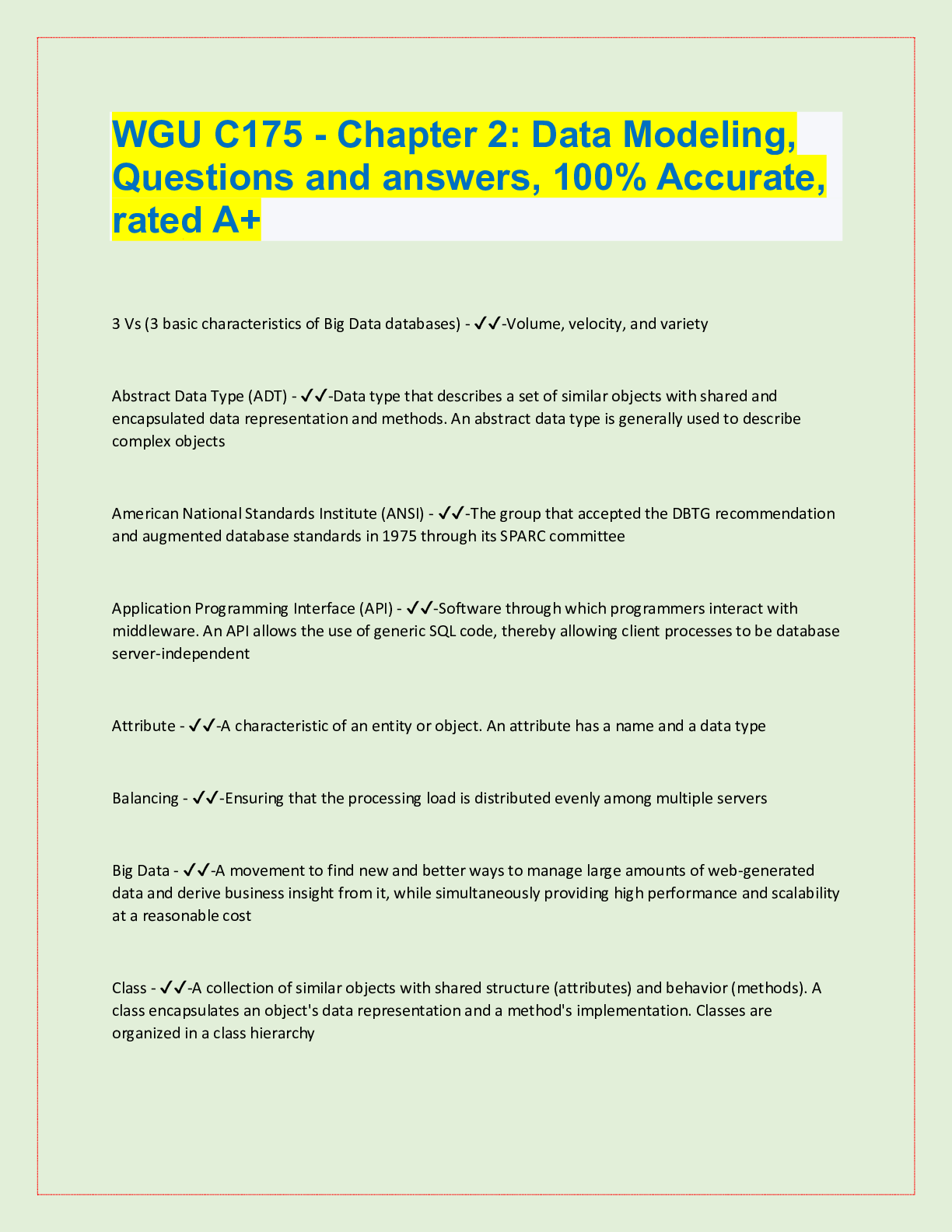
WGU C175 - Chapter 2: Data Modeling,
Questions and answers, 100% Accurate,
rated A+
3 Vs (3 basic characteristics of Big Data databases) - ✔✔-Volume, velocity, and variety
Abstract Data Type (ADT) - ✔✔-Data type that describes a set of similar objects with shared and
encapsulated data representation and methods. An abstract data type is generally used to describe
complex objects
American National Standards Institute (ANSI) - ✔✔-The group that accepted the DBTG recommendation
and augmented database standards in 1975 through its SPARC committee
Application Programming Interface (API) - ✔✔-Software through which programmers interact with
middleware. An API allows the use of generic SQL code, thereby allowing client processes to be database
server-independent
Attribute - ✔✔-A characteristic of an entity or object. An attribute has a name and a data type
Balancing - ✔✔-Ensuring that the processing load is distributed evenly among multiple servers
Big Data - ✔✔-A movement to find new and better ways to manage large amounts of web-generated
data and derive business insight from it, while simultaneously providing high performance and scalability
at a reasonable cost
Class - ✔✔-A collection of similar objects with shared structure (attributes) and behavior (methods). A
class encapsulates an object's data representation and a method's implementation. Classes are
organized in a class hierarchy
Class Diagram Notation - ✔✔-The set of symbols used in the creation of class diagrams in UML object
modeling
Class Diagrams - ✔✔-A diagram used to represent data and their relationships in UML object notation
Class Hierarchy - ✔✔-The organization of classes in a hierarchical tree in which each parent class is a
superclass and each child class is a subclass
Client - ✔✔-Any process that requests specific services from server services processes in a client/server
environment
Client Node - ✔✔-One of three types of nodes used in the Hadoop Distributed File System (HDFS). The
client node acts as the interface between user application and the HDFS.
Complex Object - ✔✔-An object formed by several different objects in complex relationships
Conceptual Model - ✔✔-The output of conceptual design process. Provides a global view of an entire
database and describes the main data objects, avoiding details
Conceptual Schema - ✔✔-A representation of the conceptual model, usually expressed graphically
Connectivity - ✔✔-The type of relationship between entities. one-to-one, one-to-many, many-to-many
Constraint - ✔✔-A restriction placed on data, usually expressed in the form of rules. Constraints are
important because they help to ensure data integrity
Crow's Foot Notation - ✔✔-A representation of the entity relationship diagram that uses a threepronged symbol to represent the many sides of the relationship
Data Definition Language (DDL) - ✔✔-The language that allows a database administrator to define the
database structure, schema, and subschema.
Data Manipulation Language (DML) - ✔✔-The set of commands that allows an end user to manipulate
the data in the database, such as SELECT, INSERT, UPDATE, DELETE, COMMIT, and ROLLBACK
Data Model - ✔✔-A representation, usually graphic, of a complex real-world data structure. Data models
are used in the database design phase of the Database Life Cycle
Data Modeling - ✔✔-The process of creating a specific data model for determined problem domain
Data Node - ✔✔-One of three types of nodes used in the Hadoop Distributed File System. The data node
stores fixed-size data blocks (that could be replicated to other data nodes
Entity - ✔✔-A person, place, thing, concept or event for which data can be stored
Entity Instance - ✔✔-A row in a relational table, also known as entity occurrence
Entity Relationship Diagram (ERD) - ✔✔-A diagram that depicts an entity relationship model's entities,
attributes, and relations
Entity Relationship Model - ✔✔-A data model that describes relationships (1:1, 1:M, N:M) among
entities at the conceptual level with the help of ER diagrams. Developed by Peter Chen
Entity Set - ✔✔-A collection of like entities
Eventual Consistency - ✔✔-A model for database consistency in which updates to the database will
propagate through the system so that all data copies will be consistent eventually
Extended Relational Data Model (ERDM) - ✔✔-A model that includes the object-oriented model's best
features in an inherently simpler relational database structured environment
Extensible Markup Language (XML) - ✔✔-A meta-language used to represent and manipulate data
elements. Unlike other markup languages, XML permits the manipulation of a document's data
elements. XML facilitates the exchange of structured documents such as orders and invoices over the
Internet
External Model - ✔✔-The application programmer's view of the data environment. Given its business
focus, an external model works with a data subset of the global database schema
External Schema - ✔✔-The specific represent
[Show More]