WGU Project Management C722, top
exam questions and answers, graded
A+. verified.
A Guide to Project Management Body of Knowledge (PMBOK Guide) - ✔✔-The project management
standard developed by the Project Managem
...
WGU Project Management C722, top
exam questions and answers, graded
A+. verified.
A Guide to Project Management Body of Knowledge (PMBOK Guide) - ✔✔-The project management
standard developed by the Project Management Institute.
Benefit measurement methods - ✔✔-A type of decision model that compares the benefits obtained
from a variety of new project requests by evaluating them using the same criteria and comparing the
results.
Co-located - ✔✔-When team members work together at the same physical location
Constrained optimization models - ✔✔-Decision models that use complex principles of statistics and
other mathematical concepts to assess a proposed project.
Cost-benefit analysis - ✔✔-A commonly used benefit measurement method that calculates the cost of
producing the product, service, or result of the project and compares this to the financial gain the
project is expected to generate.
Decision model - ✔✔-A formal method of project selection that helps managers make the best use of
limited budgets and human resources. Includes benefit measurement methods and constrained
optimization models.
Discounted cash flow (DCF) - ✔✔-Compares the value of the future cash flows of the project to today's
dollars.
Economic model - ✔✔-A type of benefit measurement method. It is a series of financial calculations that
provide data on the overall financials of the project and is generally used as a project selection
technique.
Expert judgment - ✔✔-A technique used in project selection, determining estimates, and determining
other related project information that relies on the knowledge of those with expertise on the requested
subject matter. Expert judgment can come from, stakeholders, other departments, consultants, team
members, vendors, or industry groups.
Feasibility study - ✔✔-Undertaken to determine whether the project is a viable project, the probability
of project success, and the viability of the product of the project
Functional organization - ✔✔-A form of organizational structure. Functional organizations are traditional
organizations with hierarchical reporting structures.
Internal rate of return (IRR) - ✔✔-The discount rate when the present value of the cash inflows equals
the original investment. Projects with higher IRR values are generally considered better than projects
with lower IRR values. Assumes that cash inflows are reinvested at the IRR value.
Matrix organization - ✔✔-An organizational structure where employees report to one functional
manager and at least on project manager. Functional managers assign employees to projects and carry
out administrative duties, while project managers assign tasks associated with the project to team
members and execute the project.
Net present value - ✔✔-Evaluation of the cash inflows using the discounted cash flow technique, which
is applied to each period the inflows are expected. NPV subtracts the initial project investment from the
total cash flow in today's dollars. It is similar to discounted cash flows.
Operations - ✔✔-Operations typically involve ongoing functions that support the production of goods or
services. They don't have a beginning or an end.
Payback period - ✔✔-The length of time it takes a company to recover the initial cost of producing the
product or service of the project.
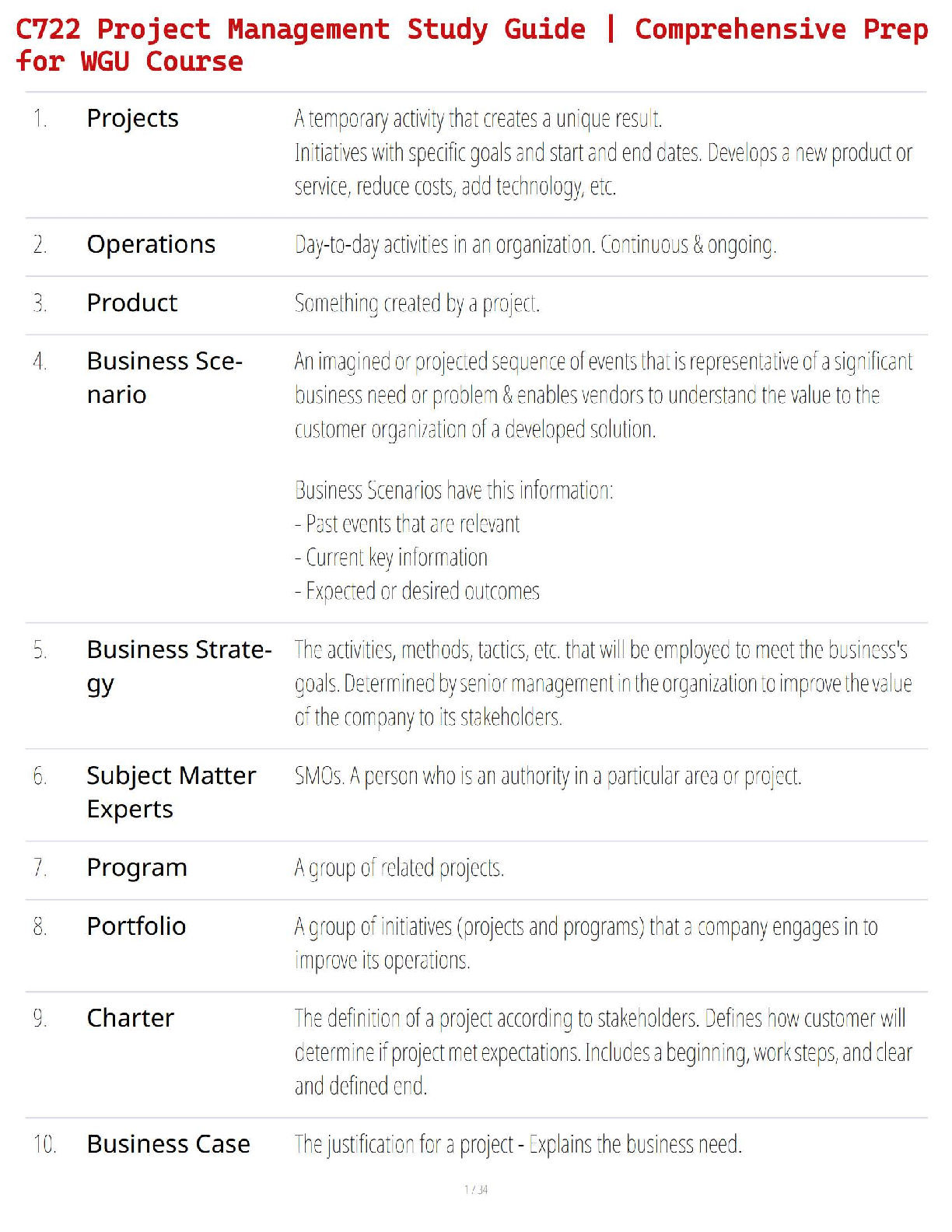
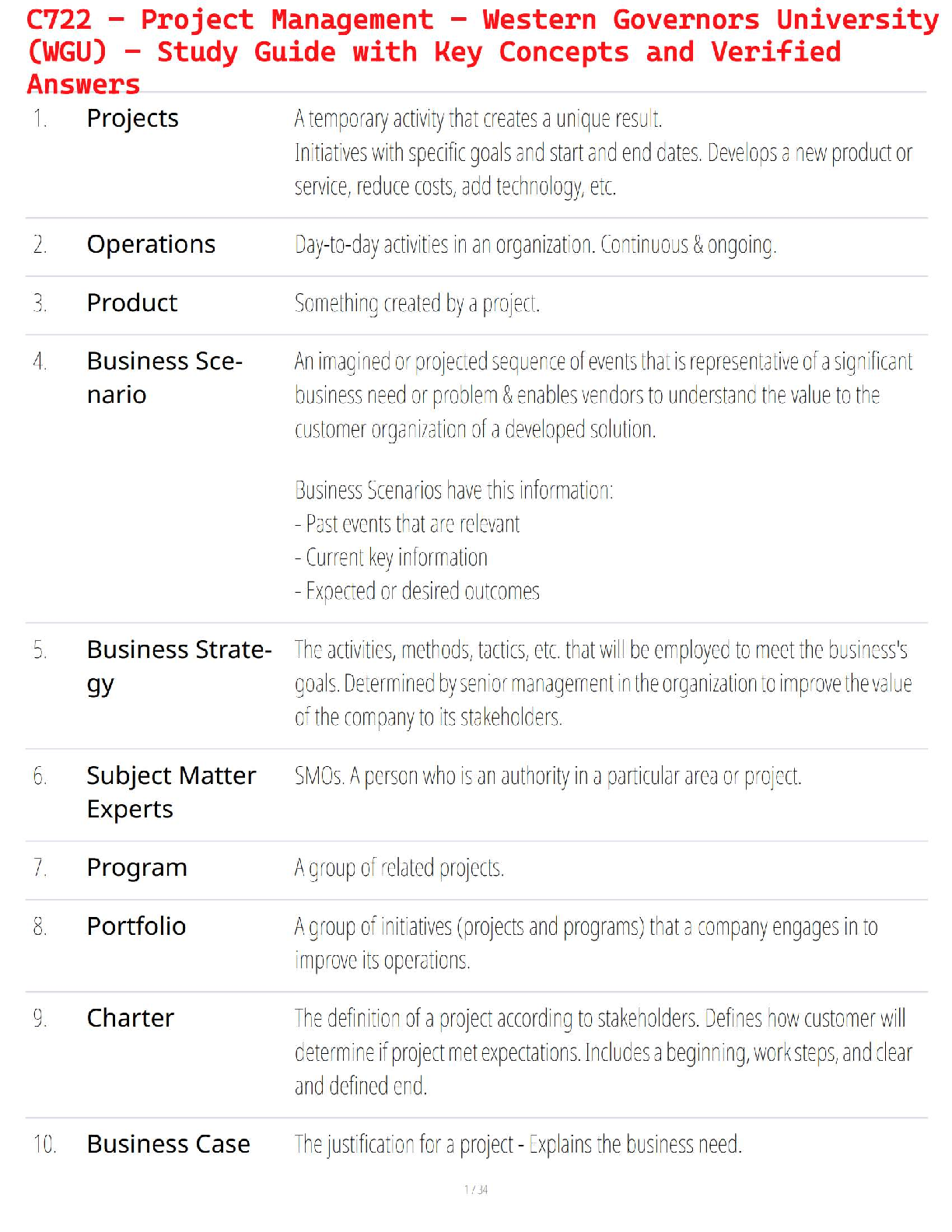
Program - ✔✔-A grouping of related projects that are managed together to capitalize on benefits that
couldn't be achieved if the projects were managed separately.
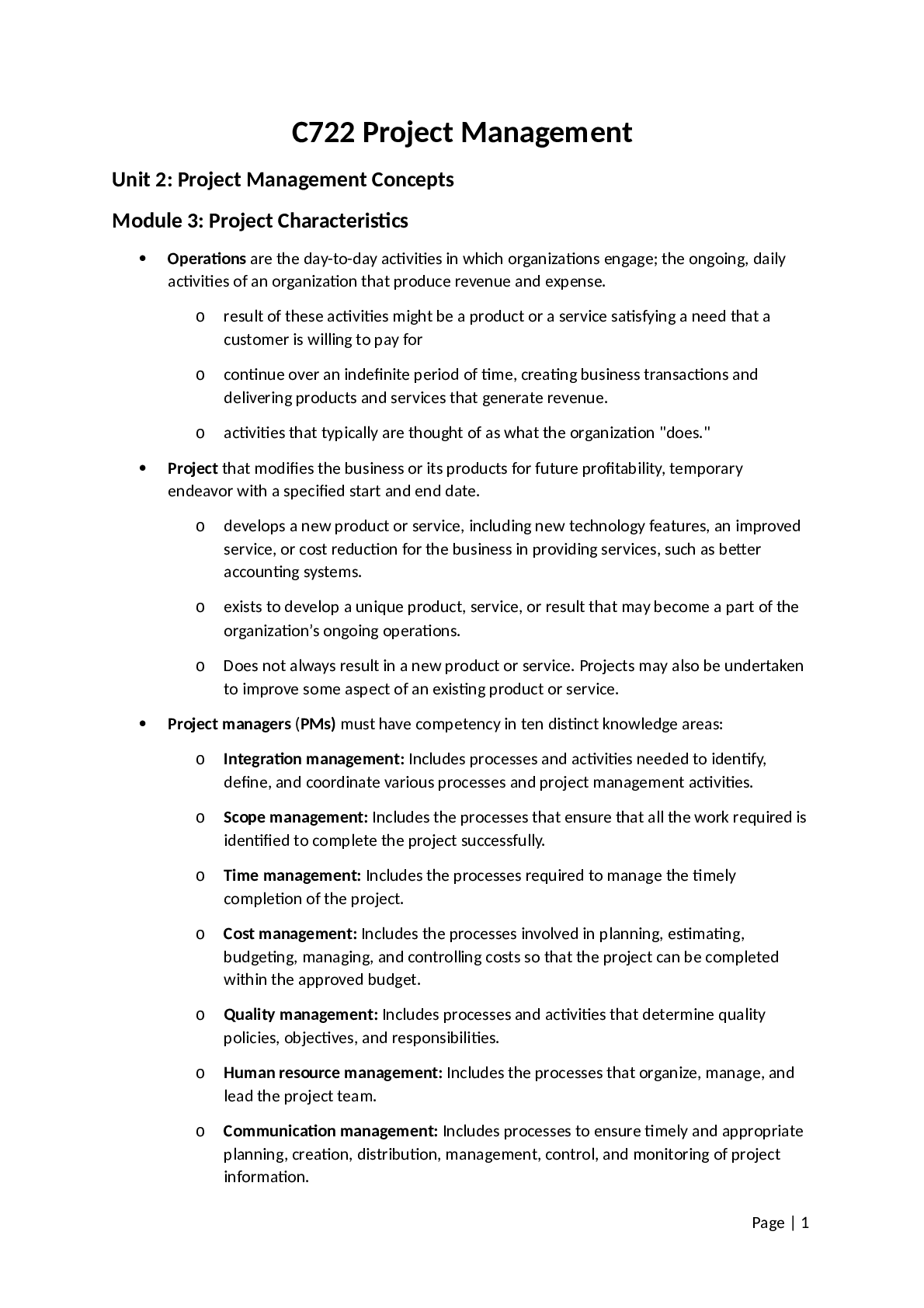
Project - ✔✔-Temporary in nature, with a definite start and end date; creates a unique product, service,
or result. It is completed when the goals and objectives of the project have been met and signed off on
by the stakeholders.
Project management - ✔✔-Applying skills, knowledge, and project management tools and techniques to
fulfill the project requirements.
Project Management Institute (PMI) - ✔✔-The world's leading professional project management
association.
Project management knowledge areas - ✔✔-The nine project management groupings, or Knowledge
Areas, that bring together common or related processes. They are Integration, Scope, Time, Cost,
Quality, Human Resource, Communications, Risk & Procurement.
Project management office (PMO) - ✔✔-Established by organizations to create and maintain procedures
and standards for project management methodologies to be used throughout the organization.
Project manager - ✔✔-The person responsible for applying the skills, knowledge, and project
management tools and techniques to the project activities to successfully complete the project
objectives.
Project performance indicators - ✔✔-Measures that the project manager uses to determine whether
the project is on track, such as any deviation from the baseline schedule or the baseline budget.
Project plan - ✔✔-A document, or assortment of documents, that constitutes what the project is, what
the project will deliver, and how all the processes will be managed. Used as the guideline throughout
the project Executing and Controlling phases to track and measure project performance and to make
future project decisions. Also used as a communication and information tool for stakeholders, team
members, and management.
Project selection - ✔✔-Used to determine which proposed projects are approved to move forward
Project-based organization - ✔✔-An organizational structure focused on projects. Project managers
generally have ultimate authority over the project, and sometimes supporting departments such as
human resources and accounting might report to the project manager. Project managers are responsible
for making project decisions and acquiring and assigning resources.
Scoring model - ✔✔-One of the benefit measurement methods used for project selection. It contains a
predefined list of criteria against which each project is ranked. Each criterion has a scoring range and a
weighting factor. A scoring model can also be used as a tool to select from among competing vendors.
Assumption - ✔✔-An event or action believed to be true for planning purposes. Project assumptions
should always be documented.
Business analyst - ✔✔-The person in charge of understanding the business unit's needs when assessing
a project request. The business analyst might be assigned directly from the business unit itself or may be
part of the IT organization.
Business case - ✔✔-Formally documents components of the project assessment, including a description
of the analysis method and the results.
Business process reengineering - ✔✔-Applying changes to an IT system and putting those elements into
place based on a project request and a business analyst's examination of the workflow--how people
handle their work relative to the request.
Business requirements - ✔✔-The requirements that describe how the business objectives of the project
will be met
Closing - ✔✔-A process that documents the final delivery and acceptance of the project and is where
hand-off occurs to the operational unit. Lessons learned are performed during this process, and project
team members are released.
Commercial off-the-shelf (COTS) - ✔✔-Describes a software application that is purchased from a re�seller, vendor, or manufacturer.
Customer - ✔✔-The recipient of the product or service created by the project. In some organizations
this stakeholder may also be referred to as the client
Enterprise project - ✔✔-A project that will be used by users throughout the enterprise.
Executing - ✔✔-This project process group is where the work of the project is performed.
Fast-tracking - ✔✔-A schedule compression technique where two activities that were previously
scheduled to start sequentially start at the same time. Fast-tracking reduces schedule duration.
Functional requirements - ✔✔-These define what the product of the project will do by focusing on how
the end user will interact with the product.
High-level requirements - ✔✔-These explain the major characteristics of the product and describe the
relationship between need and the product requested. This is also referred to as a product description.
Initiating - ✔✔-The first process in a project life cycle and the first of the five project process groups.
This is the formal acknowledgment that the project should begin. The primary result of this process is
the project charter.
Monitoring and Controlling - ✔✔-This project process group is where activities are performed to
monitor the progress of the project and determine whether there are variances from the project plan.
Corrective actions are taken during this process to get the project back on course.
Multiple business unit project - ✔✔-A project that is initiated by multiple units.
Planning - ✔✔-The process group where the project plans are developed that will be used throughout
the project to direct, monitor, and control weak results. The primary result of this process is the project
plan.
Project champion - ✔✔-The person who fully understands, believe in, and espouses the benefits of the
project to the organization. This is the cheerleader for the project.
Project charter - ✔✔-An official, written acknowledgment and recognition that a project exists. It's
signed by the project sponsor and gives the project manager authority to assign organizational resources
to the work of the project.
Project description - ✔✔-Documents the key characteristics of the project or service that will be created
by the project.
Project life cycle - ✔✔-The grouping of project phases in a sequential order from the beginning of the
project to the close.
Request for proposal (RFP) - ✔✔-A document that is sent out to potential vendors requesting them to
provide a proposal on a product or service.
Sponsor - ✔✔-An executive in the organization with authority to allocate funds, assign resources, and
enforce decisions regarding the project.
Stakeholder - ✔✔-A person or an organization that has something to gain or lose as a result of the
project. Most stakeholders have a vested interest in the outcomes of the project.
Statement of work (SOW) - ✔✔-Contains the details of a procurement item in clear, concise terms and
includes the project objectives, a description of the work of the project, and concise specifications of the
project or services required.
Technical requirements - ✔✔-Also known as nonfunctional requirements, the product characteristics
needed for the product to perform the functional requirements. Technical requirements typically refer
to information technology-related projects. They are typically the elements and functions that happen
behind the scenes of a program to meet the client's request.
Triple constraint - ✔✔-According to Comp TIA, time, cost, and quality. Other sources cite scope rather
than quality in their definitions of the triple constraints.
Acceptance criteria - ✔✔-The process and the criteria that will be used to determine whether the
deliverables are acceptable and satisfactory.
Critical success factor - ✔✔-Elements that must be completed in order for the project to be considered
complete. Critical success factors that are not satisfactory can lead to project failure.
Decomposition - ✔✔-The process of breaking project deliverables down into smaller, manageable
components of work so that work packages can be planned and estimated.
Key performance indicators (KPI's) - ✔✔-Help you determine whether the project is on track and
progressing as planned by monitoring the project against predetermined criteria.
Order of magnitude - ✔✔-A high-level estimate of the time and cost of a project based on the actual
cost and duration of a similar project.
Product description - ✔✔-Explains the major characteristics of the product and describes the
relationship between the business need and the product. This is also referred to as high-level
requirements.
Project justification - ✔✔-Documentation in the project charter that included the reason the project is
being undertaken and the business need the project will address.
Scope creep - ✔✔-The minor changes or small additions that are made to the project outside of a formal
scope change process that cause project scope to grow and change.
Scope definition - ✔✔-Per the PMBOK Guide, the process of breaking down the major deliverables from
the scope statement to create the WBS. For purposes of the Comp TIA objectives and exam, scope
definition is used in a much broader sense to cover several scope planning elements, including the scope
statement and the scope management plan.
Scope management plan - ✔✔-Defines the process for preparing the scope statement and the WBS. This
also documents the process that manages project scope and changes to project scope.
Scope planning - ✔✔-The process of defining the scope management plan, the scope statement, and the
WBS and WBS dictionary.
Scope statement - ✔✔-Documents the product description, key deliverables, success and acceptance
criteria, key performance indicators, exclusions, assumptions, and constraints. The scope statement is
used as a baseline for future project decisions.
Status date - ✔✔-The date when the project manager measures how much has been spent on a specific
task.
Work breakdown - ✔✔-
Work breakdown structure (WBS) dictionary - ✔✔-A document that describes the deliverables and their
components, the code of accounts identifier, estimates, resources, criteria for acceptance, and any
other information that helps clarify the deliverables.
Work breakdown structure (WBS) dictionary - ✔✔-A document that describes the deliverables and their
components, the code of accounts identifier, estimates, resources, criteria for acceptance, and any
other information that helps clarify the deliverables.
Work breakdown structure (WBS) dictionary - ✔✔-A document that describes the deliverables and their
components, the code of accounts identifier, estimates, resources, criteria for acceptance, and any
other information that helps clarify the deliverables.
Work breakdown structure (WBS) dictionary - ✔✔-A document that describes the deliverables and their
components, the code of accounts identifier, estimates, resources, criteria for acceptance, and any
other information that helps clarify the deliverables.
Work breakdown structure (WBS) dictionary - ✔✔-A document that describes the deliverables and their
components, the code of accounts identifier, estimates, resources, criteria for acceptance, and any
other information that helps clarify the deliverables.
Work breakdown structure (WBS) dictionary - ✔✔-A document that describes the deliverables and their
components, the code of accounts identifier, estimates, resources, criteria for acceptance, and any
other information that helps clarify the deliverables.
Work breakdown structure (WBS) dictionary - ✔✔-A document that describes the deliverables and their
components, the code of accounts identifier, estimates, resources, criteria for acceptance, and any
other information that helps clarify
Work breakdown structure (WBS) dictionary - ✔✔-A document that describes the deliverables and their
components, the code of accounts identifier, estimates, resources, criteria for acceptance, and any
other information that helps clarify the deliverables.
Work breakdown structure (WBS) dictionary - ✔✔-A document that describes the deliverables and their
components, the code of accounts identifier, estimates,
Work breakdown structure (WBS) dictionary - ✔✔-
Work breakdown structure (WBS) - ✔✔-A deliverable-oriented hierarchy that defines that defines the
total work of the project. Each level has more detailed information than the previous lever
Work breakdown structure (WBS) dictionary - ✔✔-A document that describes the deliverables and their
components, the code of accounts identifier, estimates, resources, criteria for acceptance, and any
other information that helps clarify the deliverables.
Activity definition - ✔✔-Indentifying the activities of the project that need to be performed to produce
the product or service of the project.
Activity duration - ✔✔-Assessing the number of work periods needed to complete he project activities.
Work periods are usually expressed in hours and days. Large projects might express duration in weeks or
months.
Activity list - ✔✔-A list of all the activities required to complete the work of the project that also
includes an identifier code and the WBS code it's associated with. Activities are broken down from the
work package level of the WBS.
Activity sequencing - ✔✔-Sequencing activities in logical order and determining whether dependencies
exist among the activitie
[Show More]