AMCA pct study guide exam Questions
and answers, 100% Accurate, rated A+
Ventral - ✔✔front part of body
Dorsal - ✔✔back part of body
Posterior - ✔✔toward the back part of body
Anterior - ✔✔in front of
Medial - ✔✔t
...
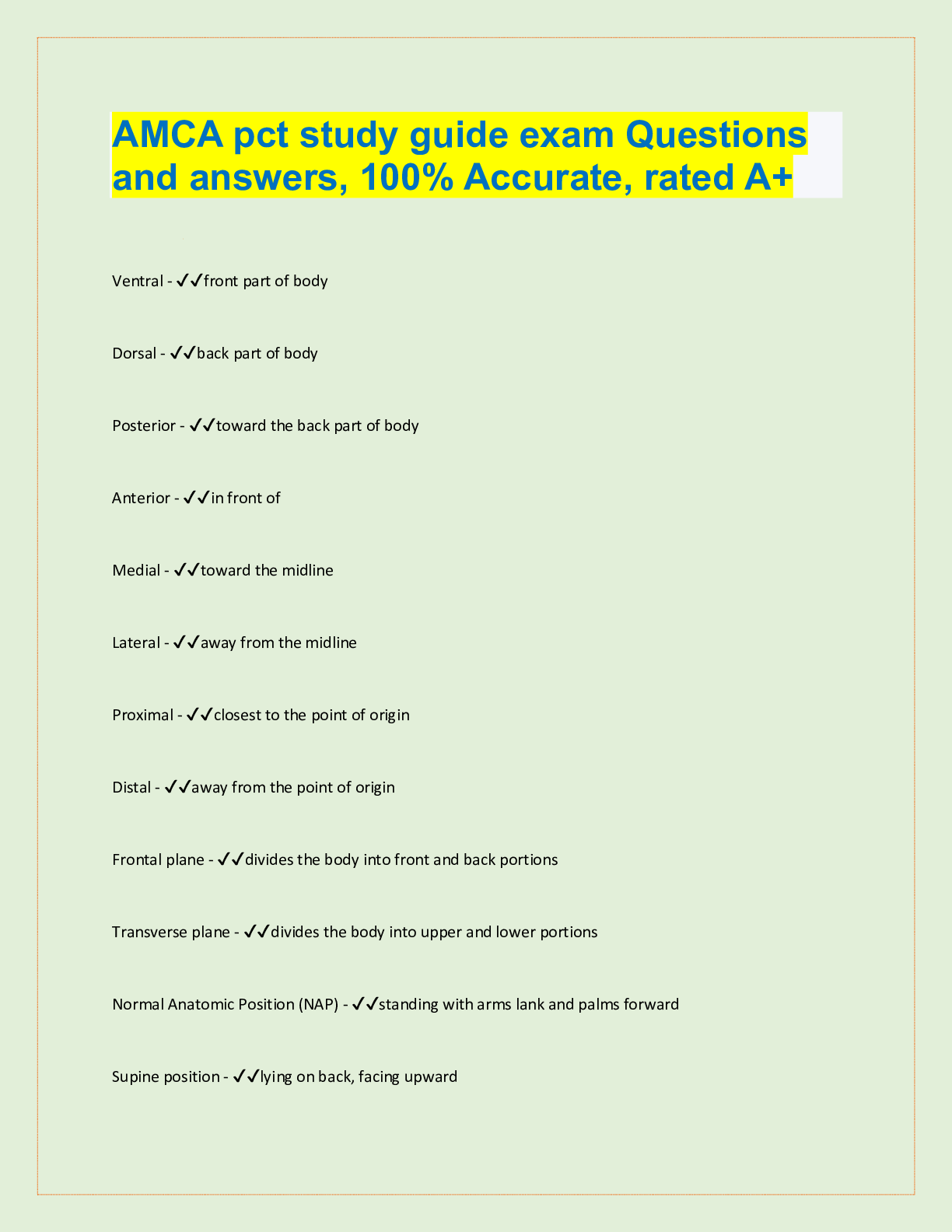
AMCA pct study guide exam Questions
and answers, 100% Accurate, rated A+
Ventral - ✔✔front part of body
Dorsal - ✔✔back part of body
Posterior - ✔✔toward the back part of body
Anterior - ✔✔in front of
Medial - ✔✔toward the midline
Lateral - ✔✔away from the midline
Proximal - ✔✔closest to the point of origin
Distal - ✔✔away from the point of origin
Frontal plane - ✔✔divides the body into front and back portions
Transverse plane - ✔✔divides the body into upper and lower portions
Normal Anatomic Position (NAP) - ✔✔standing with arms lank and palms forward
Supine position - ✔✔lying on back, facing upward
Prone position - ✔✔lying on abdomen, facing downward (head may be turned to one side)
Lateral recumbent position - ✔✔The patient is lying on their right or left side.
Cardi/o - ✔✔heart
carcin/o - ✔✔cancerous
cephal/o - ✔✔head
cerebr/0 - ✔✔cerebrum (largest part of the brain)
cyt/o - ✔✔cell
dent/i - ✔✔tooth, teeth
derm/o - ✔✔skin
electr/o - ✔✔electrical activity
enter/o - ✔✔intestines (usually the small intestine)
fet/o - ✔✔fetus
gastr/o - ✔✔stomach
hyster/o - ✔✔uterus, womb
rhin/o - ✔✔nose
sacr/o - ✔✔sacrum
thromb/o - ✔✔clotting
ur/o - ✔✔urine, urinary tract
-al - ✔✔pertaining to
-algia - ✔✔pain
-dynia - ✔✔pain
-ectomy - ✔✔excision, removal
-emia - ✔✔blood condition
-genic - ✔✔produced by
-globin - ✔✔protein
-gravida - ✔✔pregnant woman
-itis - ✔✔inflammation
-oma - ✔✔tumor, mass
-osis - ✔✔abnormal condition
-pathy - ✔✔disease condition
-sis - ✔✔state, condition
ante- - ✔✔before, in front of
anti- - ✔✔against, opposite
brady- - ✔✔abnormally slow
dia- - ✔✔through, across
end, endo- - ✔✔within, inside
epi- - ✔✔upon, above, over
hyoer- - ✔✔excessive, above normal
hypo- - ✔✔under, below
peri- - ✔✔surrounding, around
pre- - ✔✔before, in front of
sub- - ✔✔under, below
-graphy - ✔✔the process of producing a picture or record
-metry - ✔✔process of measuring
-scopy - ✔✔process of visually examining
-stomy - ✔✔surgical opening
-tomy - ✔✔process of cutting, incision
-tripsy - ✔✔surgical crushing
Digoxin (Digitalis) used to - ✔✔treat atrial fibrillation and congestive heart failure. It increases the force
of the heart's contractions and slows the heart rate. When a patient is taking digoxin they are instructed
to take their pulse regularly.
Nitroglycerin used for - ✔✔relief of ischemic chest pain in patients with coronary vascular disease and
angina.
Warfarin - ✔✔extremely useful in the treatment of blood clots.
Xylocaine (lidocaine) - ✔✔a local anesthetic as well as a first-line anti-arrhythmic used to treat
ventricular arrhythmia
ACE Inhibitors - ✔✔used in the treatment of patients with congestive heart failure. They work by
lowering the overall resistance in the vascular beds, making it easier for the heart to pump the blood.
Arteries carry blood ____ from the heart - ✔✔away from the heart
Veins carry blood ____ the heart - ✔✔to the heart
Diastole - ✔✔relaxation of the heart when the filling of the atria and ventricles occur
Systole - ✔✔contraction of the atria and ventricles and is when the blood that has filled the heart is
pumped to the pulmonary system and the systemic system
Cardiac Output (CO) - ✔✔person's heart rate x the stroke volume over 1 minute and is expressed in
liters per minute
cardiac cells unique property - ✔✔Conductivity, automaticity, excitibility, contractiility
Contractility - ✔✔ability to contact forcibly when stimulated
Automaticity - ✔✔The ability of the heart to generate and conduct electrical impulses on its own.
Conductivity - ✔✔A material's ability to allow heat or electric charges to flow.
Excitability - ✔✔ability to receive and respond to electric stimuli
Depolorization - ✔✔causes next axon to open, internal charge changes to positive and is same as
outside, change in charge produces action potential
Repolarization - ✔✔Return of the cell to resting state, caused by reentry of potassium into the cell while
sodium exits the cell.
Normal heart rate - ✔✔60-100 bpm
Regularity ECG - ✔✔measure the distance between all the R-R waves on the strip and if they are all the
same the rhythm is called regular if not the rhythm is called irregular
PR interval normal duration - ✔✔0.12-0.20 seconds
QRS complex normal duration - ✔✔0.06-0.10 seconds
Sinus Dysrhythmia (Arrhythmia) - ✔✔four dysrhythmias that are associated with the SA node:
Tachycardia, Bradycardia, sinus arrest (the total absence of the p-wave, QRScomplex, and T-wave), sinus
dysrhythmia(is the same as sinus rhythm except there is the presence of a patterned irregularity that
can be described as slowing the speeding up then slowing again) this will usually happen with the
inspiration and exhalation cycle(normal finding in chi
[Show More]