CPR Class Questions and Answers
Graded A+
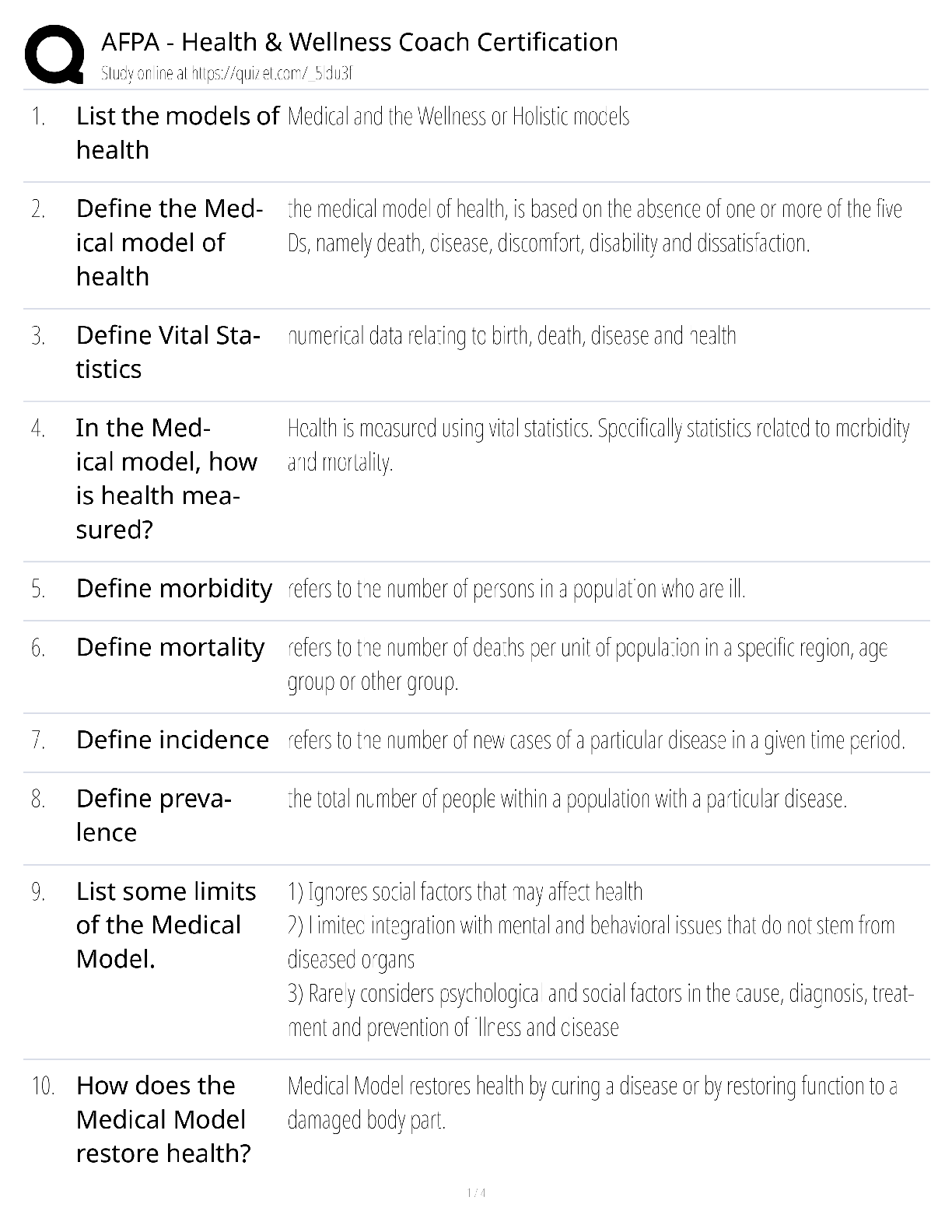
Chest Compressions ✔✔30 Chest Compressions:
Steps for performing CPR ✔✔Termed C-A-B:
A. Compressions
1. Rate of Compressions
2. Depth of the Compressions
3. Chest Recoil
...
CPR Class Questions and Answers
Graded A+
Chest Compressions ✔✔30 Chest Compressions:
Steps for performing CPR ✔✔Termed C-A-B:
A. Compressions
1. Rate of Compressions
2. Depth of the Compressions
3. Chest Recoil
B. Airway(open airway)
C. Breathing
Giving Breaths ✔✔2 rescue breaths
Check-Call-Care ✔✔Check:
1. Check how many people are involved in the incident
2. Look for clues directing you to the cause of the emergency
3. check if theres someone around to help
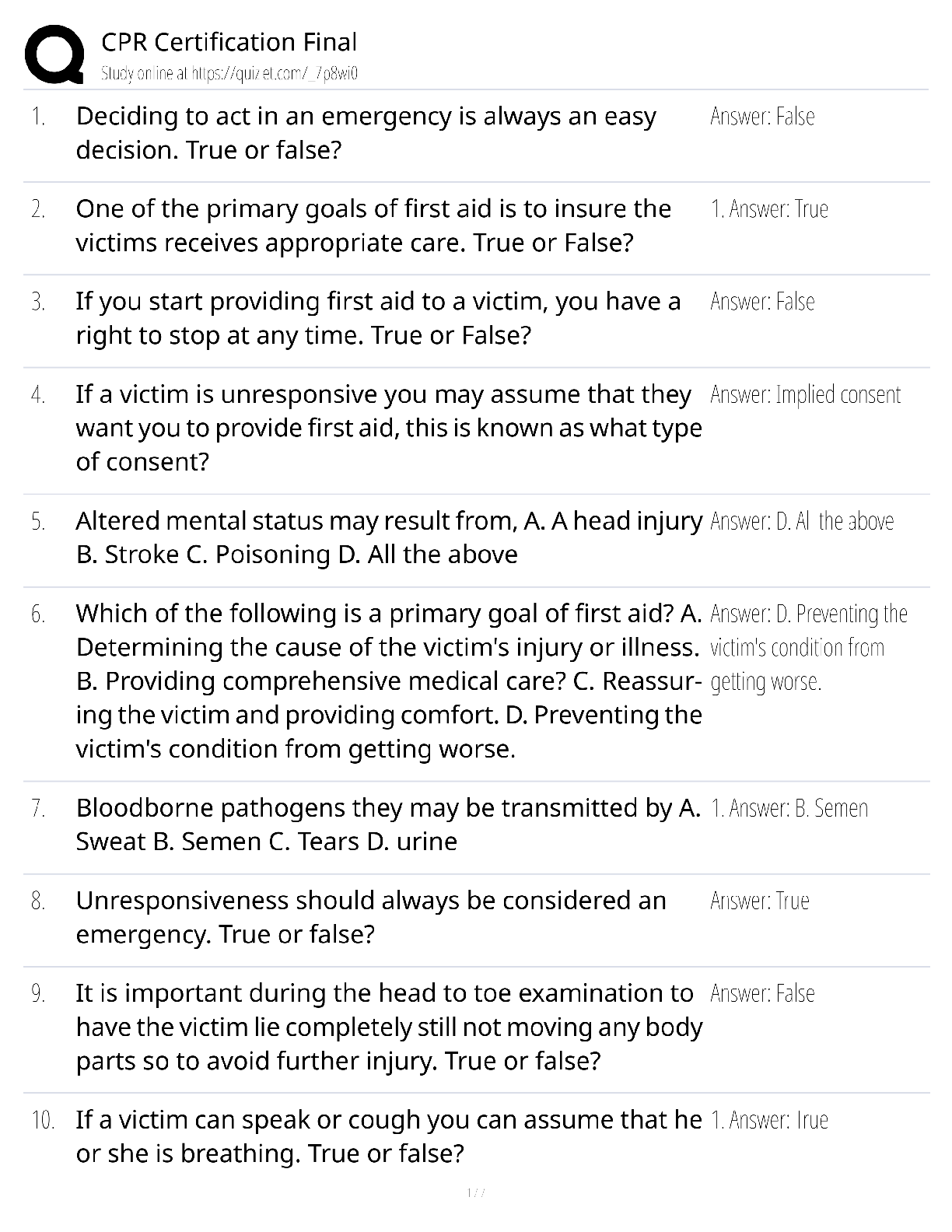
4. Check if the Person is okay by shaking them and asking "are you okay?"
Call:
1. If the person is unconscious call 9-1-1
Care:
1. Do not give care to conscious adult who refuses help
2. If victim is unconscious permission is implied
3. To get permission tell victim who you are, your training, what you plan to do, and what you
think is wrong
4. If victim is an infant get persmission from parents, or permission is implied.
CALL FOR HELP ✔✔it is one of the most important actions you can make.
Work to keep the victim alive ✔✔dont just abandon the person/ Check for medical tags on the
person
Remeber: ✔✔1. Verify victim is unresponsive by gently shaking the victim and asking "are you
okay?"
2. Call 9-1-1/ shout for help/ activate emergency response system if in hospital
3. Get an AED if available
4. begin CPR
Critical 4 Step (C-A-B) CPR sequence ✔✔1. compression
2. airway
3. Breathing
4. defibrillation
Compression ✔✔the reason for chest compressions is to keep the heart pumping blood through
the body
chest compressions ✔✔should go 2 inches deep at 100 compressions/min
perform 5 sets of compressions (30:2) until help arrives
Breaths ✔✔Give 2 breaths after every 30 compressions
Tilt the head back and lift the chin and hold the nose closed
Watch the rise and fall of the chest and use a barrier device
Give 1 breath every 5-6 secs
Check for a pulse ✔✔Check for pulse at the neck with 2-3 fingers this should last no 10 secs
Check for pulse every 2 mins
Child CPR ✔✔Requires less air for child so blow less, chest compressions still 2 inches deep, for
very small child may use one finger for compressions, for unresponsive child/infant first perform
5 cycles of cpr then call for help
Child CPR ✔✔1. Give breaths every 3-5 secs
2. check pulse every 2 mins
2 Rescuer technique on Child ✔✔Would change to 15 chest compression and 2 breaths (15:2)
with two rescuers
Infant CPR ✔✔Use 2-3 fingers only going 1.5 inches deep, Place mouth over nose and mouth of
infant, Pause between breaths just about 1 sec and just enough air to see the chest rise and fall,
check pulse no longer than 10 secs
AED (Automated External Defibrillator) ✔✔A. Increase survival rate 30-70%
B. DO NOT use a AED on a person who is in contact with water(move the victim out of water or
away from water)
C. may be used on a victim with an implant-device, however do not place pads over top of
device.
D. Do not touch victim while AED is in use
E. Place one pad on the upper right part of the chest and the other pad on the lower left side of
the chest
F. Make sure pads are not touching each other
G. Do not use child pads on 8yrs and older
H. Can use adult pads if necessary on 1-8yrs
Basic Operating steps for AED: ✔✔1. Turn on AED
2. Attach pads on bare chest
3. Stand CLEAR and let AED analyze victim
4. if AED advises to deliver shock stand CLEAR, then press the shock button
5. begin CPR
6. Keep listening to AED and more commands
Abdominal Thrust ✔✔Make a fist with one hand and place on victims abdomen just above the
navel, grab that fist with the other hand and press abdomen giving a quick upward thrust. If
victim is pregnant or too large do chest compressions instead.
Unconscious Chocking victims ✔✔Activate Emergency response team
Open victims airway and look for the object
if you see the object attempt to remove it with your fingers
begin cpr
every time you give breaths open it wide to look for object
continue giving CPR
Infant Choking victims ✔✔1. turn infant face down on forearm
2. hold neck with your palm
3. perform 5 back slaps with the heel of your hand, while supporting your arm with you thigh.
Infant Chest Thrust ✔✔1. If object is not ejected with back slaps then turn the infant face up on
your forearm
2. Hold infant with hands and forehands while supporting the head and neck, always make sure
head is lower than the chest.
3. use 2-3 fingers to locate the breastbone, once located perform chest thrust with 2-3 fingers
going 1.5 inches deep.
4. Perform 5 chest thrusts until object is removed.
5. continues giving thrusts and back slaps until object is removed, if you see the object in the
mouth remove it so infant can breath on his/her own
Recovery Position/Side-lying position ✔✔When person is lying in a face-up position:
1. bring victims arm further away from you and above his head
2. Place the victims other arm on the face/cheek with palm facing inside.
3. lift victims leg closest to you about 12 inches from the knee
4. While holding the head and neck roll the victim away from you.
5. After rolling the victim over check to make sure they are breathing
6. Remember the recovery position is for an unconscious victim who is breathing
A-B-C ✔✔keep Airway open
make sure person is Breathing
make sure there is Circulation
[Show More]
.png)
.png)