DOT EXAM Questions and answers.
Rated A+. 100% Accurate.
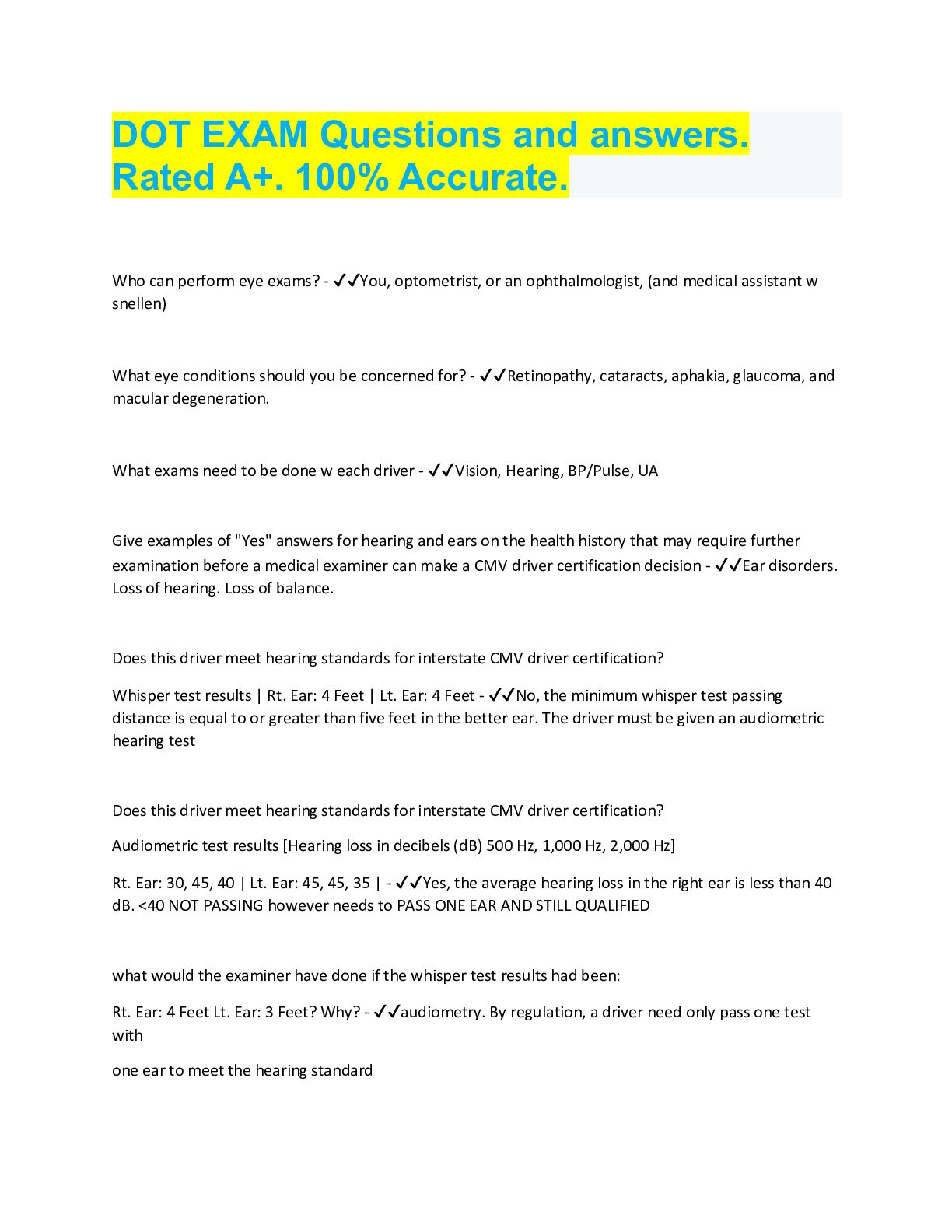
Who can perform eye exams? - ✔✔You, optometrist, or an ophthalmologist, (and medical assistant w
snellen)
What eye conditions should you be concerned for? -
...
DOT EXAM Questions and answers.
Rated A+. 100% Accurate.
Who can perform eye exams? - ✔✔You, optometrist, or an ophthalmologist, (and medical assistant w
snellen)
What eye conditions should you be concerned for? - ✔✔Retinopathy, cataracts, aphakia, glaucoma, and
macular degeneration.
What exams need to be done w each driver - ✔✔Vision, Hearing, BP/Pulse, UA
Give examples of "Yes" answers for hearing and ears on the health history that may require further
examination before a medical examiner can make a CMV driver certification decision - ✔✔Ear disorders.
Loss of hearing. Loss of balance.
Does this driver meet hearing standards for interstate CMV driver certification?
Whisper test results | Rt. Ear: 4 Feet | Lt. Ear: 4 Feet - ✔✔No, the minimum whisper test passing
distance is equal to or greater than five feet in the better ear. The driver must be given an audiometric
hearing test
Does this driver meet hearing standards for interstate CMV driver certification?
Audiometric test results [Hearing loss in decibels (dB) 500 Hz, 1,000 Hz, 2,000 Hz]
Rt. Ear: 30, 45, 40 | Lt. Ear: 45, 45, 35 | - ✔✔Yes, the average hearing loss in the right ear is less than 40
dB. <40 NOT PASSING however needs to PASS ONE EAR AND STILL QUALIFIED
what would the examiner have done if the whisper test results had been:
Rt. Ear: 4 Feet Lt. Ear: 3 Feet? Why? - ✔✔audiometry. By regulation, a driver need only pass one test
with
one ear to meet the hearing standard
What problems with the test environment exist with the forced whisper tests that do not exist
with audiometric tests? - ✔✔estimating instead of measuring the distances, performing the test in a
room with poor acoustics or subject to outside
noise or other distrac.ons
Can the driver have hearing loss <40 in one ear and still qualify? - ✔✔To meet certification standards,
the driver only needs to pass one
test in one ear
Can an interstate CMV driver who has had an acute myocardial infarction (AMI) be qualified to
drive? - ✔✔Yes, provided the AMI was at least two months prior to the date of the CMV driver physical
examination, the driver meets all the other recommended cardiac qualification criteria, and the
driver meets all meets all the other standards for interstate CMV drivers.
The driver provides the medical examiner with a copy of records, including a cardiologist's report
indicated a diagnosis of congestive heart failure and that the driver's ejection fraction is
38%. Can the driver be certified? - ✔✔no needs EF >40%
What criteria must be met in order for the FMCSA medical examiner to qualify a driver with a known
diagnosis of congestive heart failure (CHF)? - ✔✔The driver must Be asymptomatic, have no ventricular
arrhythmia s, have a left ventricular ejection fraction (LVEF) greater than 40%, be under the care of a
cardiologist
Qualifed? Driver with percutaneous coronary intervention (PCI) nine months ago; he or she has not
followed up with cardiologist and has not had exercise tolerance test (ETT) since procedure. -
✔✔Medically disqualified. According to current CVD recommendations, the driver who had PCI should
have cardiology follow-up to include ETT three to six month's post-PCI
Qualified? Coronary artery bypass graft (CABG) surgery four months ago; echo at three months showed
LVEF 55%; driver was cleared by cardiologist and has no chest pain. - ✔✔Medically qualified: According
to current CVD recommendations, the driver who had CABG surgery may be qualified at 3 months post�procedure if asymptomatic, LVEF greater than 40%
Qualifed? . Driver with CHF having dyspnea at rest - ✔✔Medically disqualified. According to current CVD
recommendations, a driver with CHF with symptoms is not medically fit for duty
Qualifed? Driver has recently had increasing angina which lasted 20 minutes after tapering a load; he or
she is unresponsive to nitroglycerin - ✔✔Medically disqualified. According to current CVD
recommendations, a driver with unstable angina is not medically fit for duty
A driver has an abdominal aortic aneurysm. The medical examiner obtains a copy of an abdominal
sonogram indicating that the aneurysm is 5.3 cm in diameter. According to current CVD
recommendations, should the medical examiner certify this individual? - ✔✔No. For a driver to be
certified, the abdominal aortic aneurysm should be less than 5 cm in
diameter
Before the examination begins, the driver gives the examiner a letter from his cardiovascular surgeon,
indicating that he had surgical repair of a 9 cm abdominal aortic aneurysm four months
previously, and the driver is now cleared to resume all activities. According to current CVD
recommendations, can the examiner certify this drive - ✔✔Yes. For up to one year. According to current
CVD recommendations, a driver with a successfully
repaired abdominal aortic aneurysm can return to driving three months postoperatively, if their
surgeons clears them to do so, but they must be rechecked every year
What signs and symptoms should medical examiners look for in drivers with a diagnosis of congestive
heart failure? Discuss how these symptoms affect the ability of the driver to safely operate a CMV? -
✔✔Fatigue, swelling in the legs, ankles, or other parts of the body, and shortness of breath, particularly
if at rest (dyspnea)
What is needed at visit s/p CABG to qualifiy - ✔✔It's been >3 months since surgery, note from
cardiologist, note that tolerating meds fine, pt has no symptoms, followed up w ECHO showing >40 EF%
When is ETT recommended yearly after CABG? - ✔✔After 5 years will need ETT annually d/t increased
risk of stent closure
Using current FMCSA guidelines, what is the maximum certification period for an interstate CMV driver
with Stage 1 hypertension - ✔✔1 year
. Using current FMCSA guidelines, what is the proper determination for an interstate CMV driver, with a
diagnosis of hypertension, who presents with a confirmed blood pressure of 182/112? - ✔✔Disqualifed
Using current FMCSA guidelines, what is the maximum period of certification for a driver disqualified for
Stage 3 hypertension, but who has, at the certification examination, a blood
pressure less than 140/90? - ✔✔Six month certification if the driver also tolerates medication with no
side effects that interfere
with driving ability.
A CMV driver with a diagnosis of hypertension presents with a BLOOD PRESSURE of 182/112.
This is Stage ____. - ✔✔stage 3
. What is the BLOOD PRESSURE range for Stage 1 hypertension? - ✔✔140/90 through 159/99 or 140-
159/90-99. (140-160/90-100)
What date is used to determine the one year expiration date of for a driver, with a one-time,
three month certificate, who achieves a BP less than or equal to 140/90 before the 3-month
certificate expires? - ✔✔if on no meds = 2 years cert. On meds = 1 year cert. One-year certification is
based on the date of the initial certification examination (the one with the high bp reading)
Pt with hx controlled HTN for years shows up late, sleep deprived, missed her meds for 2 days. BP over
140/90. PE unremarkable otherwise. Course of action? - ✔✔Cert for 3 months. Gives her a chance to fix
without losing her paycheck. Known hx of controlled BP, has reasons for it to be high today at exam, UA
is negative.
In Addition to pulmonary function tests, give examples of other signs or symptoms a medical examiner
uses to decide if a pulmonary/respiratory disease disqualifies a driver under FMCSA regulations. -
✔✔Bronchiectasis with hemoptysis or with episodes of life-threatening pulmonary infection. Chronic
pulmonary tuberculosis (TB).
§ Chronic obstructive pulmonary disease (COPD), with a cough severe enough to induce syncope.
§ Asthma that requires frequent hospitalizations or that shows severe enough pulmonary dysfunction to
put the driver at risk for loss of awareness
What conditions must a driver with acute or chronic cor pulmonale meet to be certified to operate an
interstate CMV? - ✔✔To be qualified, the driver should meet a minimum arterial blood gas (PaO2)
greater than 65 mm Hg. Drivers with acute (reversible) cor pulmonale may be certified after successful
treatment, when they can meet the above criteria for qualification.
Treated or untreated patients with pulmonary hypertension or cor pulmonale who exhibit dyspnea at
rest, dizziness, or hypotension (may be a side effect of medication) should not be
qualified to drive.
A driver states that she has exercise- induced asthma well controlled by using an albuterol
(Proventil, Ventolin) inhaler before she does any aerobic activity. Her pulmonary function (forced
expiratory volume in the first second of expiration (FEV1)) must be greater than _____ % of predicted
FEV1 to qualify. - ✔✔Greater than 65% FEV1 of predicted
A driver takes diphenhydramine (Benadryl), 25 mg, two or three times per day, to treat nasal
congestion. Discuss what, if any, concerns this causes, and what a medical examiner might do in
this example. - ✔✔drivers should abstain from using any form of an.histamines,
with known sedative side effects and narcotic-based antiussives, for the 12 hours prior to driving.
The examiner notices that the driver has marked that he has asthma and lists an albuterol [Proventil,
Ventolin] inhaler among his medication. On questioning, the driver admits to using it several times a
day, especially during the spring and fall; he admits that he has not seen his primary care physician in
several years but is still getting frequent refills on his inhaler. The driver also admits that he has been
hospitalized twice in the last six months for his asthma,
ending up on a ventilator on the last visit.
Should the medical examiner certify the driver, if so, for how long? - ✔✔Do not certify. The history
clearly suggests that the asthma that the driver has requires frequent hospitalizations and has the
potential for respiratory dysfunction that could impair the ability to operate a CMV safely. Appropriate
advice to the driver includes recommending that the driver see his primary care physician or a
pulmonologist who may be able to provide treatment to effectively control the asthma, such that the
driver meets respiratory qualification requirements.
A driver presents for examination with a history (last month) of a pneumothorax. The records provided
by the driver indicate that the pneumothorax reduced the driver's forced vital capacity (FVC) to 58% of
predicted forced vital capacity. Can this driver be certified? If not, when can the driver be certified? -
✔✔Do not certify. According to recommendations, this driver should not be certified until the medical
examiner has verified that the recovery is complete, with x-rays, and the driver has a FVC greater than
65%.
A driver presents for examination with a history (three months ago) of a pneumothorax. The records
provided by the driver indicate that this is the second spontaneous pneumothorax on the same side. The
driver's forced vital capacity (FVC) to 68% of predicted forced vital capacity is with no surgical
intervention. Can this driver be certified? If not, when can the driver be certified? - ✔✔Do not certify.
According to recommendations, this driver should not be considered medically qualified if no surgical
procedure has been done to prevent recurrence.
What three tests does medical guidance recommend for initial pulmonary function testings? -
✔✔Disqualify - pending pulmonary function testings.
Physiological impairment is potentially present in many lung disorders. Therefore, simple
pulmonary function testing should be performed for CMV drivers who have any of the following
indicators:
• A history of any specific lung disease.
• Symptoms of shortness of breath, cough, chest .tightness, or wheezing.
• Cigarette smoking in applicants aged 35 or older
PFT results: FEV1 64% of predicted, FEV1/FVC ra3o 66%. According to medical guidance, what
do Mr. Johnson's PFT test results indicate doing next? - ✔✔Forced expiratory volume in 1 second (FEV),
Forced vital capacity (FVC).,FEV/FVC ra.o
The medical examiner obtains the following information: Pulse oximetry O2 saturation - 90%;
arterial blood gas (ABG) - PaO2 [60 mm Hg], PaCO2 [42 mm Hg]. What do Mr. Johnson's test results
indicate? - ✔✔Medical guidance says that additional testings is indicated if the FEV1 is less than 65% of
the predicted value, and if the FEV1/FVC ratio is less than 65%. These individuals should have oximetry
or an arterial blood gas analysis.
Mr. Johnson's results are borderline, with FEV just below and FEV/FVC just above. FMCSA also
encourages erring on the side of public safety. Additional pulmonary testing is a reasonable course of
action.
Would the medical examiner's determination be affected by the information that Mr. Johnson had been
long-haul driving in the mountains of the West for the three immediate weeks prior to having the ABG? -
✔✔The pulse oximetry O2 saturation was less than 92% which indicated obtaining an ABG. His
PaCO2 of 42 mm Hg meets recommended standards. His PaO2 of 60 mm Hg meets
recommended standards when the altitude is over 5,000 feet but not at altitudes less than 5,000
feet. The tests were run at altitudes less than 5,000 feet. He should be disqualified.
Driver observed to huff and puff walking to exam room. Driver says he has no symptoms. Pulse OX 87%
what is your decision. - ✔✔Disqualify until pulmonary function testing/other tests
Examples of reasons to disqualify due to sequelae of Cor Pulmonale - ✔✔PaCO2 greater than 45 mmHg.
• Diagnosis of pulmonary hypertension, with or without cor pulmonale, accompanied
by symptoms of dyspnea, dizziness, or hypotension.
• Paroxysms of cough leading to cough syncope.
Pt with sleep apnea brings in recorder that shows consistent use of his CPAP, wakes refreshed, but
hasn't seen his PCP in 2 years. What is your cert decision? Had annual objective sleep apnea test. -
✔✔cert for 1 year with recommendation to fu w PCP. Needs annual sleep test to be certified.
According to regulation, for what neurological condition is medically disqualifying for the interstate CMV
driver certification? - ✔✔Epilepsy
According to medical guidance, episodic neurological conditions that are disqualifying include what? -
✔✔• Extreme headaches—such as migraine, cluster headache, and neuralgia—that could
affect the ability to remain cognizant of driving conditions and tasks.
• Vertigo.
• Diagnosed epilepsy treated with anticonvulsant medication.
• Narcolepsy.
• Sleep apnea, untreated.
• Idiopathic Central Nervous System Hypersomnolence and Primary Alveolar
Hyperventilation Syndrome.
• Restless legs associated with disorder of excessive somnolence (RLS-DOES) syndrome
which of the following diagnosed neurological conditions is
the driver considered medically unqualified for driving?
Febrile seizure.
Dementia (severe).
Dementia (metabolic).
Transient ischemic attacks (within one year).
Transient ischemic attacks (greater than one year ago) - ✔✔the driver with a diagnosis of dementia
(severe) or transient
ischemic attacks (under one year) should not be certified.
A driver is taking levodopa/carbidopa (Sinemet). Levodopa/carbidopa may cause the driver to be
disqualified because it is used for the treatment of what? - ✔✔Parkinsons
For transient ischemic attacks (TIA):
Describe "no functional residual."
Discuss future risk associated with TIA.
Discuss recommended criteria for interstate commercial motor vehicle (CMV) driver certification. -
✔✔Lack of impairment.
high rate of recurrence during the first year. A TIA is an
important warning sign of a potentially severe stroke. The risk is high, whether the
patient has had one or several attacks. One year after the TIA, the risk of recurrent
cerebrovascular symptoms has declined to less than 5% per year.
There would be an automatic one-year CMV driving disqualification. After one year, the
certification would depend on the interval history, general health, neurological
examination, and compliance with the treatment program.
Ms. Miller's left arm has mild symptoms and is weaker than the right. At what level of left arm
strength would the medical examiner certify Ms. Miller, using the provisions of alternate standard
49 CFR 391.49, which would require Ms. Miller to obtain a Skill Performance Evaluation (SPE)
certificate? - ✔✔The medical examiner should not use the provisions of alternate standard 49 CFR
391.49
because multiple sclerosis is a progressive disease process, not a fixed deficit. The SPE certificate
is only for individual fixed deficits (e.g., missing limb).
Give examples of signs and symptoms resulting from the multiple sclerosis disease process that,
at future driver physical examinations, would cause the medical examiner to disqualify Ms. Miller. -
✔✔• Ms. Miller shows signs of progression that interfere with her ability to operate a CMV
safely.
• Ms. Miller's neurologist identifies functionally significant neurologic signs and
symptoms.
• She has an abnormal MRI and triple-evoked potential studies revealing new lesions,
compared to prior evaluation made at least one year apart.
• She has a history of excessive fatigue or periodic fluctuation in motor performance,
especially in relation to heat, physical and emotional stress, and infections.
Pt with hemorrhagic stroke 2nd to AVM. Has not had surgical repair. Still in PT/OT. Once Mr. Nelson
completes his occupational and physical therapy, will he be a candidate for
alternative standard 49 CFR 391.49? What documentation would the therapist provide to
indicate he is capable of performing the tasks of a CMV driver? - ✔✔No. The cognitive impairments and
unrepaired AVM are both disqualifying regardless of
compensatory measures for the hemiplegia. While documentation from the therapist would be
useful to the medical examiner determining driver medical fitness for duty, the therapist does
not determine if the driver is capable of performing the tasks of the CMV driver. The medical examiner
makes that determination.
According to 49 CFR 391.41, is a commercial motor vehicle (CMV) driver with the loss of a leg,
foot, hand, or arm qualified to operate a CMV? - ✔✔Yes, if the driver meets all other standards except
for a fixed deficit of the lost extremity, and
the driver has been granted a Skill Performance Evaluation (SPE) certificate pursuant to 49 CFR
391.49
According to regulation, only ________ can grant drivers a SPE certificate - ✔✔Only FMCSA can grant
drivers a SPE certificat
[Show More]