PHR Certification Exam Prep Questions
and answers, 100% Accurate, rated A+
A manager approves a training course on the condition that it includes some way of ensuring that the
training reinforces critical learning o
...
PHR Certification Exam Prep Questions
and answers, 100% Accurate, rated A+
A manager approves a training course on the condition that it includes some way of ensuring that the
training reinforces critical learning objectives. Which strategy should an HR manager employ to best
meet the manager's needs?
>Conducting a pilot program for a limited group
>Revising content to meet the manager's demands
>Researching similar programs in other companies
>Surveying all participants before and after each class - ✔✔-Conducting a pilot program for a limited
group
A pilot allows for a test run of the program with selected members of the target audience in a controlled
environment. Participants and other key stakeholders have the opportunity to evaluate the program's
effectiveness and identify specific changes that will strengthen the program. After the pilot, the program
is revised and released for mass delivery.
An exit interview assessment finds that the primary reason employees leave is for better total rewards
offered at other organizations. Which is the best action HR should take to gather information on
competitive total rewards packages to potentially offer its employees?
>Participate in an external remuneration survey to assess the competitiveness of the organization's
current offerings.
>Send an internally developed survey to local competitors asking what total rewards they offer.
>Conduct a focus group session for management input on the effectiveness of total rewards.
>Survey employees to identify what total rewards the company should offer to them. - ✔✔-Participate
in an external remuneration survey to assess the competitiveness of the organization's current offerings.
Using an external remuneration survey to collect information draws on extensive databases of
incumbents and industry benchmarks. These benchmarks can be used to assess competitiveness.
What is the ultimate function of executive management?
>To be responsible for all core business functions and their effect on the organization's performance
>To implement strategy through planning and directing initiatives at all levels in each function
>To serve as the primary interface with the organization's stakeholders, from investors and regulators to
customers and communities
>To lead the organization through a shared vision and the values they model in all interactions - ✔✔-To
be responsible for all core business functions and their effect on the organization's performance
Executive management is primarily responsible for using the organization's resources to improve its
value. This means creating strategies that align with external and internal environments and working
with each business function to maximize a return on resources allocated to that function. Core business
functions create and implement their own strategies in alignment with the organization's strategy.
Executive management may be the primary interface with investors, but the administrative functions,
such as public relations and government relations, interface with those groups. Leading a vision is critical
to achieving a strategy and is in that sense a secondary responsibility of executive management.
What legal principle is followed by national policies requiring affirmative action to prevent
discrimination?
>Reservation
>Equal opportunity
>Workforce nationalization
>Positive action - ✔✔-Reservation
The principle of reservation, where laws mandate a percentage quota or other special considerations for
specified minority groups or ethnic communities, is often based on the concept that historic national
discrimination against a given minority requires counterbalancing favorable affirmative action.
Which activity best illustrates HR's strategic role in managing organizational risk?
>HR conducts a workshop with other functions to identify potential upside and downside risks under the
workforce management plan.
>HR interfaces with the organization's insurer to determine what level of insurance is required
throughout the organization.
>HR analyzes past accident reports to detect common patterns and design appropriate supervisor and
employee training.
>HR conducts regular health and safety reviews and administers documentation required by regulatory
agencies. - ✔✔-HR conducts a workshop with other functions to identify potential upside and downside
risks under the workforce management plan.
HR's strategic role recognizes the potential for upside (opportunity) and downside (threat) aspects of
risk and approaches the task of identifying and planning for threats and opportunities in an enterprise
manner, involving internal HR customers. Focusing on past health and safety issues is reactive and
narrow in focus. HR cannot speak alone for the best way to manage risk in the organization.
How has the sustainability movement changed organizations' relations with their stakeholders?
> A broader range of stakeholders is now considered, allowing for a more active role in shaping policies
and goals. - ✔✔-Sustainability has expanded both who the significant stakeholders are and how the
organization interacts with them. Instead of just those with a direct financial stake in the organization,
stakeholders now also include those affecting or affected by an organization's social and environmental
value. Sustainability also expands the ways in which the organization interacts with its stakeholders,
who now play a more active role in helping it define and implement everything from individual projects
to larger corporate social responsibility strategy and goals.
Which court case established the criteria for disparate impact?
What did each of the other court cases establish?
>National Federation of Independent Business v. Sebelius
>Phillips v. Martin Marietta Corp.
>Griggs v. Duke Power
>Ledbetter v. Goodyear Tire and Rubber Company - ✔✔-Griggs v. Duke Power recognized disparate
impact and established that it is not necessarily enough to show a lack of discriminatory intent.
Phillips v. Martin Marietta Corp. applied the sex discrimination provisions of Title VII to employment
decisions.
Ledbetter v. Goodyear Tire and Rubber Company involved sex discrimination in pay under Title VII.
National Federation of Independent Business v. Sebelius considered two key PPACA (Patient Protection
and Affordable Care Act) provisions.
National Federation of Independent Business v. Sebelius:
>U.S. Supreme Court ruling that Patient Protection and Affordable Care Act requirement that individuals
purchase health insurance was constitutional but requirement that states expand Medicaid was not.
Nominal group technique (NGT) - ✔✔-Technique in which participants each suggest ideas through a
series of rounds and then discuss the items, eliminate redundancies and irrelevancies, and agree on the
importance of the remaining items.
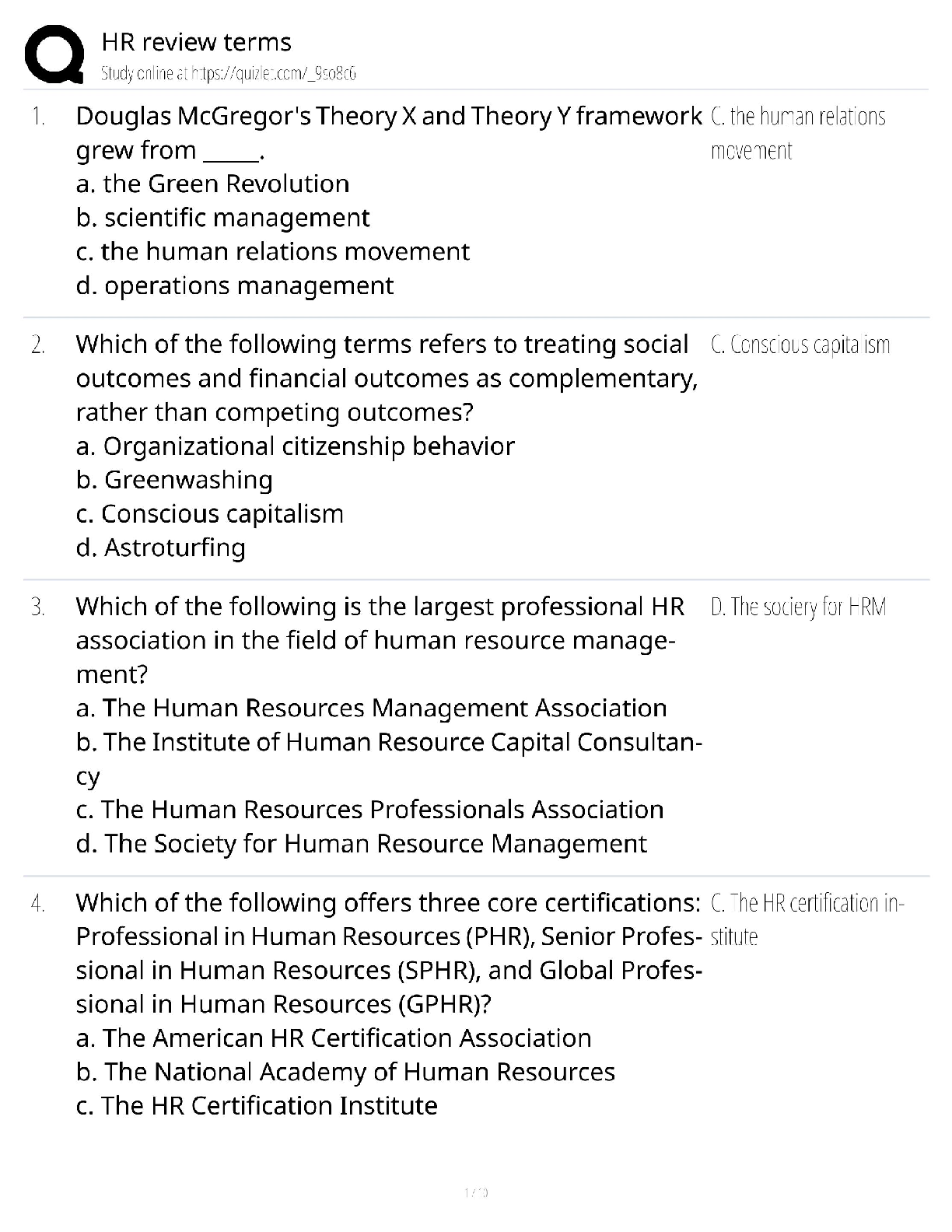
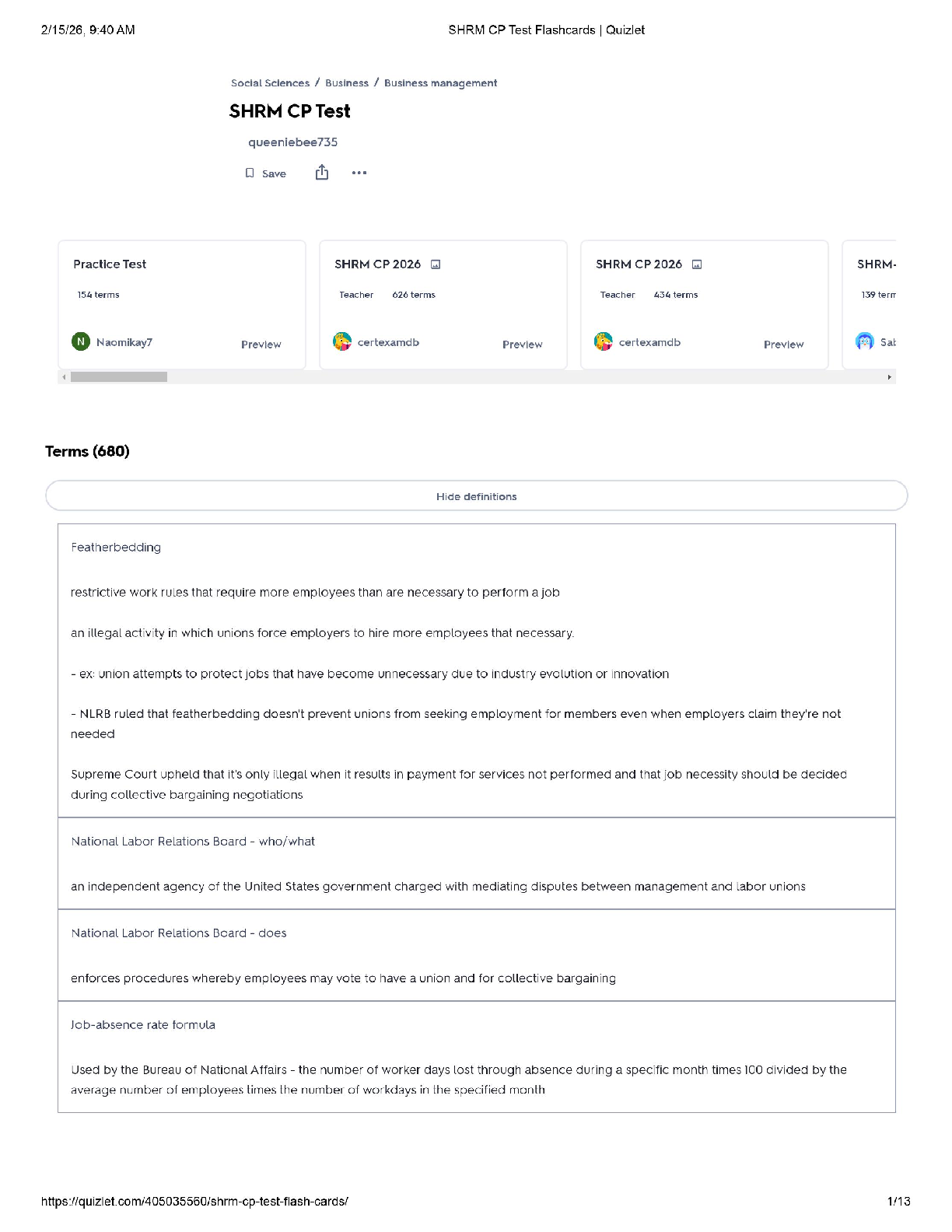
National Labor Relations Act (NLRA) - ✔✔-U.S. act that protected and encouraged the growth of the
union movement; established workers' rights to organize and bargain collectively with employers.
NLRB v. Weingarten - ✔✔-Landmark 1975 U.S. labor relations case that dealt with the right of a
unionized employee to have another person present during certain investigatory interviews.
Which is the difference between a strategic alliance and a joint venture?
Strategic alliances do not involve equity; joint ventures require that both partners contribute equity. -
✔✔-A strategic alliance is a formal agreement between two or more companies to collaborate and
contribute resources but not equity. Strategic alliances create synergy based on the partners' strengths
and technical capabilities. A joint venture is an agreement between two or more parties to create a new
economic entity. Both partners contribute equity and share in revenues, expenses, and control.
Conciliation - ✔✔-Method of nonbinding dispute resolution by which a neutral third party tries to help
disputing parties reach a mutually agreeable decision; also called mediation.
Consolidated Omnibus Budget Reconciliation Act (COBRA) - ✔✔-U.S. act that provides individuals and
dependents who may lose health-care coverage with opportunity to pay to continue coverage.
Compa-ratio - ✔✔-Pay rate divided by the midpoint of the pay range.
Common Law - ✔✔-Legal system in which each case is considered in terms of how it relates to legal
decisions that have already been made; evolves through judicial decisions over time. (USA)
Collective Bargaining - ✔✔-Process by which management and union representatives negotiate the
employment conditions for a particular bargaining unit for a designated period of time.
Codetermination - ✔✔-Form of corporate governance that requires a typical management board and a
supervisory board and that allows management and employees to participate in strategic decision
making.
Civil Rights Act of 1991 - ✔✔-U.S. act that expands the possible damage awards available to victims of
intentional discrimination to include compensatory and punitive damages; gives plaintiffs in cases of
alleged discrimination the right to a jury trial.
Civil Rights Act of 1964 - ✔✔-First comprehensive U.S. law making it unlawful to discriminate on the
basis of race, color, religion, sex, or national origin.
Civil Law - ✔✔-Legal system based on written codes (laws, rules, or regulations).
Career management vs. Career planning - ✔✔-Career Management: (Org level)
>Preparing, implementing, and monitoring employees' career paths, with a primary focus on the goals
and needs of the organization.
Career Planning: (Individual level)
Actions and activities that individuals perform in order to give direction to their work lives.
Which example illustrates strategic drift?
>Front-line managers continue to perpetuate old ways of doing things and fail to address changing
external forces.
>Strategic focus changes in an evolving and organic process when a new strategic planning cycle begins.
>Leaders slowly evolve the organization's mission and values to remain more competitive in targeted
markets.
>Because effects are not measured and corrected, strategies eventually lead organizations toward poor
performance practices. - ✔✔->Front-line managers continue to perpetuate old ways of doing things and
fail to address changing external forces.
Strategic drift occurs when an organization fails to recognize and respond to changes in its environment
that necessitate strategic change.
A new HR manager is eager to win support for her idea for a new employee benefit. Which type of
colleague would be a good ally in this situation?
>Veteran HR manager familiar with how decisions are made and with connections in other areas
>HR manager known for a number of successful initiatives and marked for promotion
>Head of HR, who is also new and wants to make a strong impression on senior leadership
>HR staff member who is expert in the organization's benefits program - ✔✔->Veteran HR manager
familiar with how decisions are made and with connections in other areas
The best ally in this situation is the veteran manager who can educate the new professional on
organizational politics, preferences, and decision-making styles. The head of HR and the up-and-coming
HR manager may be unreliable allies because of their own goals. The expert may be invested in the
status quo of the benefits program.
An HR manager observes that a staff member spends considerable time following up on compliance
questions from line managers and supervisors. How should the manager respond?
>Provide positive feedback to motivate this type of behavior.
>Say nothing now but document the amount of time spent in this manner.
>Ask line managers to submit questions to HR in e-mail form.
>Address the issue in a staff meeting without mentioning names. - ✔✔->Provide positive feedback to
motivate this type of behavior.
The staff member demonstrates HR's mission to provide service to its internal customers, and
compliance questions merit HR's prompt attention. The role of HR leaders is to model commitment to
the concept of customer service, which the manager can do by praising the staff member's
performance.
What challenge to effective cross-cultural communication is faced by an organization that believes that
its way is the best way and that lacks interest in other w
[Show More]


, 6e Ibraiz Tarique, Dennis Briscoe, Randall Schuler.png)
.png)
.png)

.png)