TMC EXAM 2, Questions with answers.
Latest update. Graded A
A patient with CHF has the following input/output history
Yesterday Today
IN 1900 mL 2100 mL
OUT 1000 mL 1100 mL
Which of the following clinical finding
...
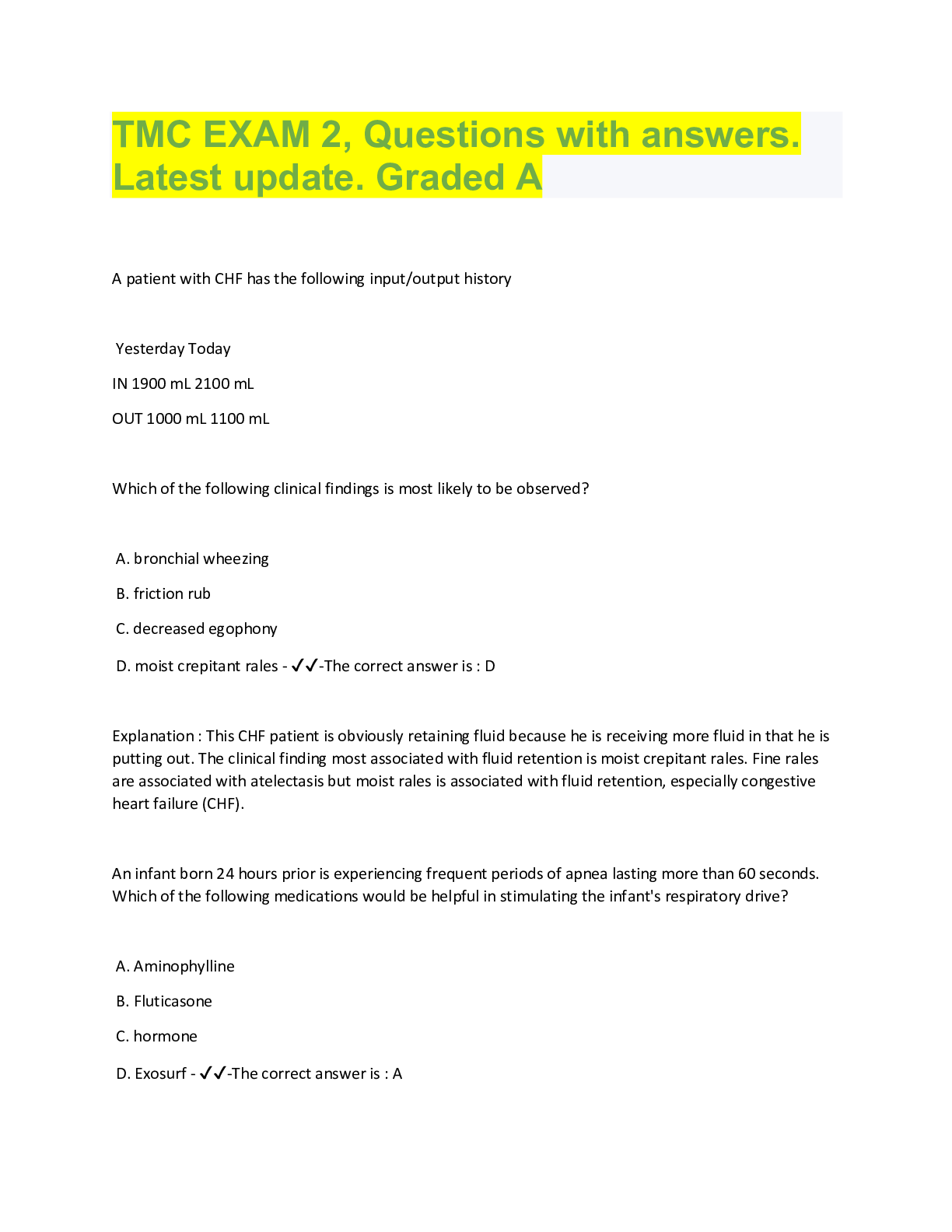
TMC EXAM 2, Questions with answers.
Latest update. Graded A
A patient with CHF has the following input/output history
Yesterday Today
IN 1900 mL 2100 mL
OUT 1000 mL 1100 mL
Which of the following clinical findings is most likely to be observed?
A. bronchial wheezing
B. friction rub
C. decreased egophony
D. moist crepitant rales - ✔✔-The correct answer is : D
Explanation : This CHF patient is obviously retaining fluid because he is receiving more fluid in that he is
putting out. The clinical finding most associated with fluid retention is moist crepitant rales. Fine rales
are associated with atelectasis but moist rales is associated with fluid retention, especially congestive
heart failure (CHF).
An infant born 24 hours prior is experiencing frequent periods of apnea lasting more than 60 seconds.
Which of the following medications would be helpful in stimulating the infant's respiratory drive?
A. Aminophylline
B. Fluticasone
C. hormone
D. Exosurf - ✔✔-The correct answer is : A
Explanation : An infant who experiences apnea periods greater than 60 seconds may need respiratory
stimulation. This may be accomplished by administering the medication Aminophylline. Aminophlylline
is only intended for ventilatory stimulation in infants. The same medication is used for long-term
bronchodilation in adults.
A respiratory therapist is having difficulty advancing a suction catheter down a fenestrated
tracheostomy tube while the inner cannula is removed. The cannula appears to meet resistance within a
few inches from insertion. The therapist should
A. remove the tracheostomy tube
B. twist the catheter while attempting to advance
C. inflate the cuff
D. obtain a smaller suction catheter - ✔✔-The correct answer is : B
Explanation : When suctioning somebody with a fenestrated tracheostomy tube, it must be
remembered that the suction catheters can sometimes get stuck on the fenestration hole inside the
tube. The best remedy for this is to twist the suction catheter until the end is clear of the hole.
The following flow volume loop (loop is tall and skinny) is obtained from a 62-year-old factory worker.
Which of the following could represent the patient's diagnosis?
A. pulmonary fibrosis
B. emphysema
C. cystic fibrosis
D. chronic bronchitis - ✔✔-The correct answer is : A
Explanation : The flow volume loop is tall and skinny, indicating normal flows but abnormal volumes.
This is consistent with a restrictive lung defect. The best answer is the disease that is restrictive in
nature. In this case, only pulmonary fibrosis qualifies.
Which of the following should be monitored for a ventilator-dependent newborn with IRDS?
A. gas distribution (SBN2) in the lungs
B. urine specific gravity
C. pH
D. fluid input and output - ✔✔-The correct answer is : D
Explanation : All choices are indicated while monitoring a critically ill neonate receiving mechanical
ventilation. I & O fluid monitoring is essential. Managing acid-base balance and the artificial airway are
also essential.
Which of the following is an important element of instruction to a home care patient who will be
receiving continuous oxygen therapy at 2 L/min by nasal cannula?
A. check oxygen concentrator flow rate once a week
B. run a flow calibration check once monthly
C. do not change flow rate without a physician order
D. increase flow rate during exercise - ✔✔-The correct answer is : C
Explanation : When instructing a home care patient on the use of their oxygen concentrator, and using
oxygen in general, the respiratory therapist must include those things that are appropriate for the
patient. In this question no open flames, use of grounded plugs only, and a restriction on changing the
flow rate without a physician order are appropriate instructions. It is inappropriate to ask the patient to
check or calibrate the concentrator's flow rate once a week. This sort of maintenance should be done by
a respiratory therapist.
Which of the following parameters is NOT consistent with weaning from mechanical ventilation?
A. A-aDO2 of 320 mmHg
B. VT to 500 mL
C. VD/VT of 0.50
D. RSBI of 86 - ✔✔-The correct answer is : A
Explanation : In order to wean from a ventilator, the patient's dead space-tidal volume ratio must be
below 60% or .60. The rapid shallow breathing index must be below 106. Spontaneous tidal volume
must be greater than 5 mL per kilogram. The alveoli-arterial oxygen difference (A-a gradient) must be
less than 300 mmHg. In this case, the dead space-tidal volume ratio is too high and the alveoli-arterial
oxygen difference is too wide. These are the two criteria that indicate the patient is not ready to wean
from the ventilator.
A respiratory therapist is alerted by a low-volume ventilator alarm on a patient who has a chest tube
drainage system in place. Set tidal volume is 600 mL while return tidal volume is 190 mL. The therapist
should FIRST
A. increase tidal volume to compensate
B. insert an additional chest tube
C. clamp the chest tube near the patient
D. disconnect the chest tube from wall suction pressure - ✔✔-The correct answer is : C
Explanation : A patient who is receiving mechanical ventilation, and has a chest tube drainage system in
place, must be monitored carefully for lost volume through the lung through the chest tube drainage
system. The clinical evidence of this is found in the return tidal volumes. If the volume administered is
far greater than the return volume, volume must be being lost in the system somewhere. A loss of
volume may be noticed by the excessive bubbling in the water seal compartment. To determine how it
is being lost, the first step would be to clamp the chest tube near the patient. If bubbling in the water
seal compartment stops, the volume being lost is most likely coming from a perforation in the lung. The
patient requires surgery to repair this.
While performing routine oxygen rounds, the respiratory therapist notes a COPD patient who is
receiving supplemental oxygen at 2 L/min is markedly cyanotic and has a heart rate of 30/min. The
therapist should FIRST
A. switch to FIO2 1.0
B. increase flow to 4 L/min by nasal cannula
C. obtain an arterial blood gas
D. go get help - ✔✔-The correct answer is : A
Explanation : Even though a COPD patient should rarely receive more than 2 L/min oxygen, there are
emergency circumstances that would dictate more supplemental oxygen. The use of the word
"markedly" is an indication of an emergency. In this case the patient is markedly cyanotic and therefore
has an oxygenation emergency. Switching to 100% oxygen is appropriate.
A respiratory therapist notices the cuff pressure on an endotracheal tube is 10 cm H2O. After
introducing 10.0 mL of air, the cuff pressure is 5 cm H2O. The patient is receiving positive pressure
ventilation. The therapist should recommend
A. replacing the ET tube
B. clamping the pilot tube
C. monitoring the patient
D. initiating high frequency jet ventilation - ✔✔-The correct answer is : A
Explanation : The ET tube cuff that fails to increase in pressure after introducing additional air is most
likely damaged. When a part of an ET tube is damaged, the only acceptable option is to replace it.
Which of the following laboratory examinations would be helpful in further assessing a patient with
diabetic ketoacidosis?
A. creatinine
B. PD50
C. glucose level
D. P50 - ✔✔-The correct answer is : C
Explanation : A patient with diabetic ketoacidosis primarily has a problem with the blood glucose level.
Further assessment therefore can be done by examining the glucose level.
What would most likely be indicated by an elevated CVP?
A. pulmonary embolism
B. fluid overload
C. left heart failure
D. increased pulmonary vascular resistance - ✔✔-The correct answer is : B
Explanation : Hypervolemia (fluid overload) is shown hemodynamically by an increase in all
hemodynamic values including CVP, PAP, PCWP, and cardiac output. Among these values CVP is the first
and most significant indicator when fluid levels in the body are high or low. Remember, CVP may be
known by other names such as, right atrial pressure, right side preload, right ventricular filling pressure,
and right ventricular end-diastolic pressure.
For which of the following conditions is PEP therapy most beneficial?
A. Postoperative recovery
B. ARDS
C. pneumonia
D. myasthenia gravis - ✔✔-The correct answer is : C
Explanation : PEP therapy is beneficial at removing secretions. Of the options given, only pneumonia is a
disease where secretions are a primary concern.
Which of the following would be most helpful in determining if a patient regularly smokes tobacco
products?
A. COHb
B. end-tidal carbon dioxide
C. DLCO
D. pulse oximetery - ✔✔-The correct answer is : A
Explanation : The most reliable data that indicates the degree to which the patient has recently been
smoking comes from a COHb analysis.
A 32-year-old 81-kg (178-lb) adult male is receiving mechanical ventilatory support. Settings are as
follows:
Mode Assist/control
Mandatory rate 10
Total rate 18
Tidal volume 450 mL
FIO2 0.6
PEEP 5 cm H2O
The patient is cyanotic and anxious. The respiratory therapist will recommend which of the following?
A. decrease mandatory rate
B. increase tidal volume
C. increase inspiratory flow rate
D. increase FIO2 - ✔✔-The correct answer is : B
Explanation : All of the answers offered indicate a change in the ventilator settings. However, the
question shows no evidence of arterial blood gas analysis. This is because a close examination of the
ventilator settings will show that there is something wrong. The patient weighs 81 kg which would
suggest a minimum tidal volume of 500 mL. (6 x 81 kg = 486 mL). The patient's set tidal volume is only
450 mL. This should be corrected.
The following graphic (shows fluttering expiratory flow) from an orally intubated patient receiving
mechanical ventilation is most likely caused by
A. vocal cord paralysis
B. condensate in the tubing
C. fixed upper airway obstruction
D. PEP therapy - ✔✔-The correct answer is : B
Explanation : Condensate in the tubing will show up as a fluttering expiratory flow.
Which of the following patients would benefit most from an inverse I:E ratio ventilation?
A. ARDS
B. chronic bronchitis
C. kyphoscoliosis
D. COPD - ✔✔-The correct answer is : A
Explanation : An inverse I:E ratio is a term that indicates a longer inspiratory time than expiratory time.
The patient with adult respiratory distress syndrom is an example of a patient who can benefit from an
inverse I:E ratio. Their lungs are noncompliant and therefore require more inspiratory time to allow for
better gas distribution.
The respiratory therapist is making a plan of care for a patient with mycoplasma pneumonia who needs
assistance with airway clearance of secretions. In which order should therapy be performed?
A. coach coughing, bronchodilator, percussion, postural drainage
B. postural drainage, percussion, bronchodilator, coach coughing
C. percussion, postural drainage, bronchodilator, coach coughing
D. bronchodilator, percussion, postural drainage, coach coughing - ✔✔-The correct answer is : D
Explanation : There is an oder at which procedures should be done to mobilize and remove secretions.
The first steps are to open the airway, dislodge the sputum, move dispute into the upper airway, and
then remove the sputum through coughing or suctioning.
A pulmonary rehabilitation patient is having difficulty complying with a smoking cessation program. A
physical and psychological screen reveals a heavy physiological dependence and a low psychological
dependence on smoking. Which of the following is appropriate?
A. Valium
B. psychological counseling
C. Versed
D. nicotine replacement therapy - ✔✔-The correct answer is : D
Explanation : A physiological dependence on nicotine can be overcome slowly by having the patient use
nicotine replacement therapy. This may include chewing gum with nicotine or transdermal preparations.
A 31-week-gestional age infant has a respiratory rate of 30/min and a heart rate of 70/min while
breathing room air. Five minutes after birth, the infant is acrocyanotic and has a weak cry. Following
suctioning of the oropharynx the respiratory therapist should
A. administer Atropine sulfate
B. provide manual ventilation with the bag-valve
C. begin chest compressions
D. place the infant in an oxyhood at FIO2 0.40 - ✔✔-The correct answer is : B
Explanation : Five minutes after birth this infant is still showing signs of significant respiratory distress.
Supporting ventilation with a bag-valve is appropriate.
Which of the following equations would determine cardiac index?
A. C.O. / ejection fraction
B. C.O. / BSA
C. C.O. x BSA
D. stroke volume x heart rate - ✔✔-The correct answer is : B
Explanation : Cardiac index can be calculated by dividing the cardiac output by the body surface area.
The body surface area is given in units of millimeters squared. Body surface area rarely deviates from
about 2 m², regardless of the size of the patient. So essentially, we could take cardiac output and divide
it by two to get cardiac index. This can be done even if the body surface area of the patient is unknown.
For example, if the cardiac output is 4 L/min, the cardiac index is about 2. Conversely, if cardiac index is
1.8, cardiac output could be estimated to be 3.6 L/min.
What is the primary purpose for a nitrogen washout test?
A. determine closing volume
B. determine FRC
C. evaluate evenness of pulmonary gas distribution
D. directly measure TLC - ✔✔-The correct answer is : B
Explanation : A nitrogen washout test is used to determine three different lung volumes: TLC, RV, and
FRC. For the NBCR exam the most important of those volumes is the FRC. Thus, when asked what a
nitrogen washout test is for (or helium dilution test), the correct answer is FRC.
While transporting a patient from a helicopter landing pad to the emergency department (ED), the
respiratory therapist notices the ET tube has become unsecured. To best confirm to location of the ET
tube, the therapist should recommen
[Show More]