TMC Exam E, Questions with accurate
answers, 100% Accurate. Rated A
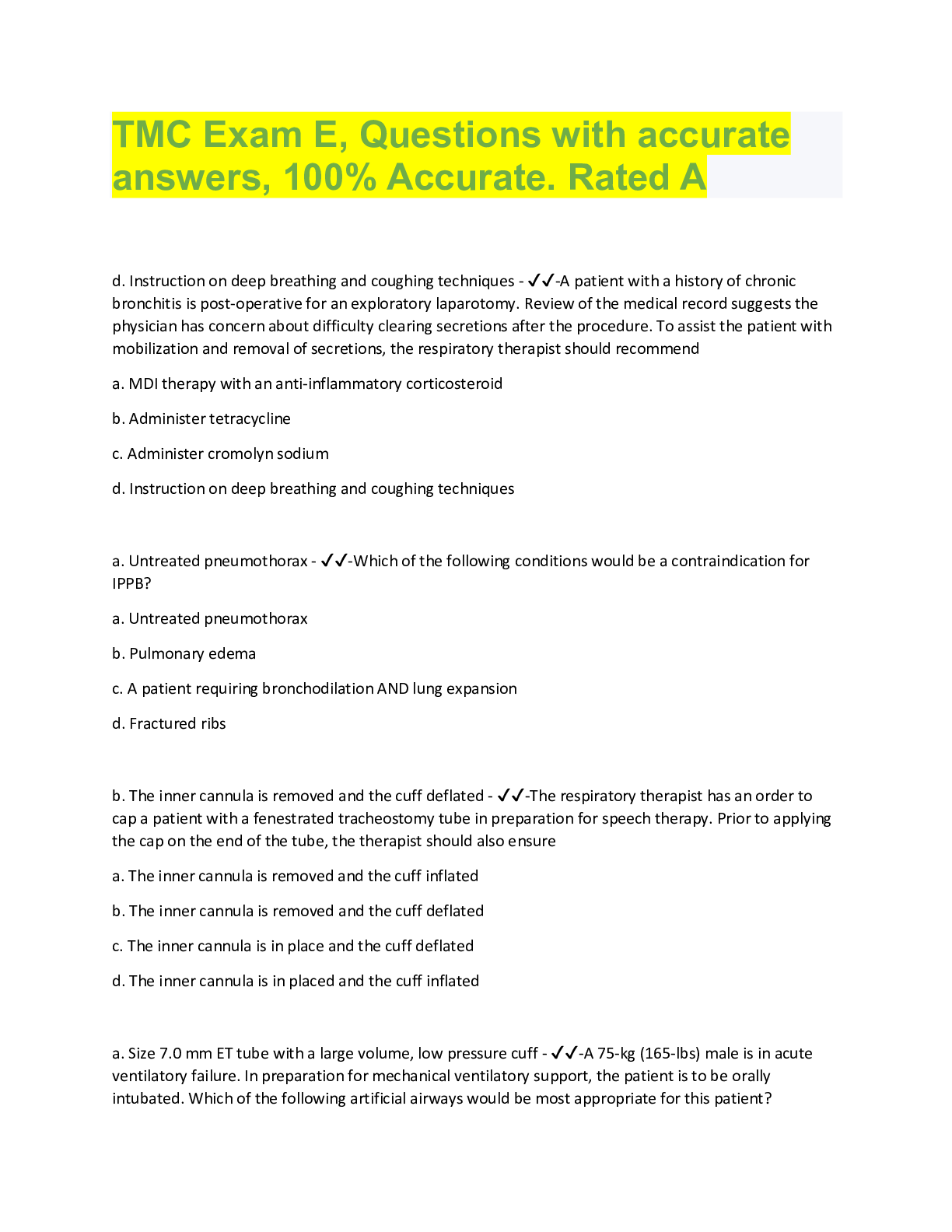
d. Instruction on deep breathing and coughing techniques - ✔✔-A patient with a history of chronic
bronchitis is post-operative for an exploratory l
...
TMC Exam E, Questions with accurate
answers, 100% Accurate. Rated A
d. Instruction on deep breathing and coughing techniques - ✔✔-A patient with a history of chronic
bronchitis is post-operative for an exploratory laparotomy. Review of the medical record suggests the
physician has concern about difficulty clearing secretions after the procedure. To assist the patient with
mobilization and removal of secretions, the respiratory therapist should recommend
a. MDI therapy with an anti-inflammatory corticosteroid
b. Administer tetracycline
c. Administer cromolyn sodium
d. Instruction on deep breathing and coughing techniques
a. Untreated pneumothorax - ✔✔-Which of the following conditions would be a contraindication for
IPPB?
a. Untreated pneumothorax
b. Pulmonary edema
c. A patient requiring bronchodilation AND lung expansion
d. Fractured ribs
b. The inner cannula is removed and the cuff deflated - ✔✔-The respiratory therapist has an order to
cap a patient with a fenestrated tracheostomy tube in preparation for speech therapy. Prior to applying
the cap on the end of the tube, the therapist should also ensure
a. The inner cannula is removed and the cuff inflated
b. The inner cannula is removed and the cuff deflated
c. The inner cannula is in place and the cuff deflated
d. The inner cannula is in placed and the cuff inflated
a. Size 7.0 mm ET tube with a large volume, low pressure cuff - ✔✔-A 75-kg (165-lbs) male is in acute
ventilatory failure. In preparation for mechanical ventilatory support, the patient is to be orally
intubated. Which of the following artificial airways would be most appropriate for this patient?
a. Size 7.0 mm ET tube with a large volume, low pressure cuff
b. Size 7.5 mm fenestrated tracheostomy tube
c. Size 8.0 mm ET tube with a small volume, high pressure cuff
d. Jackson tracheostomy tube
c. Body box - ✔✔-Which of the following devices is needed to determine a patient's airway resistance?
a. Turbine pneumotachometer
b. Wheatstone bridge helium analyzer
c. Body box
d. Geissler tube nitrogen analyzer
d. Examine chest rise and auscultate breath sounds - ✔✔-A patient is receiving manual ventilatory
support with a bag-valve connected to a size 8.0 mm ET tube. While transporting the patient from CT
scan back to the intensive care unit, the respiratory therapist notices oxygen saturation has dropped to
88% and that the bag-valve is easier to squeeze than normal. Suspecting mal-positioning of the ET tube,
the respiratory therapist should first
a. Perform diagnostic chest percussion
b. Obtain an arterial blood gas
c. Call for a chest radiograph
d. Examine chest rise and auscultate breath sounds
d. Obtain a chest radiograph - ✔✔-A 48-year-old patient has just been orally intubated prior to being
placed on volume-controlled ventilation. The respiratory therapist should do which of the following to
best confirm proper placement of the endotracheal tube?
a. Auscultate breath sounds
b. Assess chest rise symmetry
c. Examine tube markings near the lips
d. Obtain a chest radiograph
d. Return to full mechanical ventilation - ✔✔-After 20 minutes into a spontaneous breathing trial (SBT) a
mechanically ventilated female patient becomes anxious. Her baseline heart rate has increased by 20
/min. What should the respiratory therapist do?
a. Calculate the RSBI
b. Increase the FiO2 and continue to monitor
c. Measure MIP
d. Return to full mechanical ventilation
b. Hemoglobin level - ✔✔-What is needed to determine arterial oxygen content?
a. PvO2
b. Hemoglobin level
c. Oxygen index
d. P/F ratio
c. Elevated left ventricular filling pressure with low QT - ✔✔-A patient presents to the emergency room
with fulminating pulmonary edema. Which of the following would be experienced with this emergency?
a. Hypovolemia
b. A good response to supplemental O2
c. Elevated left ventricular filling pressure with low QT
d. CVP 10 torr and PAP 10 torr
d. Small pneumothorax - ✔✔-Which of the following conditions would benefit most from a
thoracentesis?
a. Pericardial contusion
b. Atelectasis
c. Complete opacification of the right lung
d. Small pneumothorax
a. Ventricular tachycardia with a pulse - ✔✔-Which of the following conditions would benefit most from
cardioversion?
a. Ventricular tachycardia with a pulse
b. Frequent PVCs
c. Asystole
d. Ventricular fibrillation
d. PaCO2 from an arterial blood gas analysis - ✔✔-Which of the following is the best indicator of the
adequacy of alveolar ventilation?
a. Tidal volume
b. Color
c. Respiratory rate
d. PaCO2 from an arterial blood gas analysis
a. Diaper weight and blood draw volumes are recorded - ✔✔-A 32-gestational week newborn is
receiving mechanical ventilation via a 3.0 mm endotracheal tube. Which of the following are associated
with ongoing assessment of renal function?
a. Diaper weight and blood draw volumes are recorded
b. mPAP
c. PCWP
d. Humidification is maintained at a non-invasive temperature
b. Exogenous surfactant - ✔✔-A patient with ARDS and asthma could benefit from which of the
following medications?
a. Tobramycin and albuterol
b. Exogenous surfactant
c. Cromolyn sodium
d. Spiriva and Decadron
d. Breath sounds before and after every treatment - ✔✔-The respiratory therapist should look to which
of the following clinical data to determine the effectiveness of incentive spirometry?
a. Arterial blood gas analysis pre and post treatment
b. Inspiratory capacity predicted volume
c. Maximum voluntary ventilation done periodically
d. Breath sounds before and after every treatment
d. Symptoms - ✔✔-Which of the following cannot be measured or evaluated in a comatose patient?
a. Pupillary response
b. Tidal volume
c. Objective information
d. Symptoms
b. Too much water in the circuit - ✔✔-A patient with a tracheostomy is receiving supplemental oxygen
via tracheostomy collar connected to a large volume nebulizer set at 40%. The respiratory therapist
analyzes the FIO2 at the tracheostomy collar with a galvanic fuel cell analyzer. The analysis shows the
FIO2 to be 55%. Which of the following could be the cause of the increase in FIO2?
a. The aerosol tubing is too short
b. Too much water in the circuit
c. Calibration error in the galvanic fuel cell
d. Clogged jet orifice in the nebulizer
a. Use of pressure support - ✔✔-A patient receiving volume-controlled ventilation in SIMV mode has a
total respiratory rate of 26/min and is showing signs of increased labor of breathing. The mandatory rate
is 14/min. Which of the following would most likely help the patient?
a. Use of pressure support
b. Switch to pressure control ventilation
c. Increase the machine flow rate
d. Increase PEEP
d. Cardioversion - ✔✔-A patient is experiencing atrial arrhythmias and is complaining of light�headedness and nausea. Which of the following should the respiratory therapist recommend to help
remedy the problem?
a. Administration of Lidocaine
b. Atropine sulfate
c. Unsynchronized defibrillation
d. Cardioversion
a. 1/2 - ✔✔-When selecting a suction catheter to be used in an oral endotracheal tube, the respiratory
therapist should select a catheter whose diameter should not exceed what fraction of the internal
diameter of the endotracheal tube?
a. 1/2
b. 2/3
c. 3/4
d. 1/4
d. Flow volume loop - ✔✔-Which of the following would be most helpful in diagnosing vocal cord
paralysis in an adult?
a. FVC maneuver
b. Thoracic gas volume measurement
c. Neck radiograph
d. Flow volume loop
d. Change the nebulizer entrainment port to 100% - ✔✔-When analyzing the FIO2 for an infant in an
oxygen hood receiving oxygen therapy with a blender set at 50%, the respiratory therapist notes an
oxygen concentration of 35% near the patient's mouth. The jet nebulizer entrainment setting is set to
50%. To correct the problem, the therapist should
a. Obtain a smaller oxyhood
b. Increase total flow to the oxyhood
c. Adjust blender setting to 60%
d. Change the nebulizer entrainment port to 100%
a. Hyperlucency in the soft tissues - ✔✔-Following the insertion of a tracheostomy tube, the patient is
found to have diffuse crackles upon auscultation secondary to subcutaneous emphysema. Which of the
following radiographic findings would be expected with this condition?
a. Hyperlucency in the soft tissues
b. Scattered patchy infiltrates
c. Diffuse pulmonary hyperlucency
d. Tracheal shift from midline
d. Cardiac arrhythmias - ✔✔-Placement of a pulmonary artery catheter is associated with which of the
following most common complications?
a. Internal bleeding
b. Pulmonary valve damage
c. Hypotension
d. Cardiac arrhythmia
[Show More]