tmc exam Questions & Answers.
Predictor paper. Latest update.
Romazicon (flumazenil) - ✔✔--antidote for benzodiazepines such as
-GABA receptor antagonist
- It can treat drowsiness caused by sedatives following sur
...
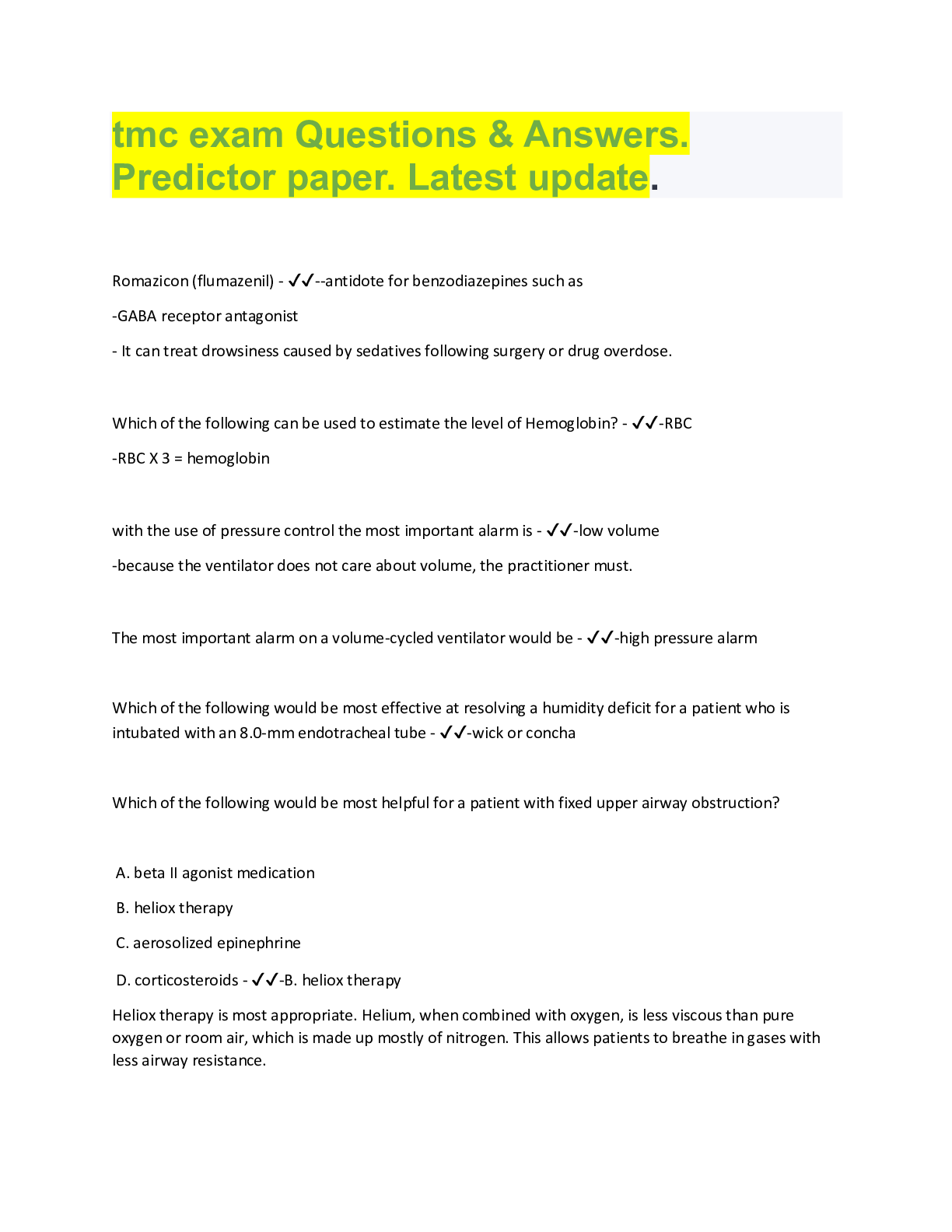
tmc exam Questions & Answers.
Predictor paper. Latest update.
Romazicon (flumazenil) - ✔✔--antidote for benzodiazepines such as
-GABA receptor antagonist
- It can treat drowsiness caused by sedatives following surgery or drug overdose.
Which of the following can be used to estimate the level of Hemoglobin? - ✔✔-RBC
-RBC X 3 = hemoglobin
with the use of pressure control the most important alarm is - ✔✔-low volume
-because the ventilator does not care about volume, the practitioner must.
The most important alarm on a volume-cycled ventilator would be - ✔✔-high pressure alarm
Which of the following would be most effective at resolving a humidity deficit for a patient who is
intubated with an 8.0-mm endotracheal tube - ✔✔-wick or concha
Which of the following would be most helpful for a patient with fixed upper airway obstruction?
A. beta II agonist medication
B. heliox therapy
C. aerosolized epinephrine
D. corticosteroids - ✔✔-B. heliox therapy
Heliox therapy is most appropriate. Helium, when combined with oxygen, is less viscous than pure
oxygen or room air, which is made up mostly of nitrogen. This allows patients to breathe in gases with
less airway resistance.
-fixed obstruction means it cannot be resolved simply with bronchodilators or other immediate
methods.
which one should be treated first, ventilation or oxygenation - ✔✔-ventilation
the patient is over oxygenating AND hyperventilating
which one should you treat first? - ✔✔-over oxygenation
-To address over-oxygenation one can either change the PEEP or the FIO2. You will always want to lower
the FIO2 below 60% before changing PEEP.
ways to decrease CO2 - ✔✔-increase the Vt
increase the rate
remove dead space
What would occur on a time-cycled ventilator with a fixed rate if the inspiratory flow rate were
increased?
A. increase in tidal volume
B. decrease in inspiratory time
C. decrease in tidal volume
D. increase in inspiratory time - ✔✔-A. increased in tidal volume
On a time-cycled ventilator inspiratory time is predetermined. So, if the flow rate is increased while the
mandatory rate is unchanged, the result would be an increase in tidal volume.
Which of the following is the most significant complication of bronchoscopy?
A. laryngospasms
B. hypotension
C. vagal nerve stimulation
D. coughing - ✔✔-A. laryngospasm
-This tendency may be reduced by administering aerosolized Lidocaine or any other tissue numbing
agent prior to the procedure.
What is the respiratory therapist observing if monitoring the total amount of gas exhaled in 60 seconds
after excluding dead space?
A. minute ventilation
B. dead space ventilation
C. alveolar minute ventilation
D. maximum voluntary ventilation - ✔✔-c. alveolar minute ventilation
Examining the breathing rate over a period of 60 seconds and multiplying it times the tidal volume gives
you minute ventilation. If deadspace is subtracted from that volume then what is being observed is
alveolar minute ventilation.
education and direction for the performance of positive expiratory pressure (PEP) therapy - ✔✔-Proper
instructions for the use of a PEP therapy device includes "inhaling deeply and exhaling actively".
equations to determine cardiac output - ✔✔-fick equation
co= SVxHR
Which of the following would result in an increase in pulmonary capillary wedge pressure?
A. decrease in pulmonary vascular resistance (PVR)
B. cor pulmonale
C. dehydration
D. mitral valve stenosis - ✔✔-D. mitral valve stenosis
If mitral valve stenosis is present, blood would have difficulty transitioning the left ventricle. This would
result in a backup pressure occurring and an elevation of the PCWP.
A patient is on 70%/30% heliox therapy by nonrebreathing mask. If flowing through an oxygen flow
meter, what is the actual flow of the mixture if the flow meter indicates 10 L/min?
A. 5 L/min
B. 8 L/min
C. 18 L/min
D. 16 L/min - ✔✔-D. 16
When helium-oxygen mixtures are run through flow meters that are intended for oxygen only, the
indicated flow on the flow meter is inaccurate. This is because the helium-oxygen mixture is less viscous
and does not push the indicator ball up as much as does oxygen. In this case, a correction factor must be
used depending upon the mixture percentage. For an 80/20% mixture a correction factor of 1.8 must be
used. A 70/30% mixture has a correction factor of 1.6 and a 60/40% mixture has a correction factor of
1.4. In this problem the 70/30% mixture factor of 1.6 must be multiplied by the indicated flow on the
oxygen flow meter to calculate actual total gas flow. When we do this we get a total gas flow of 16
L/min.
Popping sensations, also referred to as crackling sensations, during palpation of the tissues of the upper
chest and neck are related to subcutaneous emphysema, which is a condition of air entering the dermal
and subdermal spaces. It is usually caused by - ✔✔-a mal-positioned tracheostomy tube.
Pulse oximeters are also known as single wavelength spectrophotometers. There are multiple reasons
why they may read inaccurately. Those reasons include: - ✔✔-high ambient light, the use of fingernail
polish, poor peripheral perfusion, and marked hypotension
The incidence of ventilator-associated pneumonia, or VAP, is lowered by - ✔✔-using a closed system
suction catheter, periodically discontinuing sedation, keeping the patient and semi-Fowler's position,
and proper handwashing among caregivers
Which of the following airway clearance therapies should be administered first in the order of therapy?
A. postural drainage and percussion
B. nasal tracheal suctioning
C. aerosolized Acetylcysteine (Mucomyst)
D. verbal coaching for coughing - ✔✔-C
-aerosolized Acetylcysteine (Mucomyst)
the first most logical step would be to thin secretions through use of the medication Mucomyst. The
next step, would be postural drainage and percussion followed by verbal coaching for coughing and
possibly nasal tracheal suctioning.
Digitalis - ✔✔-strengthens the contraction of the heart muscle, slows the heart rate, and helps eliminate
fluid from body tissues
Which of the following is most indicative of a pulmonary embolism?
A. increased CVP, decreased PAP
B. decreased CVP, decreased cardiac output
C. increased PAP, decreased PCWP
D. increased PCWP, decreased cardiac output - ✔✔-C. increased PAP, decreased PCWP
An increased PAP followed by a decreased PCWP indicates that blood is having difficulty flowing through
the lung.
When we need to raise CO2 there are three choices - - ✔✔-decreasing tidal volume, decreasing rate, or
adding dead space
The use of PEP therapy is contraindicated by - ✔✔-epistaxis and a middle ear infection.
Paradoxical chest movement is an indication - ✔✔-individual ribs are fractured in two or places, which
causes the area of the rib cage to move in with inhalation while the rest of the chest moves out.
Exosurf - ✔✔-CLASS: ARTIFICIAL SURFACTANT
IMMATURE NEONATAL LUNGS
A left-to-right shunt, due to a leaking septum wall in the heart, is best determined by an increase in
mixed venous oxygen saturation. From what location would the respiratory therapist recommend blood
extraction for analysis to determine mixed venous oxygen saturation?
A. pulmonary artery
B. vena cava
C. pulmonary vein
D. aorta - ✔✔-A. pulmonary artery
Mixed venous blood, for the assessment of oxygen saturation, is taken from the distal port of the
pulmonary artery catheter, or the pulmonary artery
Flipped T waves on ECG waveform indicate - ✔✔-cardiac ischemia.
The best way to treat this is to administer oxygen to the patient
One treatment for metabolic alkalosis is to administer - ✔✔-potassium chloride
The lowest inflection point on a pressure-volume ventilator graphic is an indication of - ✔✔-the
minimum pressure needed to keep alveoli open.
Non-deadly arrhythmias, such as atrial tachycardia, may be addressed through - ✔✔-cardioversion
Which of the following descriptions most typifies the sound a therapist might here on a patient with a
pleural friction rub?
A. grating sound
B. scattered crackles
C. egophany
D. sonorous - ✔✔-A. grating sound
When the patient is placed in an aircraft that does not maintain cabin pressure, any changes in arterial
oxygenation result primarily from - ✔✔-a change in alveolar oxygen tension or PAO2.
Oxygen Index (OI) - ✔✔-Paw x FiO2/PaO2 (100)
is a value that takes into consideration FIO2, PaO2 levels, and inspiratory pressures.
Endrophonium (Tensilon) - ✔✔-It can help diagnose myasthenia gravis so that doctors select the proper
treatment. It can also reverse the effect of certain muscle relaxants during surgery or after an overdose.
the normal systemic vascular resistance SVRI is - ✔✔-1800-2400
mixed venous blood should be taken from - ✔✔-the distal end of pulmonary artery catheter to
determine PvO2
altitude causes hypoxemia due to barometric pressure which result in - ✔✔-decreased alveolar oxygen
tension or PAO2
straw colored stain on skin of a newborn indicates - ✔✔-presence of meconium
A patient that is taking nebulizer treatments needs to be able to demonstrate - ✔✔-manual dexterity,
and the ability to hold and manipulate the nebulizer
Which of the following would be most beneficial in resolving microatelectasis?
A. Chest tubes
B. Thoracentesis
C. Percutaneous ventilation
D. Bronchoscopy - ✔✔-D. Bronchoscopy
A bronchoscopy would be most beneficial because it can ventilate and recruit alveoli in the lung. The
other options will not decrease atelectasis
A patient with increased airway resistance from a fixed upper airway obstruction would benefit most
from which of the following?
A. epinephrine
B. heliox therapy
C. aerosolized atropine
D. bronchodilator therapy - ✔✔-B. Heliox therapy
An air-entrainment jet nebulizer is set at 50%. The respiratory therapist analyzes the oxygen coming
from the end of the tubing and finds it is 60%. Which of the following most likely explains this finding?
A. low flow through the jet orifice
B. leak in the tubing
C. excess water in the tubing
D. poorly calibrated analyzer - ✔✔-C. excess water in the tubing
When administering oxygen by any device that has a venturi mechanism, back pressure on the venturi
will slow the speed of gas, decrease room air entrainment, and result in an increase in FIO2. Of the
options offered, only excess water in the tubing would cause this type of back pressure.
During the preoperational test of the ventilator, the respiratory therapist notices the galvanic analyzer
on the ventilator is reading erroneously low. Which of the following can the respiratory therapist do to
correct the problem?
A. tag the ventilator as non-functional and avoid placing it in service
B. change the fuel cell
C. replace the electrolyte solution in the analyzer
D. replace the analyzer batteries - ✔✔-B. change the fuel cell
A galvanic oxygen analyzer will read erroneously under two conditions: the probe or the fuel cell is
depleted or the analyzer requires calibration. In this case the probe, which provides the energy for the
analyzer, is the most likely culprit and should be changed.
While monitoring a patient receiving mechanical ventilation, the respiratory therapist notices the low�pressure and low exhaled volume alarms are sounding. Which of the following could be the cause?
A. excess water in the inspiratory limb of the circuit
B. kinked endotracheal tube
C. disconnected thermistor line
D. herniated endotracheal tube cuff - ✔✔-C. disconnected thermistor line
If you have a low pressure or low exhaled volume ventilator alarm, you must look for the problem that
could cause that specific type of alarm. If you look at the answers, a kink in the endotracheal tube would
cause a high-pressure alarm so that cannot be the cause. Excess water in the limbs of the circuit would
do the same. A high-pressure alarm would also develope if there is a herniated endotracheal tube cuff.
This leaves the only possible answer which is a disconnected thermistor line.
The high pressure alarm is sounding on a patient receiving volume controlled ventilation. The
respiratory therapist should FIRST
A. provide manual ventilation
B. cancel the alarm
C. observe the alarm panel to determine source
D. suction the patient - ✔✔-The NBRC knows that in real life, when you hear a ventilator alarm, you're
tempted to cancel the alarm or attempt to immediately solve the problem. However, the correct answer
is always to first provide manual ventilation to the patient. This is true of any ventilator alarm. Your first
action should be to stabilize the ventilatory status of the patient, and then troubleshoot the problem.
Anectine (succinylcholine) - ✔✔-neuromuscular blocker
is the medication that manifests muscle twitching about the face and neck when it is working properly.
SVC Maneuver - ✔✔-A respirometer is the most important piece of equipment when measuring an SVC
Inspiratory muscle strength is determined by - ✔✔-measuring the maximum inspiratory pressure. This is
done with a pressure manometer.
PAP normal value - ✔✔-the normal systolic PAP ranges from 15 to 25 mm Hg and the diastolic PAP from
6 to 12 mm Hg.
When a patient on a ventilator is unable to exhale completely before the inhalation cycle starts, the
result will be air-trapping, which will result in - ✔✔-auto
[Show More]