TMC Mock Board Questions & Answers.
Predictor paper. Verified.
Ensure that the manual resuscitator is connected to an oxygen source. - ✔✔-A RT is manually Ventilating
a pt during a cardiopulmonary resuscitation atte
...
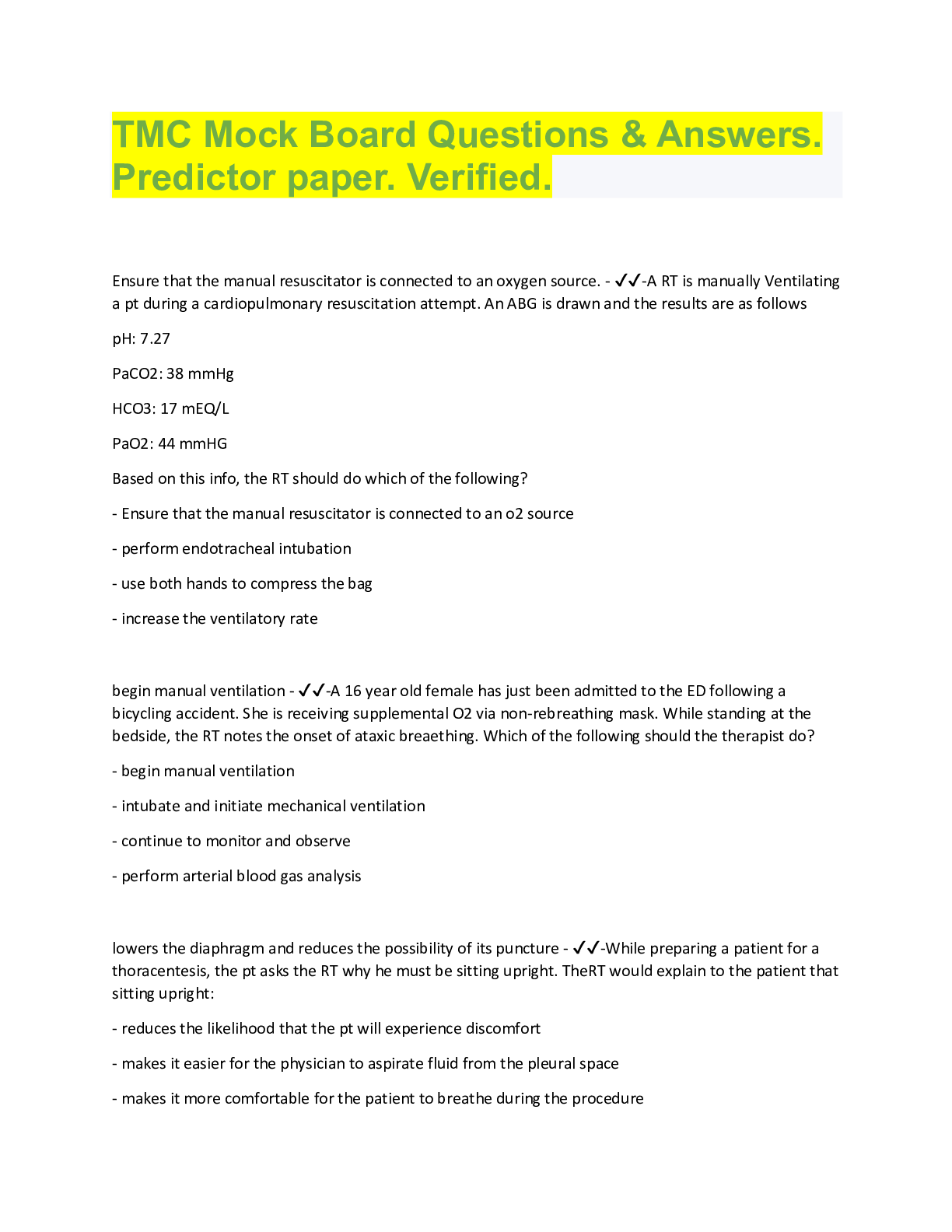
TMC Mock Board Questions & Answers.
Predictor paper. Verified.
Ensure that the manual resuscitator is connected to an oxygen source. - ✔✔-A RT is manually Ventilating
a pt during a cardiopulmonary resuscitation attempt. An ABG is drawn and the results are as follows
pH: 7.27
PaCO2: 38 mmHg
HCO3: 17 mEQ/L
PaO2: 44 mmHG
Based on this info, the RT should do which of the following?
- Ensure that the manual resuscitator is connected to an o2 source
- perform endotracheal intubation
- use both hands to compress the bag
- increase the ventilatory rate
begin manual ventilation - ✔✔-A 16 year old female has just been admitted to the ED following a
bicycling accident. She is receiving supplemental O2 via non-rebreathing mask. While standing at the
bedside, the RT notes the onset of ataxic breaething. Which of the following should the therapist do?
- begin manual ventilation
- intubate and initiate mechanical ventilation
- continue to monitor and observe
- perform arterial blood gas analysis
lowers the diaphragm and reduces the possibility of its puncture - ✔✔-While preparing a patient for a
thoracentesis, the pt asks the RT why he must be sitting upright. TheRT would explain to the patient that
sitting upright:
- reduces the likelihood that the pt will experience discomfort
- makes it easier for the physician to aspirate fluid from the pleural space
- makes it more comfortable for the patient to breathe during the procedure
- lower the diaphragm adn reduces the possibility of its puncture
Increase the frequency of suctioning through the catheter - ✔✔-A patient with chronic hypercapnia is
receiving home oxygen therapy by transtracheal cather at 1 LPM. He calls the respiratory clinic and
informs the RT that he has had increasing episodes of rice sized mucus balls lodging in the catheter.
Which of the following would NOT be appropriate advice for the therapist to give the patient?
- increase the frequency of suctioning through the catheter
-call his physician to prescribe a mucoevacuent
- increase his intake of systemic fluids
- increase the frequency of cleaning the catheter
insert a smaller restrictive orifice in the device - ✔✔-A RT is asked to assess a COPD patient who is in a
pulmonary rehabilitation program. During the interview, the patient tells the therapist that he has been
working with a resistive training device for two weeks and taht he is able to tolerate the device for 15
minutes. What should the therapist do?
- instruct the patient to exhale forecfully through the device
- instruct the patient to continue present therapy
- insert a smaller restrictive orifice in the device
- insert a larger restrictive orifice in the device
transtracheal oxygen catheter - ✔✔-A home care patient receiving continuous oxygen therapy via nasal
cannula has become increasingly noncompliant in her oxygen therapy and states she is concerned about
appearance. Which of the following would be most appropriate for the RT to suggest?
- discontinue oxygen therapy
- nasal catheter
- transtracheal oxygen catheter
- oxygen conserving cannula
apply firm pressure to the puncture site for at least 5-10 minutes - ✔✔-Immediately after assisting with
a transtracheal aspiration, the respiratory therapist should:
- apply firm pressure to the puncture site for atleast 5-10 mins
- administer an anesthetic to the neck area
- instruct the patient to take slow deep breaths and cough
- nebulize 3cc of 1% methylene solution
proceed with chest tube placement - ✔✔-A RT is assisting the physician with needle aspiration to relieve
a tension pneumothorax. The procedure has been successful. Which of the following should be done
next?
- obtain and ABG
- obtain a Chest Xray
- proceed with the chest tube placement
- ensure airway patency
begin open cardiac massage - ✔✔-A 42 year-old man who sustained a knife stab wound to the left chest
has been brough to the ED. On arrival the patient is pulseless with a wide complex rhythm at a rate of 20
bpm. He is immediately orotracheally intubated and an anterolateral left thoracotomy is done. The
pericadial sac was found to be dilated and filled with blood. Pericadiocentesis is then performed for
pericadium decompression. The next step in the tx of the pt should be to:
- begine closed chest cardiac massage
- begin open cardiac massage
- administer lidocaine
- establish and intra-arterial access line
re-expansion pulmonary edema - ✔✔-Following the removal of 1650 mL of pleural fluid, a pt suddenly
becomes diaphoretic and complains of chest pain and dyspnea. Vital signs reveal a RR of 28/min, a HR of
124 bpm, and BP of 138/86 mmHg. Which of the following is the possible cause of this patients
condition?
- re-expansion pulmonary edema
- cardiogenic shock
- lung consolidation
- atelectasis
switching to the SIMV mode - ✔✔-Shortly after the initiation of A/C vent support, the patients systolic
blood pressure drops by 24 mmhg. Which of the following should the RT recommend?
- switching to pressure support ventilation
- sedating the patient
- decreasing the ventilator rate
- switching to the SIMV mode
swtich to SIMV with a rateof 12/min - ✔✔-A RT is asked to intiate weaning for an 81kg adult male pt
who is being mechanically ventilated in the A/C mode with and FIO2 of 0.40. The therapist obtains a vital
capacity measurement and maximum inspiratory force measurement which are 550mL and -16 cmH2O,
respectively. Which of the following should the therapist initally recommed?
- switch to SIMV with a rate of 12/min
- switch ot SIMV with a rate of 6/min
- initiate a T-piece trial with and FIO2 of .40
- initiate a T-piece trial with and FIO2 of .50
[Show More]

.png)


.png)





![Preview of [FOR ELDY] Telehealth for Mental Health Services Post Pandemic](https://browseimages.nyc3.digitaloceanspaces.com/paper-images/2026/04/19/efrRqveL2026-04-19-12-0969e3f3031469a.png)