TMC practice exam Questions and
answers, 100% Accurate, Graded A+.
Within one second after initiating a forced vital capacity (FVC) maneuver, a patient with normal lungs
should be able to exhale what percent of the
...
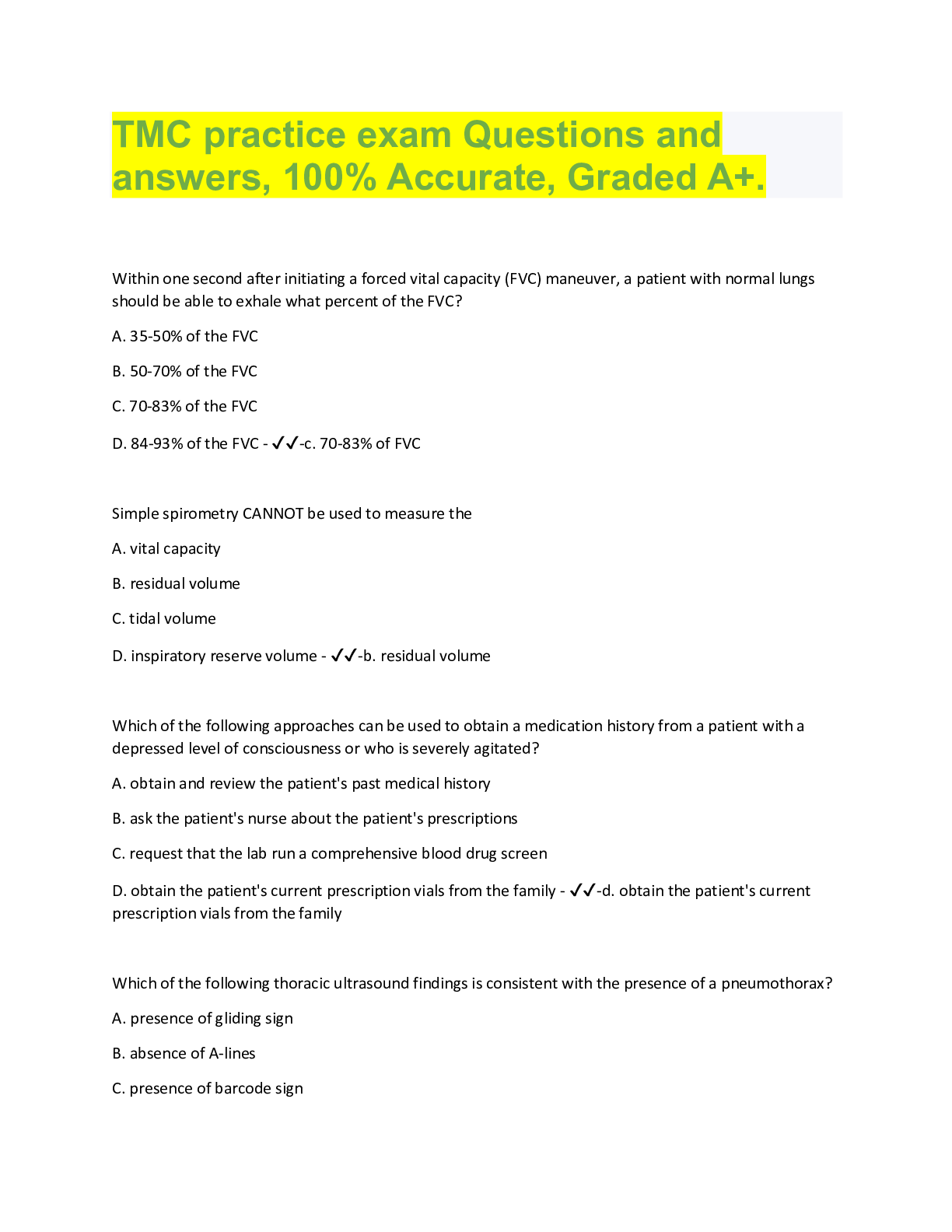
TMC practice exam Questions and
answers, 100% Accurate, Graded A+.
Within one second after initiating a forced vital capacity (FVC) maneuver, a patient with normal lungs
should be able to exhale what percent of the FVC?
A. 35-50% of the FVC
B. 50-70% of the FVC
C. 70-83% of the FVC
D. 84-93% of the FVC - ✔✔-c. 70-83% of FVC
Simple spirometry CANNOT be used to measure the
A. vital capacity
B. residual volume
C. tidal volume
D. inspiratory reserve volume - ✔✔-b. residual volume
Which of the following approaches can be used to obtain a medication history from a patient with a
depressed level of consciousness or who is severely agitated?
A. obtain and review the patient's past medical history
B. ask the patient's nurse about the patient's prescriptions
C. request that the lab run a comprehensive blood drug screen
D. obtain the patient's current prescription vials from the family - ✔✔-d. obtain the patient's current
prescription vials from the family
Which of the following thoracic ultrasound findings is consistent with the presence of a pneumothorax?
A. presence of gliding sign
B. absence of A-lines
C. presence of barcode sign
D. presence of seashore sign - ✔✔-c. presence of barcode lines
Which of the following would tend to increase insensible water loss?
A. hypothermia
B. bypassed upper airway
C. hypoventilation
D. diuretic administration - ✔✔-b. bypassed upper airway
Which of the following would tend to decrease a patient's energy expenditure?
A. hypothermia
B. inflammation
C. major trauma
D. agitation/pain - ✔✔-a. hypothermia
A patient has acute respiratory acidosis. You would expect the base excess (BE) to range between:
A. + 6 mEq/L
B. - 6 mEq/L
C. +/- 2 mEq/L
D. +/- 8 mEq/L - ✔✔-c. +/- 2 mEq/L
Which of the following arterial blood gas results would most likely be reported for a patient who is
having a mild asthma attack?
A. pH = 7.31 PCO2 = 50 torr PO2 = 60 torr
B. pH = 7.40 PCO2 = 50 torr PO2 = 50 torr
C. pH = 7.47 PCO2 = 32 torr PO2 = 60 torr
D. pH = 7.47 PCO2 = 40 torr PO2 = 50 torr - ✔✔-c. pH= 7.47 PCO2= 32 torr PO2= 60 torr
The Apgar score for a normal newborn infant ranges between
A. 1-4
B. 4-7
C. 7-10
D. 10-13 - ✔✔-c. 7-10
On inspection of a patient's ECG strip, you note no identifiable P waves; rapid irregular undulations of
the isoelectric line; and an irregular ventricular rhythm. In addition, the precordial cardiac rate is greater
than the peripheral pulse rate. The most likely problem is:
A. 2nd degree (Wenckebach) heart block
B. ventricular fibrillation
C. atrial fibrillation
D. ventricular tachycardia - ✔✔-c. atrial fibrillation
In inspecting an elderly female patient, you note that her spine has an abnormal anterposterior (AP)
curvature. Which of the following terms would you use in charting this observation?
A. kyphosis
B. scoliosis
C. kyphoscoliosis
D. pectus excavatum - ✔✔-a. kyphosis
During auscultation of a patient's chest, you hear intermittent "bubbling" sounds at the lung bases.
Which of the following chart entries best describe this finding?
A. "bronchial sounds heard at lung bases"
B. "wheezes heard at lung bases"
C. "rhonchi heard at lung bases"
D. "crackles (rales) heard at lung bases" - ✔✔-d. "crackles (rales) heard at lung bases"
While assessing a patient's radial pulse, you note that the pulse feels full and bounding. Which of the
following conditions would be the most probable cause of this finding?
A. hypovolemia
B. hypertension
C. cardiovascular shock
D. low cardiac output - ✔✔-b. hypertension
A patient is cachexic, exhibits generalized edema and dry skin, and appears listless. The most likely
problem is:
A. heart failure
B. Addison's disease
C. renal failure
D. malnutrition - ✔✔-d. malnutrition
Prior to giving an aerosol treatment, you find a note in the chart that states your patient had pink frothy
secretions on admission to the ED. This is most indicative of:
A. cor pulmonale
B. left ventricular failure
C. an electrolyte imbalance
D. ARDS - ✔✔-b. left ventricular failure
A doctor orders a changeover to CPAP for a patient receiving bi-level positive airway pressure (BiPAP)
via a device with separate IPAP and EPAP controls. To effect this change you would:
A. set IPAP less than EPAP
B. set IPAP greater than EPAP
C. set EPAP = 0 cm H2O
D. set IPAP equal to EPAP - ✔✔-a. set IPAP less than EPAP
How would you characterize the degree of dyspnea of a patient who walks slower than people of the
same age because of breathlessness?
A. slight
B. moderate
C. severe
D. very severe - ✔✔-b. moderate
Upon exam of an acutely dyspneic and hypotensive patient, you note the following - all on the left side
of the chest: reduced chest expansion, hyperresonance to percussion, absent of breath sounds and
tactile fremitus, and a tracheal shift to the right. These findings suggest:
A. left-sided pneumothorax
B. left-sided consolidation
C. left lobar obstruction/atelectasis
D. left-sided pleural effusion - ✔✔-a. left-sided pneumothorax
A patient's response to an interview question is initially vague or unclear. Which of the following
responses on your part would be most appropriate?
A. "Please go on"
B. "You seem to be anxious"
C. "I see why you are so upset"
D. "Please explain that to me again" - ✔✔-d. "please explain that to me again"
A patient is asked to inhale as deeply as possible and blow out all his air as hard as they can until empty.
What test is being performed?
A. FVC
B. IC
C. TLC
D. MVV - ✔✔-a. fvc
When a patient is receiving positive-pressure ventilation, you should strive to keep the alveolar (plateau)
airway pressure below:
A. 20 cm H2O
B. 30 cm H2O
C. 40 cm H2O
D. 50 cm H2O - ✔✔-b. 30 cm H2O
On inspection of an ECG rhythm strip from an adult patient, you note the following: rate of 150; regular
rhythm; normal P waves, P-R intervals, and QRS complexes. The most likely problem is:
A. atrial flutter
B. sinus tachycardia
C. ventricular tachycardia
D. atrial fibrillation - ✔✔-b. sinus tachycardia
On inspection of a 12-lead ECG, you note the absence of P waves and a variable R-R interval (> 0.12 sec).
Which of the following is the most likely problem?
A. atrial hypertrophy
B. first-degree heart block
C. atrial fibrillation
D. sinus arrhythmia - ✔✔-c. atrial fibrillation
What percent decrease in FEV1 needs to occur to conclude that a methacholine challenge is positive for
airway hyperreactivity?
A. 10%
B. 15%
C. 20%
D. 25% - ✔✔-c. 20%
A patient is receiving ventilatory support after thoracic surgery. You measure the patient's maximum
inspiratory pressure (MIP/NIF) as -33 cm H2O. Based on this value, the patient has:
A. a need for continued ventilatory support
B. a large leak in their endotracheal tube cuff
C. a normal maximum inspiratory pressure
D. adequate muscle strength to consider weaning - ✔✔-d. adequate muscle strength to consider
weaning
During a single-breath capnogram, the sharp downstroke and return to baseline that normally occurs
after the end-tidal point indicates:
A. exhalation of mainly deadspace gas
B. inspiration of fresh respiratory gas
C. exhalation of mixed alveolar/deadspace gas
D. exhalation of mainly alveolar gas - ✔✔-b. inspiration of fresh respiratory gas
A patient is considered as having suff
[Show More]