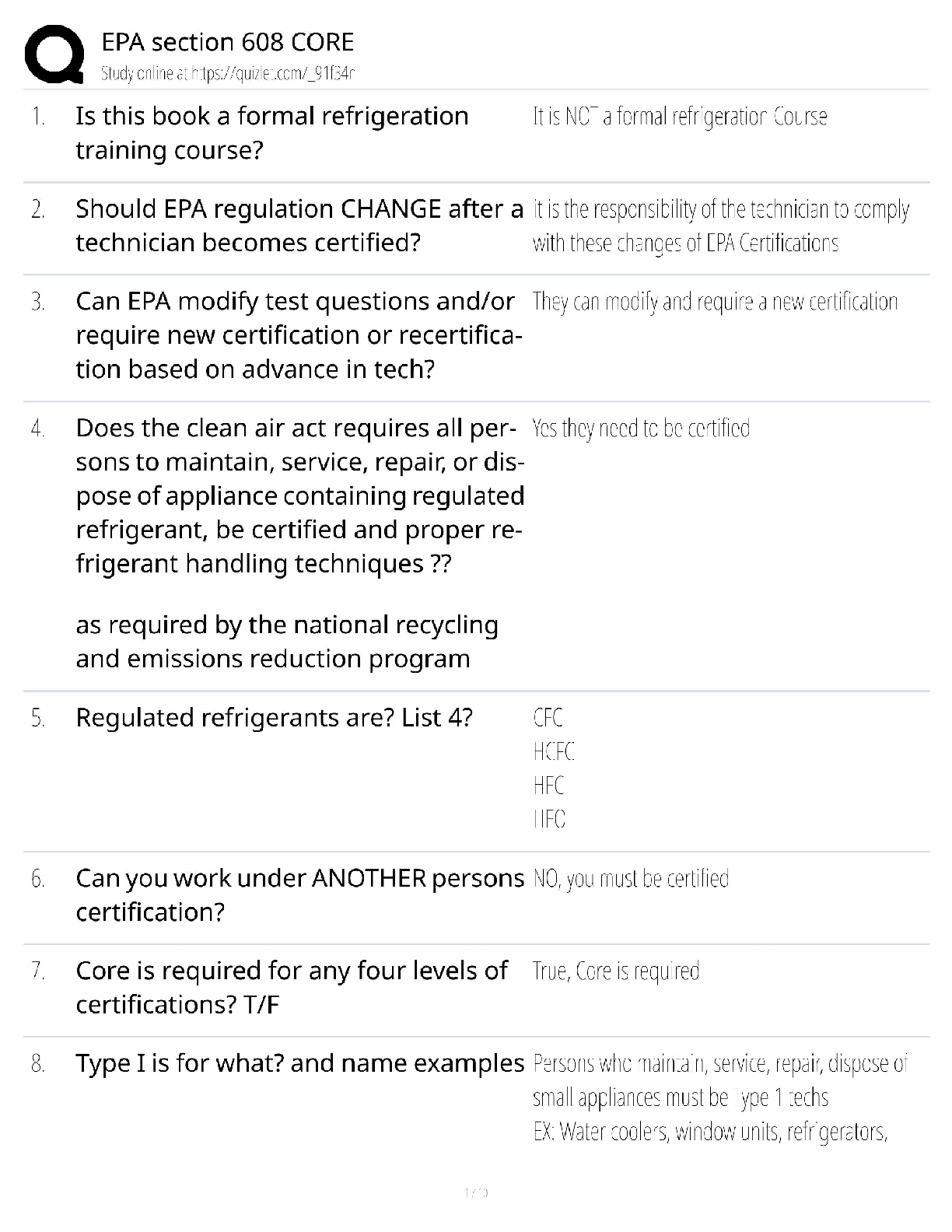
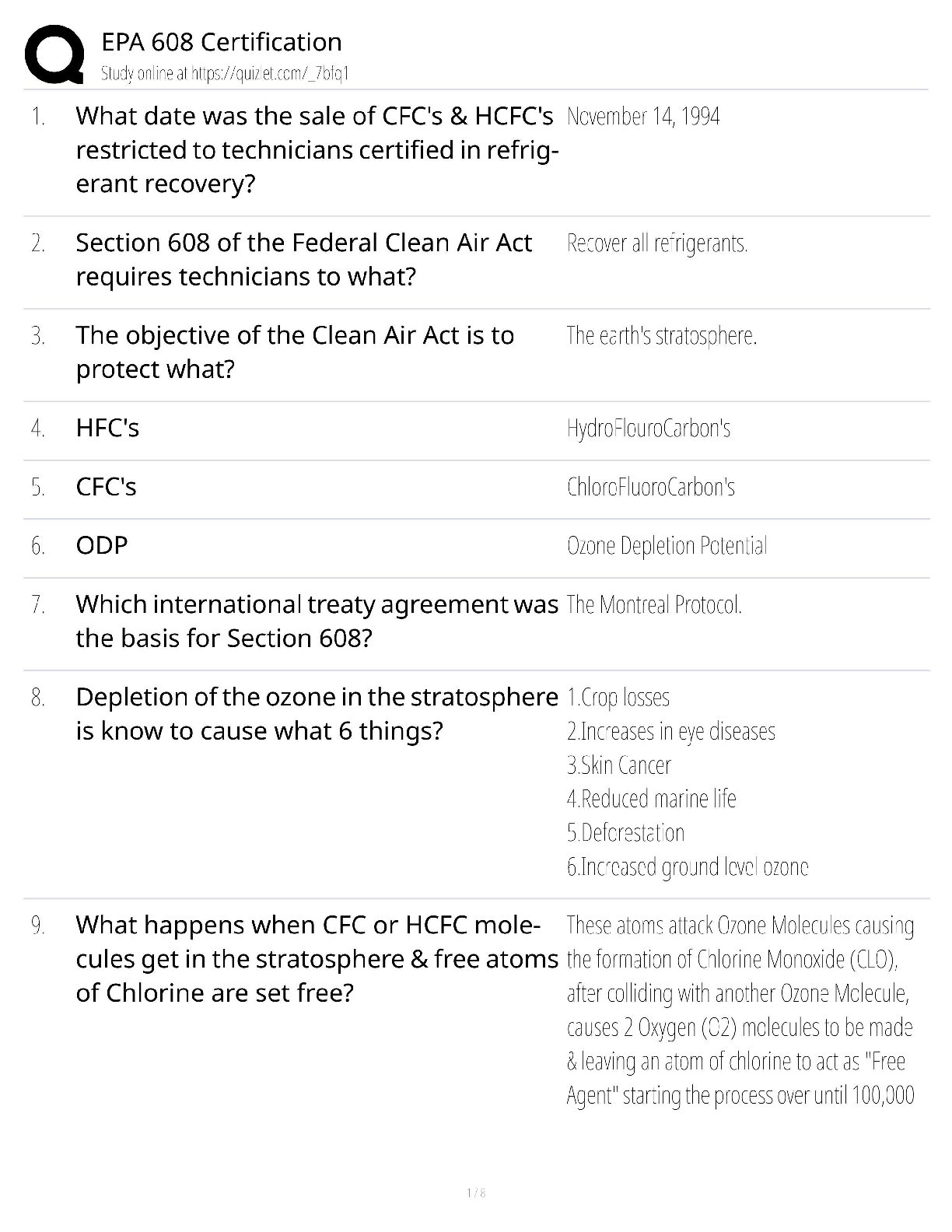
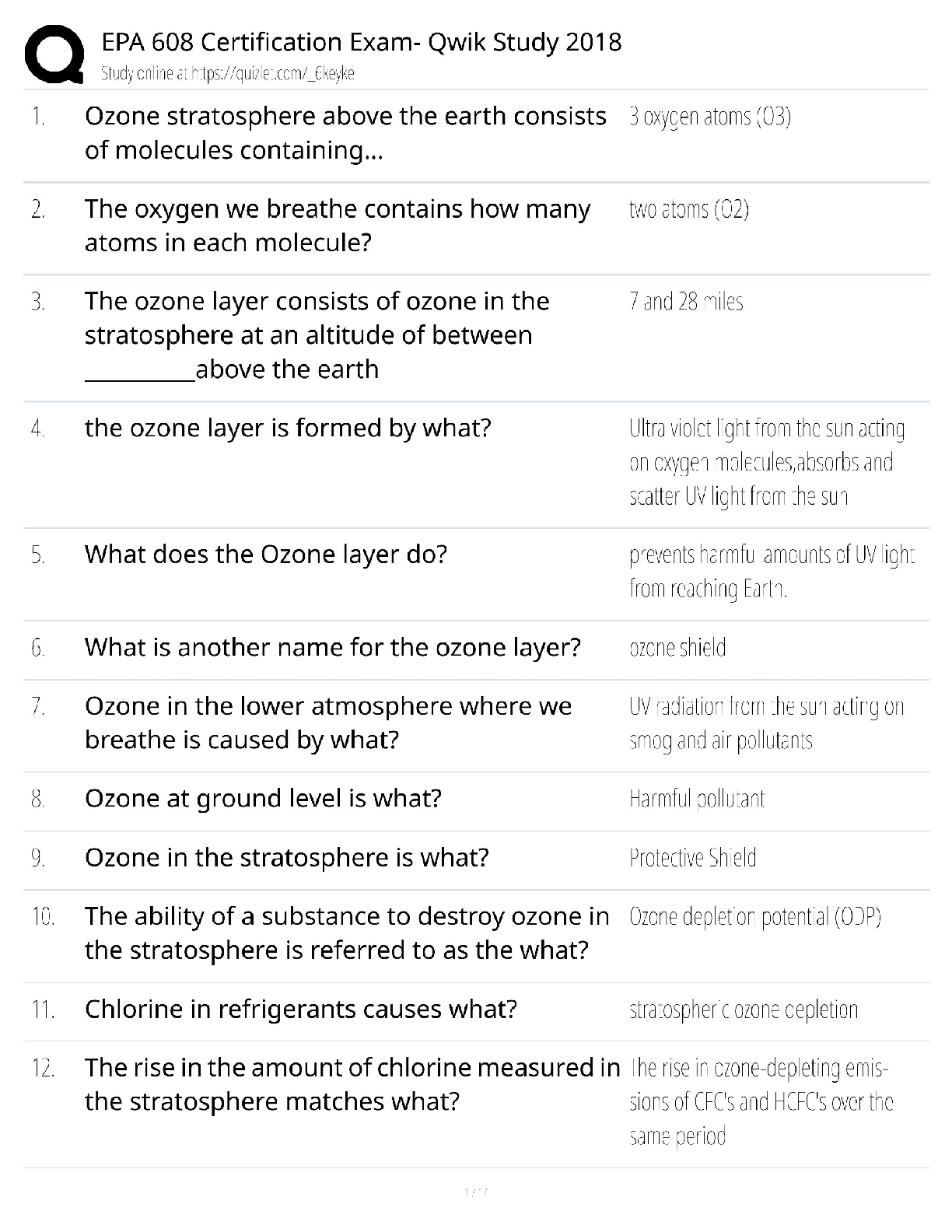
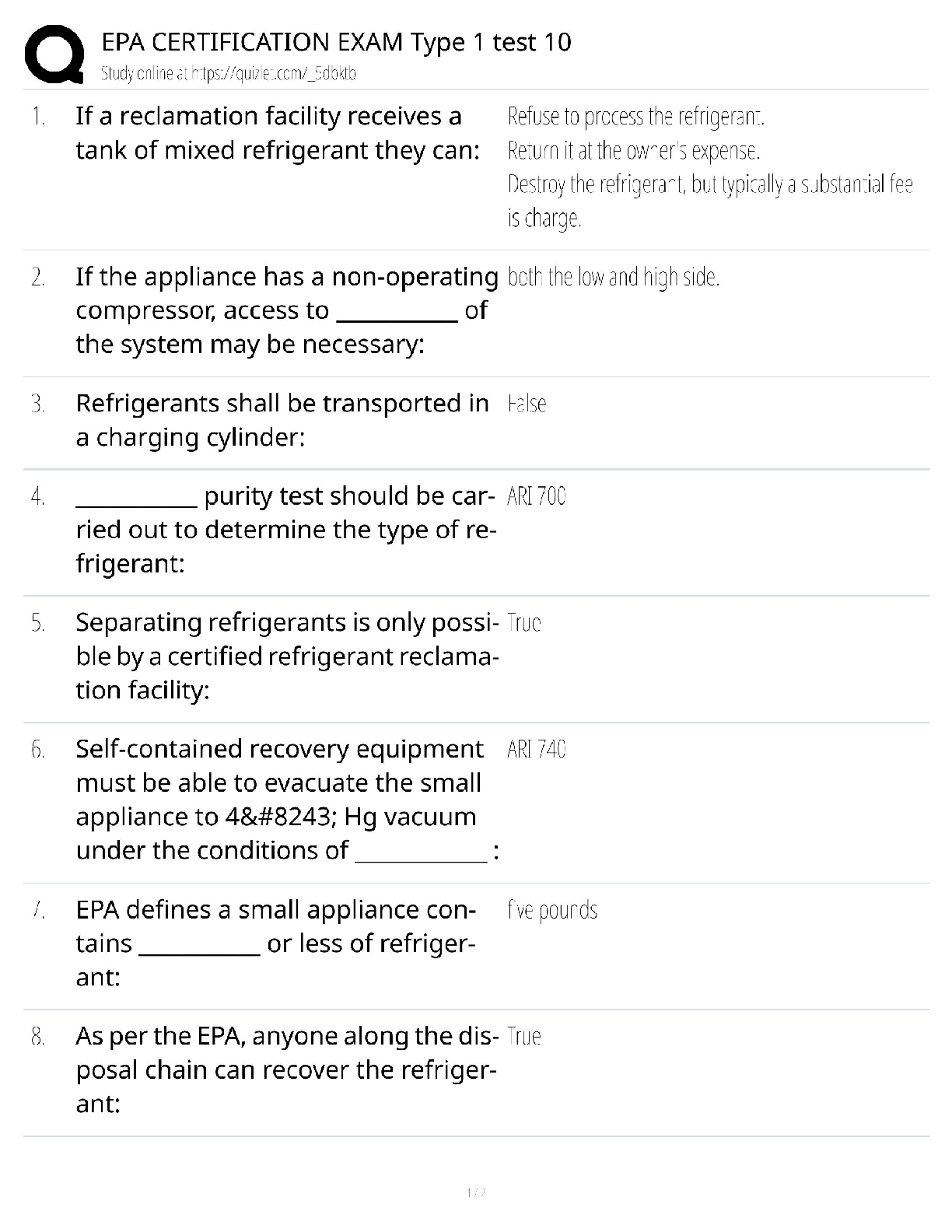
EPA 608 Core Test Sample Questions &
Answers, 100% Accurate, rated A
As of what date did it become unlawful to release Class 1 and Class II
refrigerants to the atmosphere?
a. July 1, 1992
b. July 1, 1993
c. Novemb
...
EPA 608 Core Test Sample Questions &
Answers, 100% Accurate, rated A
As of what date did it become unlawful to release Class 1 and Class II
refrigerants to the atmosphere?
a. July 1, 1992
b. July 1, 1993
c. November 14, 1994
d. January 1, 1996 - ✔✔-a. July 1, 1992
What is the ozone layer and why is it important to us on Earth?
a. Thin layer of R-22 in the atmosphere that filters UV.
b. Protective shield for Earth from the sun's harmful ultraviolent (UV)
rays in the stratosphere layer that extends about 6 to 30 miles above
earth
c. Thin layer of CFC and HCFC in the atmosphere that filters UV.
d. Protective layer that shields UV in the Troposphere - ✔✔-b. Protective shield for Earth from the sun's
harmful ultraviolent (UV)
rays in the stratosphere layer that extends about 6 to 30 miles above
earth
The atom found in CFC and HCFC refrigerants that destroys ozone in the
stratosphere is?
a. Fluorine
b. Carbon
c. Hydrogen
d. Chlorine - ✔✔-d. Chlorine
What is an ozone molecule made of?
a. Refrigerant
b. Ammonia
c. Three oxygen atoms (O3).
d. Oxygen and ammonia. - ✔✔-Three oxygen atoms (O3).
Which refrigerant is a CFC?
a. R-134A
b. R-123
c. R-22
d. R-12 - ✔✔-d. R-12
What is the name of the atom that attacks ozone molecules?
a. CFC atoms
b. HCFC atoms
c. Chlorine and bromine atoms emitted into the atmosphere
d. a and b - ✔✔-c. Chlorine and bromine atoms emitted into the atmosphere
Which refrigerant is a HFC?
a. R-134A
b. R-123
c. R-22
d. R-12 - ✔✔-a. R-134A
Describe how one Chlorine atom can destroy 100,000 ozone molecules.
a. Chlorine releases one of the oxygen atoms and forms two O2 oxygen
molecules, leaving the chlorine molecule free to attack another
ozone molecule and repeat the process.
b. Chlorine locks up the ozone molecule and then and then goes after
another.
c. Chlorine converts the ozone to bromine and then attacks more ozone
molecules.
d. Chlorine can bleach 100,000 ozone molecules before it weakens. - ✔✔-a. Chlorine releases one of the
oxygen atoms and forms two O2 oxygen molecules, leaving the chlorine molecule free to attack another
ozone molecule and repeat the process.
Which refrigerant contains no chlorine?
a. R-134A
b. R-123
c. R-22
d. R-12 - ✔✔-a. R-134A
Name the refrigerant types that belong to CFCs, HCFCs and HFCs
a. CFC R-11, R-12, R-500
b. HCFC R-22, R-123
c. HFC R-134a
d. All of the above are correct - ✔✔-d. All of the above are correct
The rule of thumb for refilling approved cylinders is a maximum of ___ percent
liquid?
a. 60%
b. 79%
c. 80%
d. 90% - ✔✔-c. 80%
What do the letters in "HCFC" stand for?
a. High Carbon Fluorine Chlorine
b. hydrochlorofluorocarbons
c. Harmful Carbon Fluorine Chlorine
d. highchlorinefluorocarbon - ✔✔-b. hydrochlorofluorocarbons
To recover refrigerant is to?
a. Remove a refrigerant in any condition from a system in either an
active or passive manner, and store it in an external container
without necessarily testing or processing
b. Reduce contaminants in used refrigerant by oil separation through filter
dryers.
c. Reprocess refrigerant to new product specifications
d. Remove refrigerant and change ownership. - ✔✔-a. Remove a refrigerant in any condition from a
system in either an
active or passive manner, and store it in an external container
without necessarily testing or processing
What is ODP?
a. Oxygen Destruction Properties
b. Ozone Depletion Potential
c. Ozone Destruction Properties
d. Oxygen Depletion Potential - ✔✔-b. Ozone Depletion Potential
R-134A is a "drop in" refrigerant for?
36 | P a g e
a. R-12
b. R-22
c. R-11
d. R-134A is not a drop-in refrigerant - ✔✔-d. R-134A is not a drop-in refrigerant
Name some of the health and environmental effects of ozone depletion.
a. Increased Temperature of the Earth
b. Increased Cases of Skin Cancer
c. Increased numbers of Cataracts in the eyes
d. All the above - ✔✔-d. All the above
The condition and state of the refrigerant leaving a receiver is?
a. Subcooled liquid
b. Subcooled vapor
c. Superheated vapor
d. Superheated liquid. - ✔✔-a. Subcooled liquid
What evidence do we have that CFCs and HCFCs are depleting the ozone?
a. The rise in the amount of chlorine measured in the stratosphere over the
past two decades matches the rise in the amount of fluorine.
b. The rise in the amount of chlorine measured in the stratosphere over the
past two decades matches the rise in CFC emissions over the same
period.
c. Samples of air taken from the stratosphere over erupting volcanoes show
that volcanoes contribute a small quantity of chlorine to the stratosphere
compared to CFCs.
d. All the above - ✔✔-d. All the above
The component of an air conditioning system that changes a low pressure vapor
to a high pressure vapor is the?
a. Condenser
b. Metering device
c. Evaporator
d. Compressor
20.What characteristics - ✔✔-d. Compressor
What characteristics make it easy for CFCs to reach the stratosphere and how
do they get there?
a. CFCs are lighter than air atoms and rise into the Stratosphere.
b. CFCs will not dissolve in water or break down into compounds that dissolve in water. Wind moves
them into the Stratosphere
c. Heating of the CFCs makes them lighter than air.
d. a and c - ✔✔-b. CFCs will not dissolve in water or break down into compounds that dissolve in water.
Wind moves them into the Stratosphere
Why do we now use R-134a refrigerant?
a. It costs less
b. HFCs do not contain any chlorine
c. It is a drop in replacement for R-22
d. It is a drop in replacement for R-11 - ✔✔-b. HFCs do not contain any chlorine
What is the purpose of the CAA?
37 | P a g e
a. Regulate California Air quality
b. Clean the air in the US
c. Limit how much of a pollutant can be in the air in the US - ✔✔-c. Limit how much of a pollutant can be
in the air in the US
What three things is the CAA doing to control chlorofluorocarbon emissions?
a. Set dates to phase out CFC's and HCFC's
b. Prohibit venting of CFC and HCFC
c. Require the EPA to set standards for recovery of refrigerants prior to
appliance disposal
d. All the above - ✔✔-d. All the above
What can states do in addition to the CAA?
a. Enforce standards more strict than the CAA laws
b. Nothing
c. States can create their own laws.
d. All of the above - ✔✔-a. Enforce standards more strict than the CAA laws
What three things can happen if you violate the CAA?
a. Fine up to $27,500 per day, per violation
b. May lose your certification to handle refrigerants
c. May need to appear in US Federal Court for the charges
d. All the above - ✔✔-d. All the above
What incentive do others have to turn you in for violating the CAA?
a. An award of up to $10,000 is offered by the EPA
b. An award of up to $100,000 is offered by the EPA
c. An award of up to $1,000 is offered by the EPA
d. None of the above - ✔✔-An award of up to $10,000 is offered by the EPA
Who can purchase refrigerants and what size cylinders can be purchased?
a. Only certified technicians may purchase refrigerants as of November 14, 1994
b. The smallest cylinder a 608 certified technician may purchase is 20 lbs
c. A certified technician can purchase HCFC
d. All the above - ✔✔-
What is the Montreal Protocol?
a. Treaty between Canada and the US to limit use of refrigerants
b. Treaty among nations designed to protect the stratospheric ozone
layer.
c. Method to clean the air developed in Montreal
d. Carbon regulation - ✔✔-b. Treaty among nations designed to protect the stratospheric ozone
layer.
What chemicals does the Montreal Protocol control?
a. chlorofluorocarbons (CFCs), halons,
b. carbon tetrachloride
c. methyl chloroform
d. All the above - ✔✔-d. All the above
When was the CFC phase out date?
a. November 31, 2003
b. December 31, 1995
c. November 15, 1990
d. November 15, 1993 - ✔✔-b. December 31, 1995
Where do CFC refrigerants come from for equipment servicing of older
systems?
a. DuPont
b. Government warehouse
c. Recovery and recycling
d. Imported from South America - ✔✔-c. Recovery and recycling
What must be done before scrapping a refrigerant container?
a. Release the refrigerant
b. Recover to (0 psig) or lower and rendered useless
c. Punch a hole in the container
d. Add compressed air - ✔✔-b. Recover to (0 psig) or lower and rendered useless
What must be done before disposing of an appliance containing CFCs or
HCFCs?
a. Identify refrigerant by attaching DOE tag.
b. Identify refrigerant by attaching CAA tag
c. Identify refrigerant by attaching EPA tag
d. Refrigerant must be recovered - ✔✔-d. Refrigerant must be recovered
Who is responsible for removing refrigerants from a system that is being
disposed of?
a. HVACR tech
b. EPA
c. Original owner
d. Final person in the disposal chain - ✔✔-d. Final person in the disposal chain
Are there "drop-in" replacements for R-12 systems and if not, why?
a. There is no "drop-in" replacement gas for R-12
b. New refrigerants are incompatible with the oils and lubricants used in R-12
c. 134A uses a different oil than R-12
d. All the above - ✔✔-d. All the above
What type of oil is used in R-134a and what oils will mix with it?
a. Ester based oils
b. Ester based oils do not mix with other oils.
c. Synthetic alkylbenzene lubricant
d. a and b - ✔✔-d. a and b
Will the gases in a ternary blend leak at the same rate and why or why not?
a. They leak at different rates because they retain their different vapor pressures.
b. They leak at the same rate. A leak is a leak.
c. Ternary blends have the same vapor pressure.
d. All the above - ✔✔-a. They leak at different rates because they retain their different vapor
pressures.
What does a compressor compress?
a. Liquid refrigerant
b. Hot vapor
c. High pressure vapor
d. Low pressure, low temperature vapor - ✔✔-d. Low pressure, low temperature vapor
Explain how cooling of a space occurs in a refrigeration cycle
a. The indoor air is cooled
b. Heat is removed from inside the building and is deposited outside the building
c. Liquid refrigerant absorbs the heat and transfers it to the exterior.
d. Cold liquid refrigerant cools the indoor air. - ✔✔-b. Heat is removed from inside the building and is
deposited outside
the building
Will refrigerant migrate to the crank case in a compressor?
a. Refrigerant seeks the lowest point in the system, the compressor crankcase.
b. Refrigerant vaporizes and does not collect tin the compressor.
c. Oil migrates to the compressor crankcase.
d. Refrigerant will migrate towards the compressor crank case while the oil will not - ✔✔-d. Refrigerant
will migrate towards the compressor crank case while
the oil will not
What color is the compound gauge and what does the compound gauge
measure?
a. Blue and measures low pressure (psig) and vacuum (inches Hg)
b. Red and measures head pressure
c. Yellow and measures vacuum - ✔✔-a. Blue and measures low pressure (psig) and vacuum (inches Hg)
What color is the high pressure gauge?
a. Blue and measures high pressure
b. Red and measures the high side (discharge) pressure
c. Red and measures low side pressure
d. Yellow and measures high pressure - ✔✔-b. Red and measures the high side (discharge) pressure
What are three things the center hose is used for and what color is it usually?
a. Red, high pressure, low pressure and vacuum
b. Yellow hose and can be connected to a recovery device, evacuation
vacuum pump or charging device
c. Blue, low pressure, vacuum and recovery
d. Green, recovery, vacuum, low and high pressure - ✔✔-b. Yellow hose and can be connected to a
recovery device, evacuation
vacuum pump or charging device
What things should you look for in equipment and systems to help limit
refrigerant emissions?
a. Equipment used is approved by the EPA
b. Leak check, repairing leaks
c. Making sure that all fittings are tight during service and recovery
d. All the above - ✔✔-d. All the above
What is the most effective method for checking for small leaks?
a. Leak noise
b. Refrigerant dye
c. Pressurize with nitrogen
d. Halide torch - ✔✔-d. Halide torch
How can you test a system for leaks?
a. Evacuate the system and pull a vacuum on it
b. Use a hydrostatic test
c. Pressurize with oxygen
d. Use water pressure - ✔✔-a. Evacuate the system and pull a vacuum on it
What should you look for if a compressor burns out?
a. Frayed wires
b. Check paint on compressor body
c. Strong smell in refrigerant
d. Melted tubing - ✔✔-c. Strong smell in refrigerant
What will need to happen if the oil has been contaminated by a burnout?
a. Triple evacuate the system
b. Install a permanent filter-drier
c. Conduct a deep vacuum before recharging
d. All the above - ✔✔-d. All the above
How is recovery different from recycling?
a. Recycle is to clean refrigerant for immediate reuse
b. Recover is to remove refrigerant in any condition from a system and store
it in an external container
c. There is no difference
d. a and b - ✔✔-d. a and b
How is recycling different from reclaiming?
a. Recycling must be performed by a recycling plant
b. Recycle is to clean
c. Reclaim is to process refrigerant to the level of new product specifications
d. b and c - ✔✔-d. b and
[Show More]