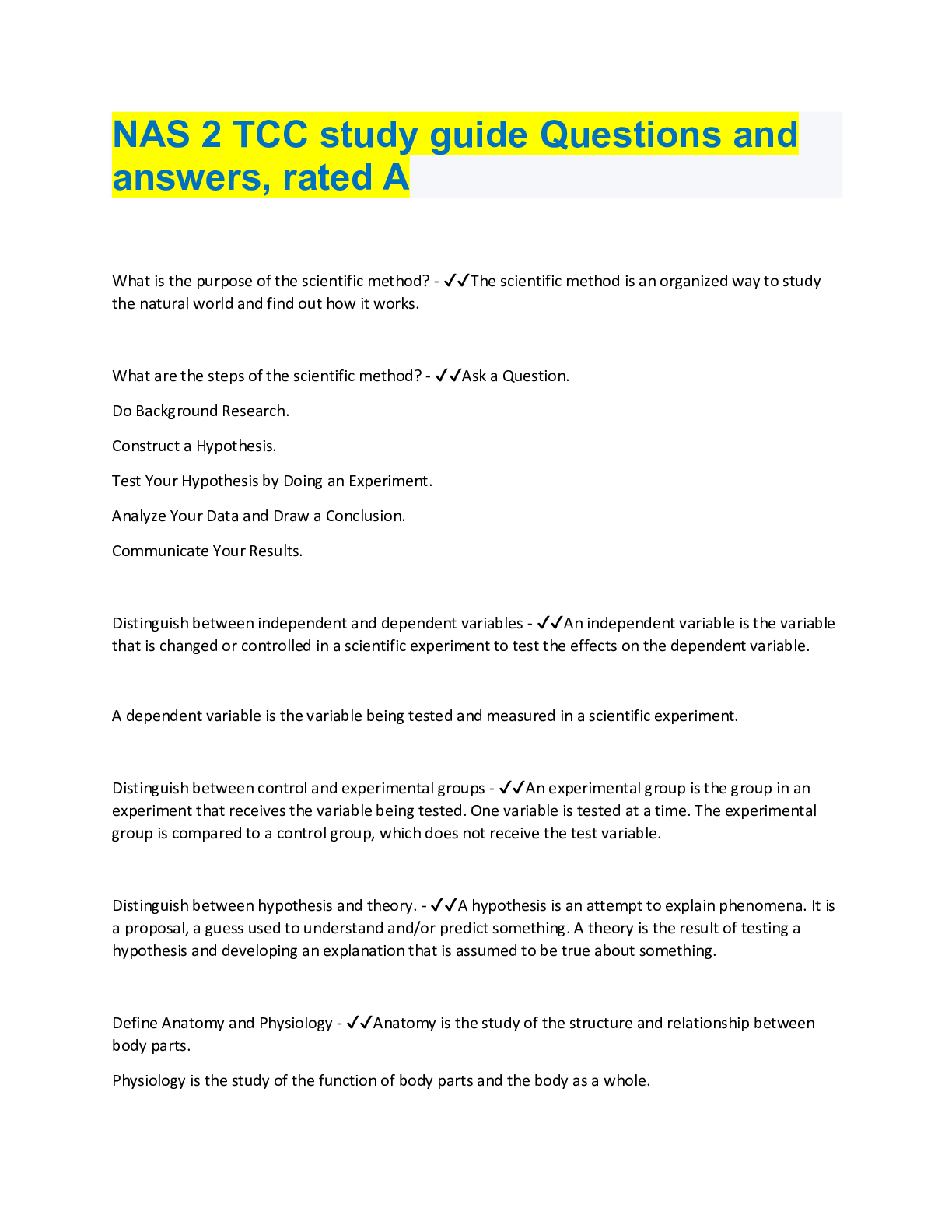
NAS 2 TCC study guide Questions and
answers, rated A
What is the purpose of the scientific method? - ✔✔The scientific method is an organized way to study
the natural world and find out how it works.
What are the st
...
NAS 2 TCC study guide Questions and
answers, rated A
What is the purpose of the scientific method? - ✔✔The scientific method is an organized way to study
the natural world and find out how it works.
What are the steps of the scientific method? - ✔✔Ask a Question.
Do Background Research.
Construct a Hypothesis.
Test Your Hypothesis by Doing an Experiment.
Analyze Your Data and Draw a Conclusion.
Communicate Your Results.
Distinguish between independent and dependent variables - ✔✔An independent variable is the variable
that is changed or controlled in a scientific experiment to test the effects on the dependent variable.
A dependent variable is the variable being tested and measured in a scientific experiment.
Distinguish between control and experimental groups - ✔✔An experimental group is the group in an
experiment that receives the variable being tested. One variable is tested at a time. The experimental
group is compared to a control group, which does not receive the test variable.
Distinguish between hypothesis and theory. - ✔✔A hypothesis is an attempt to explain phenomena. It is
a proposal, a guess used to understand and/or predict something. A theory is the result of testing a
hypothesis and developing an explanation that is assumed to be true about something.
Define Anatomy and Physiology - ✔✔Anatomy is the study of the structure and relationship between
body parts.
Physiology is the study of the function of body parts and the body as a whole.
Identify the six levels of organization (chemical, tissue, etc.) - ✔✔1) Chemical Level
2) Cellular level
3)Tissue level
4)Organ level
5)Organ system level
6) Organismal level
Identify the requirements for life: - ✔✔1. Reproduction 2. Response/reaction to environment 3.
Metabolism 4. Growth.
Identify survival needs: - ✔✔survival needs (5): nutrients, oxygen, water, stable body temperature, and
atmospheric pressure
What is homeostasis? - ✔✔The tendency of an organism or a cell to regulate its internal conditions,
usually by a system of feedback controls, so as to stabilize health and functioning, regardless of the
outside changing conditions.
What are the basic mechanisms of homeostasis? - ✔✔- Homeostatic control mechanisms have at least
three interdependent components: receptor, control center, and effector.
- The receptor senses environmental stimuli, sending the information to the control center.
- The control center, generally the brain, signals an effector (e.g. muscles) to respond to the stimuli.
- Positive feedback enhances or accelerates output created by an activated stimulus.
- Negative feedback brings a system back to its level of normal functioning such as adjusting blood
pressure, metabolism, and body temperature.
Anatomical position - ✔✔Anatomical position is the description of any region or part of the body in a
specific stance. In the anatomical position, the body is upright, directly facing the observer, feet flat and
directed forward. The upper limbs are at the body's sides with the palms facing forward.
SUPERIOR - ✔✔ABOVE THE HEAD IS SUPERIOR TO THE NECK
INFERIOR - ✔✔BELOW THE NECK IS INFERIOR TO THE HEAD
ANTERIOR (VENTRAL) - ✔✔CLOSE TO THE FRONT OF THE BODY -THE LIPS ARE ANTERIOR TO THE TEETH
POSTERIOR (DORSAL) - ✔✔CLOSE TO THE BACK OF THE BODY- THE TEETH ARE POSTERIOR TO THE LIPS
MEDIAL - ✔✔CLOSER TO THE MIDLINE OF THE BODY- THE NOSE IS MEDIAL TO THE EYES
LATERAL - ✔✔FARTHER FROM THE MIDLINE OF THE BODY- THE EYES ARE LATERAL TO THE NOSE
INTERMEDIATE - ✔✔BETWEEN TWO STRUCTURES- THE ELBOW IS INTERMEDIATE BETWEEN THE
SHOULDER AND WRIST
IPSILATERAL - ✔✔ON THE SAME SIDE OF THE BODY- THE RIGHT ARM AND THE RIGHT LEG ARE
IPSILATERAL
CONTRALATERAL - ✔✔ON OPPOSITES SIDES OF THE BODY- THE RIGHT ARM IS CONTRALATERAL TO THE
LEFT ARM
PROXIMAL - ✔✔NEARER TO THE POINT OF ATTACHMENT- THE ELBOW IS PROXIMAL TO THE WRIST
DISTAL - ✔✔FARTHER FROM THE POINT OF ATTACHMENT OF LIMB OR TRUNK- THE WRIST IS DISTAL TO
THE ELBOW
SUPERFICIAL - ✔✔CLOSER TO THE SURFACE OF THE BODY- THE SKIN IS SUPERFICIAL TO THE MUSCLE
DEEP - ✔✔FARTHER FROM THE SURFACE OF THE BODY- THE MUSCLES ARE DEEP TO THE SKIN
nasal - ✔✔nose area
orbital - ✔✔eye area
oral - ✔✔mouth area
buccal - ✔✔cheek area
cervical - ✔✔throat area
acromial - ✔✔point of shoulder
[Show More]