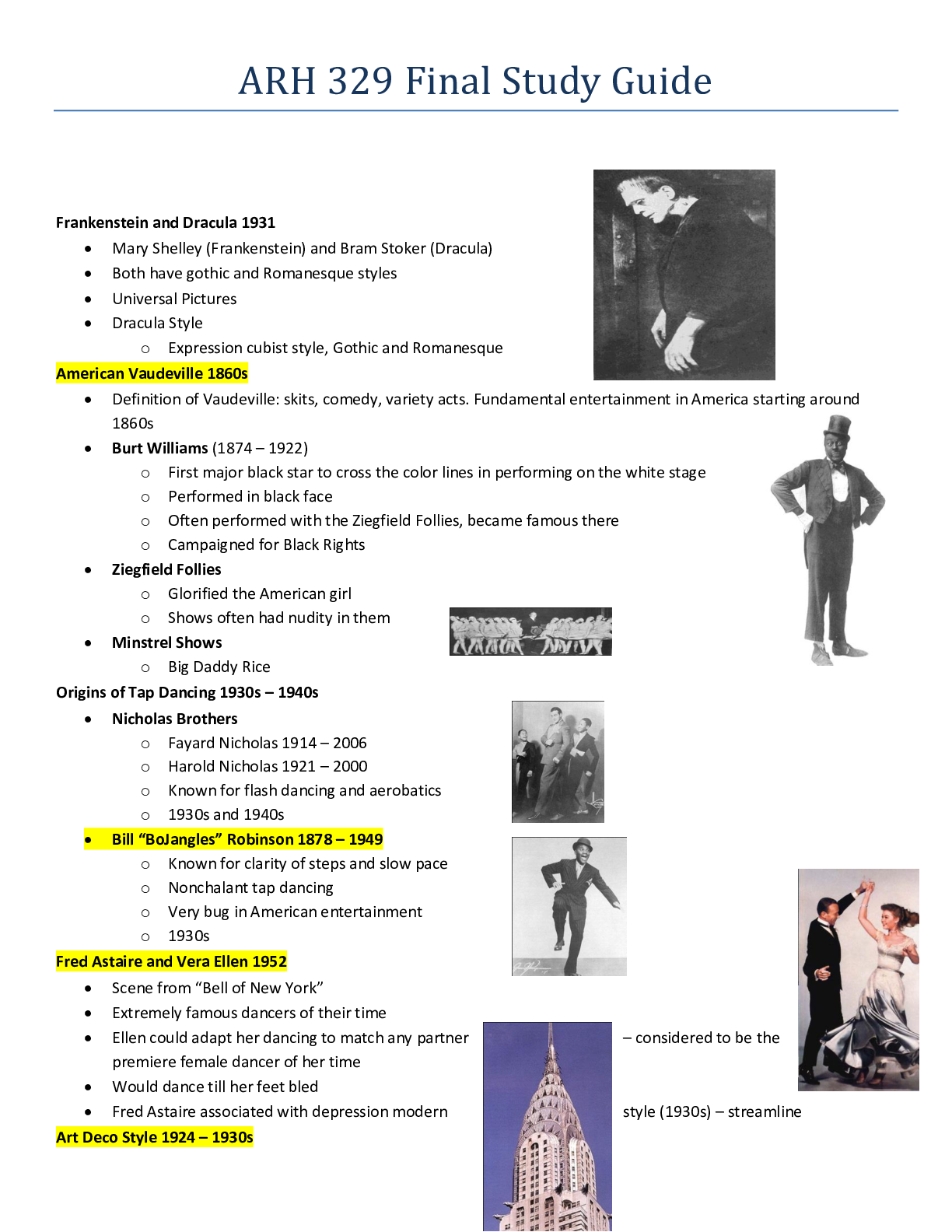
Frankenstein and Dracula 1931
• Mary Shelley (Frankenstein) and Bram Stoker (Dracula)
• Both have gothic and Romanesque styles
• Universal Pictures
• Dracula Style
o Expression cubist style, Gothic and Romanesque
...
Frankenstein and Dracula 1931
• Mary Shelley (Frankenstein) and Bram Stoker (Dracula)
• Both have gothic and Romanesque styles
• Universal Pictures
• Dracula Style
o Expression cubist style, Gothic and Romanesque
American Vaudeville 1860s
• Definition of Vaudeville: skits, comedy, variety acts. Fundamental entertainment in America starting around 1860s
• Burt Williams (1874 – 1922)
o First major black star to cross the color lines in performing on the white stage
o Performed in black face
o Often performed with the Ziegfield Follies, became famous there
o Campaigned for Black Rights
• Ziegfield Follies
o Glorified the American girl
o Shows often had nudity in them
• Minstrel Shows
o Big Daddy Rice
Origins of Tap Dancing 1930s – 1940s
• Nicholas Brothers
o Fayard Nicholas 1914 – 2006
o Harold Nicholas 1921 – 2000
o Known for flash dancing and aerobatics
o 1930s and 1940s
• Bill “BoJangles” Robinson 1878 – 1949
o Known for clarity of steps and slow pace
o Nonchalant tap dancing
o Very bug in American entertainment
o 1930s
Fred Astaire and Vera Ellen 1952
• Scene from “Bell of New York”
• Extremely famous dancers of their time
• Ellen could adapt her dancing to match any partner – considered to be the premiere female dancer of her time
• Would dance till her feet bled
• Fred Astaire associated with depression modern style (1930s) – streamline
Art Deco Style 1924 – 1930s
• 1924 – 1930; depression modern takes over
• Focused on craftsmanship and quality
• Mayan and South American architectural styles
• Step effect
• Very popular in France 1920 - 30s
• Artist: Renee Lalique
• Chrysler Building built in 1928
o William Van Alen 1882 – 1954
Clara Bow
• High-energy performer
• Known as the “It Girl”
o Flat chested, super red lips, flapper style
• Drank and smoke like a man
• Not wearing hoopskirts and whale-bone corsets
• Coined the American Flapper Style
Art Deco Building 1920s
• Art Deco as it spread across America: modernistic
o Commercialized deco
o Looks like deco “looks like $20,000, cost 20c”
• Built in 1920s
• No artist or building
• On Main Street in Columbia, Missouri
• Made to look very glitzy and stylized
King Kong Movie Scene
• Empire State building
• Architects:
o Raymond Shreive
o William Lamb
o Arthur Harmon
• Tower used to tie blimps to it
• Streamline style
Fred Astaire 1899 - 1987
• Performed with Vera Ella
• Famous dancer
• Early principal partner: Ginger Rogers
Buzby Berkley 1895 – 1976 foot light parade
• Choreographer, director for Warner Bros. and MGM
• Deco-dent style (wedding cake tier style)
• Known for pure escapism
• Taken away from stage into fantasy land
• Geometric shape (tiered cake look)
• Kaleidoscope shot
Johnson’s Wax Factory 1936
• Designed by Frank Lloyd Wright
o American Architect, educator, philosopher
• Racine, Wisconsin
• Depression Modern Style
• Blonde, curved linear
Designs by Loewy 1893 - 1986
• Raymond Loewy
• From Paris, France
• Depression Modern Style
• Very streamline
• Created a famous salon
• Influenced designs like the Coca-Cola bottle; designed after May West
Alfred Hitchcock 1899 – 1980
• Famous movie director and designer
• Obsessively meticulous
• Movies very suspenseful
• 5 characteristics of Films:
o Incompetence of police – arrest wrong man
o Kammerspiele lighting
o Appearance vs. reality – what you see is not how they are
o Original Sin – hero always flawed
o Characters have obsessions
Caress of the Sphinx 1896
• Show dualistic vision of women as angelic women but also a monster
• femme fatales
• Ferdinand Khnopff (1858 – 1921)
• Belgian Symbolist painter
• Symbolist movement began as literary movement emphasizing internal psychological phenomena rather than objective descriptions of nature
Orpheus the Painting 1893
• Delville (1867 – 1953)
• Belgium Symbolist painter, writer, and oculist (eye doctor)
• Frequently wrote about ideas but never discussed them; wanted to leave interpretations of paintings to the viewer
• Symbolist movement focused in France and Belgium
Mona Lisa with a Mustache 1919
• Duchamp
• Put a mustache on Mona Lisa
• Ready-Made art; takes something, adds something to it and declares it a new piece of art
• Meaning of this: reflect on DaVinci’s homosexuality and sexual ambiguity of Mona Lisa
• Major influence to Da-Da movement: reflects nonsense, anything can mean anything
o Anti-authoritarian
Melancholy and Mystery of a Street 1914
• Giorgio De Chirico (1888 – 1978)
• Italian Pre-Surrealist Painter
o Did not consider himself a surrealist
• Known as father of Surrealism Paintings
• Opposed modern art
• Tilt-up perspective and ambiguity of sizes
Persistence of Memory 1931
• Salvador Dali (1904 – 1989)
• Paranoiac-Critical Method
o When he would have nightmares, he would get up and draw them
• Shows time through dead fish and single living flies and ants in painting
• Spanish Surrealist painter
• Timeless, sizeless, airless
• Major themes in works:
o Dreams
o Unconscious
o Time
Spirit of the Dead Watching 1892
• Paul Gauguin (1848 – 1903)
• French symbolist painter
• Used a lot of bold coloring
• Had a huge influence on 1960s
• Post-impressionsim from France
• Synthetism: used to describe this painting
Campbell Soup One 1968
• Pop Art
• Colors jump out at you
• Designed by Andy Warhol
Andy Warhol (1928 – 1987)
• Designed Campbell Soup Can
• American Pop Artist
• “I want to be a machine” – expresses obsession with mass production
• Works show clear precision of his form and lacked any visible reference to paint texture
• Produced works that became iconic images of commercial and portrait
• Considered to be anti-commercialism but still embraced commercialism
Red, Blue, and Green 1963
• Ellsworth Kelly (1923 - )
• Minimalist, color-field painter
• American painter associated with hard-edge color field painting
• Color field popular in late 1950s – 1960s
• French American Sculpture and painter
Target with Four Faces 1955
• Jasper Johns (1930 - )
• Post-painterly abstraction
• Hard-edged, Discipline line, Color saturation, Geometric
• Primary colors at full strength
• A-traditional
• What is an object and is it still that object if isn’t used as such?
Timothy Leary 1960s
• Advocated LSD and mind expansion
• Connected to surrealism
• Harvard Professor in Psychology
• Raise yourself to higher plain
• “Turn on, tune in, drop out”
Allen Ginsberg 1950s
• Leader of beats in 1950s
• Wrote poem “Howl” it was anti-commercialism
• Funk Art: collage, described as sick, bizarre, sexual, rough, shawty
• Followed Buddhists, heavily influenced him
o His philosophy of living
The Beatles as portrayed in Yellow Submarine 1968
• Mix of pop art and surrealism
• Heavily influenced by Renee Magritte
• Highly saturated color scheme, hard edges
Loreena McKennitt
• Canadian Romantic Musician
• Pre-Raphaelite
• Bonny Swan
• Lady of Shallot
The Scream 1893
• Edvard Munch (1863 – 19
• Post impressionist
• Van Gogh and Freud
• Worked with Max Reinhart in Berlin
• Influenced German cinema
• Dr. Caligari
[Show More]


















.png)