ANCC FNP sample questions &
Answers. 100% Accurate. Verified.
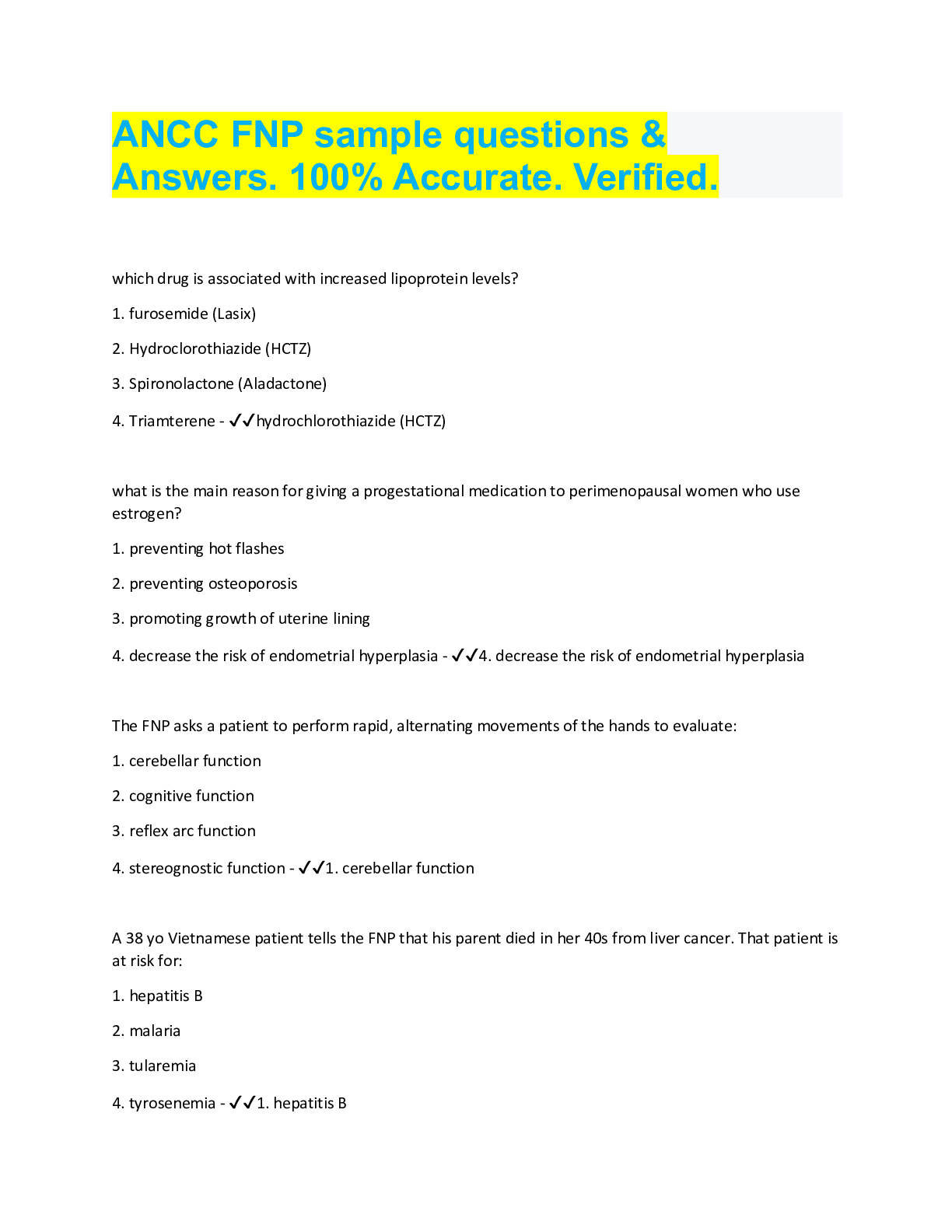
which drug is associated with increased lipoprotein levels?
1. furosemide (Lasix)
2. Hydroclorothiazide (HCTZ)
3. Spironolactone (Aladactone)
4. Triamt
...
ANCC FNP sample questions &
Answers. 100% Accurate. Verified.
which drug is associated with increased lipoprotein levels?
1. furosemide (Lasix)
2. Hydroclorothiazide (HCTZ)
3. Spironolactone (Aladactone)
4. Triamterene - ✔✔hydrochlorothiazide (HCTZ)
what is the main reason for giving a progestational medication to perimenopausal women who use
estrogen?
1. preventing hot flashes
2. preventing osteoporosis
3. promoting growth of uterine lining
4. decrease the risk of endometrial hyperplasia - ✔✔4. decrease the risk of endometrial hyperplasia
The FNP asks a patient to perform rapid, alternating movements of the hands to evaluate:
1. cerebellar function
2. cognitive function
3. reflex arc function
4. stereognostic function - ✔✔1. cerebellar function
A 38 yo Vietnamese patient tells the FNP that his parent died in her 40s from liver cancer. That patient is
at risk for:
1. hepatitis B
2. malaria
3. tularemia
4. tyrosenemia - ✔✔1. hepatitis B
a difficult aspect of determining occupational exposure to disease is the:
1. confidentiality of the information in company records
2. inaccuracy of disease reporting
3.long latency period between exposure and disease development
4. reliance on workers' memories - ✔✔3. long latency period between exposure and disease
development
To comply with regulations for third-party payor reimbursement and documentation, a family nurse
practitioner correlates:
1. evaluation and management code with history, examination and medical decision making.
2. health outcomes with physical examination findings and plan of care.
3.medication orders and treatment plan with electronic billing.
4. patient privacy with informed consent. - ✔✔1. evaluation and management code with history,
examination and medical decision making.
The family nurse practitioner examines a patient who has sustained a non-work-related injury that
interferes with the patient's ability to perform his or her job. The patient does not qualify for medical
disability and has a reasonable chance of engaging in a suitable occupation with proper therapy. The
nurse practitioner recommends that the patient apply for:
1. Family and Medical Leave Act benefits.
2. home health services.
3. Social Security benefits.
4.vocational rehabilitation services. - ✔✔4.vocational rehabilitation services.
A 45-year-old patient who is an opera singer reports progressive hoarseness for the last four weeks. The
hoarseness began after a three-hour opera performance. The patient does not smoke and reports no
weight loss, upper respiratory infection, dysphagia, or shortness of breath. The family nurse practitioner
manages this patient by:
1. ordering a computed tomography scan of the head.
2. ordering an immediate lateral neck x-ray.
3. prescribing systemic antibiotics and cool mist inhalations.
4. requesting a referral for evaluation of the larynx. - ✔✔4. requesting a referral for evaluation of the
larynx.
Routine immunization guidelines recommend administering the hepatitis B vaccine at birth and
repeating doses at:
1. one month and six months.
2. one month and two months.
3. four months and two years.
4. six months and 12 months. - ✔✔1. one month and six months.
A patient who sustained a myocardial infarction comes to the clinic for a refill of atorvastatin (Lipitor).
The family nurse practitioner explains that the medication is prescribed for:
1.cancer prevention.
2. primary prevention.
3. secondary prevention.
4. tertiary prevention. - ✔✔4. tertiary prevention.
Which health promotion strategy is most appropriate for adolescents who are obese?
1. individual-based behavior modification.
2. Motivational interviewing.
3. Parents should regulate meals.
4. Presenting video case studies. - ✔✔2. Motivational interviewing.
Treatment of viral conjunctivitis includes the use of:
1. antihistamine/decongestant drops.
2. antihistamine/mast cell stabilizer drops.
3. cold compresses.
4. steroid eyedrops. - ✔✔3. cold compresses.
A 60-year-old patient with diabetes has a blood pressure reading of 150/96 mmHg. After three months
of increased exercise and decreased calories, the patient has lost 10 lb (4.54 kg). The patient's follow-up
blood pressure is 142/94 mmHg. Which medication does the family nurse practitioner prescribe?
1. Enalapril (Vasotec).
2. Furosemide (Lasix).
3. Hydrochlorothiazide (HydroDIURIL).
4. Propranolol (Inderal). - ✔✔1. Enalapril (Vasotec).
A family nurse practitioner advises a nursing mother who has postpartum mastitis to take antibiotics as
prescribed and:
1. continue to nurse with both breasts.
2. pump the unaffected breast with a lactation pump.
3. take cool showers.
4. temporarily switch to formula. - ✔✔continue to nurse with both breasts.
A patient who had a total gastrectomy one year ago complains of a sore mouth, indigestion, and tingling
in the lower extremities. Which test is ordered by the family nurse practitioner?
1. Blood urea nitrogen level.
2. Complete blood count.
3. Liver function study.
4. Thyroid function study. - ✔✔2. Complete blood count.
A 42-year-old patient with epistaxis, dilated pupils, tachycardia, and mild euphoria shows symptoms
associated with the use of:
1. benzodiazepine (Alprazolam).
2. cocaine.
3. morphine (MS Contin).
4. oxycodone (OxyContin). - ✔✔2. cocaine.
A 40-year-old patient has had a generalized, nonpruritic skin eruption with intermittent exacerbations
over the past 10 years. Currently, a well-circumscribed erythematous plaque appears over the patient's
left gluteal fold area. The lesion is covered with scales and has some fissuring. The family nurse
practitioner makes a diagnosis of:
1. atopic dermatitis.
2. ichthyosis.
3. psoriasis.
4. tinea corporis. - ✔✔3. psoriasis.
During cardiac auscultation, a soft first heart sound with a holosystolic apical murmur that radiates to
the left axilla suggests:
1. aortic stenosis.
2. mitral regurgitation.
3. mitral stenosis.
4. mitral valve prolapse. - ✔✔mitral regurgitation.
A 68-year-old male patient reports an unintended weight loss of 15 lbs (6.8 kgs) over the last two
months. The patient states that he feels well. His problem list includes depression, tobacco use,
hyperglycemia, obesity, and dyslipidemia. The patient's medications are sertraline (Zoloft), metformin
(Glucophage), simvastatin (Zocor), and famotidine (Pepcid). The family nurse practitioner initiates which
three interventions?
Decreasing the statin medication.
Increasing the Glucophage dose.
Evaluating medication side effect profile.
Ordering a thyroid-stimulating hormone level test.
Performing a depression screening. - ✔✔Ordering a thyroid-stimulating hormone level test.
Performing a depression screening.
Evaluating medication side effect profile.
To determine whether sufficient evidence exists to prescribe glucosamine for a patient who has
osteoarthritis (OA) of the knee, the family nurse practitioner reviews three article summaries. Place the
article summaries in sequential order of strength of evidence from strongest to weakest:
1. Investigators conducted a retrospective review of 1000 charts of patients who were diagnosed with
OA and had glucosamine on their medication list. The investigators assessed the pain rating scale at the
time the glucosamine was prescribed and compared this score with the pain rating scale three months
after the medication had been prescribed. They also reviewed the progress notes and included only
patients for whom clinicians stated in the note that the patient took the medication regularly.
2. Investigators randomly assigned a group of 1600 patients with OA of the knee to receive either a
placebo or glucosamine for six months. The goal was to determine if glucosamine and/or chondroitin
treats pain related to OA of the knee and could help prevent structural damage. The study found no
benefit for pain relief for the study group compared with the placebo group.
3. Researchers evaluated the benefit of glucosamine for osteoarthritis of the hip and/or knee by
searching MEDLINE and the Cochrane database for studies that investigated this question. The
researchers included only studies that were double-blind, placebo-controlled, randomized trials of at
least four weeks duration and tested glucosamine's effectiveness in treating OA in the knee or hip.
Fifteen studies were included in the analysis and the investigators applied a statistical formula to
evaluate these studies, giving the larger studies more weight.
1, 2, 3
1, 3, 2
2, 1, 3
2, 3, 1
3, 1, 2
3, 2, 1 - ✔✔3, 2, 1
After determining that a two-and-half-year-old patient has a lead level of 16 mcg/dL, the family nurse
practitioner:
1. advises the parent to avoid giving the patient bottles of whole milk.
2. consults with a physical therapist for muscle strengthening.
3. observes for signs of diminished reflexes on the physical exam.
4. orders an increase of iron supplements to 6 mg/kg per day divided in two doses. - ✔✔observes for
signs of diminished reflexes on the physical exam.
Clinical practice guidelines are designed to:
1. be used in every patient situation.
2. increase variations in clinical care.
3. mandate practice decisions.
4. serve as a handbook to best practice. - ✔✔4. serve as a handbook to best practice.
Susan, age 59, has no specific complaints when she comes in for her annual examination. She does,
however, have type 2 diabetes mellitus (DM), slight hypertension, dyslipidemia, and central obesity.
How would you diagnose her?
1. As a healthy adult with several problems.
2. As having a glycemic event.
3. As having metabolic syndrome.
4. As having multiple organ dysfunction.
(cards 23-43 obtained from DavisEdge) - ✔✔As having meta
[Show More]