Project Title: Installation of MITRE CALDERA (Att@ck framework) within the testbed environment and
show its benefit in terms of attack-defense orchestration for sample attack defense use-cases.
Team Members: Matthew Jo
...
Project Title: Installation of MITRE CALDERA (Att@ck framework) within the testbed environment and
show its benefit in terms of attack-defense orchestration for sample attack defense use-cases.
Team Members: Matthew Johnson and Souradeep Bhattacharya
Project Objective: The objective of this project is to implement the MITRE CALDERA (Att@ck framework)
within the PowerCyber Testbed environment. The goal is to orchestrate the Lab experiments (Lab-1 to
Lab-5, in addition to a DoS attack) within the Caldera environment.
The following experiments will be conducted:
Experiment-1: Network Discovery with Active Scanning and Vulnerability Assessment
Experiment-2a: Network Sniffing and Exploitation on DNP3 Payload – without firewall protection
Experiment-2b: Network Sniffing and Exploitation on DNP3 Payload – with firewall protection
Experiment-3: DoS attack on SCADA Server
Description of Implementation:
Testbed: PowerCyber Testbed
Protocol: DNP3
Platform/Tools: MITRE Caldera, Python Plugin Library for Caldera (Sandcat, Deploy, Stockpile, etc.)
Virtual Environment: KaliVM
About Caldera: CALDERA (Cyber Adversary Language and Decision Engine for Red-team Automation), as
a cybersecurity framework, can be used in several ways. It is built on the MITRE ATT&CK™ framework. The
framework consists of two components:
• The core system - This is the framework code, consisting of what is available in this repository.
Included is an asynchronous command-and-control (C2) server with a REST API and a web-based
interface.
• Plugins - These repositories expand the core framework capabilities and providing additional
functionality. Examples include agents, reporting, collections of TTPs and more.
Requirements:
• Linux or MacOS operating system [KaliVM installed in PowerCyber Testbed will be utilized]
• Python 3.7+ (with pip3) [Python library for Caldera Plugins available on GitHub]
Applications:
• Autonomous red-team engagements – Building a specific adversary threat profile and deploying
in a network to see where it may be susceptible to attacks.
• Autonomous incident-response – Identifying TTPs that other security tools may not see or block
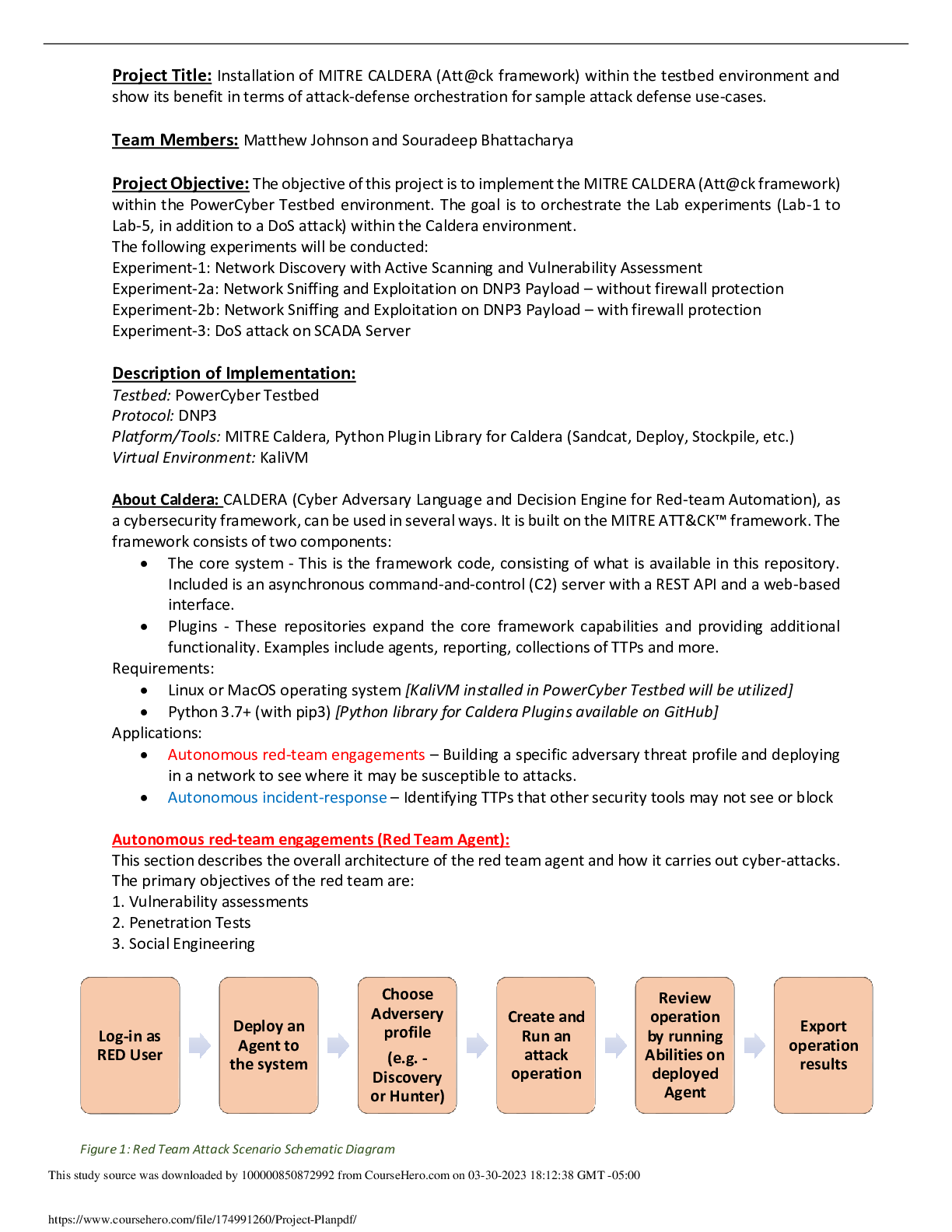
Autonomous red-team engagements (Red Team Agent):
This section describes the overall architecture of the red team agent and how it carries out cyber-attacks.
The primary objectives of the red team are:
1. Vulnerability assessments
2. Penetration Tests
3. Social Engineering
[Show More]