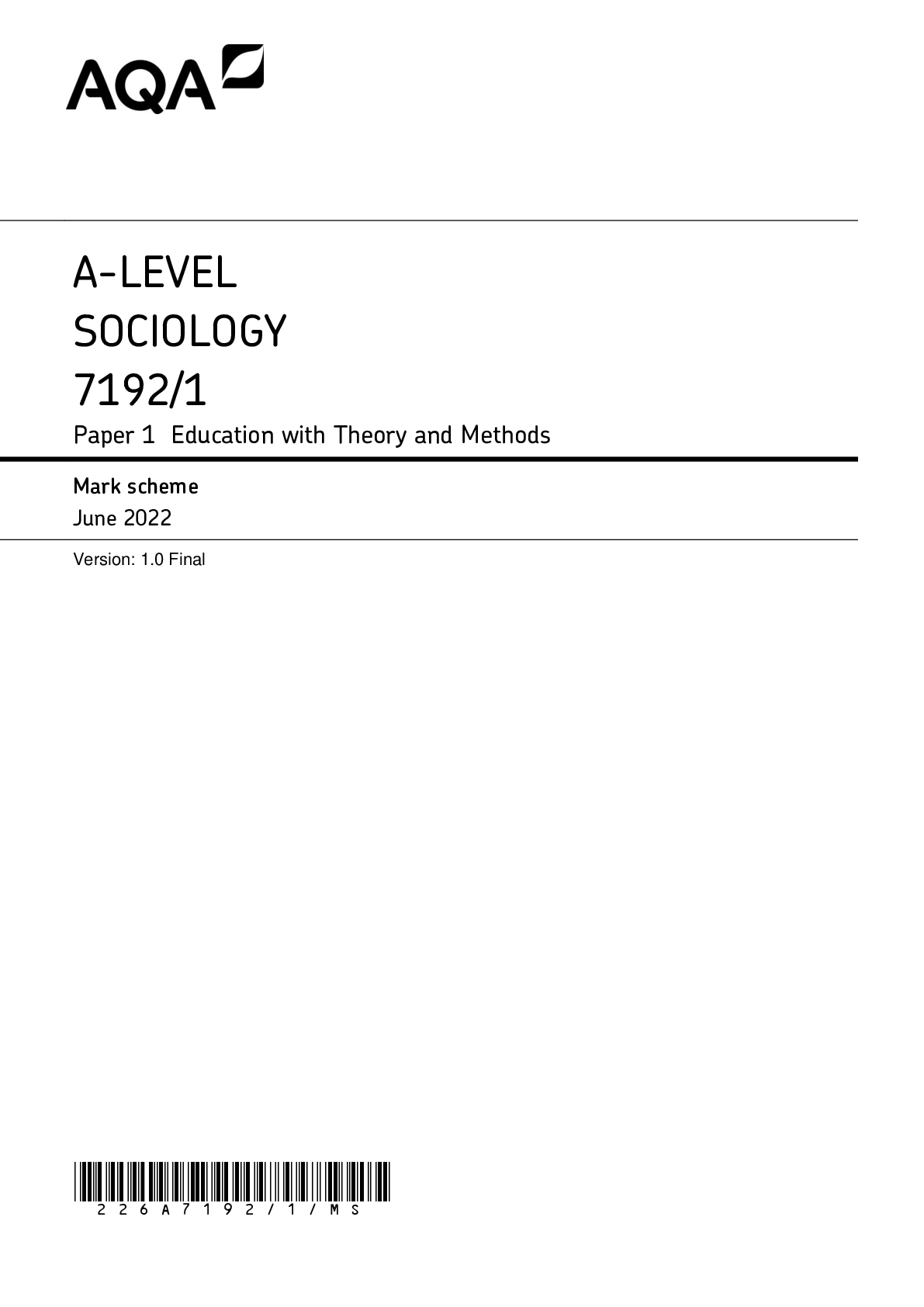
A-level
CHEMISTRY
7405/3
Paper 3
Mark scheme
June 2022
Version: 1.0 Final
*226A74053/MS*
MARK SCHEME – A-LEVEL CHEMISTRY – 7405/3 – JUNE 2022
2
Mark schemes are prepared by the Lead Assessment Writer and consi
...
A-level
CHEMISTRY
7405/3
Paper 3
Mark scheme
June 2022
Version: 1.0 Final
*226A74053/MS*
MARK SCHEME – A-LEVEL CHEMISTRY – 7405/3 – JUNE 2022
2
Mark schemes are prepared by the Lead Assessment Writer and considered, together with the relevant
questions, by a panel of subject teachers. This mark scheme includes any amendments made at the
standardisation events which all associates participate in and is the scheme which was used by them in
this examination. The standardisation process ensures that the mark scheme covers the students’
responses to questions and that every associate understands and applies it in the same correct way.
As preparation for standardisation each associate analyses a number of students’ scripts. Alternative
answers not already covered by the mark scheme are discussed and legislated for. If, after the
standardisation process, associates encounter unusual answers which have not been raised they are
required to refer these to the Lead Examiner.
It must be stressed that a mark scheme is a working document, in many cases further developed and
expanded on the basis of students’ reactions to a particular paper. Assumptions about future mark
schemes on the basis of one year’s document should be avoided; whilst the guiding principles of
assessment remain constant, details will change, depending on the content of a particular examination
paper.
Further copies of this mark scheme are available from aqa.org.uk
Copyright information
AQA retains the copyright on all its publications. However, registered schools/colleges for AQA are permitted to copy material from this booklet for
their own internal use, with the following important exception: AQA cannot give permission to schools/colleges to photocopy any material that is
acknowledged to a third party even for internal use within the centre.
Copyright © 2022 AQA and its licensors. All rights reserved.
MARK SCHEME – A-LEVEL CHEMISTRY – 7405/3 – JUNE 2022
3
AS and A-Level Chemistry
Mark Scheme Instructions for Examiners
1. General
The mark scheme for each question shows:
• the marks available for each part of the question
• the total marks available for the question
• the typical answer or answers which are expected
• extra information to help the examiner make his or her judgement and help to delineate what
is acceptable or not worthy of credit or, in discursive answers, to give an overview of the area
in which a mark or marks may be awarded.
The extra information in the ‘Comments’ column is aligned to the appropriate answer in the left�hand part of the mark scheme and should only be applied to that item in the mark scheme.
You should mark according to the contents of the mark scheme. If you are in any doubt about
applying the mark scheme to a particular response, consult your Team Leader.
At the beginning of a part of a question a reminder may be given, for example: where
consequential marking needs to be considered in a calculation; or the answer may be on the
diagram or at a different place on the script.
In general the right-hand side of the mark scheme is there to provide those extra details which
might confuse the main part of the mark scheme yet may be helpful in ensuring that marking is
straightforward and consistent.
The use of M1, M2, M3 etc in the right-hand column refers to the marking points in the order in
which they appear in the mark scheme. So, M1 refers to the first marking point, M2 the second
marking point etc.
2. Emboldening
2.1 In a list of acceptable answers where more than one mark is available ‘any two from’ is
used, with the number of marks emboldened. Each of the following bullet points is a
potential mark.
2.2 A bold and is used to indicate that both parts of the answer are required to award the
mark.
2.3 Alternative answers acceptable for a mark are indicated by the use of OR. Different terms
in the mark scheme are shown by a / ; eg allow smooth / free movement.
3. Marking points
3.1 Marking of lists
This applies to questions requiring a set number of responses, but for which students
have provided extra responses. The general ‘List’ principle to be followed in such a
situation is that ‘right + wrong = wrong’.
Each error / contradiction negates each correct response. So, if the number of errors /
contradictions equals or exceeds the number of marks available for the question, no
marks can be awarded.
However, responses considered to be neutral (often prefaced by ‘Ignore’ in the mark
scheme) are not penalised.
MARK SCHEME – A-LEVEL CHEMISTRY – 7405/3 – JUNE 2022
4
For example, in a question requiring 2 answers for 2 marks:
Correct
answers
Incorrect
answers (ie
incorrect rather
than neutral)
Mark (2) Comment
1 0 1
1 1 1
They have not exceeded the maximum
number of responses so there is no
penalty.
1 2 0
They have exceeded the maximum number
of responses so the extra incorrect
response cancels the correct one.
2 0 2
2 1 1
2 2 0
3 0 2 The maximum mark is 2
3 1 1
The incorrect response cancels out one of
the two correct responses that gained
credit.
3 2 0
Two incorrect responses cancel out the two
marks gained.
3 3 0
3.2 Marking procedure for calculations
Full marks should be awarded for a correct numerical answer, without any working
shown, unless the question states ‘Show your working’ or ‘justify your answer’. In this
case, the mark scheme will clearly indicate what is required to gain full credit.
If an answer to a calculation is incorrect and working is shown, process mark(s) can
usually be gained by correct substitution / working and this is shown in the ‘Comments’
column or by each stage of a longer calculation.
3.3 Errors carried forward, consequential marking and arithmetic errors
Allowances for errors carried forward are most likely to be restricted to calculation
questions and should be shown by the abbreviation ECF or consequential in the marking
scheme.
An arithmetic error should be penalised for one mark only unless otherwise amplified in
the marking scheme. Arithmetic errors may arise from a slip in a calculation or from an
incorrect transfer of a numerical value from data given in a question.
3.4 Equations
In questions requiring students to write equations, state symbols are generally ignored
unless otherwise stated in the ‘Comments’ column.
Examiners should also credit correct equations using multiples and fractions unless
otherwise stated in the ‘Comments’ column.
MARK SCHEME – A-LEVEL CHEMISTRY – 7405/3 – JUNE 2022
5
3.5 Oxidation states
In general, the sign for an oxidation state will be assumed to be positive unless
specifically shown to be negative.
3.6 Interpretation of ‘it’
Answers using the word ‘it’ should be given credit only if it is clear that the ‘it’ refers to the
correct subject.
3.7 Phonetic spelling
The phonetic spelling of correct scientific terminology should be credited unless there is a
possible confusion with another technical term or if the question requires correct IUPAC
nomenclature.
3.8 Brackets
(…..) are used to indicate information which is not essential for the mark to be awarded
but is included to help the examiner identify the sense of the answer required.
3.9 Ignore / Insufficient / Do not allow
Ignore or insufficient is used when the information given is irrelevant to the question or not
enough to gain the marking point. Any further correct amplification could gain the marking
point.
Do not allow means that this is a wrong answer which, even if the correct answer is
given, will still mean that the mark is not awarded.
3.10 Marking crossed out work
Crossed out work that has not been replaced should be marked as if it were not crossed
out, if possible. Where crossed out work has been replaced, the replacement work and
not the crossed out work should be marked.
3.11 Reagents
The command word ‘Identify’, allows the student to choose to use either the name or the
formula of a reagent in their answer. In some circumstances, the list principle may apply
when both the name and the formula are used. Specific details will be given in mark
schemes.
The guiding principle is that a reagent is a chemical which can be taken out of a bottle or
container. Failure to identify complete reagents will be penalised, but follow-on marks
(eg for a subsequent equation or observation) can be scored from an incorrect attempt
(possibly an incomplete reagent) at the correct reagent. Specific details will be given in
mark schemes.
For example, no credit would be given for:
• the cyanide ion or CN– when the reagent should be potassium cyanide or KCN;
MARK SCHEME – A-LEVEL CHEMISTRY – 7405/3 – JUNE 2022
6
• the hydroxide ion or OH– when the reagent should be sodium hydroxide or NaOH;
• the Ag(NH3)2
+
ion when the reagent should be Tollens’ reagent (or ammoniacal silver
nitrate). In this example, no credit is given for the ion, but credit could be given for a
correct observation following on from the use of the ion. Specific details will be given in
mark schemes.
In the event that a student provides, for example, both KCN and cyanide ion, it would be
usual to ignore the reference to the cyanide ion (because this is not contradictory) and
credit the KCN. Specific details will be given in mark schemes.
3.12 Organic structures
Where students are asked to draw organic structures, unless a specific type is required in
the question and stated in the mark scheme, these may be given as displayed, structural
or skeletal formulas or a combination of all three as long as the result is unambiguous.
In general
• Displayed formulae must show all of the bonds and all of the atoms in the molecule, but
need not show correct bond angles.
• Skeletal formulae must show carbon atoms by an angle or suitable intersection in the
skeleton chain. Functional groups must be shown and it is essential that all atoms
other than C atoms are shown in these (except H atoms in the functional groups of
aldehydes, secondary amines and N-substituted amides which do not need to be
shown).
• Structures must not be ambiguous, eg 1-bromopropane should be shown as
CH3CH2CH2Br and not as the molecular formula C3H7Br which could also represent the
isomeric 2-bromopropane.
• Bonds should be drawn correctly between the relevant atoms. This principle applies in
all cases where the attached functional group contains a carbon atom, eg nitrile,
carboxylic acid, aldehyde and acid chloride. The carbon-carbon bond should be clearly
shown. Wrongly bonded atoms will be penalised on every occasion. (see the
examples below)
• The same principle should also be applied to the structure of alcohols. For example, if
students show the alcohol functional group as C ─ HO, they should be penalised on
every occasion.
• Latitude should be given to the representation of C ─ C bonds in alkyl groups, given
that CH3─ is considered to be interchangeable with H3C─ even though the latter would
be preferred.
• Similar latitude should be given to the representation of amines where NH2─ C will be
allowed, although H2N─ C would be preferred.
• Poor presentation of vertical C ─ CH3 bonds or vertical C ─ NH2 bonds should not be
penalised. For other functional groups, such as ─ OH and ─ CN, the limit of tolerance
is the half-way position between the vertical bond and the relevant atoms in the
attached group.
MARK SCHEME – A-LEVEL CHEMISTRY – 7405/3 – JUNE 2022
7
By way of illustration, the following would apply.
CH3 C C
CH3
C
CH3CH2
OH C C
OH
allowed allowed not allowed not allowed not allowed
NH2 C C
NH2
NH2
NH2
NO2
allowed allowed allowed allowed not allowed
CN C C
CN
COOH C C
COOH
C
COOH
not allowed not allowed not allowed not allowed not allowed
CHO C C
CHO
C
CHO
COCl C C
COCl
not allowed not allowed not allowed not allowed not allowed
• Representation of CH2 by C−H2 will be penalised.
• Some examples are given here of structures for specific compounds that should not
gain credit (but, exceptions may be made in the context of balancing equations)
CH3COH for ethanal
CH3CH2HO for ethanol
OHCH2CH3 for ethanol
C2H6O for ethanol
CH2CH2 for ethene
CH2.CH2 for ethene
CH2:CH2 for ethene
• Each of the following should gain credit as alternatives to correct representations of
the structures.
CH2 = CH2 for ethene, H2C=CH2
CH3CHOHCH3 for propan-2-ol, CH3CH(OH)CH3
MARK SCHEME – A-LEVEL CHEMISTRY – 7405/3 – JUNE 2022
8
• In most cases, the use of ‘sticks’ to represent C ─ H bonds in a structure should not be
penalised. The exceptions to this when “sticks” will be penalised include
• structures in mechanisms where the C ─ H bond is essential (e.g. elimination
reactions in halogenoalkanes and alcohols)
• when a displayed formula is required
• when a skeletal structure is required or has been drawn by the candidate
3.13 Organic names
As a general principle, non-IUPAC names or incorrect spelling or incomplete names
should not gain credit. Some illustrations are given here.
Unnecessary but not wrong numbers will not be penalised such as the number ‘2’ in 2-
methylpropane or the number ‘1’ in 2-chlorobutan-1-oic acid.
but-2-ol should be butan-2-ol
2-hydroxybutane should be butan-2-ol
butane-2-ol should be butan-2-ol
2-butanol should be butan-2-ol
ethan-1,2-diol should be ethane-1,2-diol
2-methpropan-2-ol should be 2-methylpropan-2-ol
2-methylbutan-3-ol should be 3-methylbutan-2-ol
3-methylpentan should be 3-methylpentane
3-mythylpentane should be 3-methylpentane
3-methypentane should be 3-methylpentane
propanitrile should be propanenitrile
aminethane should be ethylamine (although aminoethane can gain credit)
2-methyl-3-bromobutane should be 2-bromo-3-methylbutane
3-bromo-2-methylbutane should be 2-bromo-3-methylbutane
3-methyl-2-bromobutane should be 2-bromo-3-methylbutane
2-methylbut-3-ene should be 3-methylbut-1-ene
difluorodichloromethane should be dichlorodifluoromethane
MARK SCHEME – A-LEVEL CHEMISTRY – 7405/3 – JUNE 2022
9
3.14 Organic reaction mechanisms
Curly arrows should originate either from a lone pair of electrons or from a bond.
The following representations should not gain credit and will be penalised each time
within a clip.
H3C Br H3C Br H3C Br .
.
.
.
OH OH
..
_ _
:
For example, the following would score zero marks
H3C C
H
H
Br
HO
When the curly arrow is showing the formation of a bond to an atom, the arrow can go
directly to the relevant atom, alongside the relevant atom or more than half-way towards
the relevant atom.
In free-radical substitution:
• the absence of a radical dot should be penalised once only within a clip.
• the use of half-headed arrows is not required, but the use of double-headed arrows or
the incorrect use of half-headed arrows in free-radical mechanisms should be penalised
once only within a clip.
The correct use of skeletal formulae in mechanisms is acceptable, but where a C-H bond
breaks, both the bond and the H must be drawn to gain credit.
3.15 Extended responses
For questions marked using a ‘Levels of Response’ mark scheme:
Level of response mark schemes are broken down into three levels, each of which has a
descriptor. Each descriptor contains two statements. The first statement is the Chemistry
content statement and the second statement is the communication statement.
Determining a level
Start at the lowest level of the mark scheme and use it as a ladder to see whether the
answer meets the Chemistry content descriptor for that level. The descriptor for the level
indicates the qualities that might be seen in the student’s answer for that level. If it meets
the lowest level, then go to the next one and decide if it meets this level, and so on, until
you have a match between the level descriptor and the answer.
MARK SCHEME – A-LEVEL CHEMISTRY – 7405/3 – JUNE 2022
10
When assigning a level you should look at the overall quality of the answer and not look to
pick holes in small and specific parts of the answer where the student has not performed
quite as well as the rest. If the answer covers different aspects of different levels of the
mark scheme you should use a best fit approach for defining the level.
Once the level has been decided, the mark within the level is determined by the
communication statement:
• If the answer completely matches the communication descriptor, award the higher mark
within the level.
• If the answer does not completely match the communication descriptor, award the lower
mark within the level.
The exemplar materials used during standardisation will help you to determine the
appropriate level. There will be an exemplar in the standardising materials which will
correspond with each level of the mark scheme and for each mark within each level. This
answer will have been awarded a mark by the Lead Examiner. You can compare the
student’s answer with the exemplar to determine if it is the same standard, better or worse
than the example. You can then use this to allocate a mark for the answer based on the
Lead Examiner’s mark on the exemplar.
You may well need to read back through the answer as you apply the mark scheme to
clarify points and assure yourself that the level and the mark are appropriate.
Indicative content in the mark scheme is provided as a guide for examiners. It is not
intended to be exhaustive and you must credit other chemically valid points. Students
may not have to cover all of the points mentioned in the indicative content to reach the
highest level of the mark scheme. The mark scheme will state how much chemical
content is required for the highest level.
An answer which contains nothing of relevance to the question must be awarded no
marks.
For other extended response answers:
Where a mark scheme includes linkage words (such as ‘therefore’, ‘so’, ‘because’ etc),
these are optional. However, a student’s marks for the question may be limited if they do
not demonstrate the ability to construct and develop a sustained line of reasoning which is
coherent, relevant, substantiated and logically structured. In particular answers in the
form of bullet pointed lists may not be awarded full marks if there is no indication of logical
flow between each point or if points are in an illogical order.
The mark schemes for some questions state that the maximum mark available for an
extended response answer is limited if the answer is not coherent, relevant, substantiated
and logically structured. During the standardisation process, the Lead Examiner will
provide marked exemplar material to demonstrate answers which have not met these
criteria. You should use these exemplars as a comparison when marking student answer.
MARK SCHEME – A-LEVEL CHEMISTRY – 7405/3 – JUNE 2022
11
Question Answers Additional Comments/Guidelines Mark
01.1
The enthalpy change / ΔH when one mole of a (solid) ionic compound
dissociates (fully) into gaseous ions
Ignore standard states / conditions
Allow heat change at constant pressure when…
Ignore heat change (alone) / energy change
M2 Allow suitable equation with state symbols for
ions
Not one mole of gaseous ions
1
1
(2 x AO1)
Question Answers Additional Comments/Guidelines Mark
01.2
LE = 26 + 307 + 314
= (+)647
Allow + water or +aq
M1 = cycle (3 ‘corners’ with formulae and state
symbols and suitable arrows)
Allow equivalent Born-Haber style energy cycle
Not ecf to M2 and M3 from incorrect cycle
M2 = working e.g. 26 = LE – 307 – 314
M3 = answer (+)647 gets 3/3 if M1 given or 2/3 if
not
–647 = 2/3 if M1 given or 1/3 if not
+595 / –595 = 2/3 if M1 given or 1/3 if not
–621/+621 = 1/3 if M1 given
Not ecf for M3 from incorrect expression in
[Show More]



 Paper 1 H630-01 Pure Mathematics and Mechanics June 2022 QUESTION PAPER.png)