Midterm Quiz 1 - Audit Learners | Midterm Quiz 1 - Audit Learners | ISYE6501x Courseware | Latest 2022
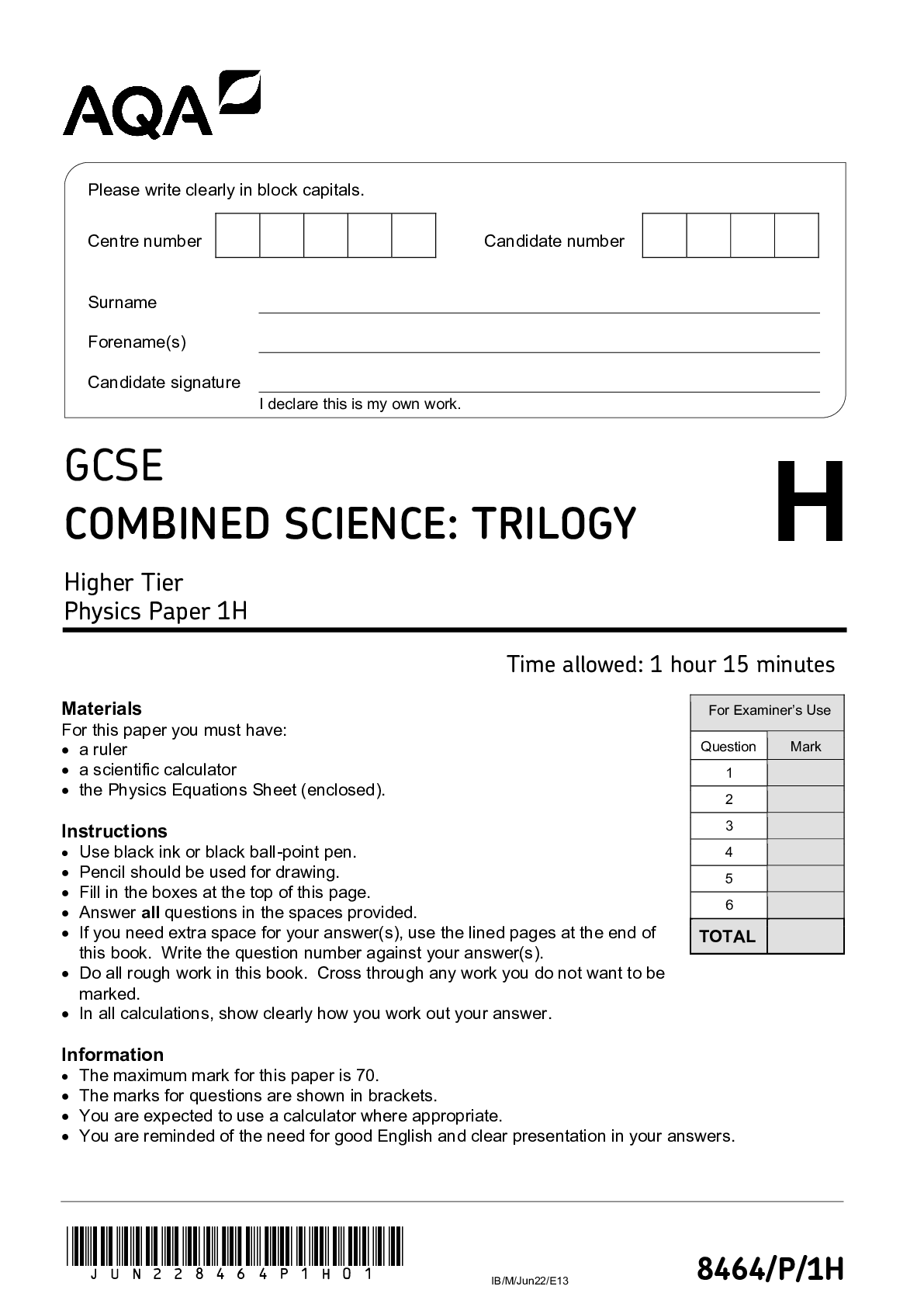
Physics > QUESTION PAPER (QP) > Mark Scheme Results Summer 2022 Pearson Edexcel GCSE In Physics (1PH0) Paper 1F Edexcel and BTEC Q (All)
Mark Scheme Results Summer 2022 Pearson Edexcel GCSE In Physics (1PH0) Paper 1F Edexcel and BTEC Qualifications Edexcel and BTEC qualifications are awarded by Pearson, the UK’s largest award ... ing body. We provide a wide range of qualifications including academic, vocational, occupational and specific programmes for employers. For further information visit our qualifications websites at www.edexcel.com or www.btec.co.uk. Alternatively, you can get in touch with us using the details on our contact us page at www.edexcel.com/contactus. Pearson: helping people progress, everywhere Pearson aspires to be the world’s leading learning company. Our aim is to help everyone progress in their lives through education. We believe in every kind of learning, for all kinds of people, wherever they are in the world. We’ve been involved in education for over 150 years, and by working across 70 countries, in 100 languages, we have built an international reputation for our commitment to high standards and raising achievement through innovation in education. Find out more about how we can help you and your students at: www.pearson.com/uk Summer 2022 Publications Code 1PH0_1F_2206_MS All the material in this publication is copyright © Pearson Education Ltd 2022 General Marking Guidance • All candidates must receive the same treatment. Examiners must mark the first candidate in exactly the same way as they mark the last. • Mark schemes should be applied positively. Candidates must be rewarded for what they have shown they can do rather than penalised for omissions. • Examiners should mark according to the mark scheme not according to their perception of where the grade boundaries may lie. • There is no ceiling on achievement. All marks on the mark scheme should be used appropriately. • All the marks on the mark scheme are designed to be awarded. Examiners should always award full marks if deserved, i.e. if the answer matches the mark scheme. Examiners should also be prepared to award zero marks if the candidate’s response is not worthy of credit according to the mark scheme. • Where some judgement is required, mark schemes will provide the principles by which marks will be awarded and exemplification may be limited. • When examiners are in doubt regarding the application of the mark scheme to a candidate’s response, the team leader must be consulted. • Crossed out work should be marked UNLESS the candidate has replaced it with an alternative response. Mark schemes have been developed so that the rubrics of each mark scheme reflects the characteristics of the skills within the AO being targeted and the requirements of the command word. So for example the command word ‘Explain’ requires an identification of a point and then reasoning/justification of the point. Explain questions can be asked across all AOs. The distinction comes whether the identification is via a judgment made to reach a conclusion, or, making a point through application of knowledge to reason/justify the point made through application of understanding. It is the combination and linkage of the marking points that is needed to gain full marks. When marking questions with a ‘describe’ or ‘explain’ command word, the detailed marking guidance below should be consulted to ensure consistency of marking. Assessment Objective Command Word Strand Element Describe Explain AO1* An answer that combines the marking points to provide a logical description An explanation that links identification of a point with reasoning/justification(s) as required AO2 An answer that combines the marking points to provide a logical description, showing application of knowledge and understanding An explanation that links identification of a point (by applying knowledge) with reasoning/justification (application of understanding) AO3 1a and 1b An answer that combines points of interpretation/evaluation to provide a logical description AO3 2a and 2b An explanation that combines identification via a judgment to reach a conclusion via justification/reasoning AO3 3a An answer that combines the marking points to provide a logical description of the plan/method/experiment AO3 3b An explanation that combines identifying an improvement of the experimental procedure with a linked justification/reasoning *there will be situations where an AO1 question will include elements of recall of knowledge directly from the specification (up to a maximum of 15%). These will be identified by an asterisk in the mark scheme Question Number Answer Mark 1(a)(i) A ray box B is not correct because a ruler does not produce a beam of white light C is not correct because a measuring cylinder does not produce a beam of white light D is not correct because an ammeter does not produce a beam of white light (1) AO1 Question Number Answer Mark 1(a)(ii) C green A is not correct because red appears at the start of the spectrum B is not correct because orange appears in the middle of the spectrum D is not correct because violet appears at the end of the spectrum (1) AO1 Answer Additional guidance Mark 1(b)(i) x-ray(s) allow X x no mark if more than one wave given e.g. x-rays and gamma rays scores 0 (1) AO1 Answer Additional guidance Mark 1(b)(ii) infrared allow any recognisable spelling IR ir no mark if more than one wave given e.g. infrared and gamma rays scores 0 (1) AO1 Answer Additional guidance Mark 1(b)(iii) infrared allow any recognisable spelling IR ir no mark if more than one wave given e.g. infrared and gamma rays scores 0 (1) AO1 Answer Additional guidance Mark 1(b)(iv) gamma (rays) allow any recognisable spelling γ no mark if more than one wave given e.g. gamma rays and UV scores 0 (1) AO1 (Total for Question 1= 6 marks) Answer Additional guidance Mark 2(a)(i) 12 (1) AO1 Answer Additional guidance Mark 2(a)(ii) 42 (1) 12 3.5 (cm) (1) ecf from2ai allow 0.035 for 1 mark award full marks for the correct answer without working (2) AO1 Answer Additional guidance Mark 2(a)(iii) A description to include: either time a crest/ripple/wavefront (1) (moving) between P and Q (1) use (wave speed =) distance (1) time or count number of crests /ripples /wavefronts passing (eg P) (1) in a given time (to find f) (1) use (v =) f λ (1) allow ‘how long it takes’ allow ‘wave’ for crest allow – over the 42 cm over a (set) distance allow waves if no other mark scored measure frequency for 1 mark (3) AO1 Question Number Answer Mark 2(b)(i) A longitudinal yes B is not correct because sound waves can transfer energy C is not correct because sound waves are longitudinal D is not correct because sound waves are longitudinal and sound waves can transfer energy (1) AO1 Answer Additional guidance Mark 2(b)(ii) select wave equation (1) (v =) f × λ evaluation (1) (speed = ) 330 (m/s) (speed =) freq(uency) × wavelength [Show More]
Last updated: 2 years ago
Preview 1 out of 31 pages
Buy this document to get the full access instantly
Instant Download Access after purchase
Buy NowInstant download
We Accept:

Can't find what you want? Try our AI powered Search
Connected school, study & course
About the document
Uploaded On
Apr 03, 2023
Number of pages
31
Written in
All
This document has been written for:
Uploaded
Apr 03, 2023
Downloads
0
Views
130
Scholarfriends.com Online Platform by Browsegrades Inc. 651N South Broad St, Middletown DE. United States.
We're available through e-mail, Twitter, Facebook, and live chat.
FAQ
Questions? Leave a message!
Copyright © Scholarfriends · High quality services·