Chemistry  >  QUESTION PAPER (QP)  >  AQA 2022// GCSE COMBINED SCIENCE: TRILOGY Higher Tier Chemistry Paper 2H (All)

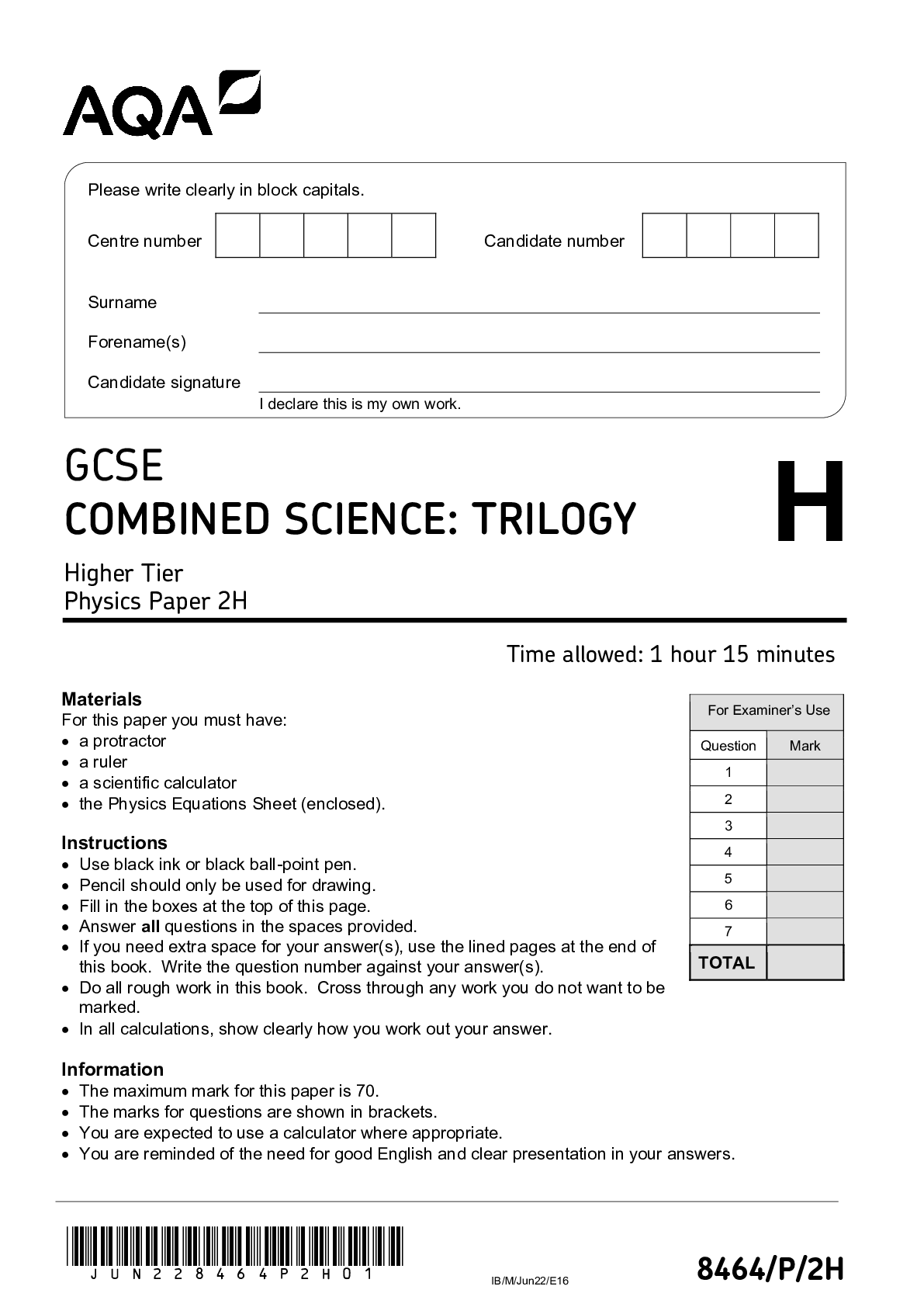
AQA 2022// GCSE COMBINED SCIENCE: TRILOGY Higher Tier Chemistry Paper 2H

Document Content and Description Below

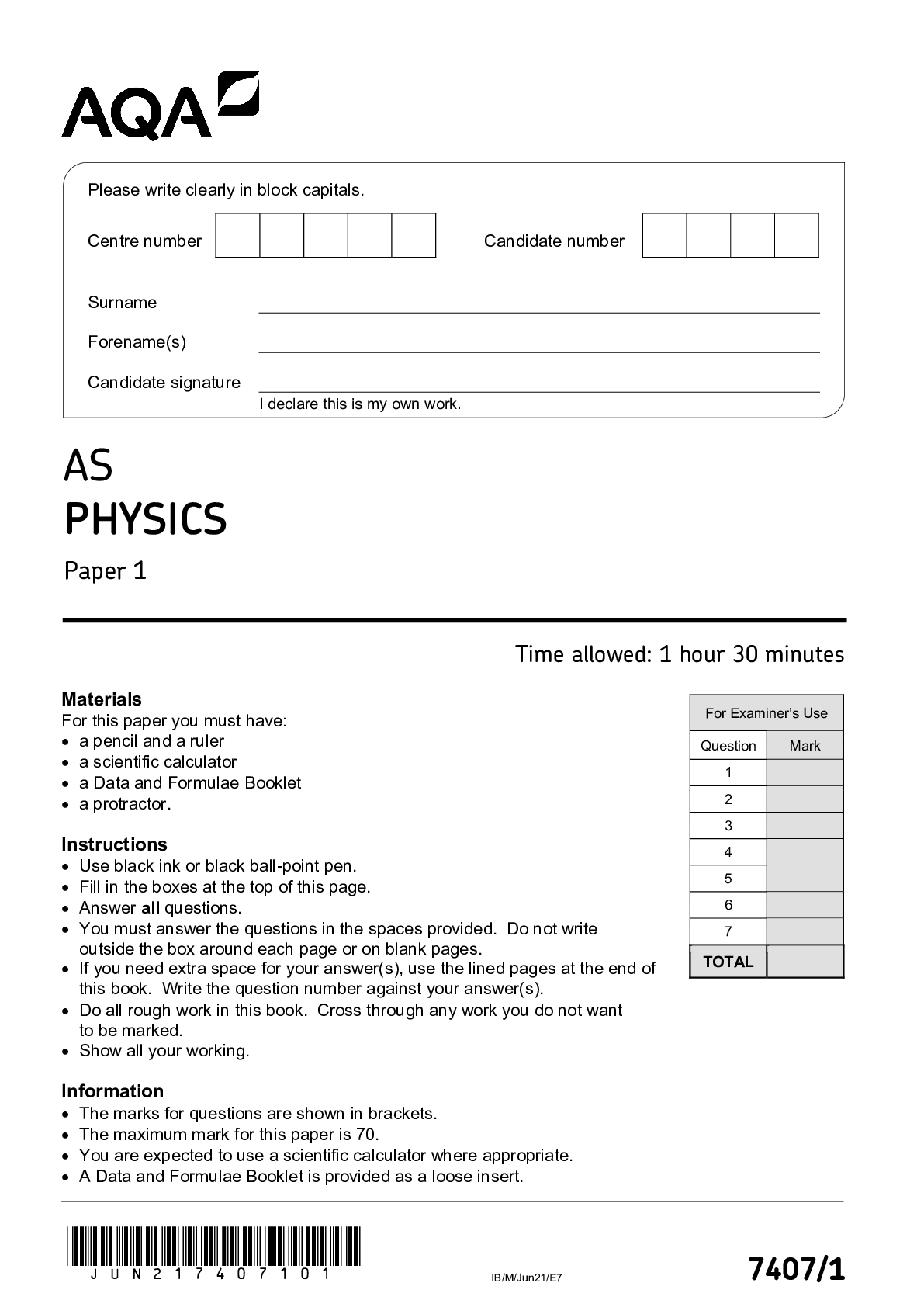
Materials For this paper you must have: • a ruler • a scientific calculator • the periodic table (enclosed). Instructions • Use black ink or black ball-point pen. • Pencil should only ... be used for drawing. • Fill in the boxes at the top of this page. • Answer all questions in the spaces provided. • If you need extra space for your answer(s), use the lined pages at the end of this book. Write the question number against your answer(s). • Do all rough work in this book. Cross through any work you do not want to be marked. • In all calculations, show clearly how you work out your answer. Information • The maximum mark for this paper is 70. • The marks for questions are shown in brackets. • You are expected to use a calculator where appropriate. • You are reminded of the need for good English and clear presentation in your answers. Please write clearly in block capitals. Centre number Candidate number Surname Forename(s) Candidate signature I declare this is my own work. GCSE COMBINED SCIENCE: TRILOGY Higher Tier Chemistry Paper 2H H 2 *02* IB/M/Jun22/8464/C/2H 0 1 A student investigated the colours in a brown ink using chromatography. 0 1 . 1 Figure 1 shows the apparatus used. Figure 1 Give two errors made by the student. Describe the problem each error would cause. [4 marks] Error 1 Problem 1 Error 2 Problem 2 Do not write outside the box 3 *03* Turn over ► IB/M/Jun22/8464/C/2H Do not write outside the A different student set up the apparatus correctly. box Figure 2 shows the results. Figure 2 0 1 . 2 Give two conclusions the student can make from Figure 2 about the four colours in the brown ink. [2 marks] 1 2 Question 1 continues on the next page 4 *04* IB/M/Jun22/8464/C/2H Do not write outside the box 10 0 1 . 3 Why was the green colour still on the start line at the end of the experiment? [1 mark] Tick () one box. The experiment was left for too long. The green colour was insoluble in the solvent. The green spot contained too many colours. The green spot was too small. 0 1 . 4 A student calculated the Rf value of a colour to be 0.24 The colour moved 1.8 cm from the start line. Calculate the distance the solvent moved. Use the equation: Rf = distance moved by colour distance moved by solvent [3 marks] Distance moved by solvent = cm 5 *05* Turn over ► IB/M/Jun22/8464/C/2H Do not write outside the box 0 2 . 1 Water that is safe to drink is called potable water. Compare how easily potable water can be obtained from: • waste water (sewage) • ground water (fresh water). [6 marks] Question 2 continues on the next page 6 *06* IB/M/Jun22/8464/C/2H Do not write outside the box 10 A scientist produced potable water from 150 cm3 of salty water. 0 2 . 2 Which process can be used to produce potable water from salty water? [1 mark] Tick () one box. Distillation Electrolysis Filtration Sterilisation 0 2 . 3 The salty water contains sodium chloride. The scientist collected 2.40 g of sodium chloride from 150 cm3 of salty water. Calculate the concentration of sodium chloride in grams per dm3 [3 marks] Concentration of sodium chloride = g/dm3 7 *07* Turn over ► IB/M/Jun22/8464/C/2H Do not write outside the box 0 3 This question is about the reaction between sodium thiosulfate solution and hydrochloric acid. The equation for the reaction is: Na2S2O3(aq) + 2 HCl(aq) → 2 NaCl(aq) + H2O(l) + SO2(g) + S(s) 0 3 . 1 The mass of the conical flask and contents was greater at the start of the reaction than at the end. Explain why. [2 marks] Question 3 continues on the next page 8 *08* IB/M/Jun22/8464/C/2H Do not write outside the A teacher demonstrated the reaction between sodium box thiosulfate solution and hydrochloric acid. Figure 3 shows the experiment. The experiment was done in a fume cupboard. Figure 3 This is the method the teacher used. 1. Pour 50 cm3 of sodium thiosulfate solution into a conical flask. 2. Put the conical flask on a black cross drawn on a piece of paper. 3. Pour 10 cm3 of hydrochloric acid into the conical flask and start a timer. 4. Stop the timer when the cross can no longer be seen. 5. Repeat the experiment at different temperatures. 0 3 . 2 What type of variable is time in this reaction? [1 mark] Tick () one box. Control Dependent Independent 9 *09* Turn over ► IB/M/Jun22/8464/C/2H Do not write outside the 0 3 box . 3 Table 1 shows the results. Table 1 Temperature in °C Time in seconds 19 82 32 48 45 43 52 15 63 7 73 3 Complete Figure 4. You should: • plot the data from Table 1 on Figu [Show More]

Last updated: 2 years ago

Preview 1 out of 24 pages

Buy Now

Instant download

We Accept:

Payment methods accepted on Scholarfriends (We Accept)
Preview image of AQA 2022// GCSE COMBINED SCIENCE: TRILOGY Higher Tier Chemistry Paper 2H document

Buy this document to get the full access instantly

Instant Download Access after purchase

Buy Now

Instant download

We Accept:

Payment methods accepted on Scholarfriends (We Accept)

Reviews( 0 )

$7.00

Buy Now

We Accept:

Payment methods accepted on Scholarfriends (We Accept)

Instant download

Can't find what you want? Try our AI powered Search

197
0

Document information


Connected school, study & course


About the document


Uploaded On

Apr 04, 2023

Number of pages

24

Written in

All

Seller


Profile illustration for Cate
Cate

Member since 2 years

0 Documents Sold

Additional information

This document has been written for:

Uploaded

Apr 04, 2023

Downloads

 0

Views

 197

Document Keyword Tags


$7.00
What is Scholarfriends

Scholarfriends.com Online Platform by Browsegrades Inc. 651N South Broad St, Middletown DE. United States.

We are here to help

We're available through e-mail, Twitter, Facebook, and live chat.
 FAQ
 Questions? Leave a message!

Follow us on
 Twitter

Copyright © Scholarfriends · High quality services·