Complex / Doris Turner Med Math Questions
1. Problem type: IV infusion rate + infusion pump
Medication: azithromycin
PROBLEM
Suppose Mrs. Turner’s orders call for 500 mg of azithromycin to be administered
intravenou
...
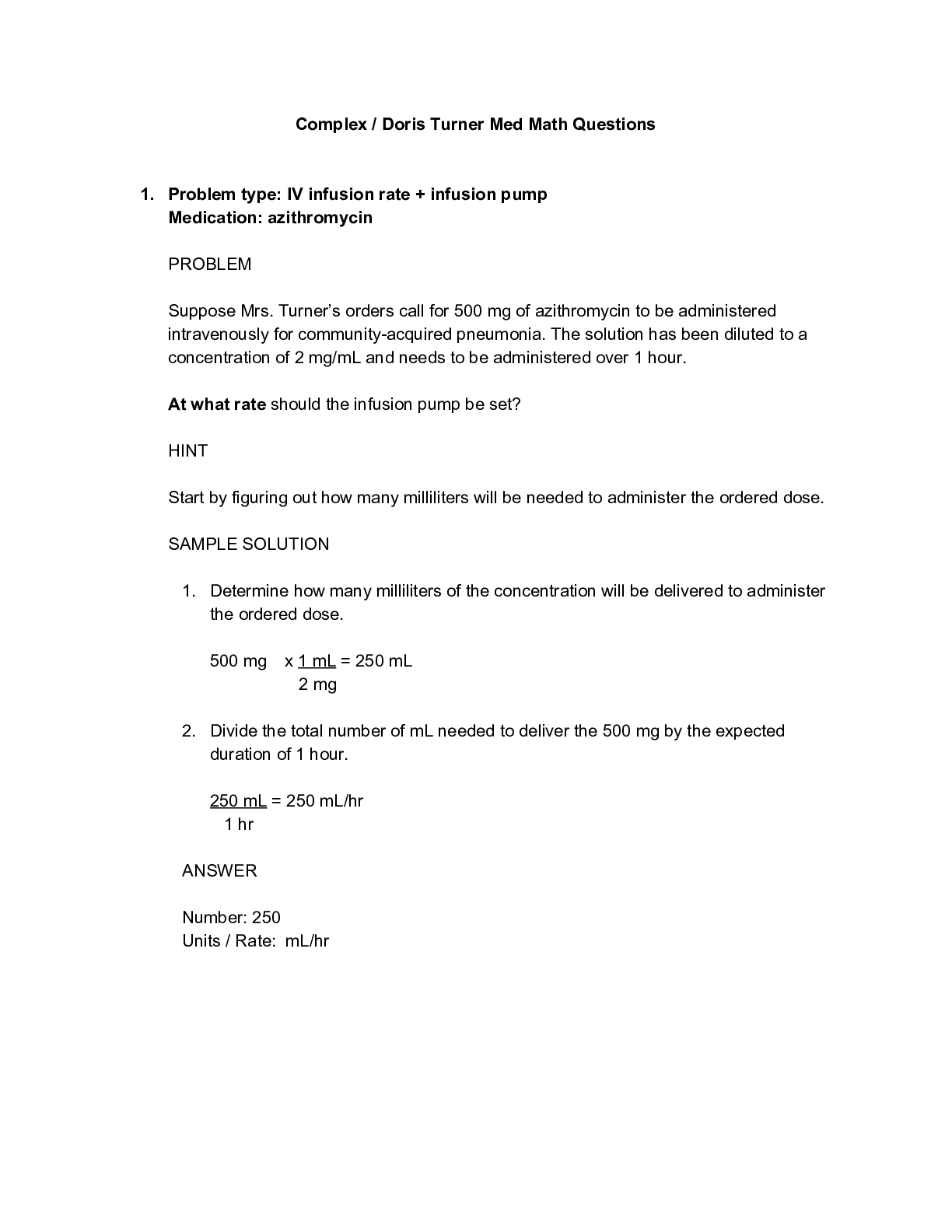
Complex / Doris Turner Med Math Questions
1. Problem type: IV infusion rate + infusion pump
Medication: azithromycin
PROBLEM
Suppose Mrs. Turner’s orders call for 500 mg of azithromycin to be administered
intravenously for communityacquired pneumonia. The solution has been diluted to a
concentration of 2 mg/mL and needs to be administered over 1 hour.
At what rateshould the infusion pump be set?
HINT
Start by figuring out how many milliliters will be needed to administer the ordered dose.
SAMPLE SOLUTION
1. Determine how many milliliters of the concentration will be delivered to administer
the ordered dose.
500 mg x 1 mL= 250 mL
2 mg
2. Divide the total number of mL needed to deliver the 500 mg by the expected
duration of 1 hour.
250 mL= 250 mL/hr
1 hr
ANSWER
Number: 250
Units / Rate: mL/hr2. Problem type: Dosage calculation + Stock on hand
Medication: venlafaxine
PROBLEM
Mrs. Turner’s daily medications include venlafaxine extendedrelease, 150 mg, by
mouth, once a day. However, the hospital pharmacy only carries 75 mg
extendedrelease tablets.
How many tablets of venlafaxine extendedreleaseshould be administered to her?
HINT
You can use the equation below, where X is the number of tablets that should be
administered.
D (ordered dose ) x Quantity = X
H (dose on hand)
SAMPLE SOLUTION
1. Determine what information you have.
D (ordered dose) = 150 mg
H (dose on hand) = 75 mg
Q (quantity) = 1 tablet
2. Plug into the equation and solve.
D (150 mg ) x 1 tablet = X
H (75 mg)
X = 2 tablets
ANSWER
Number: 2
Units: tablets3. Problem type: Total daily dosage
Medication: Acetaminophen @ hospital hypothetical
Suppose Mrs. Turner’s provider updated her order for 325 mg, 2 tabs, by mouth q6h
PRN temp. > 100.5 F to 325 mg, 2 tabs, by mouth q4h PRN temp. > 100.5 F. The
Davis’s Drug Guide reports that acetaminophen has a maximum recommended dosage
of 4 g/day.
How many dosescan Mrs. Turner take without exceeding the recommended maximum
dosage?
HINT
There are 1000 mg in one gram.
SAMPLE SOLUTION
1. Determine how many milligrams are in 4 grams.
4 g x 1000 mg= 4000 mg
1 g
2. Determine how many 325 mg tablets go into 4000 mg.
4000 mgx 1 tablet = 12.3 tablets
325 mg
3. Round down to the nearest whole tablet = 12 tablets
4. Divide the total number of tablets by the number tablets in a dose.
12 tablets total x 1 dose = 6 doses
2 tablets
ANSWER
Number: 6
Units: doses4. Problem type: Total daily dose calculation
Medication: acetaminophen @ hospital
PROBLEM
Suppose Mrs. Turner’s current temperature is 100.8 F. For temperatures greater than 100.5
F, the prescriber’s order allows acetaminophen, 325 mg, 2 tabs, by mouth, every 6 hours.
Assume that on her first day of hospitalization, Mrs. Turner’s temperature is greater than
100.5 F three times.
How many grams of acetaminophenwill she have ingested on her first day of
hospitalization? Round your answer to hundredths.
HINT
Multiply the number of taken doses by the number of tablets.
SAMPLE SOLUTION
1. Multiply the number of doses taken by the number of tablets per dose.
3 doses x 2 tablets= 6 tablets
1 dose
2. Multiply the dosage of acetaminophenby the number of tablets.
6 tablets x 325 mg= 1950 mg
1 tablet
3. Convert the total daily milligrams to grams.
1950 mg x 1 g = 1.95 g
1000 mg
ANSWER
Number: 1.95
Units: g5. Problem type: Dosage calculation + Stock on hand
Medication: potassium chloride
PROBLEM
Mrs. Turner’s daily medications include potassium chloride, 10 mEq tablet by mouth
once daily. The hospital pharmacy will dispense potassium chloride liquid 10% (1.5 gram
or 20 mEq per 15 mL). The KCl liquid will be further diluted in a 6 oz glass of water or
juice for administration.
What volume of the KCl 10% liquid should be used for Mrs. Turner’s usual daily dose?
HINT
Multiply the desired dose by the concentration.
SAMPLE SOLUTION
1. Multiply the desired dose by the concentration.
10 mEqx 15 mL = 7.5 mL of KCl 10% liquid
day 20 mEq day
ANSWER
Number: 7.5
Units: mL / day6. Problem type: IV flow + allergic reaction
Medication: ceftriaxone hypothetical
PROBLEM
Mrs. Turner’s original orders called for ceftriaxone, 1g, to be administered intravenously
daily. The solution has been diluted to a concentration of 1 g / 50 mL to be administered
over 30 minutes. Twenty minutes into the first infusion, Mrs. Turner reports an adverse
reaction to the antibiotic and the infusion is stopped.
How many mL of concentrationwere administered before the infusion was stopped?
Round your answer to the nearest whole number.
HINT
Divide the time elapsed by the infusion rate to determine the completion percentage of
the infusion.
SAMPLE SOLUTION
1. Determine the completion percentage of the infusion.
20 min (time elapsed) = 0.667 (or 66.7 %)
30 min (total infusion time)
2. Multiply the infusion volume by the percentage.
50 mL x 0.667 = X
X = 33 mL
ANSWER
Number: 33
Units: mL7. Problem type: Dosage calculation + weightbased dosage
Medication: azithromycin @ hospital hypothetical
According to the Davis’s Drug Guide, children sixmonthsold or younger with
communityacquired pneumonia can be administered azithromycin orally using a
weightbased dosage. Children in this age group can receive 10 mg/kg on the first day,
then 5 mg/kg for four more days. Assume you need to administer this to a child weighing
20.3 lbs.
What is the total dose of azithromycinthe child will receive over five days? Round
your answer to the nearest whole number.
HINT
Convert pounds to kilograms, and multiply the weight by the dosage.
SAMPLE SOLUTION
1. Convert pounds (lbs) to kilograms (kg).
20.3 lbs x 1 kg= 9.227 kg
2.20 lb
2. Multiply the first day’s dosage by weight in kg.
10 mgx 9.227 kg = 92.27 mg
kg
3. Multiply the dosage given for days 25 by weight in kg, and multiply by the number of
days administered (4).
9.227 kg x 5 mgx 4 = 184.54 mg
kg
4. Add the results from steps 2 and 3.
92.27 mg + 184.54 mg = 276.81 mg, rounded to 277 mg
ANSWER
Number: 277 mg
Units: mg8. Problem type: Unit conversation + stock on hand
Medication: levothyroxine @ hospital
Mrs. Turner’s orders called for 50 mcg of levothyroxine, by mouth, daily. The pharmacy
stocks the medication in 0.025 mg tablets.
How many tablets are needed to administer the ordered dose?
HINT
Start by converting 50 mcg to mg. Then use the equation below, where X is the number
of tablets that should be administered.
D (ordered dose ) x Quantity = X
H (dose on hand)
SAMPLE SOLUTION
1. Convert micrograms (mcg) to milligrams (mg).
50 mcg x 1 mg= 0.05 mg
1000 mcg
2. Determine what information you have.
D = 0.05 mg
H = 0.025 mg
Q = 1 tablet
3. Plug into the equation and solve.
D (0.05 mg)x 1 tablet = X
H (0.025 mg)
X = 2 tablets
ANSWER
Number: 2
Units: tablets9. Problem type: Total daily dose calculation
Medication: Units of insulin @ home
At home, Mrs. Turner takes 16 units of insulin aspart, twice a day with meals. She also
takes 45 units of longacting insulin glargine, daily.
How many total units of insulin does Mrs. Turner take daily?
HINT
Start by multiplying the dosage of insulin aspart by how often Mrs. Turner takes it.
SAMPLE SOLUTION
1. Multiply the dosage by the number of units per dose.
16 units x2= 32 units
2. Add the total number of insulin aspart units and the total number of insulin glargine
units.
32 units + 45 units = 77 units
ANSWER
Number: 77
Units: units10. Problem type: Dosage calculation
Medication: Insulin aspart @ hospital hypothetical
The provider ordered insulin aspart on a sliding scale for 1 unit/10 g CHO subcutaneous
+ 1 unit/50 points above 150 BG. Mrs. Turner will eat a meal that contains 40 g CHO and
has a premeal BG level of 160.
How many units of insulinshould be administered?
HINT
Add the units calculated from the sliding scale to the units necessary for the patient’s
current BG level.
SAMPLE SOLUTION
1. Perform the sliding scale calculation (1 unit/10g CHO).
40 g CHO x 1 unit = 4 units
10 g CHO
2. Subtract 150 from Mrs. Turner’s premeal BG.
160 BG 150 BG = 10 points
3. Multiply 10 points by the number of units per 50 points.
10 points x 1 unit = 0.2 units
50 points
Round down to the next whole unit = 0 unit
4. Add the units from the sliding scale to the additional units needed for every 50 points
above 150 BG.
4 units + 0 unit = 4 units
ANSWER
Number: 4
Units: units11. Problem type: Unit conversion + orders correction
Medication: levothyroxine @ hospital hypothetical
Suppose Mrs. Turner’s provider writes a revised order of 25 mg of her daily
levothyroxine. Given that her original order was in micrograms, you suspect this new
order contains an error. You take the appropriate measures to get the orders corrected
in order to avoid administering an overdose.
If the error had not been caught, how many times more levothyroxine would have been
given?
HINT
Start by converting 25 mg to micrograms.
SAMPLE SOLUTION
1. Convert milligrams (mg) to micrograms (mcg).
25 mg x 1000 mcg = 25,000 mcg
1 mg
2. Divide the incorrect mcg dosage by correct mcg dosage.
25,000 mcg= 1000
25 mcg
ANSWER
Number: 1000
Units: times overdose12. Problem type: IV flow rate + drop factor
Medication: azithromycin @ hospital hypothetical
Suppose Mrs. Turner’s provider orders 500 mg of azithromycin to be delivered in a 250
mL IV solution over 3 hours. The dose will be delivered using IV tubing with a drop factor
of 15 (15 gtt (drops) = 1 mL)
What is the appropriate rate of flow for the IV, in drops per minute? Round your
answer to the nearest whole number.
HINT
Start by determining how many mL will be delivered per minute.
SAMPLE SOLUTION
1. Divide the total number of mL needed to deliver the 500 mg dilution by the expected
duration in minutes, converting hours to minutes.
250 mL x 1 hr= 1.389 mL/min
3 hr 60 min
2. Multiply the mL / min by the drop factor and round to the nearest whole number.
1.389 mLx 15 gtt= 20.8 gtt/min
1 min 1 mL
3. Round your answer to the nearest whole number.
= 21 gtt / min
ANSWER
Number: 21
Units: gtt / min13. Problem type: IV flow rate + drop factor
Medication: azithromycin @ hospital hypothetical
On the second day of hospitalization, Mrs. Turner’s orders call for 500 mg of
azithromycin to be delivered in a 250 mL IV solution over 3 hours. The dose will be
delivered using IV tubing with a drop factor of 10 (10 gtt (drops) = 1 mL).
What is the appropriate rate of flow for the IV in drops per minute? Round your
answer to the nearest whole number.
HINT
Start by determining how many mL will be delivered per minute.
SAMPLE SOLUTION
1. Divide the total number of mL needed to deliver the 500 mg dilution by the expected
duration, converting hours to minutes.
250 mL x 1 hr = 1.389 mL/min
3 hr 60 min
2. Multiply the mL / min by the drop factor and round to the nearest whole number.
1.389 mLx 10 gtt= 13.89 gtt / min
1 min 1 mL
Round your answer to the nearest whole number = 14 gtt / min
ANSWER
Number: 14
Units: gtt / min14. Problem type: Correct days’ supply
Medication: Insulin @ primary care hypothetical
Mrs. Turner is prescribed insulin aspart, 16 units, SC TID at mealtimes. When Mrs.
Turner returns home, the provider would like to switch her mealtime insulin
administration to a pen delivery device instead of insulin syringes. The provider will keep
the same dose. Assume that Mrs. Turner eats three meals a day.
If the pen cartridges contain 3 mL of U100 insulin aspart, how often will Doris need to
replace the cartridge? Round your answer down to the nearest whole day.
HINT
U100 insulin contains 100 units / 1 mL.
SAMPLE SOLUTION
1. Multiply the number of units by the number of meals each day.
16 unitsx 3 meals= 48 units of insulin aspart
meal day day
2. Multiply the concentration of U100 insulin by the volume of a cartridge.
100 unitsx 3 mL= 300 units
mL cartridge cartridge
3. Multiply the result from step 2 by the number of units per day, so that the units cancel.
300 unitsx 1 day= 6.25 days / cartridge, rounded to 6 days
cartridge 48 units
ANSWER
Number: 6
Units: days15. Problem type: Correct days’ supply
Medication: Insulin @ primary care hypothetical
Assume that Mrs .Turner’s provider decides to prescribe insulin aspart, 16 units SC TID
at mealtimes, and Mrs. Turner receives a U100, 10 mL vial of insulin aspart. Assume
that Mrs. Turner eats three meals a day.
How long would a U100, 10 mL vial of insulin aspart last at this dosage? Round your
down answer to the nearest whole day.
HINT
U100 insulin contains 100 units / 1 mL.
SAMPLE SOLUTION
1. Multiply the number of units by the number of meals each day.
16 unitsx 3 meals= 48 units of insulin aspart
meal day day
2. Multiply the concentration of U100 insulin by the volume of the vial.
100 units x 10 mL= 1000 units
1 mL vial vial
3. Multiply the result from step 2 by the number of units per day, so that the units cancel.
1000 unitsx 1 day = 20.8 days/vial, rounded down to 20 days
Vial 48 units
ANSWER
Number: 20
Units: days
[Show More]

.png)
 2e Peter Olver, Chehrzad Shakiban.png)