ESB V.2 EXAM 2 QUESTIONS AND
ANSWERS ALREADY GRADED A
In general, which two characteristics define a "small" business? (Choose two) ✔✔Fewer then
1,500 employees
AND
Less than $35.5 million revenue
Classify each of
...
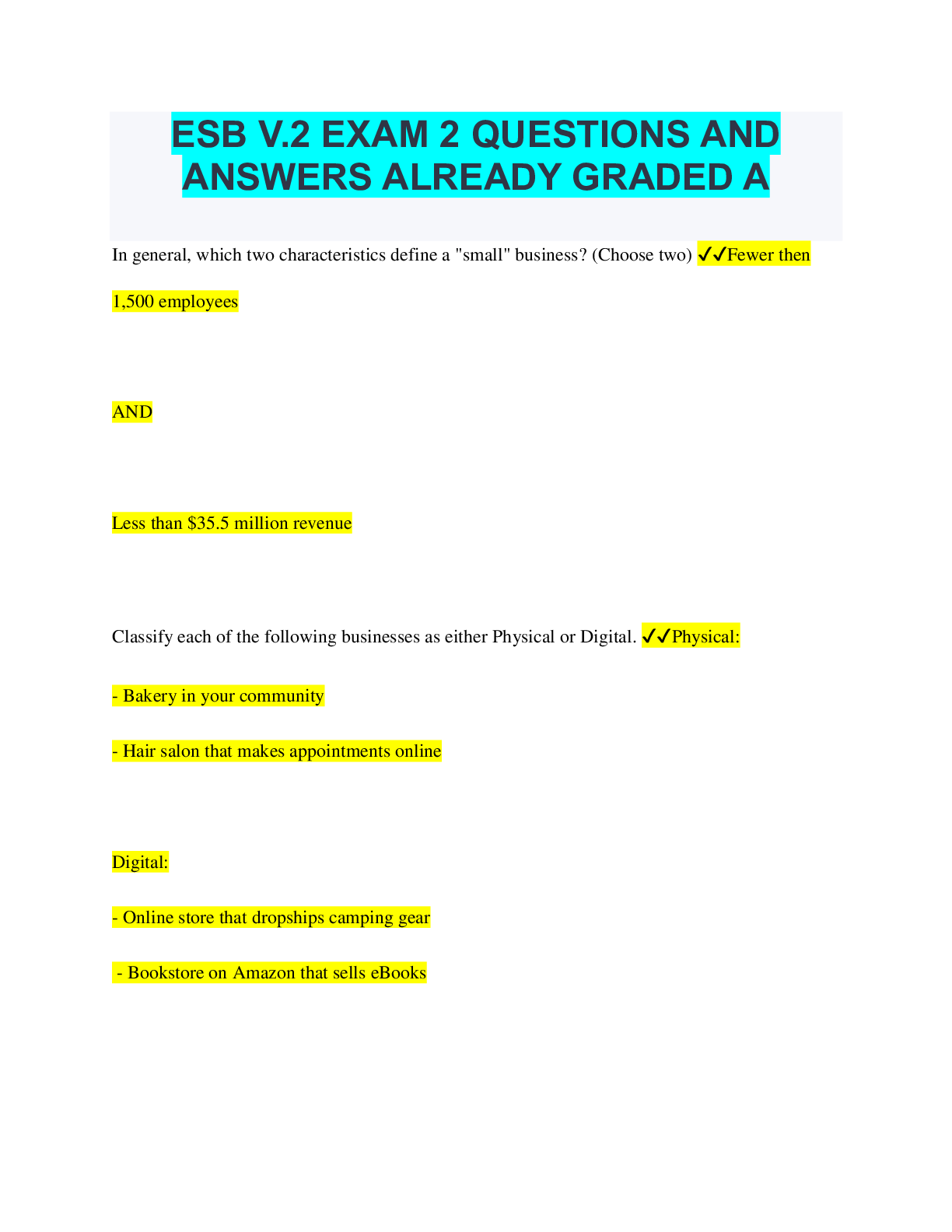
ESB V.2 EXAM 2 QUESTIONS AND
ANSWERS ALREADY GRADED A
In general, which two characteristics define a "small" business? (Choose two) ✔✔Fewer then
1,500 employees
AND
Less than $35.5 million revenue
Classify each of the following businesses as either Physical or Digital. ✔✔Physical:
- Bakery in your community
- Hair salon that makes appointments online
Digital:
- Online store that dropships camping gear
- Bookstore on Amazon that sells eBooks
You need to create a legal structure for your small business. You have plans for it to grow and
hope in the future to sell shares to the public. Your startup partners are citizens of Mexico and
Japan. You do not want to be personally responsible for business liabilities.
Which legal structure should you set up for your business? ✔✔C-Corporation
Match each business management role to its corresponding description.
To answer, move each role from the list on the left to its description on the right. ✔✔COO:
Oversees the day-to-day administrative functions of a business; second in command.
CIO: Develops policies and structures to protect company data.
CFO: Creates budgets, analyzes financial data, and forecasts company profits.
CEO: The highest-ranking employee in the company; reports to the board of directors.
You own a lawn care business. You have employees who work long hours laboring in good
weather, often exceeding 40 hours per week. They also work short hours when the weather is
bad, sometimes they can't work at all. You do all of the sales for your business.
Which two types of compensation would be appropriate for these landscape employees?
✔✔Salary & Hourly
Match each Stage of the Business Life Cycle to its corresponding description.
To answer, move each stage from the list on the left to its description on the right. ✔✔Maturity:
The business is separate from the owner with responsibilities delegated to staff. A business in
this stage usually commands a considerable share of the market and may even be a household
name.
Success: Company is stable and profitable.
Takeoff: Expansion strategies are implemented, and investment is balanced with potential.
Survival of the Fittest: Focus shifts to revenue, expenses, and growth. Cashflow is the major
issue.
Existence: The business introduces itself to the market and attempts to catch the attention of
potential customers.
For each statement about the Design Thinking Process, select True or False. ✔✔True:
- Assumptions are challenged and ideas are created in the Ideate phase.
- Problem statements are written in the Define phase.
False:
- The Empathize phase tests solutions to users' problems.
- Building Prototypes is the final phase of the Design Thinking Process.
Which of these is a characteristic of a successful entrepreneur mindset? ✔✔Doesn't give up
easily
Which is one of the greatest risks of being an entrepreneur? ✔✔Financial instability
What is a primary benefit of starting a new business without purchasing a franchise or buying an
existing business? ✔✔Developing your own rules
[Show More]