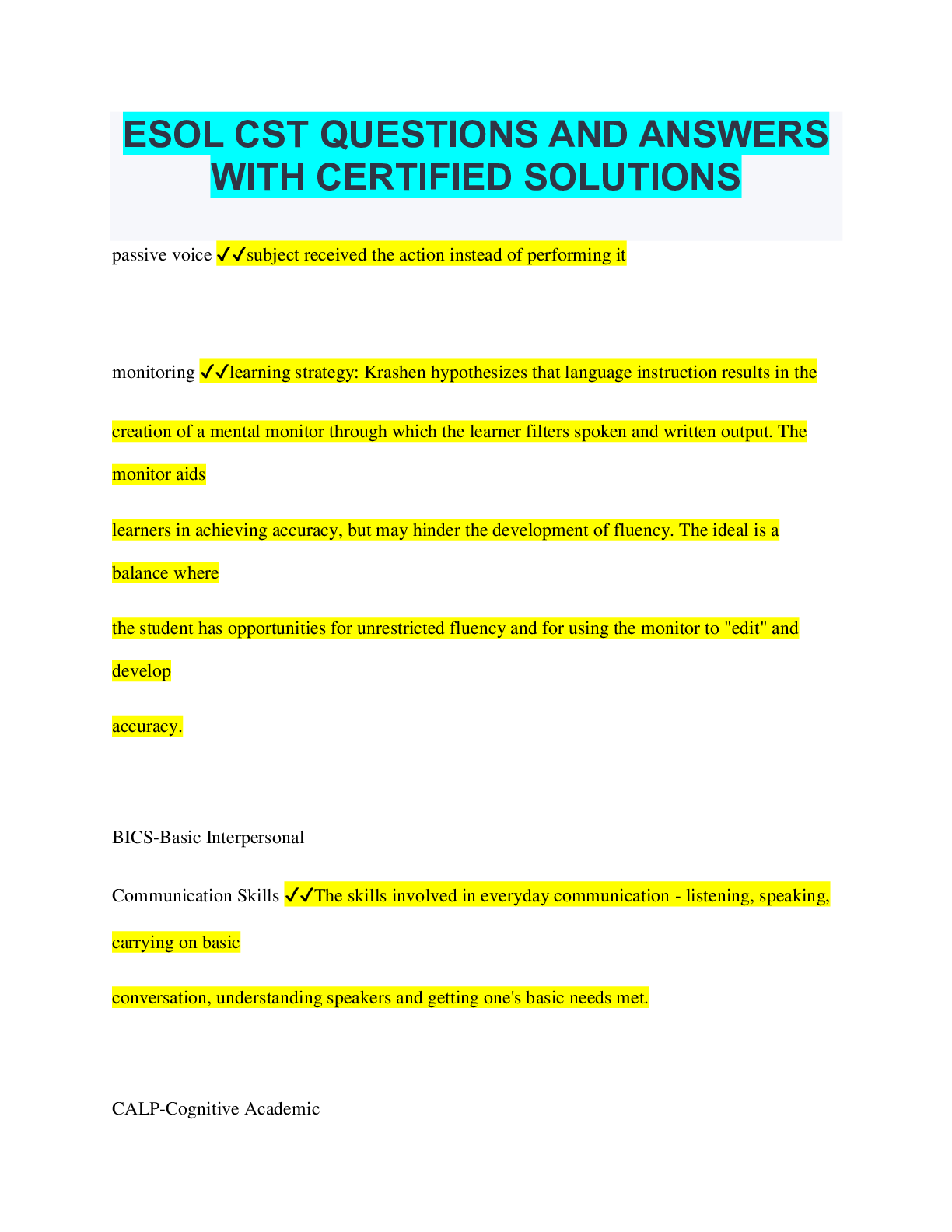
ESOL CST QUESTIONS AND ANSWERS
WITH CERTIFIED SOLUTIONS
passive voice ✔✔subject received the action instead of performing it
monitoring ✔✔learning strategy: Krashen hypothesizes that language instruction results in th
...
ESOL CST QUESTIONS AND ANSWERS
WITH CERTIFIED SOLUTIONS
passive voice ✔✔subject received the action instead of performing it
monitoring ✔✔learning strategy: Krashen hypothesizes that language instruction results in the
creation of a mental monitor through which the learner filters spoken and written output. The
monitor aids
learners in achieving accuracy, but may hinder the development of fluency. The ideal is a
balance where
the student has opportunities for unrestricted fluency and for using the monitor to "edit" and
develop
accuracy.
BICS-Basic Interpersonal
Communication Skills ✔✔The skills involved in everyday communication - listening, speaking,
carrying on basic
conversation, understanding speakers and getting one's basic needs met.
CALP-Cognitive Academic
Language Proficiency ✔✔The skills that are needed to succeed in the academic classroom,
including problem
solving, inferring, analyzing,
synthesizing, and predicting. They go beyond the BICS, demanding much greater competence in
the language.
Comprehensible Input: ✔✔Students learn best when exposed to samples of
the target language that are at or just above the student's current level of acquisition of the
language. Teachers
can ensure that the language used in the classroom is comprehensible by
evaluating the students on the Stages of Language Acquisition.
Low Affective Filter: ✔✔Students are best able to absorb and mentally process the language
input they receive
when they are in an environment where they are relaxed and their
anxiety level is low. The teacher can provide this by making the classroom a warm, supportive
place where students feel free to take risks with language.
register ✔✔degree of formality
morphology ✔✔branch of linguistics (internal structure of words) language's morphemes and
other linguistic units, such as root words, affixes, parts of speech, intonations and stresses, or
implied context.
overgeneralization ✔✔Example: treating irregular as a regular on (go--> goed)
communicative approach ✔✔emphasizes learning to communicate: focus is on meaningful
communication not structure, use not usage. In this approach, students are given tasks to
accomplish using language, instead of studying the language.
context-reduced language ✔✔no background knowledge given
Miscue Analysis ✔✔reading assessment that allows teacher to evaluate deviations from actual
text during oral reading. Determines how a reader is decoding and processing printed words and
using them to construct meaning: strat to decode and comprehend text
Holistic Scoring ✔✔teacher judges overall communicative effectiveness of students written
work: evaluate writers ability to communicate ideas rather than assess mechanical (grammar)
Steps towards reading for information ✔✔1. ask specific questions to clarify and extend meaning
of texts: inferring, verifying meaning in texts
2. determining fact from opinion
3. determining relevance of information
kinestitic learner ✔✔learns best when physically active using movement to reinforce memory
and comprehension
Sheltered approach to ELL instruction (SEP) ✔✔used in content classes to provide additional EL
support: ELL acquire academic English as they learn academic content. Development of
communicative language skills is offered in tandem with SEP and is not a fundamental elements
of this approach
Vygotsky ✔✔Views language first as social communication, which gradually promotes both
language itself and cognition.
A person who begins to learn a second language after the onset of puberty... ✔✔will likely find
language learning more difficult and depend more o repetition
Affective strategies (to lower affective filter) ✔✔Lower your anxiety, take your emotional
temperature
Social strategies ✔✔Asking questions, cooperating with others, empathizing with others
Interlanguage ✔✔A strategy used by 2nd language learners to compensate for lack of
proficiency: preserving some features of their first language (or L1), or overgeneralizing target
language rules in speaking or writing the target language and creating innovations
Natural Approach ✔✔Krashen & Terrell: Students can improve vocal through meaningful
interaction/meaningful context
Willig & Lee's 4 developmental stages ✔✔1) Pre-production stage
2) Early production stage
3) The speech emergence stage
4) The intermediate fluency stage
James Asher TPR (total physical response) ✔✔introduces new language through a series of
commands to physically enact an event. The student responds to the
commands with action. Research on this strategy shows that more efficient
learning with fuller student involvement occurs when students actually
move than when they do not. For beginning students, an advantage of TPR is that students are
not required
to make oral responses until they have achieved and demonstrated full comprehension through
physical actions.
LEA ✔✔Language Experience Approach: Encourages spoken responses from LEP students after
they are exposed to a variety of first-hand, sensory experiences.Helps develop reading and
writing skills by using their ideas and language
CBI ✔✔Content-based Instruction (sheltered instruction) Integrates L2 acquisition and the basic
content areas math, social studies, literature
HOw long does is take LEP to learn academic language ✔✔5-7 years
CALLA ✔✔Chamot & O Malley Cognitive academic language learning approach helps
intermediate and advanced students understand and retain content area material while they are
improving their English language skills.
Whole language approach ✔✔Primary strategy is LEA (language experience approach),
develops all 4 language skills (reading, writing, speaking, listening)
Schema Theory ✔✔Carrell & Eisterhold schemas must be activated through activating
background knowledge
Jigsaw reading ✔✔each group is assigned 1 reading or part of a reading which further requires
them to work with other groups to combine their respective parts to make sense of the whole
reading
Instrumental motivation ✔✔acquiring a 2nd language for a specific reason, such as a job
Integrative motivation ✔✔acquiring a second language to fulfill a wish to communicate within a
different culture
Bailey (facilitative [helpful] anxiety) ✔✔Anxiety that compels an individual to stay on task not
all anxiety is debilitative, some can be positive
Acculturation ✔✔process of becoming accustomed to the customs, language practices, and
environment of a new culture affected by the learner's desire and ability to become a part of the
dominant culture
Schumann's model of acculturation ✔✔The degree to which a learner acculturates to the target
language group will control the degree to which he acquires the L2
Schumann's social elements that affect acculturation process ✔✔the L1 and L2 groups view each
with mutual respect, have optimistic attitudes, and are compatible both groups wish for the
primary group to assimilate into the culture both groups agree to share social services and
conveniences. The L1 group wants to remain in the area beyond a temporary status
Ways to learn idioms ✔✔Grouping them according to types of language use- translating from
native language into English- create original idioms- using visuals
Empty language (perfunctory [daily routine] speech) ✔✔has little meaning but is important is
social exchanges
Educational level of ELLS parents.. ✔✔has a great influence on literacy development
Language achievement tests - ✔✔Unit exams- final exams (relate directly to a specific
curriculum or course of study)
Placement tests ✔✔TOFEL, NYSITELL, NYSESLAT
Diagnostic language tests ✔✔Identify individual students' strength and weaknesses in language
(administered by speed therapists/psychologists)
Attitudinal Bias ✔✔negative attitude of an examiner towards a certain language/culture
Test bias/norming bias ✔✔excluding ELLs from school populate to obtain norm results
A fair way to administer tests to ELLs ✔✔Administer practice tests
Bottom-up processing of listening ✔✔listener analyzes the language to find out the intended
meaning of the message.
Top-down processing of listening ✔✔Relies on listeners' bank of prior knowledge or global
expectations. Involves prediction based on background knowledge
Content schemata ✔✔Familiarity with the topic, cultural knowledge and previous experience
with a field
Formal schemata ✔✔people's knowledge of discourse forms: text types, rhetorical conversations,
and structional organization of prose
Content and formal schemata ✔✔help listeners in comprehension
Intensive listening ✔✔Trying to understand all of the facts and information (for writing a
summary/listening to a lecture)
Extensive listening ✔✔Listening to overall content of a long-text (watching a film or play)
Language analysis tasks ✔✔Language for perception to analyze selected aspects of both
language structure and language use. (comprehension is secondary and emphasis is on aural
perception)
Language use tasks ✔✔Language for comprehension to get information and use it
communicatively
Krashen and Terrell Natural Approach ✔✔Students are introduced to new vocal through
different experiences
A good way to start developing comprehension skills? ✔✔Explicit instruction in sounding out
words
The closer the phonologies of L1 and L2... ✔✔the greater the literacy development in L2
[Show More]


![Preview of eBook [PDF] Justice in Extreme Cases Criminal Law Theory Meets International Criminal Law](https://browseimages.nyc3.digitaloceanspaces.com/paper-images/2026/04/08/acGCc4HP2026-04-08-10-4169d606955eedb.png)
![Preview of eBook [PDF] Introductory Circuit Analysis 14th Edition By Robert Boylestad, Brian Olivari](https://browseimages.nyc3.digitaloceanspaces.com/paper-images/2026/04/08/kXyZwsZP2026-04-08-10-3969d6063e1a5a0.png)
![Preview of eBook [PDF] Introduction to Organic and Medicinal Chemistry By Keighley N](https://browseimages.nyc3.digitaloceanspaces.com/paper-images/2026/04/08/TDWdpUI42026-04-08-10-3469d605180ade8.png)
![Preview of eBook [PDF] A New Balance of Payments for the United States 1790 1919 By Lawrence H. Offic](https://browseimages.nyc3.digitaloceanspaces.com/paper-images/2026/03/13/ELlbBDk92026-03-13-11-3469b474f2a5aa2.png)
![Preview of eBook [PDF] Uncertainty Management for Robust Industrial Design in Aeronautics By Charles](https://browseimages.nyc3.digitaloceanspaces.com/paper-images/2026/03/14/AIPpM5am2026-03-14-12-3869b483c6ddbca.png)
![Preview of eBook [PDF] A concise guide to opioid addiction for counselors By Kevin G. Alderson and Sa](https://browseimages.nyc3.digitaloceanspaces.com/paper-images/2026/03/13/OkVGzZ1C2026-03-13-11-3369b47483699ed.png)