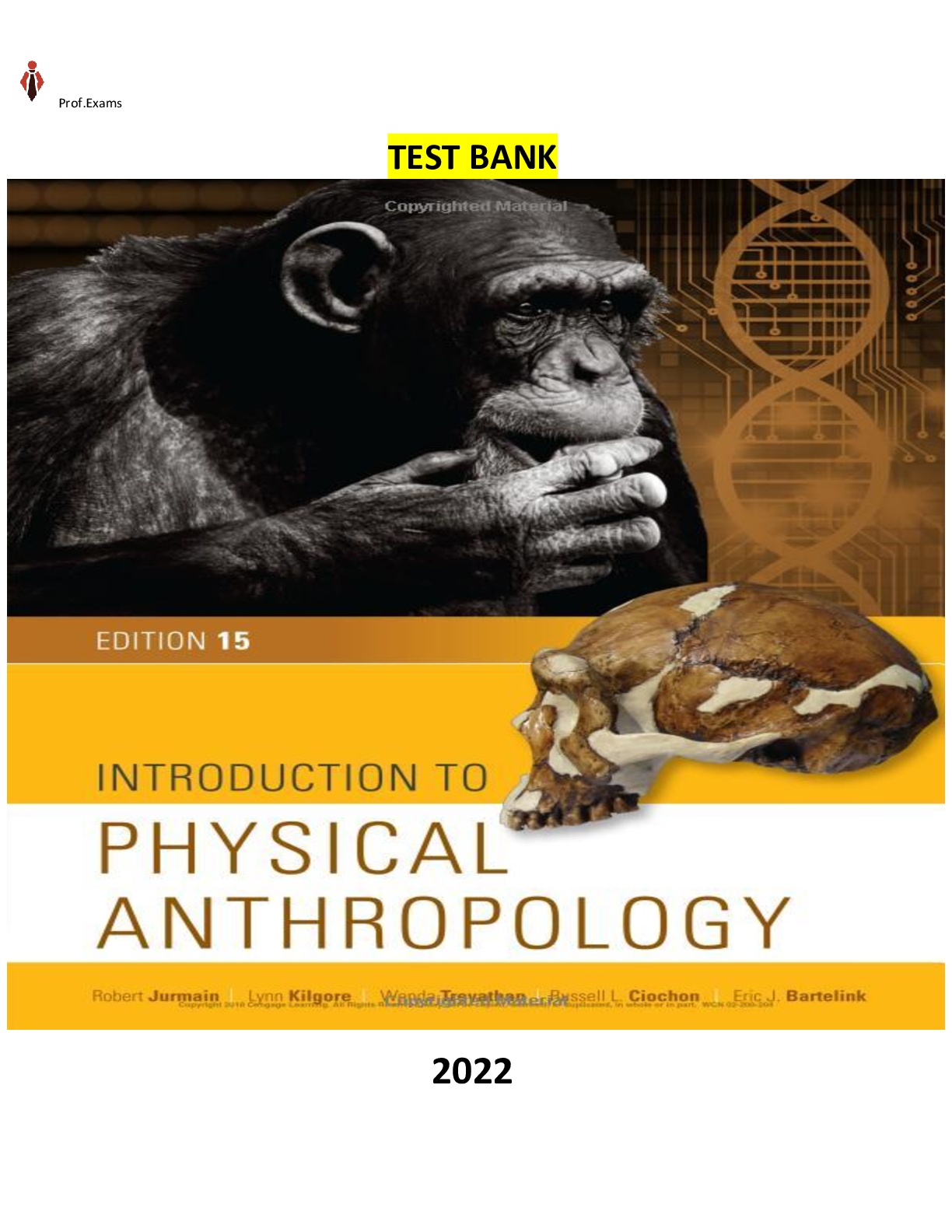
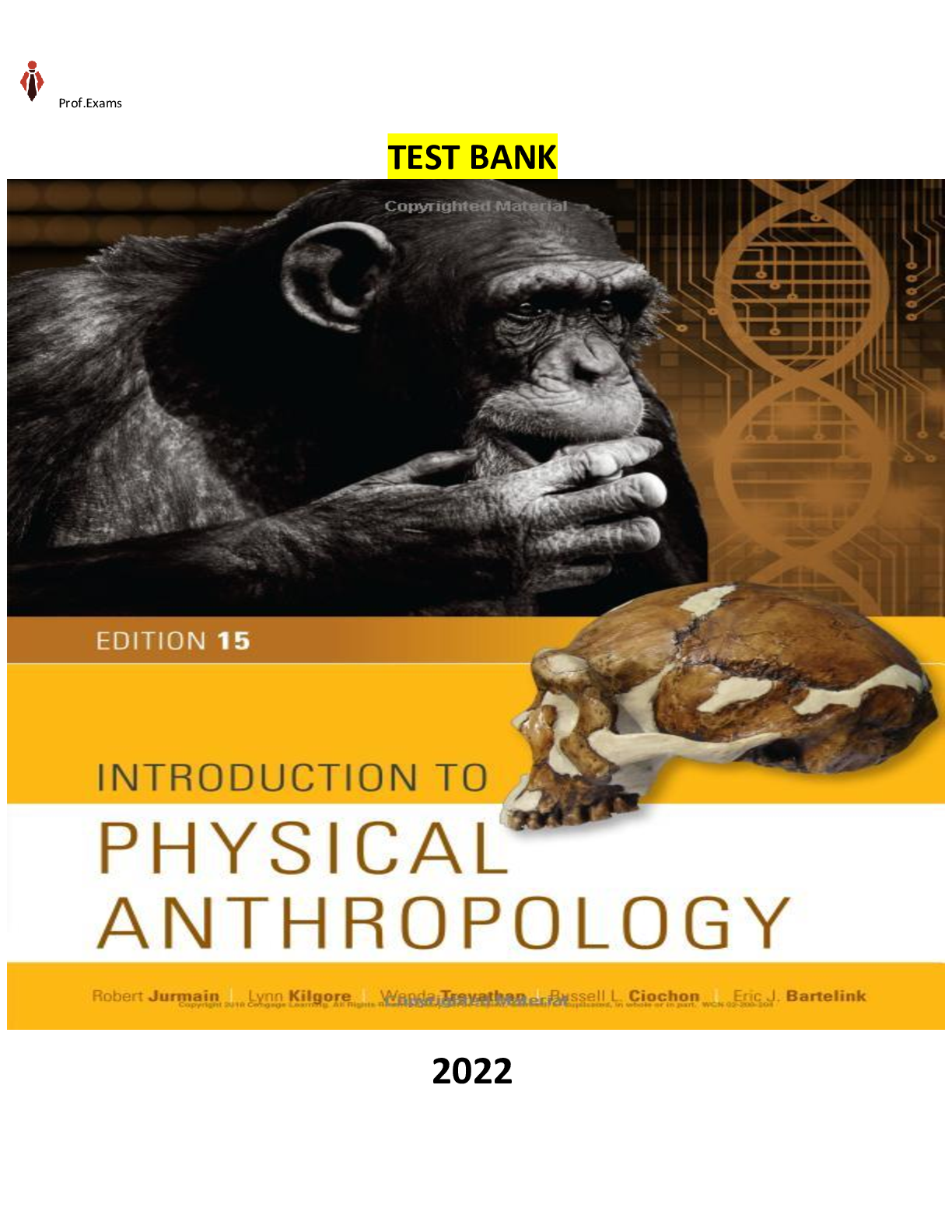
COMPLETE - Elaborated Test Bank for Introduction to Physical Anthropology 15Ed. by Robert Jurmain, Lynn Kilgore, Wenda Trevathan, Russell L. Ciochon & Eric Bartelink.ALL Chapters1-17(289 pages) included and updated for
...
COMPLETE - Elaborated Test Bank for Introduction to Physical Anthropology 15Ed. by Robert Jurmain, Lynn Kilgore, Wenda Trevathan, Russell L. Ciochon & Eric Bartelink.ALL Chapters1-17(289 pages) included and updated for 2023
COMPLETE - Elaborated Test Bank for Introduction to Physical Anthropology 15Ed. by Robert Jurmain, Lynn Kilgore, Wenda Trevathan, Russell L. Ciochon & Eric Bartelink.ALL Chapters1-17(289 pages) included and updated for 2023
Introduction to Physical Anthropology 15Ed. by Robert Jurmain, Lynn Kilgore, Wenda Trevathan, Russell L. Ciochon & Eric Bartelink
TABLE OF CONTENTS:
Chapter 1: Introduction to Physical Anthropology
Chapter 2: The Development of Evolutionary Theory
Chapter 3: The Biological Basis of Life
Chapter 4: Heredity and Evolution
Chapter 5: Macroevolution: Processes of Vertebrate and Mammalian Evolution
Chapter 6: Survey of the Living Primates
Chapter 7: Primate Behavior
Chapter 8: Overview of the Fossil Primates
Chapter 9: Paleoanthropology: Reconstructing Early Hominin Behavior and Ecology
Chapter 10: Hominin Origins in Africa
Chapter 11: The First Dispersal of the Genus Homo: Homo erectus and Contemporaries
Chapter 12: Premodern Humans
Chapter 13: The Origin and Dispersal of Modern Humans
Chapter 14: Modern Human Biology: Patterns of Variation
Chapter 15: Modern Human Biology: Patterns of Adaptation
Chapter 16: Legacies of Human Evolutionary History: Effects on the Life Course
Chapter 17: The Human Disconnection
CHAPTER 01
1. At present, the members of the family hominin includes
a. apes.
b. monkeys.
c. all primates.
d. humans.
e. rats
ANSWER: d
DIFFICULTY: Factual
REFERENCES: 4
LEARNING OBJECTIVES: INTR.JURM.18.1.1 - 1
OTHER: Pickup
2. A group of organisms that can interbreed and produce fertile offspring is called
a. hominidae.
b. a species.
c. a family.
d. a hominin.
e. a mammal.
ANSWER: b
DIFFICULTY: Factual
REFERENCES: 4
LEARNING OBJECTIVES: INTR.JURM.18.1.1 - 1
OTHER: Pickup
3. Simply stated, evolution
a. is NOT subject to the same factors that have produced other species.
b. is a change in the physiological traits of an organism.
c. is a change in the genetic makeup of a population.
d. is too controversial and thus invalid.
e. refers only to the appearance of a new species.
ANSWER: c
DIFFICULTY: Factual
REFERENCES: 5
LEARNING OBJECTIVES: INTR.JURM.18.1.1 - 1
OTHER: Pickup
4. Many aspects of our behavior have direct connection to
a. primates.
b. reptiles.
c. birds.
d. insects.
e. mammals.
ANSWER: a
DIFFICULTY: Factual
Copyright Cengage Learning. Powered by Cognero. Page 2
REFERENCES: 5
LEARNING OBJECTIVES: INTR.JURM.18.1.1 - 1
OTHER: Pickup
5. The strategy humans developed that helped them to adapt to the natural environment is
a. evolution.
b. culture.
c. biological adaptation.
d. walking on two legs.
e. genetic change.
ANSWER: b
DIFFICULTY: Factual
REFERENCES: 6
LEARNING OBJECTIVES: INTR.JURM.18.1.1 - 1
OTHER: Pickup
6. Cultural behaviors
a. have become less important throughout human evolution.
b. are genetically determined.
c. include only those aspects of human lifestyle that relate to the arts.
d. are NOT genetically determined.
e. are the same in all species.
ANSWER: d
DIFFICULTY: Factual
REFERENCES: 6
LEARNING OBJECTIVES: INTR.JURM.18.1.1 - 1
OTHER: Pickup
7. The term biocultural evolution refers to
a. biological changes in a species over time.
b. changes in human culture from generation to generation.
c. the interaction between biology and culture in human evolution.
d. biological evolution in all species except humans.
e. the general orientation shared by members of a society.
ANSWER: c
DIFFICULTY: Factual
REFERENCES: 10
LEARNING OBJECTIVES: INTR.JURM.18.1.1 - 1
OTHER: Pickup
8. Which of the following is NOT generally considered one of the fields of anthropology in the United States?
a. Historical
b. Cultural
c. Linguistics
d. Archaeology
Copyright Cengage Learning. Powered by Cognero. Page 3
e. Physical
ANSWER: a
DIFFICULTY: Factual
REFERENCES: 11
LEARNING OBJECTIVES: INTR.JURM.18.1.1 - 1
OTHER: Pickup
9. In the United States, anthropology is comprised of _____ major subfields.
a. 2
b. 7
c. 6
d. 4
e. 1
ANSWER: d
DIFFICULTY: Factual
REFERENCES: 11
LEARNING OBJECTIVES: INTR.JURM.18.1.1 - 1
OTHER: Pickup
10. Cultural anthropology
a. was first developed in the seventeenth century.
b. includes the recovery and analysis of material culture from earlier civilizations.
c. focuses solely upon the study of traditional societies.
d. has no practical application in modern society.
e. is the study of patterns of belief and behavior found in modern and historical cultures.
ANSWER: e
DIFFICULTY: Factual
REFERENCES: 11
LEARNING OBJECTIVES: INTR.JURM.18.1.1 - 1
OTHER: Pickup
11. Ethnographies
a. focus only on Western European societies.
b. are studies of nonhuman primates.
c. are detailed descriptive studies of human societies.
d. are studies done by archaeologists.
e. involve the study of the human skeleton.
ANSWER: c
DIFFICULTY: Factual
REFERENCES: 11
LEARNING OBJECTIVES: INTR.JURM.18.1.1 - 1
OTHER: Pickup
12. The population of any city is composed of many subgroups defined by
a. economic status.
Copyright Cengage Learning. Powered by Cognero. Page 4
b. popularity.
c. intelligence.
d. good looking people.
e. the type of technology used.
ANSWER: a
DIFFICULTY: Conceptual
REFERENCES: 11
LEARNING OBJECTIVES: INTR.JURM.18.1.1 - 1
OTHER: Pickup
13. Archaeologists obtain information mainly from
a. artifacts.
b. artwork left behind by earlier cultures.
c. books written by early explorers.
d. folk stories passed down from generation to generation.
e. their own interpretation only.
ANSWER: a
DIFFICULTY: Conceptual
REFERENCES: 11
LEARNING OBJECTIVES: INTR.JURM.18.1.1 - 1
OTHER: Pickup
14. The most important source of data for archaeologists is
a. material culture left by earlier societies.
b. interviews with living people.
c. DNA preserved in fossils.
d. early hominid fossils.
e. human skeletal remains.
ANSWER: a
DIFFICULTY: Factual
REFERENCES: 12
LEARNING OBJECTIVES: INTR.JURM.18.1.1 - 1
OTHER: Pickup
15. Linguistic anthropology is the study of
a. human speech and language.
b. evolution of superior languages.
c. origins of language.
d. human speech, language, and evolution of superior languages.
e. human speech, language, and origins of language.
ANSWER: e
DIFFICULTY: Conceptual
REFERENCES: 11
LEARNING OBJECTIVES: INTR.JURM.18.1.1 - 1
OTHER: Pickup
Copyright Cengage Learning. Powered by Cognero. Page 5
16. The subdiscipline of anthropology concerned with various aspects of human language is called
a. primatology.
b. linguistic anthropology.
c. ethnology.
d. paleoanthropology.
e. anthropometry.
ANSWER: b
DIFFICULTY: Factual
REFERENCES: 11
LEARNING OBJECTIVES: INTR.JURM.18.1.1 - 1
OTHER: Pickup
17. The study of human biology within the framework of human evolution is the domain of
a. cultural anthropology.
b. physical/biological anthropology.
c. primatology.
d. osteology.
e. archaeology.
ANSWER: b
DIFFICULTY: Factual
REFERENCES: 12
LEARNING OBJECTIVES: INTR.JURM.18.1.1 - 1
OTHER: Pickup
18. Primate Paleontology is the study of primate
a. behavior.
b. fossil record.
c. anatomy.
d. intelligence.
e. dentition.
ANSWER: b
DIFFICULTY: Factual
REFERENCES: 13
LEARNING OBJECTIVES: INTR.JURM.18.1.2 - 2
OTHER: Pickup
19. The origins of physical anthropology arose from which two areas of interest among nineteenth-century scientists?
a. The ancestry of modern species and human variation
b. The genetic determinants of behavior and osteology
c. Nonhuman primates and origins of modern species
d. Human variation and osteology
e. Human evolution and nonhuman primates
ANSWER: a
DIFFICULTY: Factual
Copyright Cengage Learning. Powered by Cognero. Page 6
REFERENCES: 12
LEARNING OBJECTIVES: INTR.JURM.18.1.2 - 2
OTHER: Pickup
20. During the nineteenth century, the sparks of interest in biological change over time were fanned into flames by the:
a. discovery of Neandertal fossils in the 1800s.
b. publication of Charles Darwin’s On the Origin of Species.
c. discovery of Australopithecus afarensis in the late 1800s.
d. discovery of the Americas.
e. witch craze period.
ANSWER: b
DIFFICULTY: Factual
REFERENCES: 12
LEARNING OBJECTIVES: INTR.JURM.18.1.2 - 2
OTHER: Pickup
21. The subfield of physical anthropology that is concerned with the study of human evolution as evidenced in the fossil
record is
a. osteology.
b. paleoanthropology.
c. anthropometry.
d. ethnography.
e. paleopathology.
ANSWER: b
DIFFICULTY: Factual
REFERENCES: 12
LEARNING OBJECTIVES: INTR.JURM.18.1.2 - 2
OTHER: Pickup
22. ___________ anthropologists help us to understand relationships between extinct and living species by comparing
DNA sequences.
a. DNA
b. Osteological
c. Molecular
d. Cultural
e. Historical
ANSWER: c
DIFFICULTY: Factual
REFERENCES: 14
LEARNING OBJECTIVES: INTR.JURM.18.1.2 - 2
OTHER: Pickup
23. Why are physical anthropologists concerned with human variation?
a. It focuses on separating different species.
b. They want to identify the factors that produce variation.
c. They want to prove that race is real.
[Show More]










![Recommended document preview for ATI COMPREHENSIVE PREDICTOR RETAKE 2019 WITH NGN |180 VERIFIED Q & A [UPDATED FOR 2023/2024]](https://browseimages.nyc3.digitaloceanspaces.com/paper-images/2024/Jun/05/D4Xmkbtl2024-06-05-02-07665f9e4e9c09e.png)