WGU D115 Unit 5 Questions and
Answers with Certified Solutions
Which two processes are involved in platelet activation?
Cyclooxygenase-1 (COX-1) inactivation
Aggregation
Adhesion ✔✔Platelet activation involves three
...
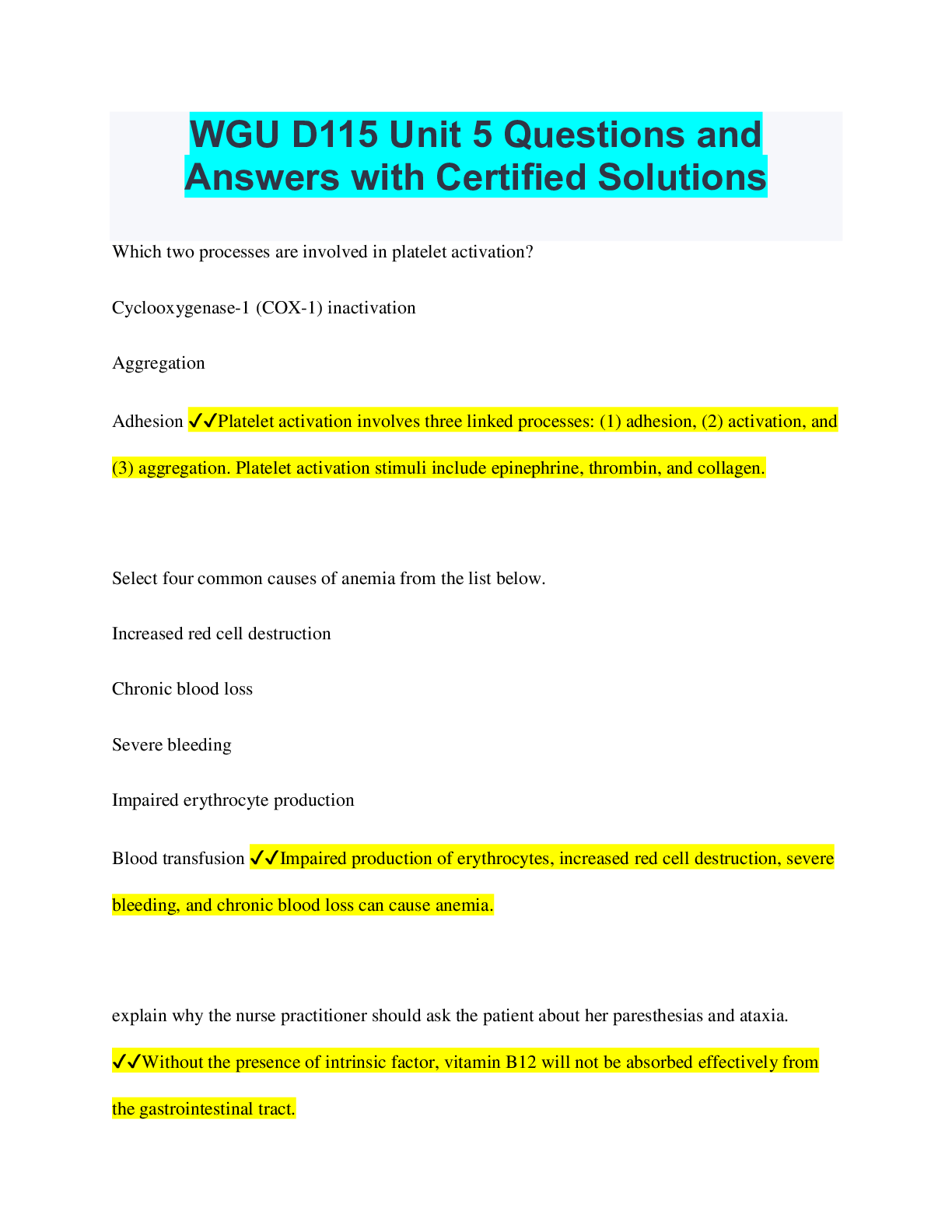
WGU D115 Unit 5 Questions and
Answers with Certified Solutions
Which two processes are involved in platelet activation?
Cyclooxygenase-1 (COX-1) inactivation
Aggregation
Adhesion ✔✔Platelet activation involves three linked processes: (1) adhesion, (2) activation, and
(3) aggregation. Platelet activation stimuli include epinephrine, thrombin, and collagen.
Select four common causes of anemia from the list below.
Increased red cell destruction
Chronic blood loss
Severe bleeding
Impaired erythrocyte production
Blood transfusion ✔✔Impaired production of erythrocytes, increased red cell destruction, severe
bleeding, and chronic blood loss can cause anemia.
explain why the nurse practitioner should ask the patient about her paresthesias and ataxia.
✔✔Without the presence of intrinsic factor, vitamin B12 will not be absorbed effectively from
the gastrointestinal tract.
Describe what causes pernicious anemia. ✔✔Pernicious anemia is caused by vitamin B12
deficiency, which is often associated with the end stage of type A chronic atrophic (autoimmune)
gastritis. Autoimmune gastritis impairs the production of IF, which is required for vitamin B12
uptake from the gut.
Select three possible causes of lymphadenopathy from the options below.
Inflammatory condition
Lipid storage disease
Neoplastic disease
Cardiac disease
Peripheral vascular dysfunction ✔✔There are multiple causes of lymphadenopathy. It may be
caused by neoplastic disease, so all lymphadenopathies must be closely followed and evaluated.
Lymphadenopathy may also be caused by an immunologic or inflammatory condition and by
lipid storage disease; this type of lymphadenopathy is usually widespread, including the liver and
spleen.
What is the most common cause of iron deficiency anemia (IDA) in children during the first few
years of life?
Dietary insufficiencies
Absorption problems
Blood loss
Increased iron requirement ✔✔Insufficient dietary iron is the most common cause of IDA in
children during the first few years of life.
Which stressor triggers sickling?
Increased plasma volume
Increased oxygen tension of the blood
Decreased plasma osmolality
Low temperature ✔✔Low temperature causes vasoconstriction, slowing blood flow, leading to
RBC deoxygenation, which triggers sickling.
cause of ITP ✔✔In 70% of ITP cases, there is an antecedent viral disease that stimulates
production of antiplatelet antibodies that bind to the plasma membranes of platelets, causing
platelet sequestration and destruction by phagocytes in the spleen and other lymphoid tissues at a
rate that exceeds the ability of the bone marrow to produce them.
What is the likelihood that the patient will recover? with ITP ✔✔The prognosis is excellent;
75% of children recover completely within three months. By six months after onset, 80% of
affected children have regained normal platelet counts.
What is a function of the pericardial sac?
It provides protection to heart valves and heart chambers.
It provides a physical barrier that protects the heart against infection and inflammation.
It forms a lining that is continuous with the arteries, veins, and capillaries of the body.
It creates a continuous closed circulatory system. ✔✔The pericardial sac provides a physical
barrier that protects the heart against infection and inflammation. It also protects the heart during
gravitational acceleration and deceleration.
Which factors determine cardiac output?
Parasympathetic and sympathetic activity
Heart rate and stroke volume
Right and left atrial pressure
Preload and afterload
Previousquestion ✔✔Cardiac output is the product of heart rate multiplied by stroke volume.
Which three enzymes are released when the myocardial muscle is damaged?
Lactic acid dehydrogenase (LDH)
Creatine phosphokinase-myocardial band (CPK-MB)
Cardiac troponin I (cTnI)
Low-density lipoprotein (LDL)
Aspartate aminotransferase (AST) ✔✔Creatine phosphokinase-myocardial band (CPK-MB) and
lactic acid dehydrogenase (LDH) are biomarkers released by damaged myocardial cells. Cardiac
troponin I (cTnI) is the most specific indicator of myocardial infarction.
HTN is a risk factor for coronary atherosclerosis. What does it do to afterload? ✔✔It also
increases afterload and causes ventricular hypertrophy, both of which increase myocardial
oxygen demand.
why it is important to determine if the patient has fainted recently or has blurred vision.
✔✔Syncope and blurred vision are signs of severely decreased cardiac output or orthostatic
hypotension.
Describe systolic heart failure. ✔✔Systolic heart failure is reduced contractility of the
myocardium so that the heart is unable to produce enough cardiac output to meet the oxygen
demands of body cells.
Previousquestion
What does systolic HF do to ejection fraction? ✔✔ejection fraction would be decreased below
40% because her stroke volume is decreased (reduced contractility) and her LVEDV is
increased.
Which statement is true regarding congenital heart disease?
Deficiency of folic acid has been associated with congenital birth defects.
The underlying cause of congenital heart disease is known in 30% of cases.
Congenital heart disease is the second leading cause of death in infants during the first year of
life.
Maternal use of drugs during pregnancy has not been shown to increase congenital heart disease.
✔✔Congenital heart disease is the leading cause of death, excluding prematurity, in infants
during the first year of life.
what is kawasaki disease ✔✔which is an acute, usually self-limiting systemic vasculitis that may
have serious complications if not recognized and managed. The actual etiology of this disorder is
not clear, but there is likely a genetic component, and current hypotheses are focused on
immunologic responses to an infectious, toxic, or antigenic substance as the etiology for
Kawasaki disease. During the acute phase, small capillaries, arterioles, and venules in the heart
become inflamed. During the subacute state, inflammation spreads to larger blood vessels like
the coronary arteries, and aneurysms may develop. During the convalescent stage, the mediumsized arteries begin to heal; however, the granulation process may cause coronary artery
thickening with increased risk for coronary thrombosis. After the convalescent stage,
inflammation decreases, but there is potential for scarring of the affected vessels, calcification,
and the development of vessel stenosis.
treatment for kawasaki in children ✔✔treated with oral aspirin therapy until the inflammation is
resolved. Intravenous administration of immunoglobulin is also used to manage the acute
inflammatory response.
Prognosis for kawasaki in kids ✔✔Treatment of Kawasaki disease with aspirin and intravenous
immunoglobulin during the acute phase has decreased the morbidity and reduced the incidence
of coronary abnormalities, and most children like this patient completely recover from Kawasaki
disease. However, there is the possibility of coronary thrombosis.
chief phagocytes of early inflammation ✔✔Neutrophil- 57-67% of total leukocytes
primary cells of immune response- ✔✔Lymphocytes-mature into T
and B cells.
most common blood disorder in children ✔✔. Anemia
What causes pernicious anemia ✔✔caused by B12 deficiency, often associated with end stage
type A chronic atrophic gastritis. Autoimmune gastritis impairs the production of intrinsic factor
(IF), which is required for Vitamin B12 uptake from the gut.
most common nutritional deficiency in kids ✔✔Iron deficiency anemia. with highest incidence
between 6 months and two years of age due to high need for iron for growth.
treatment for iron deficiency anemia in kids ✔✔dietary modification and possible iron
supplements
Whats the most important variable in determining the occurrence of sickling. ✔✔Deoxygenation
What triggers sickling ✔✔Triggered by hypoxemia, decreased pH, increased plasma osmolality,
and decreased
temperature.
Acute Leukemias happen how ✔✔abrupt and rapid onset
Most common chronic leukemia ✔✔CLL-involves malignant transformation and progressive
accumulation of monoclonal B
lymphocytes.
Where does lymphoma start ✔✔Usually starts in lymph nodes or lymphoid tissues of stomach or
intestines
accounts for 30% of childhood lymphomas ✔✔Burkitt Lymphoma- a B- cell non-Hodgkin
lymphomaWhat is associated with almost all cases of B- cell non-Hodgkin lymphoms ✔✔EBV
What is - Lymphoblastic Lymphoma- ✔✔rare Non-Hodgkin Lymphoma, but accounts for 20%
of NHL in childrenSymptoms of plasma cell malignancies ✔✔increased calcium levels, renal failure, anemia, bone
lesions, proteinuria, Increased M protein
Risk factors for cardiovascular disease ✔✔HYPERTENSION, age, smoking, obesity, increased
cholesterol, Diabetes, family history
Most common cardiovascular disease condition ✔✔Hypertension then coronary atherosclerosis
(HTN is a risk factor)
what does an echocardiogram assess ✔✔most effective and widely used for evaluation structures
of the heart- assesses cardiac output, ejection fraction, and valvular function
What does a SPECT evaluate for ✔✔for CAD and MI during stress test
What is raynauds phenomenon ✔✔attacks of vasospasm in the small arteries and arterioles of
fingers and sometimes toes
Symptom of raynauds ✔✔pallor, numbness, and cold sensation in fingers.
Leading cause of CAD and cerebrovasuclar disease ✔✔Atherosclerosis
What is atherosclerosis ✔✔thickening and hardening of the vessel are caused by the
accumulation of lipid laden macrophages within arterial wall, leading to the formation of plaque.
Most common complication of acute MI ✔✔Dysrhythmias
what is a pericardial effusision ✔✔accumulation of fluid in the pericardial cavity. Can occur in
all forms of pericarditis. May develop into tamponade (dyspnea, tachycardia, JVD,
cardiomegaly, and pulsus paradoxus), muffled heart sounds, poorly palpable apical pulse,
dyspnea on exertion, dull chest pain. Echo most reliable for diagnosis.
Most common valve disorder ✔✔mitral valve prolapse
What is a mitral valve prolapse ✔✔the anterior and posterior cusps of the mitral valve prolapse
into atrium during systole
symptoms of mitral valve prolapse ✔✔Usually asymptomatic- may have murmur - symptomatic
may cause palpations, tachycardia, fatigue, chest tightness, dyspnea, anxiety, depression, vague
symptoms.
seocond degree block Mobitz 1- Wenckebach ✔✔Rapid and irregular heart rhythm
Ineffective blood pumping raises the likelihood of coagulation and thrombosis. Pt has increased
risk for stroke.
What is the term for a reduction in red blood cells, white blood cells, and platelets?
Aplastic anemia
Hereditary hemochromatosis
Myelodysplastic syndrome
Sideroblastic anemia ✔✔Aplastic anemia results in a reduction in red blood cells, white blood
cells, and platelets.
Which illness is the most common cause of aplastic anemia?
Type A influenza virus
Chronic myeloid leukemia
Varicella zoster
Human parvovirus B19 ✔✔Human parvovirus B19 infection may lead to the cessation of red
blood cell production, resulting in aplastic anemia.
What are three possible causes of eosinophilia?
Hay fever
Cushing syndrome
Drug reactions
Prolonged infection
Asthma ✔✔Eosinophilia is an absolute increase (more than 450/µL) in the total number of
circulating eosinophils. Asthma (or the initiators of asthma), hay fever, and drug reactions may
cause eosinophilia.
What are two true statements regarding Hodgkin lymphoma?
Incidence is greater in black individuals.
Incidence peaks in the early 20s through 30s and then later in life.
The number of Reed-Sternberg cells is increased.
Japan and Australia have the highest incidence rate. ✔✔The peak incidence of Hodgkin
lymphoma occurs during the early 20s through 30s and again in the sixth and seventh decades of
life. An increase in Reed-Sternberg cells occurs with Hodgkin lymphoma.
What are two true statements regarding Burkitt lymphoma?
Burkitt lymphoma is associated with the Epstein-Barr virus.
Burkitt lymphoma is a fast-growing tumor of the jaw and facial bones.
Burkitt lymphoma is common in the United States.
Burkitt lymphoma is a type of Hodgkin lymphoma. ✔✔Burkitt lymphoma is fast-growing and
primarily involves the jaw and facial bone and may cause distortion of the facial bones. It is also
commonly associated with the Epstein-Barr virus and is one form of Epstein-Barr virusassociated lymphoproliferative disease.
Which condition is cyanosis followed by rubor and paraesthesias in the digits associated with?
Atherosclerosis
Varicose veins
Raynaud phenomenon or disease
Thromboangiitis obliterans ✔✔Raynaud phenomenon affects the small vessels supplying blood
to the fingers and toes; this vasoconstriction produces rubor and paresthesias in the digits.
Which three assessment findings are a sign of atherosclerosis?
Arcus senilis
Cardiac murmurs
Xanthelasmas
Carotid arterial bruits
Extra-rapid heart sounds ✔✔Xanthelasmas, arcus senilis, and carotid arterial bruits are
associated with atherosclerosis. Xanthelasmas are small fat deposits around the eyes that
suggests dyslipidemia, which is associated with atherosclerosis. Arcus senilis is a yellow lipid
ring around the cornea that suggests dyslipidemia, which is associated with atherosclerosis.
Carotid arterial bruits result from a narrowing of the carotid arteries and suggest probable
atherosclerotic disease.
Which three statements are true regarding atherosclerosis?
Atherosclerosis is the thickening and hardening of the vessel wall.
Atherosclerosis can affect all vascular systems in the body.
Atherosclerosis is an acute process of heart muscle degeneration.
Endothelial cell injury begins the process of atherosclerosis. ✔✔Atherosclerosis is a form of
arteriosclerosis in which thickening and hardening of the vessels (not heart muscle) occurs.
Collagen deposits over a fatty streak cause plaque. Additionally, atherosclerosis begins with
injury to the endothelial cells that line artery walls. Furthermore, atherosclerosis is not a single
disease; rather, it is a pathologic process that can affect vascular systems throughout the body.
Which four cardiac anomalies are associated with tetralogy of Fallot?
Right ventricular hypertrophy
Atrial septal defect
Tricuspid atresia
Overriding aorta
Ventricular septal defect
Pulmonary stenosis ✔✔A ventricular septal defect (VSD) that is high in the septum and usually
large is associated with tetralogy of Fallot. Pulmonary stenosis and right ventricular hypertrophy
are also associated with tetralogy of Fallot. The overriding aorta straddles the VSD and is
associated with tetralogy of Fallot.
Select four characteristics of tricuspid atresia.
No pathway between the right heart chambers
Cyanosis in the newborn experiencing this disorder
Children at risk for endocarditis
Mixing of deoxygenated and oxygenated bloods
Decrease in pulmonary blood flow ✔✔Tricuspid atresia is failure of the tricuspid valve to
develop; consequently, there is no communication from the right atrium to the right ventricle.
Additionally, blood flows through an atrial septal defect or a patent foramen ovale to the left
atrium and through a VSD into the right ventricle, resulting in the complete mixing of
deoxygenated and oxygenated blood. Moreover, in the newborn period, a murmur is noted, and
cyanosis is usually seen. Lastly, children are at risk for bacterial endocarditis, brain abscess, and
stroke.
[Show More]