Network + Port Numbers Latest 2023
with Verified Solutions
FTP ✔✔File Transfer Protocol: transfers files between clients and servers. Originally used two
ports: 21 for control messages and 20 for the actual data. Use
...
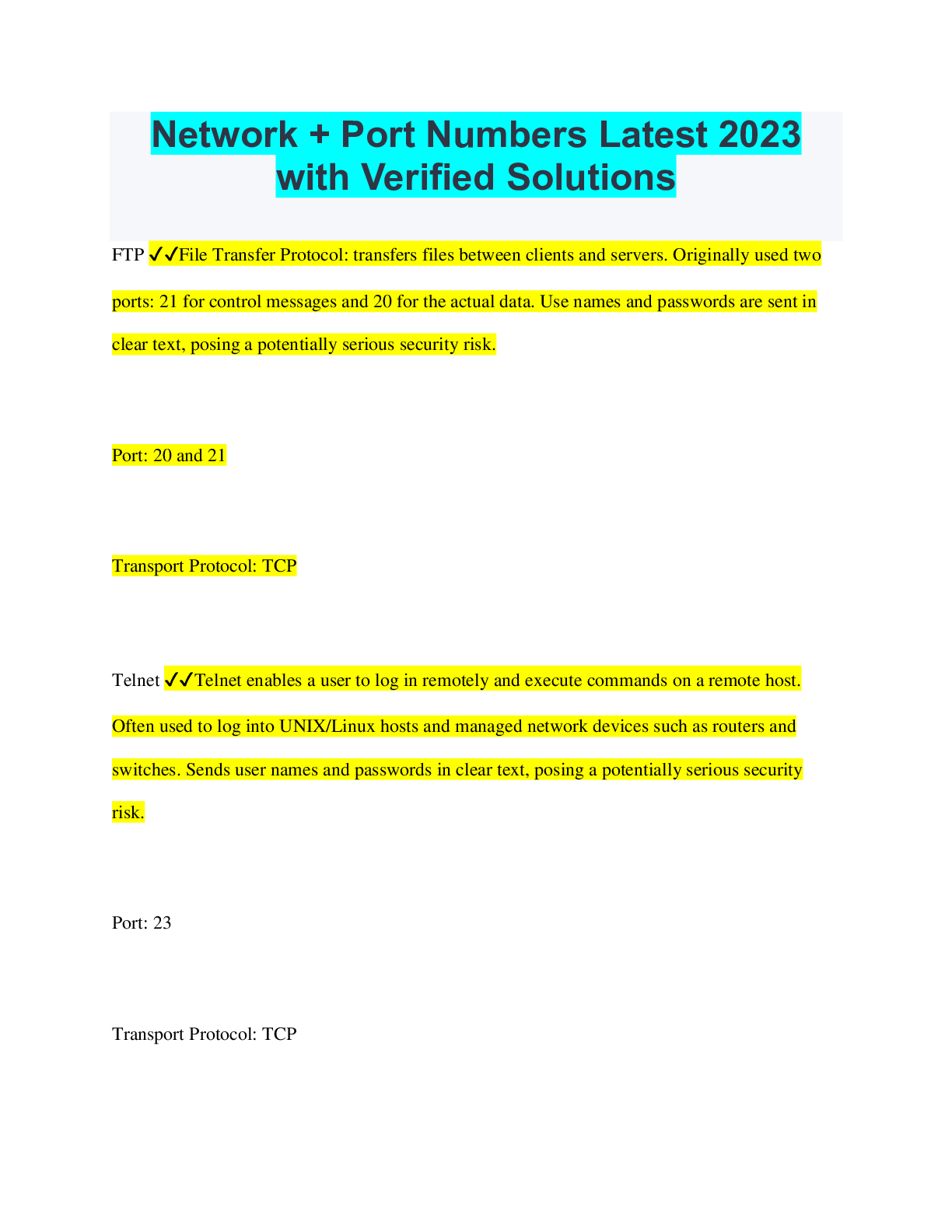
Network + Port Numbers Latest 2023
with Verified Solutions
FTP ✔✔File Transfer Protocol: transfers files between clients and servers. Originally used two
ports: 21 for control messages and 20 for the actual data. Use names and passwords are sent in
clear text, posing a potentially serious security risk.
Port: 20 and 21
Transport Protocol: TCP
Telnet ✔✔Telnet enables a user to log in remotely and execute commands on a remote host.
Often used to log into UNIX/Linux hosts and managed network devices such as routers and
switches. Sends user names and passwords in clear text, posing a potentially serious security
risk.
Port: 23
Transport Protocol: TCP
SSH ✔✔Secure Shell, a secure replacement for Telnet, encrypts both login information and data
sent over the connection.
Port: 22
Transport Protocol: TCP
SCP ✔✔Secure Copy uses the encryption provided by SSH to transfer files securely between
hosts. Use SCP instead of FTP when available.
Port: 22
Transport Protocol: TCP
DNS ✔✔Domain Name System maps computer names to IP addresses. TCP 53 is used for DNS
zone transfers, whereas UDP 53 is used for DNS queries and replies.
Port: 53
Transport Protocol: TCP and UDP
DHCP ✔✔Dynamic Host Configuration Protocol is used to assign IP addresses automatically to
clients on the network. The connectionless DHCP uses UDP port 67 for sending data to the
server and UDP port 68 for sending data to the client. DHCP replaced an earlier protocol called
BOOTP that functioned similarly.
Port: 67 and 68
Transport Protocol: UDP
TFTP ✔✔Trivial File Transfer Protocol transfers files between servers and clients without
requiring any user login. Most commonly used for downloading operating systems and
configuration files to systems with no local hard disk (for example, diskless workstations and
routers).
Port: 69
Transport Protocol: UDP
HTTP ✔✔Web servers use the Hypertext Transfer Protocol to accept connections from and to
send data to web browsers such as Google Chrome, Internet Explorer, and Mozilla Firefox.
Port: 80
Transport Protocol: TCP
SMTP ✔✔Simple Mail Transfer Protocol sends e-mail messages between mail servers. Mail
clients also use SMTP to send outgoing e-mail to a mail server.
Port: 25
Transport Protocol: TCP
POP3 ✔✔E-mail clients (such as Microsoft Outlook) use Post Office Protocol version 3 to
retrieve e-mail from mail servers.
Port: 110
Transport Protocol: TCP
IMAP 4 ✔✔E-mail clients use Internet Message Access Protocol version 4 to access e-mail
messages while leaving the messages themselves stored on the server.
Port: 143
Transport Protocol: TCP
NNTP ✔✔Network News Transfer Protocol transfers Usenet newsgroup messages between
servers and between clients and servers.
Port: 119
Transport Protocol: UDP
NTP ✔✔Network Time Protocol is used to synchronize the time on TCP/IP hosts.
Port: 123
Transport Protocol: UDP
NetBIOS ✔✔Used to support functions such as Microsoft File and Print Sharing over TCP/IP
networks.
Port: 137, 138, 139
Transport Protocol: TCP
SNMP v2/v3 ✔✔Simple Network Management Protocol enables network management
applications to monitor network devices remotely.
Port: 161
Transport Protocol: UDP
LDAP ✔✔Clients use the Lightweight Directory Access Protocol to search and update
information in directories over a TCP/IP network. Directory services such as Microsoft's Active
Directory can be accessed using LDAP.
Port: 389
Transport Protocol: TCP
Raw SMB ✔✔When NetBIOS support is disabled, Microsoft File and Print Sharing uses port
445.
Port: 445
Transport Protocol: TCP
IGMP ✔✔Clients use Internet Group Multicast Protocol to register as members of a multicast
group. IGMP is popular with streaming video or gaming applications, for which the same data
needs to be delivered to a group of systems at one time. This is far more efficient than sending
many separate unicast messages.
Port: 463
Transport Protocol: UDP
LPR ✔✔The Line Printer protocol is used to communicate between the LPR client and the LPD
(Line Printer Daemon) server. Typically used for printing using UNIX/Linux systems (and found
as wrong answers in the CompTIA exam).
Port: 515
Transport Protocol: TCP
[Show More]




.png)