Neurological System NCLEX Questions:
Ch. 66 Already Passed
The nurse is assessing the motor function of an unconscious client. The nurse should plan to use
which technique to test the client's peripheral response to p
...
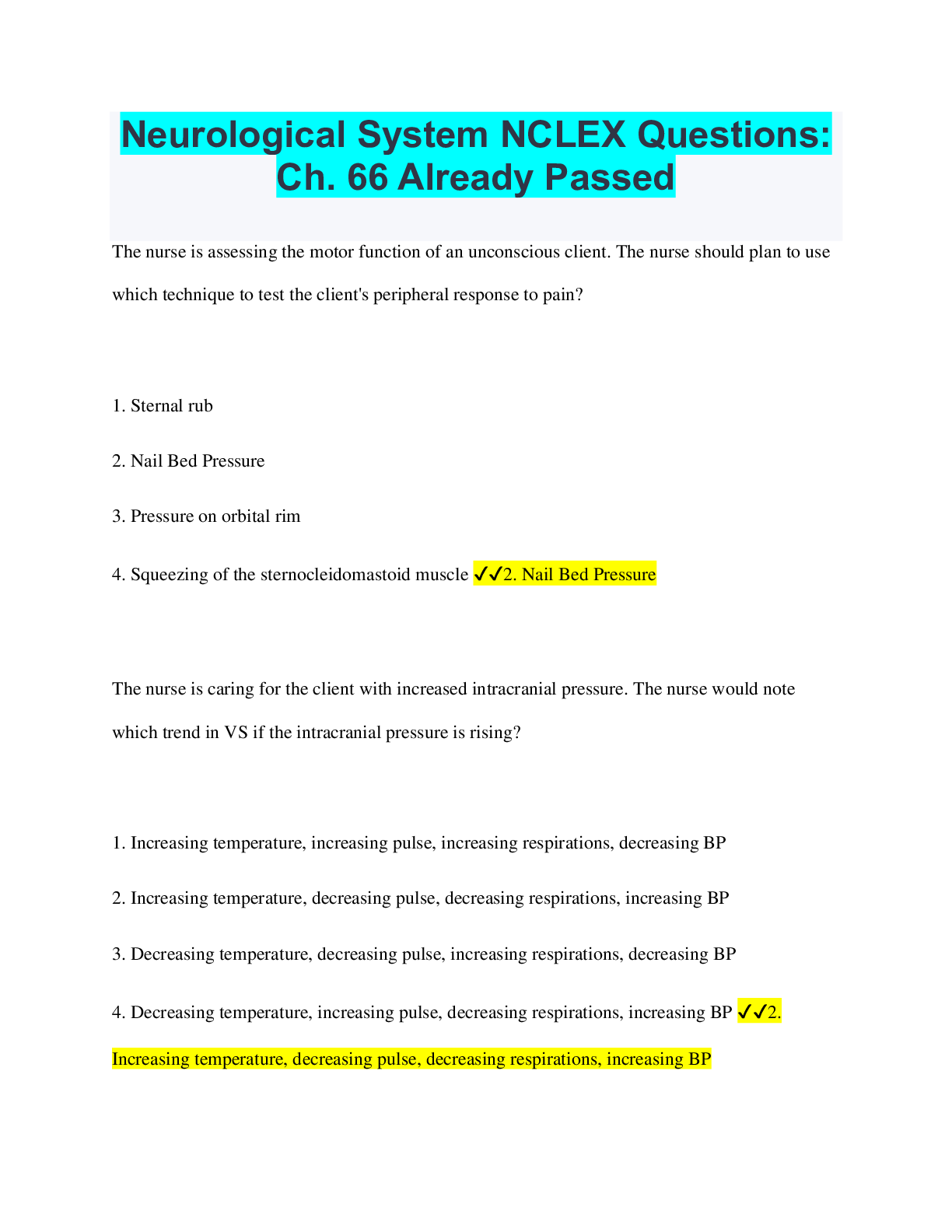
Neurological System NCLEX Questions:
Ch. 66 Already Passed
The nurse is assessing the motor function of an unconscious client. The nurse should plan to use
which technique to test the client's peripheral response to pain?
1. Sternal rub
2. Nail Bed Pressure
3. Pressure on orbital rim
4. Squeezing of the sternocleidomastoid muscle ✔✔2. Nail Bed Pressure
The nurse is caring for the client with increased intracranial pressure. The nurse would note
which trend in VS if the intracranial pressure is rising?
1. Increasing temperature, increasing pulse, increasing respirations, decreasing BP
2. Increasing temperature, decreasing pulse, decreasing respirations, increasing BP
3. Decreasing temperature, decreasing pulse, increasing respirations, decreasing BP
4. Decreasing temperature, increasing pulse, decreasing respirations, increasing BP ✔✔2.
Increasing temperature, decreasing pulse, decreasing respirations, increasing BP
A client recovering from a head injury is participating in care. The nurse determines that the
client understands measures to prevent elevations in intracranial pressure if the nurse observes
the client doing the activity?
1. Blowing the nose
2. Isometric exercises
3. Coughing vigorously
4. Exhaling during repositioning ✔✔4. Exhaling during repositioning
A client has clear liquid leaking from the nose following a basilar skull fracture. Which finding
would alert the nurse that cerebrospinal fluid is present?
1. Fluid is clear and tests negative for glucose.
2. Fluid is grossly bloody in appearance and has a pH of 6.
3. Fluid clumps together on the dressing and has a pH of 7.
4. Fluid separates into concentric rings and tests positive for glucose. ✔✔4. Fluid separates into
concentric rings and tests positive for glucose.
A client with a spinal chord injury is prone to experiencing autonomic dysreflexia. The nurse
should avoid which measure to minimize the risk of occurrence?
1. Strict adherence to a bowel retraining program
2 Keeping the linen wrinkle-free under the client
3. Preventing unnecessary pressure on the lower limbs
4. Limiting bladder catheterization to once ever 12 hours ✔✔4. Limiting bladder catheterization
to once ever 12 hours
The nurse is evaluating the neurological signs of a client in spinal shock following spinal chord
injury. Which observation indicates that spinal shock persists?
1. Hyperreflexia
2. Positive reflexes
3. Flaccid paralysis
4. Reflex emptying of the bladder ✔✔3. Flaccid paralysis
The nurse is caring for a client who begins to experience seizure activity while in bed. Which
action by the nurse is contraindicated?
1. Loosening restrictive clothing
2. Restraining the client's limbs
3. Removing the pillow and raising padded side rails
4. Positioning the client to the side, if possible, with the head flexed forward ✔✔2. Restraining
the client's limbs
The nurse is assigned to care for a client with complete right-sided hemiparesis. Which
characteristics are associated with this condition? Select all that apply.
1. The client is aphasic
2. The client has weakness in the face and tongue
3. The client has weakness on the right side of the body
4. The client has complete bilateral paralysis of the arms and legs
5. The client has lost the ability to move the right arm but is able to walk independently
6. The client has lost the ability to ambulate independently but is able to feed and bathe himself
or herself without ✔✔1. The client is aphasic
2. The client has weakness in the face and tongue
3. The client has weakness on the right side of the body
The nurse has instructed the family of a client with stroke (brain attack) who has homonymous
hemianopsia about measures to help the client overcome the deficit. Which statement suggests
that the family understands the measures to help when caring for the client?
1. "We need to discourage him from wearing eyeglasses."
2. "We need to place objects in his impaired field of vision."
3. "We need to approach him from the impaired field of vision."
4. "We need to remind him to turn his head to scan the lost visual field." ✔✔4. "We need to
remind him to turn his head to scan the lost visual field."
The nurse is assessing the adaption of a client to changes in functional status after a stroke (brain
attack). Which observation indicates to the nurse that the client is adapting most successfully?
1. Gets angry with the family if they interrupt a task
2. Experiences bouts of depression and irritability
3. Has difficulty with using modified feeding utensils
4. Consistently uses adaptive equipment in dressing self ✔✔4. Consistently uses adaptive
equipment in dressing self
The nurse is teaching a client with myasthenia gravis about the prevention of myasthenic and
cholinergic crises. Which client activity suggests that teaching is most effective?
1. Eating large, well-balanced meals
2. Doing muscle-strengthening exercises
3. Doing all chores early in the day while less fatigued
4. Taking medications on time to maintain therapeutic blood levels ✔✔4. Taking medications on
time to maintain therapeutic blood levels
The nurse has given instructions to a client with Parkinson's Disease about maintaining mobility.
Which action demonstrates that the client understands the directions?
1. Sits in soft, deep chairs to promote comfort.
2. Exercises in the evening to combat fatigue.
3. Rocks back and forth to start movement with bradykinesia.
4. Buys clothes with many buttons to maintain finger dexterity. ✔✔3. Rocks back and forth to
start movement with bradykinesia.
The nurse has given suggestions to a client with trigeminal neuralgia about strategies to
minimize episodes of pain. The nurse determines that the client needs further education if the
client makes which statement?
1. "I will wash my face with cotton pads."
2. "I'll have to start chewing on my unaffected side."
3. "I'll try to eat my food either very warm or very cold."
4. "I should rinse my mouth if toothbrushing is painful." ✔✔3. "I'll try to eat my food either very
warm or very cold."
The client is admitted to the hospital with a dx of Guillian-Barre syndrome. Which past medical
history finding makes the client most at risk for the disease?
1. Meningitis or encephalitis during the last 5 years
2. Seizures or trauma to the brain within the last year
3. Back injury or trauma to the spinal chord during the last 2 years
4. Respiratory or gastrointestinal infection during the previous month ✔✔4. Respiratory or
gastrointestinal infection during the previous month
A client with Guillian-Barre syndrome has ascending paralysis and is intubated and receiving
mechanical ventilation. Which strategy should the nurse incorporate in the plan of care to help
the client cope with this illness?
1. Giving client full control over care decisions and restricting visitors
2. providing positive feedback and encouraging active range of motion
3. Providing information, giving positive feedback, and encouraging relaxation
4. Providing IV administered sedatives, reducing distractions, and limiting visitors ✔✔3.
Providing information, giving positive feedback, and encouraging relaxation
A client has a neurological deficit involving the limbic system. Which assessment finding is
specific to this type of deficit?
1. Is disoriented to person, place, and time
2. Affect is flat, with periods of emotional lability
3. Cannot recall what was eaten for breakfast today
4. Demonstrates inability to add and subtract; does not know who is the president of the United
States ✔✔2. Affect is flat, with periods of emotional lability
The nurse is planning to institute seizure precautions for a client who is being admitted from the
emergency department. Which measures should the nurse include in planning for the client's
safely? Select all that apply.
1. Padding the side rails of the bed
2. Placing an airway at the bedside
3. Placing the bed in high position
4. Putting a padded tongue blade at the head of the bed
5. Placing oxygen and suction equipment at the bedside
6. Having IV equipment ready for insertion of an IV catheter ✔✔1. Padding the side rails of the
bed
2. Placing an airway at the bedside
5. Placing oxygen and suction equipment at the bedside
6. Having IV equipment ready for insertion of an IV catheter
The nurse is evaluating the status of a client who had a craniotomy 3 days ago. Which
assessment finding would indicate that the client is developing meningitis as a complication of
surgery?
1. A negative Kernig sign
2. Absence of nuchal rigidity
3. A positive Brudzinski sign
4. A Glasgow Coma Scale score of 15 ✔✔3. A positive Brudzinski sign
The nurse has completed discharge instructions for a client with application of a halo device.
Which action indicates that the client needs further clarification of the instructions?
1. Uses a straw for drinking
2. Drives only during the daytime
3. Uses caution because the device alters balance
4. Washes the skin daily under the lamb's wool liner of the vest ✔✔2. Drives only during the
daytime
The nurse is admitting a client with Guillain-Barre syndrome to the nursing unit. The client has
ascending paralysis to the level of the waist. Knowing the complications of the disorder, the
nurse should bring most essential items into the client's room?
1. Nebulizer and pulse oximeter
2. Blood pressure cuff and flashlight
3. Flashlight and incentive spirometer
4. Electrocardiographic monitoring electrodes and intubation tray ✔✔4. Electrocardiographic
monitoring electrodes and intubation tray
[Show More]