Endocrine sample PANCE questions and
answers already passed
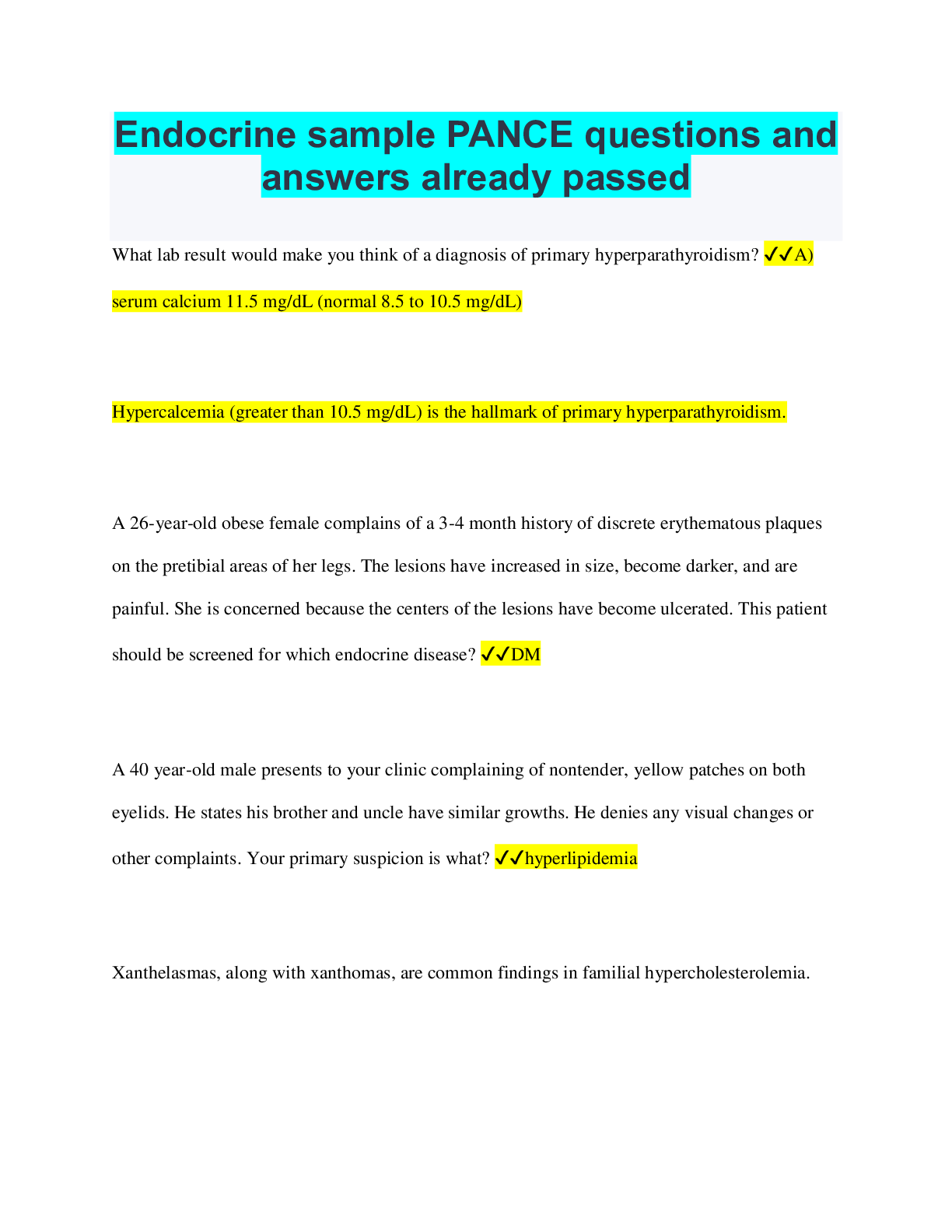
What lab result would make you think of a diagnosis of primary hyperparathyroidism? ✔✔A)
serum calcium 11.5 mg/dL (normal 8.5 to 10.5 mg/dL)
Hypercalcemia (
...
Endocrine sample PANCE questions and
answers already passed
What lab result would make you think of a diagnosis of primary hyperparathyroidism? ✔✔A)
serum calcium 11.5 mg/dL (normal 8.5 to 10.5 mg/dL)
Hypercalcemia (greater than 10.5 mg/dL) is the hallmark of primary hyperparathyroidism.
A 26-year-old obese female complains of a 3-4 month history of discrete erythematous plaques
on the pretibial areas of her legs. The lesions have increased in size, become darker, and are
painful. She is concerned because the centers of the lesions have become ulcerated. This patient
should be screened for which endocrine disease? ✔✔DM
A 40 year-old male presents to your clinic complaining of nontender, yellow patches on both
eyelids. He states his brother and uncle have similar growths. He denies any visual changes or
other complaints. Your primary suspicion is what? ✔✔hyperlipidemia
Xanthelasmas, along with xanthomas, are common findings in familial hypercholesterolemia.
A patient complains of fatigue, tremors, palpitations, and heat intolerance. The thyroid is
diffusely enlarged and firm on palpation. What would you expect TSH levels to be? ✔✔LOW
TSH.
The presentation is consistent with hyperthyroidism. Laboratory findings include low TSH,
elevated free and total thyroid hormone levels, and an increased uptake on radionuclide scan.
There may also be elevated bilirubin, liver thrombocytopenia.
A solitary thyroid nodule is noted on physical examination. The TSH level is normal. The next
step in the evaluation is ______________. ✔✔Fine needle bx.
Fine needle aspiration (FNA) is the first step in the evaluation of a solitary nodule with a normal
TSH level. FNA has a high level of accuracy in diagnosing benign versus malignant nodules in
this setting.
30 year-old female complains of fatigue, weakness, diminished appetite, weight loss, and
syncope. She denies fever, chest or abdominal pain, palpitations, changes in bowel patterns or
sleep patterns. Physical examination reveals a thin female, BP 90/65 mmHg, and pulse 80 beats
per minute. Pulmonary, cardiovascular, abdominal, and neurologic exam are without
abnormalities. Areas of brown and bronze hyperpigmentation are noted 39 on her elbows and the
creases of her hands. What is the dx? ✔✔Addison's disease
Addison's disease (adrenal insufficiency) would account for all her symptoms, the hypotension,
and the hyperpigmentation of the skin.
A 72 year-old female is being evaluated for recurrent kidney stones. Physical examination
reveals no abnormal findings. Laboratory findings show elevated calcium and decreased
phosphate levels. Which of the following is the most likely diagnosis? ✔✔hyperparathyroidism
The majority of patients with hyperparathyroidism are asymptomatic. Recurrent nephrolithiasis
may be one of the presentations of primary hyperparathyroidism. Measurement of parathyroid
levels would be the initial laboratory test for the evaluation of hypercalcemia.
A 38 year-old male presents to your clinic complaining of increasing constant headaches and
progressive loss of peripheral vision. His medical and family history is unremarkable. Physical
examination reveals bitemporal hemianopsia but is otherwise without any abnormalities. Which
of the following is the most likely diagnosis? ✔✔Pituitary tumor.
A pituitary tumor would account for the headaches and the loss of the peripheral vision in both
visual fields. As the tumor grows, the optic chiasm will be compressed by the tumor.
The most effective method to prevent diabetic retinopathy is _______________. ✔✔Question 8
Explanation: The most effective method to prevent diabetic retinopathy is through *intensive
glycemic control.*
A diabetic patient returns for follow-up of non-fasting blood work done at a local health fair. The
total cholesterol is 230 mg/dl. Which of the following is the appropriate next step? ✔✔Obtain a
fasting HDL and LDL lipid measurement.
Radioactive iodine is most successful in treating hyperthyroidism that results from
_____________________. ✔✔Grave's disease
can you tx papillary thyroid carcinoma with radioactive iodine? ✔✔NO must tx with
thyroidectomy.
A newborn infant exhibits prolonged jaundice, feeding problems, hypotonia, and an enlarged
tongue. Proper treatment in this infant would consist of __________________. ✔✔Thyroid
hormone replacement
This scenario is consistent with congenital hypothyroidism. Measurement of TSH or T4 would
confirm this and T4 should be given.
______________ can result in hypokalemia. ✔✔adrenal adenoma.
Excessive secretion of aldosterone from an adrenal adenoma will lead to sodium retention and
the secretion of potassium in the distal tubule of the kidney, eventually leading to hypokalemia.
A 43 year-old asymptomatic diabetic female is found to have an elevated total calcium level of
12.4 mg/dL. Which test do you need to order next? ✔✔Serum albumin
Since approximately 50% of calcium is protein bound, total calcium levels should be interpreted
relative to albumin levels.
A 64 year-old male presents complaining of new onset of fatigue, weight gain, constipation,
erectile dysfunction, and loss of body hair. Laboratory investigation demonstrates: TSH less than
0.5 microunits/mL (normal range 0.5-5.0 microU/mL); Thyroxine (T4) 2 mcg/dL (normal range
5-12 mcg/dL); Prolactin 10 nanograms/ml (normal). What is the dx? ✔✔Hypopituitarism
The low trophic and target hormone levels combined with symptoms of hypogonadism indicate
this patient has hypopituitarism.
A known alcoholic presents to the emergency department with altered level of consciousness and
a blood glucose level of 35 mg/dL. What would explain this glucose result? ✔✔Hepatic
glycogen depletion and impaired gluconeogenesis
Alcohol-related hypoglycemia results from hepatic glycogen depletion and impaired
gluconeogenesis and not due to antibody formation, excessive insulin release from the pancreas,
or rapid release of carbohydrate into the small bowel
A 53 year-old female who is well known to the practice presents to the office complaining of
increasing fatigue, constipation, and a weight gain of 10 lb (4.5 kg) over the past year. She also
states others have noticed a recent hoarseness to her voice, and she is bothered by "charley
horses" in her legs that wake her up at night. Her past medical history is unremarkable except for
a history of hyperthyroidism treated by radioactive iodine 5 years ago. She is currently taking no
medications and has no known drug allergies. What is the most likely cause of the patient's
symptoms? ✔✔Hypothyroidism
The current symptoms, along with the past treatment of hyperthyroidism with radioactive iodine,
would indicate hypothyroidism.
A patient presents with signs and symptoms of Cushing's syndrome. Extensive diagnostic
evaluation reveals an ACTH-secreting pituitary adenoma. First-line therapy should consist of
____________________. ✔✔transsphenoidal resection of the tumor
Transsphenoidal resection of the tumor cures about 80% of patients. The remainder can be given
a combination of pituitary radiation and medical adrenalectomy with one or more drugs. If these
procedures fail, the last option is bilateral adrenalectomy.
While awaiting operative removal of pheochromocytoma, which of the following classes of
medications are used for control of hypertension? ✔✔alpha-adrenergic blocker
Alpha-adrenergic blockers are used preoperatively to control hypertension in a patient with
pheochromocytoma that occurs from unopposed alpha stimulation when the tumor is
manipulated
central obesity, glucose intolerance, and easy bruising. Dx is _________________. ✔✔Cushing's
syndrome
hyponatremia WITH hyperkalemia signifies _______________. ✔✔acute adrenal insufficiency
As part of the long-term management of a patient with type 1 diabetes mellitus, the glycosylated
hemoglobin (HgbA1C) level should be ideally maintained at ✔✔6 to 7%
The HgbA1C in patients with type 1 diabetes mellitus should be maintained between 6 and 7%.
Lower levels lead to an increased number of episodes of hypoglycemia, and higher levels lead to
an increased risk of retinopathy, nephropathy, and neuropathy.
A 72 year-old female is being evaluated for recurrent kidney stones. Physical examination
reveals no abnormal findings. Laboratory findings show elevated calcium and decreased
phosphate levels.hyperparathyroidism ✔✔hyperparathyroidism
The majority of patients with hyperparathyroidism are asymptomatic. Recurrent nephrolithiasis
may be one of the presentations of primary hyperparathyroidism. Measurement of parathyroid
levels would be the initial laboratory test for the evaluation of hypercalcemia.
which imaging modality provides the best visualization of pituitary tumors? ✔✔brain MRI
what is a common sign/symptom s/p iatrogenic injury during subtotal thyroidectomy?
✔✔Hoarseness
The recurrent laryngeal nerve is most commonly injured during subtotal thyroidectomy. If
injured, hoarseness is the most common presentation for this nerve impairment.
A patient presents to the office with worsening fatigue, weight loss, and weakness. She notes that
she is having recurrent bouts of abdominal pain and has been losing her pubic hair. Patient is
found to have orthostatic hypotension. Dx is ___________________. ✔✔Addison's disease
Patients with Addison's disease have primary adrenal failure from an autoimmune problem in the
adrenal gland or due to hemorrhage into the adrenal gland. These patients are not able to make
glucocorticoids, mineralocorticoids, or sex hormones which result in hypotension,
hyperpigmentation (from an increase in the ACTH and MSH hormones) and are hyponatremic.
A patient is diagnosed with hypothyroidism and started on levothyroxine (Synthroid). When is it
ideal to recheck the TSH level? ✔✔Three to four weeks
Patients taking levothyroxine (Synthroid) for thyroid replacement will achieve peak levels of T4
within three to four weeks. The half-life of levothyroxine is 7 days so it will take three to four
weeks in order to achieve a steady state which means that TSH levels or T4 levels should not be
checked sooner than this recommended time of three to four weeks.
Patients with primary adrenal insufficiency will have which electrolyte abnormality?
✔✔Hyperkalemia
Patients with primary adrenal insufficiency will not have the adrenal gland producing cortisol,
aldosterone, and the sex hormones. As a result of the lack of the mineralocorticoid aldosterone,
the kidney will not save sodium and will instead save potassium.
What is the most common presentation for an elderly female patient with primary
hyperparathyroidism? ✔✔asymptomatic
Patients with primary hyperparathyroidism are most commonly found to have this disease by an
incidental finding of hypercalcemia on routine laboratory testing as a result of screening. Up to
0.1% of the adult population has this condition which is most commonly seen in females over
age 50.
What is a known complication to prescribing excessive doses of levothyroxine (Synthroid) for
patients with hypothyroidism? ✔✔Osteoporosis
Osteoporosis may result from overaggressive therapy with levothyroxine (Synthroid) because of
the increased bone turnover that results from increased basal metabolic rate.
Which hormone primarily inhibits growth hormone secretion from the pituitary gland?
✔✔Somatostatin
Somatostatin inhibits the release of growth hormone from the pituitary gland as well as
hyperglycemic states. It is therefore useful in the treatment of excessive growth hormone release
that occurs with gigantism and acromegaly.
An adult presents with a three month history of progressive severe muscle cramps, extremity
paresthesias and lethargy which began shortly after a thyroidectomy for a malignant thyroid
lesion. What is the most likely diagnosis? ✔✔Hypoparathyroidism
Hypocalcemia secondary to hypoparathyroidism is commonly seen as a complication of
thyroidectomy.
A 58 year-old female presents with acute onset of 105 degrees F fever, chills, delirium and
tachycardia. Laboratory analysis reveals a TSH of 0.08 mcU/L (0.4-6.0 mcU/L), total T3 of 400
ng/dL (95-190 ng/dL)and a total T4 of 180 mcg/dL (5-11 mcg/dL). What is the initial treatment
of choice to normalize this condition? ✔✔Propylthiouracil
Propylthiouracil is the preferred initial drug in patients with thyroid storm.
A patient with adrenal insufficiency is taking hydrocortisone 25 mg daily. What should the
patient do with the hydrocortisone dose when they develop a minor illness such as a cold?
✔✔Increase the dose to 50 mg daily until the illness resolves.
To better mimic the normal physiologic response the baseline dose should be doubled for the
duration of the illness. Doses should be increased 5-10 fold with major events such as surgery.
A 34 year-old female status-post trans-sphenoidal resection of pituitary adenoma presents with
worsening polydipsia of 10-12 liters daily and polyuria within four days of discharge. A
urinalysis reveals a specific gravity of 1.004 (1.001- 1.035) and shows decreased urine
osmolality but is otherwise normal. Labs reveal mild hypernatremia. What is the treatment of
choice for this patient? ✔✔Desmopressin
The main treatment for diabetes insipidus is Desmopressin.
A stuporous patient is brought to the emergency room with a five day history of progressive
lethargy and confusion along with polyuria and polydipsia. On examination the patient is
dehydrated and is without Kussmaul respirations. Serum glucose is 1200 mg/dL (75-110 mg/dL),
serum sodium 150 mEq/L (136-146 mEq/L) serum pH is 7.5 and serum osmolality is 320
mosm/kg (280-300 mosm/kg). Urinalysis reveals no ketones. What is the most likely diagnosis?
✔✔Hyperglycemic hyperosmolar state
Extreme hyperglycemia with normal pH and negative ketones are hallmark for this clinical
picture.
A 32 year-old male with a history of pheochromocytoma is seen in the office. The patient is
scheduled for adrenalectomy, however has developed a throbbing headache and racing heart.
Vital signs reveal pulse 126 bpm, blood pressure 160/115 mmHg, and respiratory rate 20. The
patient appears diaphoretic and anxious. Which medication is the most appropriate acute
management in this patient? ✔✔Oral Phenoxybenzamine (Dibenzyline)
Phenoxybenzamine is an alpha-blocker utilized to control hypertension in patient with a
pheochromocytoma.
A patient with Type 2 diabetes uses a mixture of NPH and regular insulin twice daily. She
consistently has mid- afternoon bouts of hypoglycemia, despite eating her meals as scheduled.
How would you modify her insulin dosing to reduce her mid-afternoon hypoglycemic events?
✔✔Reduce morning dose of NPH insulin
Reducing the morning dose of NPH insulin would be most appropriate as it exerts its greatest
effect on the noontime meal.
Hypoglycemia in an elderly patient with diabetes is most likely to manifest as
_______________? ✔✔mental confusion
Manifestations of hypoglycemia in the elderly are mainly from impaired central nervous system
function. Manifestations include mental confusion, bizarre behavior, and ultimately coma.
A 55 year-old female presents to the clinic with lethargy, fatigue, constipation, and menorrhagia.
Physical examination reveals an enlarged thyroid, dry skin, and a heart rate of 50 bpm.
Laboratory results show a decrease in free T4, and an elevation in TSH. What is the most likely
diagnosis? ✔✔Primary hypothyroidism
This is a classic presentation of symptoms of primary hypothyroidism. Symptoms include weight
gain, fatigue, lethargy, depression, weakness, constipation, menorrhagia; and patients often
present with a palpable, enlarged thyroid.
An 18 year-old female with diabetes presents to the emergency department with altered level of
consciousness, deep breathing and fruity odor to her breath. Which of the following medications
is indicated for this patient? ✔✔Regular insulin
Regular insulin has a rapid onset of action when given intravenously and is the initial choice in
patients with diabetic ketoacidosis. Following the initial dose, a continuous infusion often
promotes a steady, slow fall of glucose levels to normal, which can then be stabilized by
decreasing the insulin.
A 32 year-old male presents with a one-month history of weakness, anorexia, and weight loss.
On physical examination, he is hypotensive and his skin has diffuse hyperpigmentation. Plasma
cortisol levels drawn at 8 am are low. Which of the following is the most likely diagnosis?
✔✔Addison disease (chronic adrenocortical insufficiency)
Screening for hypothyroidism is always indicated in which age group? ✔✔newborns
The American Academy of Pediatrics recommends screening of hypothyroid disease between 2-
4 days of birth.
A person with type 2 diabetes who requires insulin brings in a home monitoring record for
review. The current insulin regimen is 15 units of NPH with 5 units of regular in the morning,
and 10 units of NPH with 5 units of regular in the evening. A trend of elevated blood sugar
readings occurring at noon should prompt you to adjust insulin dosing in what way? ✔✔increase
morning regular dose
The elevated noon blood sugar reading indicates a need to increase the morning regular dose.
[Show More]