Week 2 Discussion: Context, Meaning, and Value
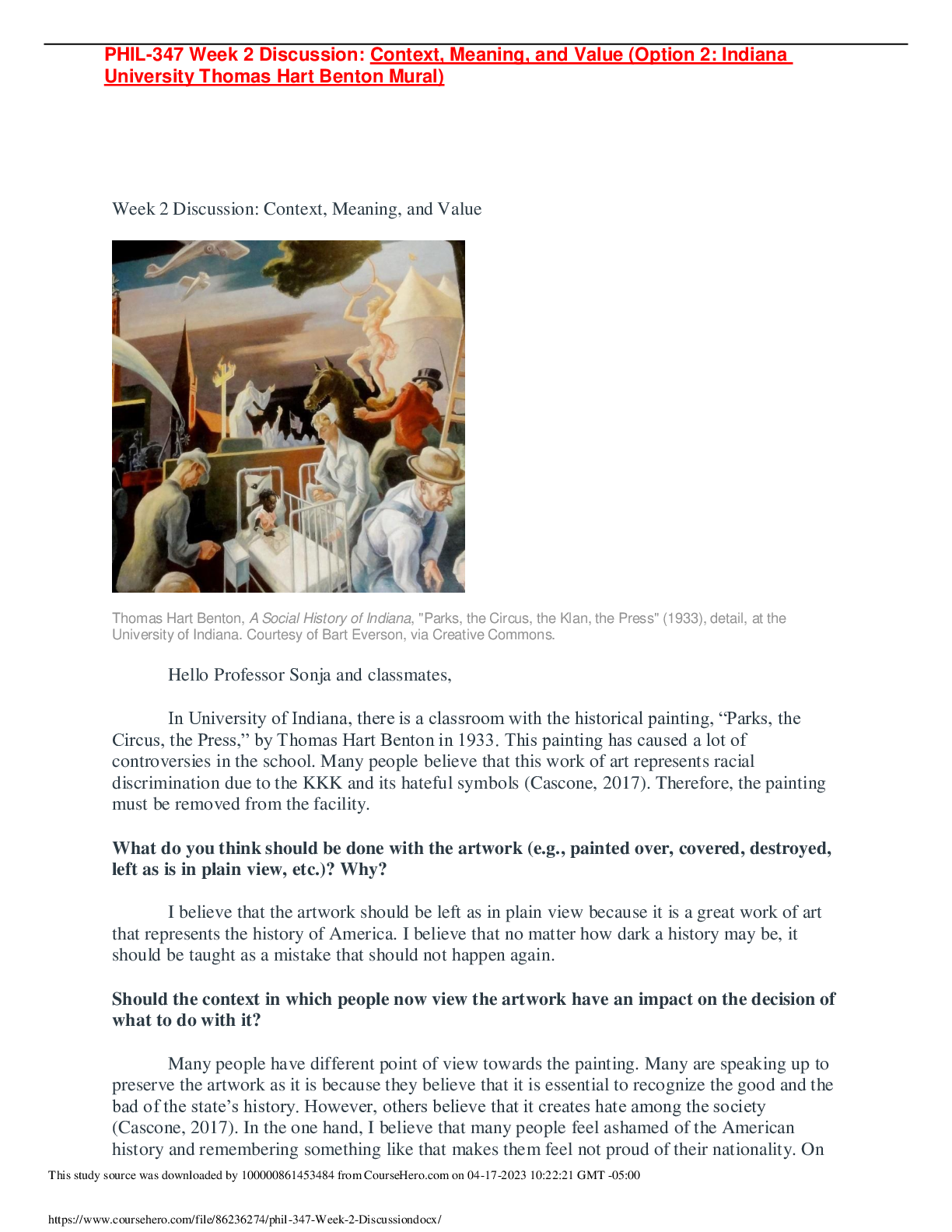
Thomas Hart Benton, A Social History of Indiana, "Parks, the Circus, the Klan, the Press" (1933), detail, at the University of Indiana. Courtesy of Bart Everson, via Crea
...
Week 2 Discussion: Context, Meaning, and Value
Thomas Hart Benton, A Social History of Indiana, "Parks, the Circus, the Klan, the Press" (1933), detail, at the University of Indiana. Courtesy of Bart Everson, via Creative Commons.
Hello Professor Sonja and classmates,
In University of Indiana, there is a classroom with the historical painting, “Parks, the Circus, the Press,” by Thomas Hart Benton in 1933. This painting has caused a lot of controversies in the school. Many people believe that this work of art represents racial discrimination due to the KKK and its hateful symbols (Cascone, 2017). Therefore, the painting must be removed from the facility.
What do you think should be done with the artwork (e.g., painted over, covered, destroyed, left as is in plain view, etc.)? Why?
I believe that the artwork should be left as in plain view because it is a great work of art that represents the history of America. I believe that no matter how dark a history may be, it should be taught as a mistake that should not happen again.
Should the context in which people now view the artwork have an impact on the decision of what to do with it?
Many people have different point of view towards the painting. Many are speaking up to preserve the artwork as it is because they believe that it is essential to recognize the good and the bad of the state’s history. However, others believe that it creates hate among the society (Cascone, 2017). In the one hand, I believe that many people feel ashamed of the American history and remembering something like that makes them feel not proud of their nationality. On
the other hand, minorities might feel attacked in the sense that white people are showing off what they did in the past. Therefore, minorities feel discriminated.
Do you think the message of the artwork is sufficiently important that the message alone requires that it be saved?
Yes, I strongly believe that the message is important, and it should be preserved because is part of the American history. We need to learn from our past to create a better future. Facione (2016, p.66), explains that critical thinkers use four interpretive questions to expose the real context and purpose of what it is being communicating. These questions are “what values were significant enough to motivate the author? Who was the author’s intended audience? What did the author intend to communicate? And what did the author believe that audience already knew?” I believe that if we analyzed every aspect of the painting, we would realize that the author portrays a reality that needed to be faced, even if we don’t agree with it.
Do you think the artists were biased or prejudiced? If yes, explain specifics about the artwork that support your opinion. Do you think viewers might be bringing bias or prejudice to their opinions? Are you?
Even though the author stated, “I paint sometimes to get people to criticize my work” (Blake, 2009), I believe that he was speaking his truth by using his talent. Benton was an American painter and one of the regionalist art movement during his time. Benton was known as the “melodrama of democracy,” because of his controversial historical events such as depictions of the 1920s Klan and rock-throwing strikers (Blake, 2009). However, many critics complained about Benton’s exaggerations and inaccuracy of his paintings. For example, the independence newspaper stated that “Missouri is not proud of hangings and negro honky-tonks…and the whipping of slaves” (Blake, 2019). There is no doubt that Benton’s art influenced the world against homosexuality and Jews. However, such communication mobilized mass movements of workers and farmers in the 1880s and 1890s to fight against the exploitation by monopolistic (Blake, 2019). I believe that some people are bringing bias or prejudice due to Benton’s art.
However, the way I see it, it is just an expression of the artist that was trying to communicate his perspective of our society, which we should learn the good and the bad.
References:
Blake, C. N. (2009, June). Thomas Hart Benton and the Melodrama of Democracy. Shibboleth Authentication Request. https://eds-b-ebscohost- com.chamberlainuniversity.idm.oclc.org/eds/pdfviewer/pdfviewer?vid=3&sid=53e1fa64- 2a4f-4939-b4ce-90f96edff860%40pdc-v-sessmgr01.
Cascone, S. (2017, October 31). Students Rally to Remove a Thomas Hart Benton Mural Depicting the KKK at Indiana University. Artnet News. https://news.artnet.com/art- world/thomas-hart-benton-mural-indiana-1133765.
Facione, P. A., & Gittens, C. A. (2016). Think critically (3rd ed.). Boston: Pearson.
[Show More]