CompTIA A+ 220-1001 (2022/2023)
Already Passed
PCI Express (PCIe) ✔✔-released by Intel in 2004
-uses point-to-point serial communications (each component can have a dedicated link to any
other component)
-can supply
...
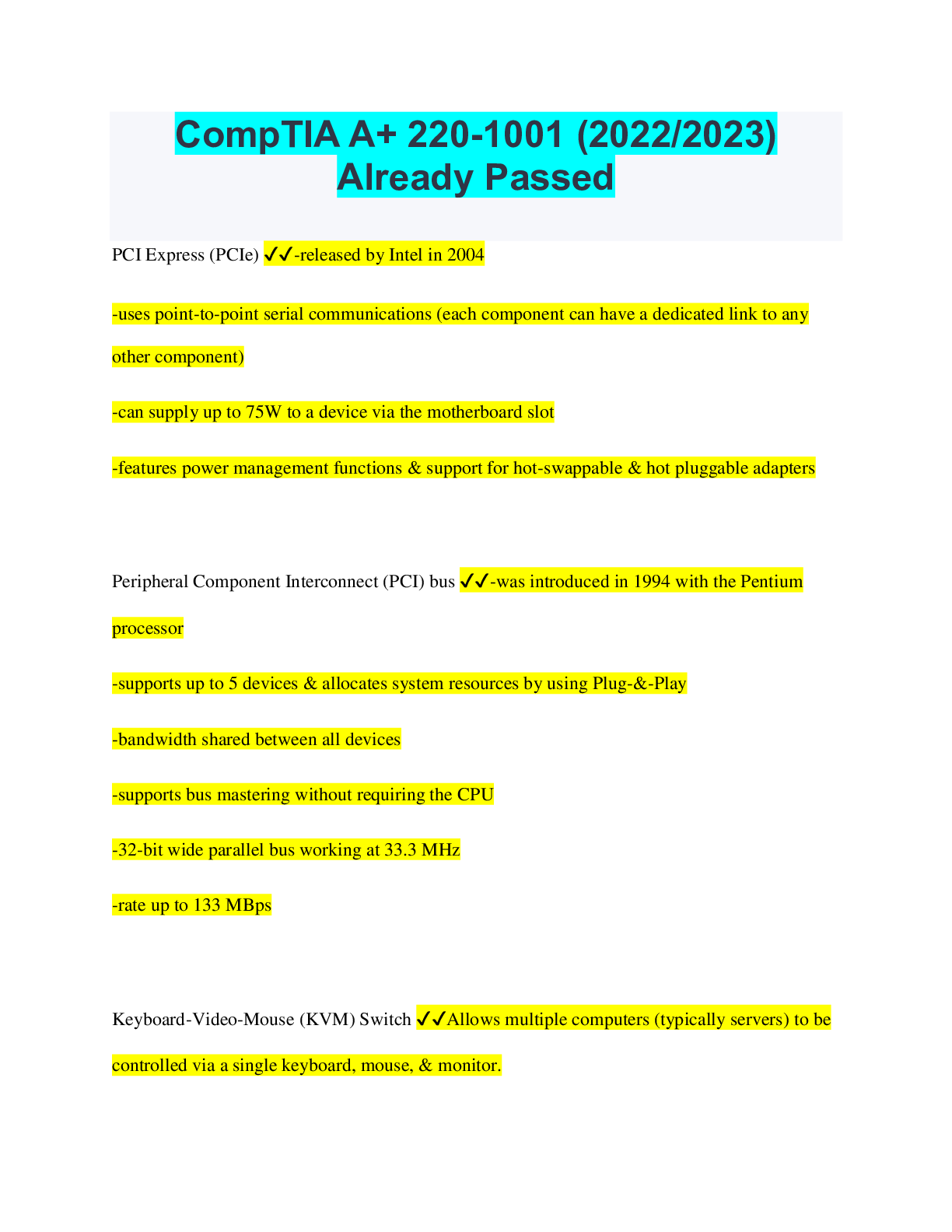
CompTIA A+ 220-1001 (2022/2023)
Already Passed
PCI Express (PCIe) ✔✔-released by Intel in 2004
-uses point-to-point serial communications (each component can have a dedicated link to any
other component)
-can supply up to 75W to a device via the motherboard slot
-features power management functions & support for hot-swappable & hot pluggable adapters
Peripheral Component Interconnect (PCI) bus ✔✔-was introduced in 1994 with the Pentium
processor
-supports up to 5 devices & allocates system resources by using Plug-&-Play
-bandwidth shared between all devices
-supports bus mastering without requiring the CPU
-32-bit wide parallel bus working at 33.3 MHz
-rate up to 133 MBps
Keyboard-Video-Mouse (KVM) Switch ✔✔Allows multiple computers (typically servers) to be
controlled via a single keyboard, mouse, & monitor.
Keyboard ✔✔The longest serving type of input device (or HIDs).
Human Interface Devices (HIDs) ✔✔Peripherals that enable the user to enter data & select
commands. AKA input devices
Network Interface Cards (NIC) ✔✔This card is installed if there is not already a network adapter
installed as part of the motherboard chipset or if you need to upgrade an adapter to use a different
type of network, bandwidth, or cabling.
Expansion cards ✔✔AKA add-on cards
can be installed on the motherboard to add functions or ports not provided as part of the chipset
RJ-11 Connector ✔✔-connector used with 2- or 3-pair UTP or with flat ribbon "silver satin"
phone cables (1 pair carries the dial tone & voice circuit and the other pair is usually unused but
can be deployed for a second unit)
-used for telephone systems
-6P2C - 6 position/2 contacts
RJ-45 (Registered Jack) Connector ✔✔-used with twisted pair cable for Ethernet local area
networking products.
-also referred to as 8P8C(8 position/8 contact) meaning that all 8 "potential" wire positions are
supplied with contacts so they can carry signals if needed
Twisted-pair cable ✔✔A type of copper cabling where pairs of insulated conductors minimize
electrical interference.
Molex Connectors ✔✔For older devices, the computer power supply comes from this type of
connector. It is usually white and has 4 pins plus red, yellow, and black wires.
Small Computer Systems Interface (SCSI) ✔✔Internal PC storage devices often use Parallel
ATA (PATA)/Enhanced Integrated Drive Electronics(EIDE) connections that support transfer
rates up to about 133 MBps. Workstations and servers requiring MORE speed would use this bus
instead. It could support up to 320 MBps data rates.
Serial Advanced Technology Attachment (SATA) ✔✔The standard means of attaching internal
storage drives to a desktop PC. Each of these host adapter ports supports a single device.
Communications (COM) Port ✔✔The name for a serial port in Windows.
Serial Ports / RS-232 ✔✔So called because data is transmitted over one wire one bit at a a time.
Start, stop, and parity bits are used to format and verify data transmission.
-It is less a sophisticated signaling method vs. USB
-Supports data rates up to 115 Kbps only
Lightning ✔✔Reversible connector used with Apple's iPhone and iPad mobile devices.
Thunderbold (TB) ✔✔-Peripheral interface that was developed by Intel and is primarily used on
Apple workstations & laptops.
-Can be used as a display interface (like DisplayPort or HDMI) and a general peripheral interface
(like USB).
USB 2.0 Type B Micro (5-pin) ✔✔-Updated connector for smaller devices such as smartphones
or tablets
-Distinctly flatter than the older mini type connector
USB 2.0 Type B Mini (5-pin) ✔✔-Smaller connector for connection to a device
-Seen on early digital cameras but no longer widely used
USB 2.0 Type B (4-pin) ✔✔-For connection to a device
-Connector & port are square with beveled top
USB 2.0 Type A (4-pin) ✔✔-For connection to the host
-Connector & port shaped like flat rectangles
USB On-The-Go (OTG) ✔✔Allows a port to function as either a host or as a device. For
example, a port on a smartphone might operate as a device when connected to a PC but as a host
when connected to a keyboard.
SuperSpeed+ mode ✔✔Mode defined by USB 3.1 with a data rate of 10 Gbps
SuperSpeed mode ✔✔Mode introduced with USB 3.0 that improves the bus bandwidth tenfold
& makes the link full duplex so a device can send & receive at up to 5Gbps simultaneously.
USB 2.0 (HighSpeed) Standard ✔✔Specifies a data rate at 480 Mbps. (Shared bandwidth
between all devices attached to the same host)
Universal Serial Bus (USB) ✔✔_____ has become the standard means of connecting peripheral
devices to a computer. It is an example of a multi-purpose cable that can be used to attach a wide
range of peripherals and storage devices.
Input/Output (I/O) ✔✔Ports that allow additional devices to be connected to the PC. Ex.
graphics port, USB
Computer connections ✔✔The physical access points that enable a computer to communicate
with internal or external devices. They include the ports on both the computer and the connected
devices, plus a transmission medium which is either a cable with connectors at each end or a
wireless technology.
Port ✔✔-A hardware interface that you can use to connect devices to a computer.
-Also referred to as an endpoint
-Transfers electronic signals between the device and the system unit
Interface ✔✔The point at which 2 devices connect and communicate with each other.
Jumpers ✔✔A small plastic clip containing a metal conductor that fits over 2 contacts on the
motherboard. The position of the clip completes the circuit that configures the motherboard in
one way or another.
Storage bus ✔✔A special type of expansion bus dedicated to communicating with storage
devices, such as hard disks, solid state drives, and optical drives (CD/DVD/Blu-Ray).
System Clock ✔✔Synchronizes the operation of all parts of the PC and provides the basic timing
signal for the CPU.
Riser Card ✔✔If a PC case design is slimline and therefore does not have enough space for full
height expansion cards, this type of card is used and installed at a right angle to the main board,
enabling you to connect additional adapters to the system, in an orientation that is parallel to the
motherboard and thus saves space.
Expansion Slot ✔✔Enables you to install plug-in adapter cards in a computer to extend the range
of functions it can perform.
Expansion Bus ✔✔An external bus, or _________ allows additional components to be
connected to the computer.
Local Bus ✔✔An internal bus, or _________ connects core components such as the CPU,
memory, and the system controllers.
Bus ✔✔An electrical pathway on the motherboard or through cabling that carries data
transmitting signals.
Chipset ✔✔Consists of several controllers that handle the transfer of data between the CPU and
various devices. Examples of controllers: system memory controller, I/O controller to handle
disk drives & expansion buses, controllers for any integrated video, sound, and network
interfaces.
Random Access Memory (RAM) ✔✔System memory uses this type of memory technology.
Program code is loaded into it so that it can be accessed and executed by the processor. It also
holds data, such as the contents of a spreadsheet document while it is being modified. It is
volatile; it loses its contents when power is removed.
Central Processing Unit ✔✔CPU stands for:
Mini-ITX ✔✔-Motherboard form factor
-Becoming popular as home machines (and in image-conscious offices) for SFF
-6.7in square
-Only 1 expansion slot
Micro-ATX (mATX) ✔✔-Motherboard form factor
-Specifies a 9.6in square board
-Has fewer expansion slots than ATX boards, max of 4
Advanced Technology Extended ✔✔ATX stands for:
ATX Form Factor ✔✔-Motherboard form factor
-Was developed by Intel in 1995 to provide a new design for PC motherboards, updating the
previous FF
-Full size is 12in wide by 9.6in deep
-Can contain up to 7 expansion slots
Standoffs / no other part of it touches the case ✔✔The motherboard is attached to the case using
_____ which hold the motherboard firmly to ensure ________.
Motherboard ✔✔-AKA: mobo, system board, main board
-A printed circuit board that houses the processor, chipset, memory, and expansion slots.
Field Replaceable Units (FRU) ✔✔PC components that are easily user-replaceable (or
upgradeable)
Blanking Plate ✔✔A metal strip used to cover an unused slot that would otherwise be used for
an adapter card.
Small Form Factor (SFF) ✔✔Has a case design that is semi-portable and space-saving.
Office or home PCs ✔✔Mini tower cases are usually used for these PCs, where the requirements
for additional internal devices and adapter cards is limited.
High-end User PCs ✔✔Mid tower cases are used for these PCs, which do require extra devices
and adapter cards, but not as many as a server.
PC Servers ✔✔Full tower cases are usually used for these because they require the extra internal
space for additional hard disks, adapter cards, and redundant power supply units.
System Case ✔✔-AKA: chassis, boxes, main units, base units
-A plastic and metal box that houses components such as the motherboard, CPU, memory,
adapter cards, disk drives, and power supply units.
A Desktop Computer ✔✔A PC that is not designed to be used on the move.
[Show More]