AMLS Final Exam Questions and
Answers Graded A+
A 45-year-old patient is found supine on the floor. Healthcare providers note pinpoint pupils,
shallow respirations, and vomitus in and around the mouth. What course of
...
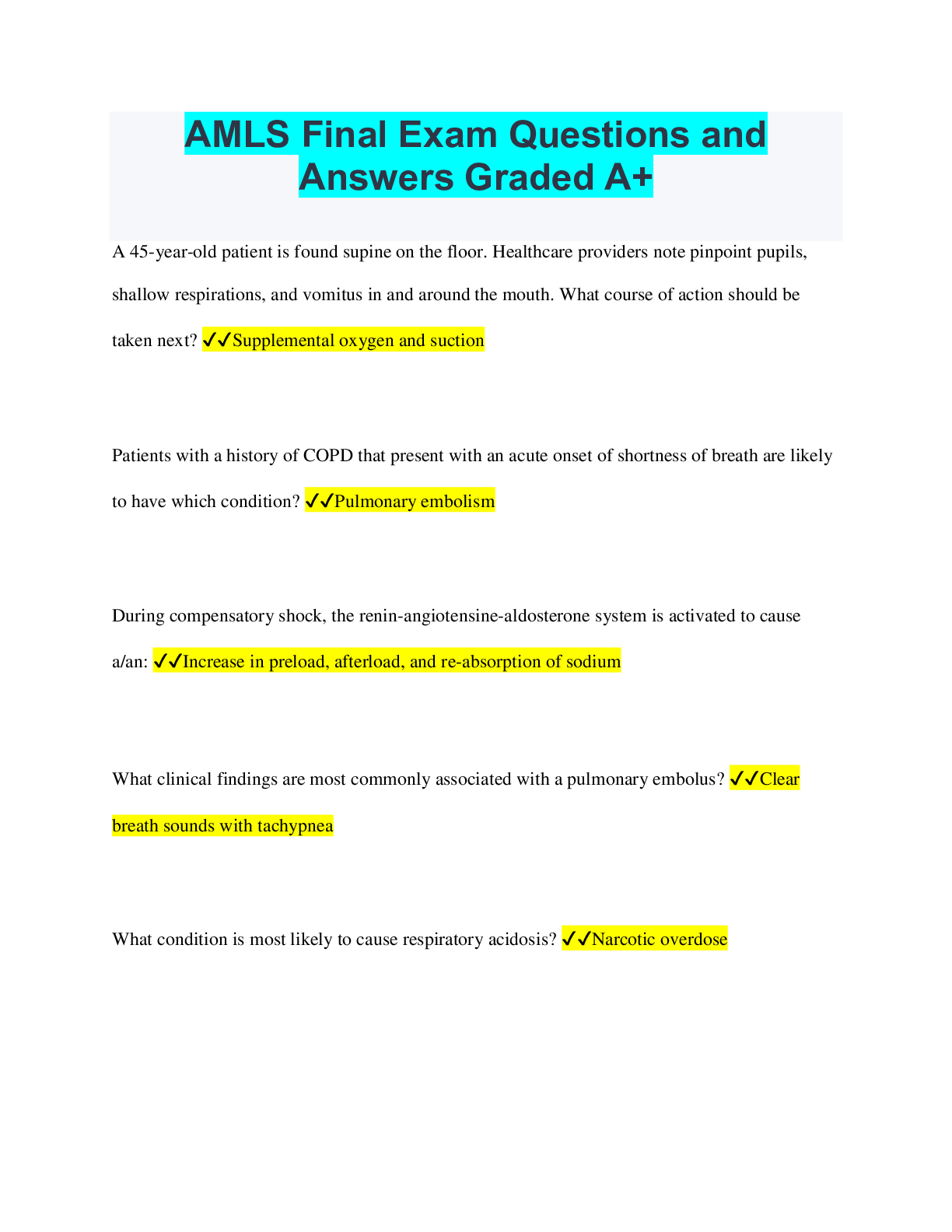
AMLS Final Exam Questions and
Answers Graded A+
A 45-year-old patient is found supine on the floor. Healthcare providers note pinpoint pupils,
shallow respirations, and vomitus in and around the mouth. What course of action should be
taken next? ✔✔Supplemental oxygen and suction
Patients with a history of COPD that present with an acute onset of shortness of breath are likely
to have which condition? ✔✔Pulmonary embolism
During compensatory shock, the renin-angiotensine-aldosterone system is activated to cause
a/an: ✔✔Increase in preload, afterload, and re-absorption of sodium
What clinical findings are most commonly associated with a pulmonary embolus? ✔✔Clear
breath sounds with tachypnea
What condition is most likely to cause respiratory acidosis? ✔✔Narcotic overdose
A 55-year-old complains of an "aching" chest discomfort that persists over several days. The
patient has a temperature of 101*F (38.3*C). Which finding will help narrow the diagnosis to
pericarditis? ✔✔ST-segment elevation in all leads
Anaphylaxis is most associated with which physiological event? ✔✔Vasodilation
Acute Respiratory Distress Syndrome (ARDS) is characterized by what pathologic change?
✔✔Breakdown of the alveolar-capillary membrane
Continuous positive airway pressure would be most beneficial in treating which patient? ✔✔A
22-year-old with severe asthma who is not responding to nebulizer treatments
What is the initial treatment for a patient experiencing hyperosmolar hyperglycemic nonketotic
coma (HHNC)? ✔✔Crystalloid IV fluid administration
Your patient has had a seizure secondary to a nerve agent exposure. What medication would be
best to diminish the seizure? ✔✔Midazolam
Respiratory alkalosis may occur as a result of: ✔✔Fever and anxiety
An age-related change that increases the risk of respiratory compromise is: ✔✔Decrease in lung
compliance
Paroxysmal nocturnal dyspnea is most common in patients with a history of: ✔✔Left-sided heart
failure
The patient presents with a history of fever and an upper respiratory infection. Historical
information reveals increasing water intake, orthostatic hypotension, and an increase in urination.
You suspect these symptoms are caused by: ✔✔Hyperglycemia
You are dispatched to the home of a 32-year-old patient with a history of Graves' disease. The
patient was in the ER earlier today for some "tests for my ulcers." He received contrast and was
discharged. He is now complaining of not feeling well, chest pain, and palpitations. You note an
anxious patient with fine tremors. He is diaphoretic and has a temperature of 101.5*F, BP
100/62, P 156 (sinus tachycardia), R 30, glucose level 133. Which of the following are
management considerations for this patient? ✔✔Beta Blockers
Metabolic acidosis is best described by which arterial blood gas interpretation? ✔✔pH
decreased, pCO2 decreased, H2CO3 low
The AMLS Assessment Pathway first advises safety and initial observations of the scene. The
second process described in this pathway asks the healthcare provider to: ✔✔Identify and
manage life-threats
Observing a patient's body positioning can be an early indicator that the patient is: ✔✔Sick or
not sick
Which assessment finding is crucial to obtain from a patient suspected of a stroke? ✔✔Onset of
symptoms
A 62-year-old patient presents with a severe headache. It is described as a "thunderclap"
accompanied with nausea, blurred vision, and an elevated blood pressure. What neurologic
condition is most likely causing this patient's presentation? ✔✔Subarachnoid hemorrhage
A 38-year-old presents with mild chest tightness and urticaria after mowing the lawn. He felt a
"sting" in his left lower leg and states the symptoms came on suddenly. BP 130/82, P 100, R 20
with a normal work of breathing and clear lung sounds. The healthcare provider should:
✔✔Initiate an IV with 0.9% normal saline and administer 0.5mg of epinephrine
Healthcare providers are treating a patient complaining of substernal chest pain accompanied
with nausea and one episode of vomiting. The patient has had two cardiac stents placed within
the last year. He has a familial history of heart disease and takes a baby aspirin daily. What
information is most concerning? ✔✔Recent stent placement
The patient complains of sharp chest pain that worsens when supine. He is bed ridden due to
complications from a recent hip surgery. The patient is tachypneic adn the ECG reveals sinus
tachycardia. What is the patient's working diagnosis? ✔✔Pulmonary embolism
A patient is a resident in an assisted-living facility to obtain physical therapy after a knee
replacement surgery. She complains of a rash that is red and has small bumps. She has been
feeling ill for several days. What is the most likely working diagnosis? ✔✔Methicillin-resistant
Staphylococcus aureus
A foreign exchange university student is found by his roommate and EMS is dispatched. The
patient presents with an unusual flat red rash on his chest and arms. He has been ill with fever,
nausea, and vomiting. Physical exam reveals stiffness of the neck. The healthcare provider will
anticipate which diagnosis? ✔✔Meningitis
Healthcare providers are treating a 49-year-old male complaining of diffuse abdominal
cramping. He has been ill with vomiting for 3 days. What working diagnosis is most probable?
✔✔Gastroenteritis
While assessing your patient, you note he involuntarily flexes the legs in response to flexing the
neck. The patient is presenting with: ✔✔A positive Brudzinski's sign indicating possible
meningitis
Healthcare providers are assessing an obese 49-year-old who is lethargic and has not been
feeling well for several days. His family reports a history of extreme thirst. Vital signs are P 143,
R 14, and BP 88/58. He takes medication for type 2 diabetes daily. What is the most probably
working diagnosis? ✔✔Hyperosmolar hyperglycemic nonketotic coma
A fire fighter has been working a fire for 4 hours on a humid, hot day. He suddenly becomes
nauseated and restless. The provider observes pupil dilation and an almond odor to his breath.
The vital signs are P 56, R 22, BP 140/86. The ECG reveals sinus bradycardia with occasional
PACs. Which toxin exposure has occurred? ✔✔Cyanide poisoning
Healthcare providers are treating a patient that has taken an unknown amount of a prescribed
pain medicine along with an over-the-counter analgesic numerous times over the last 36 hours
for chronic lumbar pain. The patient is experiencing abdominal pain, nausea, and vomiting. The
providers note pallor, and diaphoresis. Blood glucose level is 42mg/dL (2.3mmol/L). What toxin
overdose is suspected? ✔✔Acetaminophen
A patient complains of nausea and is passing black, tarry stools rectally. This patient is most
likely suffering from: ✔✔Upper GI bleed
The provider assesses a patient suffering from fever, nausea, vomiting, and peri-umbilical pain.
Further evaluation reveals right lower quadrant pain and lower back pain. A physical exam
reveals an increase in right lower quadrant pain when the patient's right leg is extended from the
hip. Which working diagnosis is most appropriate? ✔✔Appendicitis
Intra-abdominal bleeds, like pancreatitis, often present with discoloration or bruising around the
umbilicus. This physical exam finding is known as: ✔✔Cullen's sign
Which of the following is a hallmark sign of tricyclic antidepressant toxicity? ✔✔Dysrhythmias
A daughter states that her 72-year-old mother has a history of hypertension, high cholesterol, and
rheumatoid arthritis. Daily medications include aspirin, Tenormin, Plaquenil, and Plavix. She is
concerned as her mother has mixed up her medications and is now lethargic with diminished
respirations. Vital signs are P 58 and regular, R 10 and shallow, and BP 90/74. Blood glucose
level is 52mg/dL (2.8mmol/L). Which medication toxicity would be indicative of this
presentation? ✔✔Beta Blocker
If untreated, a cardiac tamponade will present with signs and symptoms of which type of shock?
✔✔Obstructive
A patient presents anxious with difficulty in breathing and chest pain. An assessment reveals
hypotension, muffled heart tones, and distended neck veins. There is a past medical history of
pericarditis. The provider notes that there is decrease in systolic blood pressure when the patient
inhales. Which diagnosis would be considered with this presentation? ✔✔Cardiac tamponade
The healthcare provider is assessing a 60-year-old female patient with complaints of indigestion
and mild upper abdominal discomfort. This presentation should prompt the provider to:
✔✔Perform a 12-lead ECG
The most common underlying medical conditions found in patients with acute pancreatitis is:
✔✔Gall stones and heavy alcohol use
A patient complaining of a 3-day history of left lower abdominal pain describes it as sharp and,
during the focused physical exam, the pain intensifies during palpitation over the site.
Differentials should include: ✔✔Ectopic pregnancy or diverticulitis
A 22-year-old male has recently undergone a surgical procedure to repair an injury to thoracic
vertebrae T4-T6. Assessment indicates the patient is alert and oriented, bradycardic, hypotensive,
and has warm, dry skin. Which type of shock is most likely occurring? ✔✔Neurogenic
A caregiver for a quadriplegic patient notes an onset of difficulty in breathing and anxiousness in
her patient. Further assessment shows a temperature of 101.2*F (38*C), P 128, BP 86/68, and R
24. Physical exam shows the skin is warm and urine in the catheter is dark yellow and cloudy.
This patient is most likely experiencing what type of shock? ✔✔Septic
When assessing geriatric patients, infectious diseases are more difficult to identify for all the
following reasons EXCEPT: ✔✔Heightened immune response is common
A local businesswoman has returned from missionary work in South Africa. She is complaining
of night sweats, chest discomfort, and a persistent cough for several weeks. Which underlying
diagnosis is most likely causing these symptoms? ✔✔Tuberculosis
Healthcare providers are responding to a near-drowning at a local lake. The patient is
experiencing uncontrollable shivering and complains of nausea and weakness. The patient had
been treading water for 25 minutes and now presents with tachycardia and rapid respirations.
Core body temperature is 93.2*F (34*C). Which diagnosis is most likely? ✔✔Mild hypothermia
An elderly patient is receiving nursing care at home while recuperating from a recent knee
surgery. A post-operative infection developed, and the patient has been on antibiotics for quite
some time. She is complaining of a foul-smelling diarrhea, and abdominal cramping and loss of
appetite. On the basis of this presentation, the provider should suspect: ✔✔Clostridium difficile
(C Diff)
A 20-year-old female presents with a 2-day history of dyspnea, nonproductive cough, chest
tightness, and audible wheezing. Further exam reveals no fever or stridor. The patient has rapid
respirations with difficulty exhaling. Which diagnosis is most likely? ✔✔Bronchiolitis
An elderly patient with a 1-week history of productive cough and wheezing notices an increase
in difficulty in breathing when grocery shopping. Further assessment reveals pursed lip
breathing, rhonchi, and minimal jugular vein distention. Which diagnosis should should the
healthcare provider suspect? ✔✔COPD
A 50-year-old female has called 911. She complains of shortness of breath and chest discomfort.
Assessment reveals her skin is pale, moist, and cool. BP is 102/68, R 24, labored with crackles, P
of 130 and regular. Which type of shock is most likely occurring? ✔✔Cardiogenic
[Show More]