NCIHC Standards of Practice Latest 2023
Graded A+
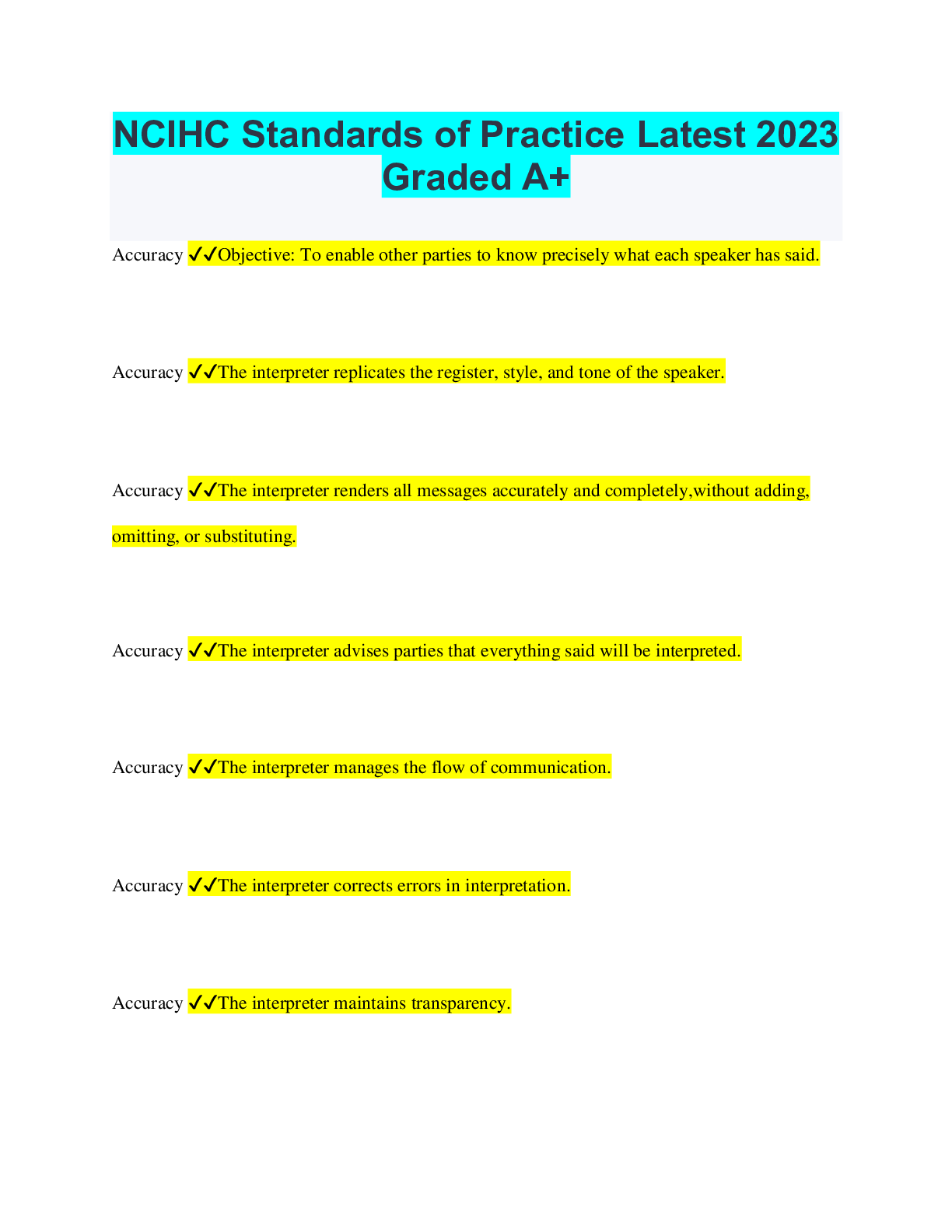
Accuracy ✔✔Objective: To enable other parties to know precisely what each speaker has said.
Accuracy ✔✔The interpreter replicates the register, style, and tone of the
...
NCIHC Standards of Practice Latest 2023
Graded A+
Accuracy ✔✔Objective: To enable other parties to know precisely what each speaker has said.
Accuracy ✔✔The interpreter replicates the register, style, and tone of the speaker.
Accuracy ✔✔The interpreter renders all messages accurately and completely,without adding,
omitting, or substituting.
Accuracy ✔✔The interpreter advises parties that everything said will be interpreted.
Accuracy ✔✔The interpreter manages the flow of communication.
Accuracy ✔✔The interpreter corrects errors in interpretation.
Accuracy ✔✔The interpreter maintains transparency.
Confidentiality ✔✔Objective: To honor the private and personal nature of the health care
interaction and maintain trust among all parties.
Confidentiality ✔✔The interpreter maintains confidentiality and does not disclose information
outside the treating team, except with the patient's consent or if required by law.
Confidentiality ✔✔The interpreter protects written patient information in his or her possession.
Impartiality ✔✔Objective: To eliminate the effect of interpreter bias or preference.
Impartiality ✔✔The interpreter does not allow personal judgments or cultural values to influence
objectivity.
Impartiality ✔✔The interpreter discloses potential conflicts of interest, withdrawing from
assignments if necessary.
Respect ✔✔Objective: To acknowledge the inherent dignity of all parties in the interpreted
encounter.
Respect ✔✔The interpreter uses professional, culturally appropriate ways of showing respect.
Respect ✔✔The interpreter promotes direct communication among all parties in the encounter.
Respect ✔✔The interpreter promotes patient autonomy.
Cultural Awareness ✔✔Objective: To facilitate communication across cultural differences.
Cultural Awareness ✔✔The interpreter strives to understand the cultures associated with the
languages he or she interprets, including biomedical culture.
Cultural Awareness ✔✔The interpreter alerts all parties to any significant cultural
misunderstanding that arises.
Role Boundaries ✔✔Objective: To clarify the scope and limits of the interpreting role, in order
to avoid conflicts of interest.
Role Boundaries ✔✔The interpreter limits personal involvement with all parties during the
interpreting assignment.
Role Boundaries ✔✔The interpreter limits his or her professional activity to interpreting within
an encounter.
Role Boundaries ✔✔The interpreter with an additional role adheres to all interpreting standards
of practice while interpreting.
Professionalism ✔✔Objective: To uphold the public's trust in the interpreting profession.
Professionalism ✔✔The interpreter is honest and ethical in all business practices.
Professionalism ✔✔The interpreter is prepared for all assignments.
Professionalism ✔✔The interpreter discloses skill limitations with respect to particular
assignments.
Professionalism ✔✔The interpreter avoids sight translation, especially of complex or critical
documents, if he or she lacks sight translation skills.
Professionalism ✔✔The interpreter is accountable for professional performance.
Professionalism ✔✔The interpreter advocates for working conditions that support quality
interpreting.
Professionalism ✔✔The interpreter shows respect for professionals with whom he or she works.
Professionalism ✔✔The interpreter acts in a manner befitting the dignity of the profession and
appropriate to the setting
Professional Development ✔✔Objective: To attain the highest possible level of competence and
service.
Professional Development ✔✔The interpreter continues to develop language and cultural
knowledge and interpreting skills.
Professional Development ✔✔The interpreter seeks feedback to improve his or her performance.
Professional Development ✔✔The interpreter supports the professional development of fellow
interpreters.
Professional Development ✔✔The interpreter participates in organizations and activities that
contribute to the development of the profession.
Advocacy ✔✔Objective: To prevent harm to parties that the interpreter serves.
Advocacy ✔✔The interpreter may speak out to protect an individual from serious harm.
Advocacy ✔✔The interpreter may advocate on behalf of a party or group to correct mistreatment
or abuse.
[Show More]