CCHI - Cardiovascular System
(2022/2023) Graded A+
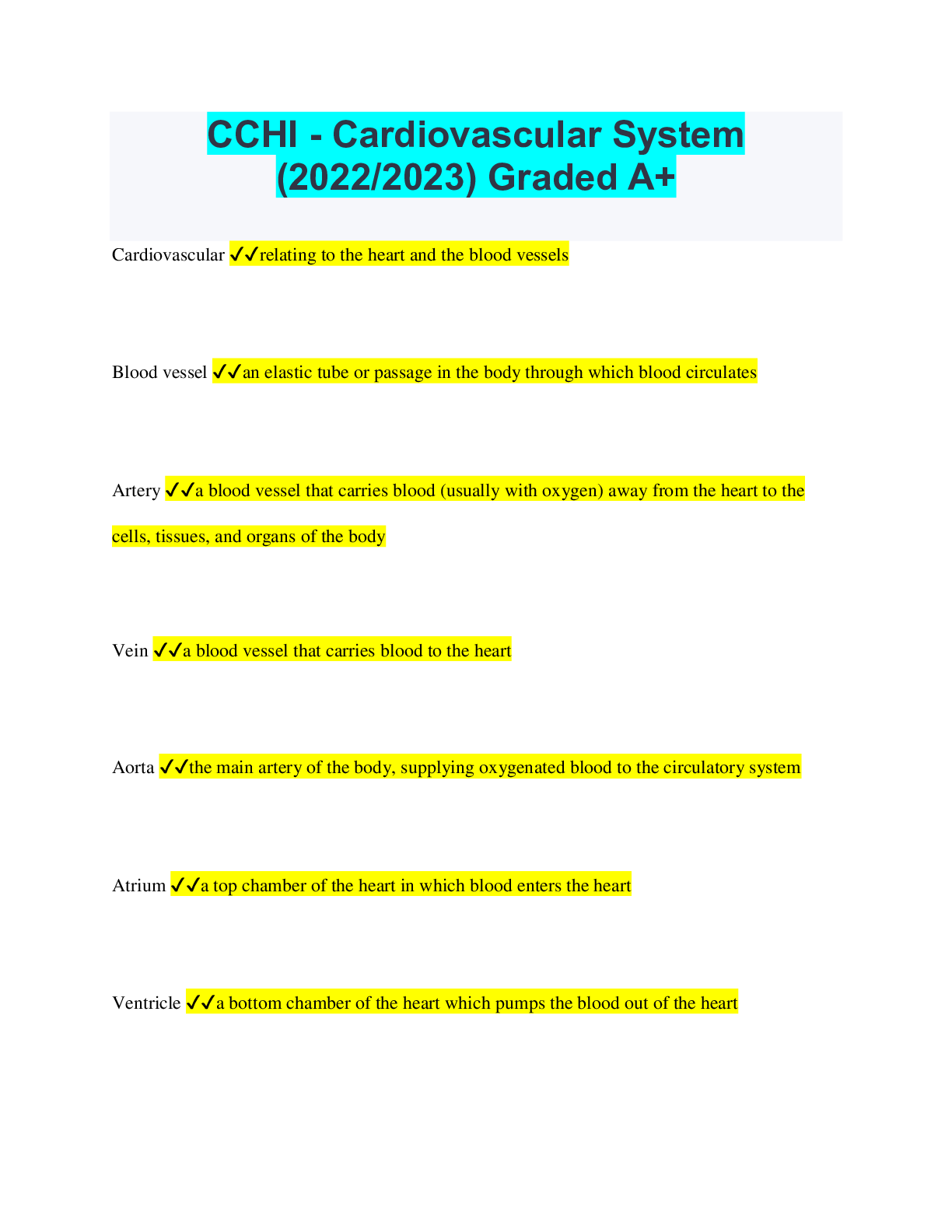
Cardiovascular ✔✔relating to the heart and the blood vessels
Blood vessel ✔✔an elastic tube or passage in the body through which blood circulates
Artery ✔✔a blood ve
...
CCHI - Cardiovascular System
(2022/2023) Graded A+
Cardiovascular ✔✔relating to the heart and the blood vessels
Blood vessel ✔✔an elastic tube or passage in the body through which blood circulates
Artery ✔✔a blood vessel that carries blood (usually with oxygen) away from the heart to the
cells, tissues, and organs of the body
Vein ✔✔a blood vessel that carries blood to the heart
Aorta ✔✔the main artery of the body, supplying oxygenated blood to the circulatory system
Atrium ✔✔a top chamber of the heart in which blood enters the heart
Ventricle ✔✔a bottom chamber of the heart which pumps the blood out of the heart
Valve ✔✔allows blood to flow through it in only one direction
Cholesterol ✔✔a fat-like substance (lipid) that is found in certain foods and is also produced in
the body (liver and intestines). The body needs some cholesterol to work properly. But high
levels of cholesterol in the blood can block arteries and increase the risk of heart disease.
Plaque ✔✔A deposit, build-up of fatty material, cellular waste products, calcium and other
substances on the inner lining of an arterial wall.
Atherosclerosis ✔✔a disease when arteries harden and become narrower due to the plaque
High Blood Pressure / Hypertension ✔✔in an adult as a blood pressure greater than or equal to
140 mm Hg systolic pressure or greater than or equal to 90 mm HG diastolic pressure
Low blood pressure / hypotension ✔✔generally when systolic blood pressure is less than 90 mm
Hg or diastolic less than 60 mm Hg
Coronary Artery Disease (CAD) ✔✔it is arteriosclerosis of the inner lining of the blood vessels
that supply blood to the heart.
Angina (Angina Pectoris) ✔✔chest pain or discomfort that usually occurs with activity or stress.
Angina is chest discomfort
Palpitations ✔✔the feelings of having rapid, fluttering or pounding heart. Heart palpitations can
be triggered by stress, exercise, medication or, rarely, a medical condition
Shortness of breath / dyspnea ✔✔a sensation of not being able to get enough air; difficulty
breathing
Heart Attack / Myocardial infarction ✔✔Scarring or death of the heart due to the lack of oxygen.
It occurs when the blood supply to part of the hear muscle itself -- the myocardium -- is severely
reduced or stopped. The reduction or stoppage happens when one or
Cardiac arrest / cardiopulmonary arrest ✔✔When the heart stop beating suddenly and respiration
and other body functions stop as a result. Sudden cessation of heartbeat and pumping action of
the heart, resulting in the loss of effective circulation.
Blood clot Thromb ✔✔a thickened (coagulated) mass of blood formed by platelets, as within a
blood vessel or at the site of an open wound.
Embolism ✔✔a sudden blockage of an artery caused by a blood clot (embolus) that travels from
other parts of the body (such as the leg). An enbolism can get stuck in the brain, lungs, heart, or
other area, leading to severe damage
Thrombolytic drug / therapy ✔✔Medications used to dissolve blood clots and limit the damage
caused by the blockage of the blood vessel. Thrombolysis may be used to treat a heart attack or
stroke.
Anticoagulant / Blood thinner ✔✔A class of drugs that prevent blood from clotting and help to
keep existing blood clots from getting worse (e.g. Coumadin)
Beta Blocker ✔✔any of group of drugs (as propranolol) that block the activity of a beta-receptor
in order to decrease the heart rate and force of contractions and lower high blood pressure. Beta
blockers are used especially to treat hypertension, angina, and ventricular and supraventricular
arrhythmias.
Aneurysm ✔✔an abnormal blood-filled bulge of a blood vessel and especially an artery resulting
from weakening (as from disease) of the vessel wall
Stroke / Cerebral vascular accident (CVA) ✔✔a condition when blood supply to he brain is
interrupted depriving the cells of oxygen and other nutrients. There are two types of stroke --
those caused by blood clots in the brain and those that occur when blood vessels burst.
Mini-stroke / Transient ischaemic attack (TIA) ✔✔it is caused by temporary disturbance of
blood supply to a restricted area of the brain, resulting in brief neurologic dysfunction that
usually persists for less than 24 hours. It may be a warning sign of an imminent full-blown
stroke.
Heart murmurs ✔✔they are most often caused by defective heart valves. A stenotic heart valve
has a smaller-than-normal opening and can't open completely. A valve may also be unable to
close completely. This leads to regurgitation, which is blood leaking backward through the valve
when it should be closed. Murmurs also can be cause by conditions such as pregnancy, fever,
thyrotoxicosis (a diseased condition resulting from an overactive thyroid gland) or anemia.
Arrhythmia ✔✔any of a group of conditions in which the electrical activity of the heart is
irregular or is faster or slower than normal. An irregular heart rate.
Atrial fibrillation ✔✔an irregular and often rapid rate that commonly causes poor blood flow to
the body. During this, the heart's two upper chambers (the atria) beat chaotically and irregularly -
- out of coordination with the two lower chambers (the ventricles) of the heart. This symptoms
include heart palpitations, shortness of breath and weakness.
Ventricular Fibrillation ✔✔a condition in which there is uncoordinated contraction of the
ventricles. As a result, the heart fails to adequately pump blood; oxygen deficiency soon occurs,
followed by unconsciousness within 20 to 30 seconds. The condition can often be reversed by
the electric shock from a defibrillator.
Defibrilator ✔✔A device that generates an electric charge (of various voltage) and delivers the
shock through paddles or pads on the patient's chest.
Resuscitate (v) ✔✔to revive, especially from apparent death or from unconsciousness.
Tachycardia ✔✔a fast heart rate. Rapid heart beating in the ventricles can be life-threatening.
Implantable cardioverter defibrillator (ICD) ✔✔a small device that is implanted under the skin,
most often in the shoulder area just under the collarbone. This senses the rate of the heartbeat.
When the heart rate exceeds a rate programmed into the device, it delivers a small electrical
shock to the heart to slow the heart rate.
Bradycardia ✔✔it is a heart rate that's "too slow," it is caused by problems in the AV node. A
heartbeat of less than 60 beats per minute can cause fatigue, dizziness, light-headedness o
fainting.
Pacemaker ✔✔a medical device which uses electrical impulses, delivered by electrodes
contacting the heart muscles, to regulate the beating of the heart. The primary purpose of a
pacemaker is to maintain an adequate heart rate.
ECHO = echocardiogram ✔✔the ultrasound of the heart. Pulses of high-frequency sound wave
are transmitted into the chest, and echoes returning from the valves, chambers, and surfaces of
the hear are electrically recorded. This procedure can show the structure and movement of the
heart.
Exercise stress test ✔✔it helps a doctor find out how well the patient's heart handles work.
During this test a patient walks on a treadmill or pedals a stationary bicycle while hooked up to
equipment that monitors the heart. As the body works harder duing the test, it requires more
oxygen, so the heart must pump more blood. The test can show if the blood supply is reduced in
the arteries that supply the heart.
EKG (ECG) = electrocardiogram ✔✔process of recording the electricity flowing through the
heart and hus the rhythm f the heartbeat.
Nuclear stress test / nuclear imaging, perfusion imaging ✔✔a diagnostic procedure used to show
how well the heart is supplied (perfused) with blood at rest and under stress. It shows areas of the
heart that have reduced blood supply due to narrowing of cor nary arteries. A small amount of
radioactive tracer (isotope thallium) is used to show the heart muscle.
Cardiac catheterization (cardiac cath) ✔✔A thin, flexible tube is introduced into a vein or artery
and is guided into the heart for purposes of detecting pressures and patterns of blood flow.
Contrast dye can also be injuected an x-ray films made (angiography).
Angioplasty ✔✔A wire is passed through the diseased coronary artery, to beyond the area of
coronary artery that is being worked upon. Over this wire, a balloon catheter is passed into the
segment that is to be opened up. The end of the catheter contains a small folded balloon. When
the balloon is hydraulically inflated, it compresses the plaque and stretches the artery was to
expand. At the same time, if an expendable wire mesh tube(Stent) was on the balloon, then the
stent will be implanted to suppor the new stretched open position of the artery from the inside.
Stent ✔✔a tiny tube of plastic or metal mesh placed inside a blood vessel or other duct to keep it
open. When a stent is placed into the body, the procedure is called stenting. Most of time, they
are used to treat conditions that result when arteries become narrow or blocked. The devices are
also used to unblock and keep open other tube-shaped structures in the body, including the bile
ducts, the ureters, and bronchi.
Coronary artery bypass grafting (CABG) / Bypass surgery ✔✔surgery usually minimally
invasive) when vessels grafts, consisting of veins of arteries taken from other parts of the body,
are connected to existing coronary arteries to detour around blockages in the coronary arteries
and keep the heart (myocardium) supplied with oxygenated blood.
Graft ✔✔a piece of tissue or an organ transplanted from a donor or from the patient's own body
to an area of the body needs the tissue.
Cardiac ablarion ✔✔A procedure that can correct heart rhythm problems (arrhythmias). Ablation
typically uses catheters -- long, flexible tubes inserted through a vein in your structural problems
in your heart that cause an arrhythmia.
This works by scarring or destroying tissue in your heart that triggers an abnormal heat rhythm.
In some cases, ablation prevents abnormal electrical signals from traveling through your heart
and thus stops the arrhythmia.
Deep venous thrombosis (DVT) / Deep vein thrombosis ✔✔a condition in whihc a blood clot
forms in a vein that is deep inside the body. This mainly affects the large veins in the lower leg
and thigh. The clot can block blood flow and cause swelling and pain.
Varicose veins ✔✔enlarged veins that are swollen and raised above the surface of the skin. They
can be dark purple or blue, and look twisted an bulging. They are commonly found on the back
of the calves or on the inside of the leg. They develop when valves in the veins that allow blood
to flow toward the heart stop working properly. As a result, blood pools in the veins and causes
them to get larger.
[Show More]