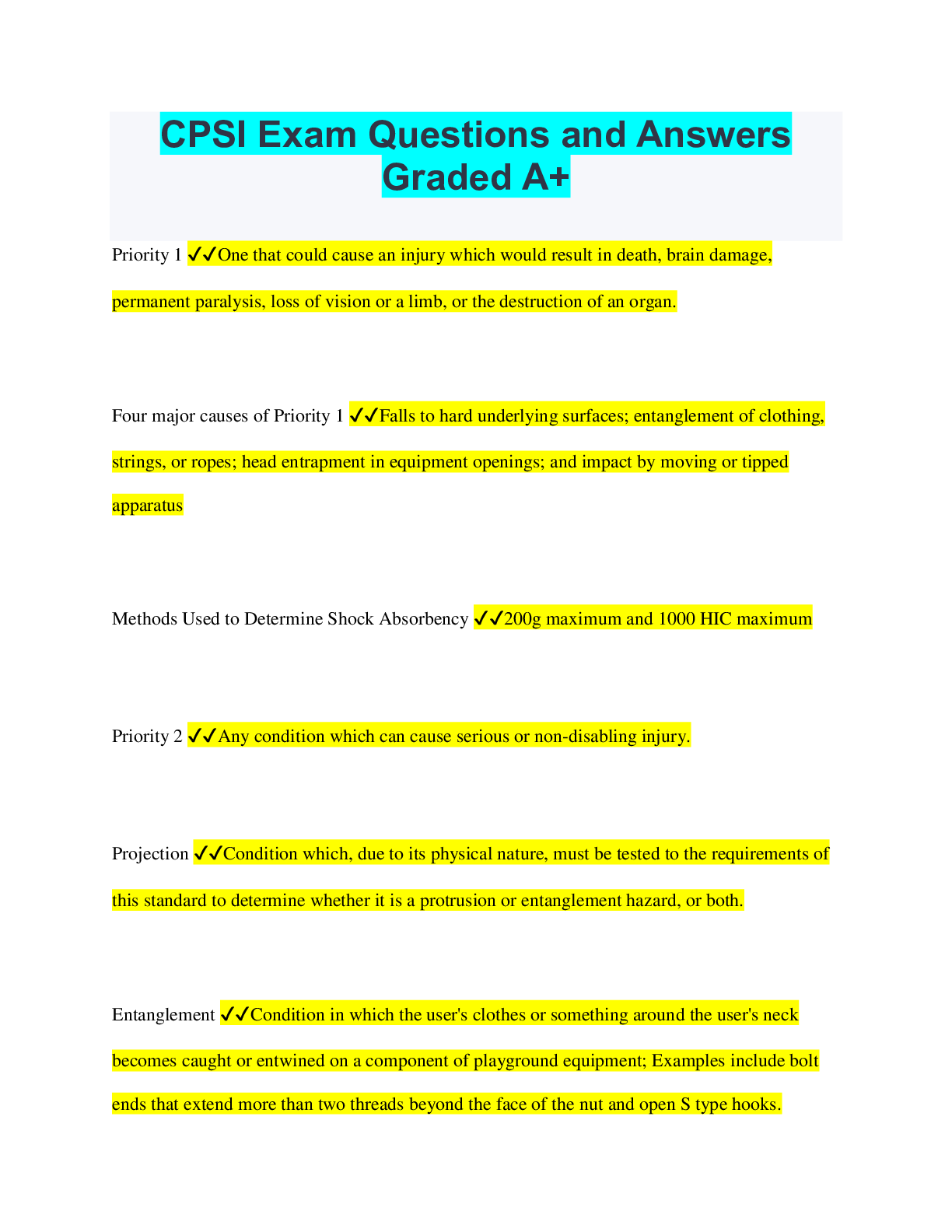
CPSI Exam Questions and Answers
Graded A+
Priority 1 ✔✔One that could cause an injury which would result in death, brain damage,
permanent paralysis, loss of vision or a limb, or the destruction of an organ.
Four maj
...
CPSI Exam Questions and Answers
Graded A+
Priority 1 ✔✔One that could cause an injury which would result in death, brain damage,
permanent paralysis, loss of vision or a limb, or the destruction of an organ.
Four major causes of Priority 1 ✔✔Falls to hard underlying surfaces; entanglement of clothing,
strings, or ropes; head entrapment in equipment openings; and impact by moving or tipped
apparatus
Methods Used to Determine Shock Absorbency ✔✔200g maximum and 1000 HIC maximum
Priority 2 ✔✔Any condition which can cause serious or non-disabling injury.
Projection ✔✔Condition which, due to its physical nature, must be tested to the requirements of
this standard to determine whether it is a protrusion or entanglement hazard, or both.
Entanglement ✔✔Condition in which the user's clothes or something around the user's neck
becomes caught or entwined on a component of playground equipment; Examples include bolt
ends that extend more than two threads beyond the face of the nut and open S type hooks.
Entrapment ✔✔Any condition which impedes withdrawal of a body or body part that has
penetrated an opening; No opening may measure between three and one-half inches and nine
inches
Protective Barrier ✔✔Enclosing device around an elevated surface that prevents both inadvertent
and deliberate attempts to pass through the device.
Protrusion ✔✔Projection which, when tested in accordance with the requirements of this
standard, is found to be a hazard having the potential to cause bodily injury to a user
who impacts it.
ASTM F1292 ✔✔Specification for Impact Attenuation of Surfacing Materials Within the Use
Zone of Playground Equipment
ASTM 1951 ✔✔Specification for Determination of Accessibility of Surface Systems Under and
Around Playground Equipment
ASTM F1487 ✔✔Standard Consumer Safety Performance Specification for Playground
Equipment for Public Use
5th percentile ✔✔2-year-old
95th percentile ✔✔12-year-old
CCA ✔✔Chromated copper arsenate
The designer or manufacturer of each play structure shall provide to the owner/operator
✔✔Clear and concise inspection, maintenance, and
repair instructions, including, but not limited to, what, when, and how to inspect, maintain, and
repair.
The owner/operator shall establish and maintain detailed ✔✔Installation, inspection,
maintenance, and repair records for each public-use playground equipment area
Posting of signs and/or labels shall be the responsibility of the ✔✔Owner/operator of the play
equipment.
The information regarding the intended ages of users shall be provided by ✔✔The manufacturer,
designer, or consultant
Information communicated on the sign or label, or both, shall address but not be limited to the
following ✔✔Age appropriateness, supervision recommendation, removal of helmets,
drawstrings or accessories around the neck, hot play surfaces and/or surfacing, when applicable,
hazard of play equipment located over hard surfaces, when applicable
All play structures and composite play structures shall
be required to have the manufacturer's ✔✔Identification
Toddlers ✔✔6 months through 23 months
Pre-school age ✔✔Ages 2 through 5
School age ✔✔Ages 5 through 12
Pre-school — Ages 2-5 years ✔✔Certain climbers, Horizontal ladders less than or equal to 60"
high for ages 4 and 5, Merry-go-rounds, Ramps, Rung ladders, Single file step ladders, Slides,
Spiral slides up to 360°, Spring rockers, Stairways, Swings - belt, full bucket seats (2-4 years) &
rotating tire
School-age — Ages 5-12 years ✔✔Arch climbers, Chain or cable walks, Free standing climbing
events with flexible parts, Fulcrum seesaws, Ladders - Horizontal, Rung, and Step, Overhead
rings, Merry-go-rounds, Ramps, Ring treks, Slides, Spiral slides more than one 360° turn,
Stairways, Swings - belt and rotating tire, Track rides, Vertical sliding poles
[Show More]