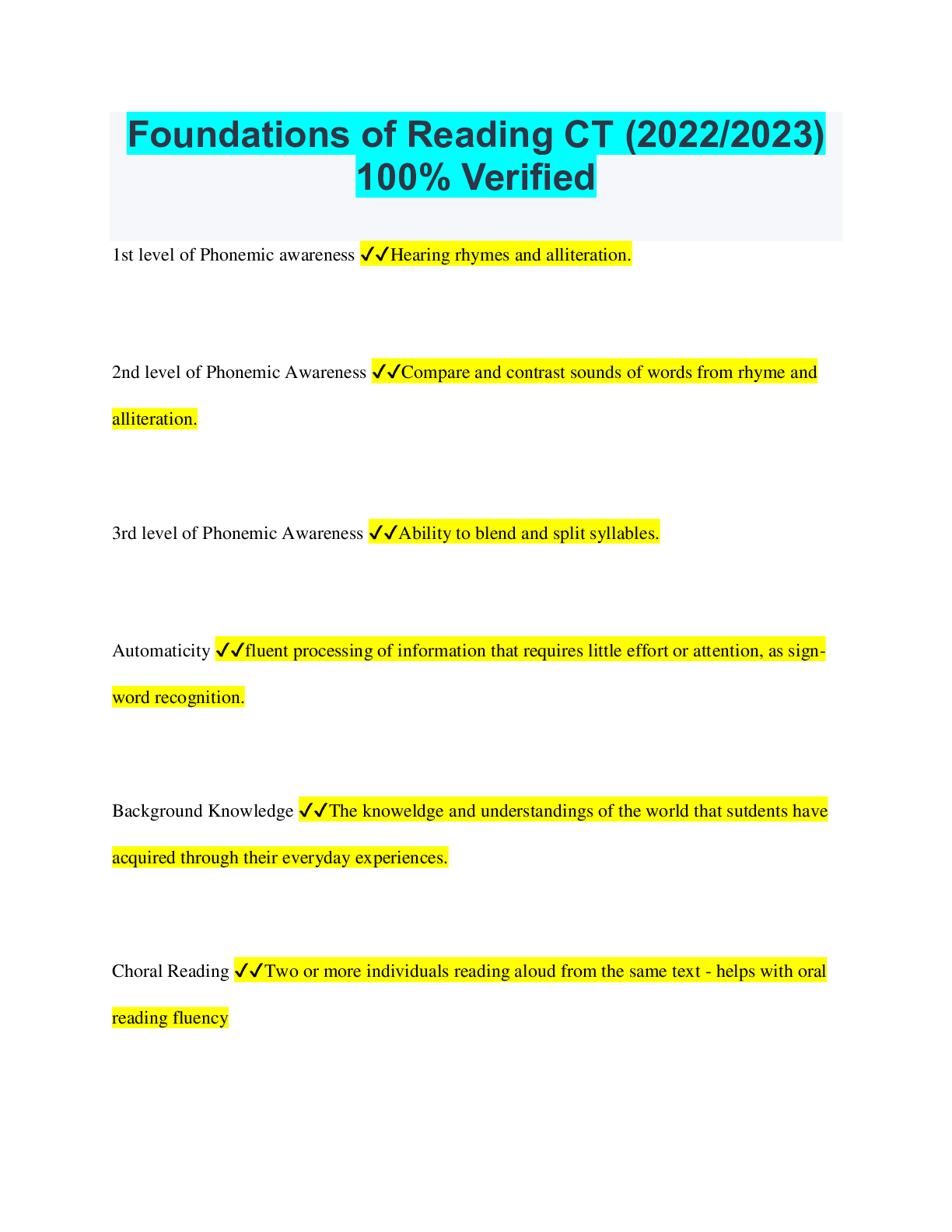
Foundations of Reading CT (2022/2023)
100% Verified
1st level of Phonemic awareness ✔✔Hearing rhymes and alliteration.
2nd level of Phonemic Awareness ✔✔Compare and contrast sounds of words from rhyme and
alliteratio
...
Foundations of Reading CT (2022/2023)
100% Verified
1st level of Phonemic awareness ✔✔Hearing rhymes and alliteration.
2nd level of Phonemic Awareness ✔✔Compare and contrast sounds of words from rhyme and
alliteration.
3rd level of Phonemic Awareness ✔✔Ability to blend and split syllables.
Automaticity ✔✔fluent processing of information that requires little effort or attention, as signword recognition.
Background Knowledge ✔✔The knoweldge and understandings of the world that sutdents have
acquired through their everyday experiences.
Choral Reading ✔✔Two or more individuals reading aloud from the same text - helps with oral
reading fluency
Closed Syllable ✔✔Syllable which ends in one of more consonants.
Consonant Blend ✔✔In a syllable, a sequence of two or more distinguishable consonant sounds
before or after a vowel sound. (Examples: cl, bl, st, or, tr)
Consonant Digraph ✔✔Two consonants that represent one speech sound. (Examples: ch, sh, th)
Constructing Meaning ✔✔A process of making sense of text, by connecting one's own
knowledge with the print readers "build" an understanding of what the text is about.
Context Cues ✔✔Information from the surrounding text that helps identify or gives meaning ot a
specific word or phrase, ex. "yesterday I read the book." The words surrounding "read" helps us
know how to pronounce it.
Conventions of Print ✔✔The understandings an individual has about the rules or accepted
practices that govern the use of print, and the use of written language. Ex. reading left to right,
top to bottom, words are made of letters, use of spaces between words, upper case letters,
spelling patterns, etc.
Conventional Spelling ✔✔Spelling that is in the standard or correct form for written documents.
Cueing System ✔✔Any of the various sources of information that may aid identification of a
word such as: graphophonics, semantic and syntactic information.
Cultural Load ✔✔Relationship between language and culture. Can help or hinder learning.
Cumulative/Pattern Story ✔✔A story that has many elements or language patterns repeated until
the climax, a predictable text.
CvCe ✔✔Vowels are long or say their name. (Examples, late, gate, side)
Decoding ✔✔Analyzing text in order to identify and undertand individual words. Figuring out
the written code.
Diphthong ✔✔A vowel sound produced when the tongue moves or glides from one vowel sound
toward another vowel or semivowel sound in the same syllable. Examples: coin, house)
Echo Reading ✔✔Reading of a text where an adult or experienced reader reads a line of text, and
the student repeats the line. Good technique for Emergent and Early Readers to build fluency and
expression.
Emergent Reader ✔✔A reader who is developing an association of print with meaning. The
early stages of learning ot read.
Fluency ✔✔The clear, easy, written or spoken expression of ideas. Can be described as having
two parts, automaticity and accuracy.
Grammar Conventions ✔✔The rules, or accepted practices, that govern the use of grammar in
written or spoken language.
Grapheme ✔✔A letter
Graphophonics (Phonics) ✔✔Referring to the relationship between the letters and the letter
sounds of a language.
Guided Reading ✔✔A method by which an experienced reader provides structure and purpose,
and models strategies in order to move beginning readers towards independence.
Homophone ✔✔Words that are spelled differently but pronounced the same.
Inference ✔✔Drawing meaning from a combination of clues in the text without explicit
reference to the text. "The sky was dark and cloudy so I took my umbrella." We can infer that it
might rain even though the text does not say that.
Informal Reading Inventory ✔✔Tests grade-level passages from which students real aloud.
Grade level is determined in a variety of ways including: frequency, complexity, number of
syllables, decoding)
Invented Speling ✔✔An attempt by beginning writers to spell a word when the standard spelling
is unknown, using whatever knowledge of sounds or visual patterns the writer has.
Inversions ✔✔Reversal or "flipping" of letters either horizontally or vertically, ex. p-d, or d-b,
m-w, u-n. Not unusual for Emergent writers or readers.
KWL Chart ✔✔(Know, Want to know, Learned). A Pre-reading or during reading activity to
support understanding in which adult and child develop a chart organized in these 3 columns.
Language Experience Approach ✔✔A method of teaching reading by using the reader's own
dictated language.
Language Structure ✔✔The organization of words (both spoken and written) into meaningful
segments (phrases or sentences) using conventions of grammar and syntax.
Letter Recognition ✔✔The identification of individual letters by name and/or sound in a variety
of contexts
Letter/Sound Association ✔✔Making a connection between individual letters and the sounds
they represent (graphophonics).
Linguistic Approach ✔✔A reading approach based on highly regular spelling patterns. Such as:
Nat the cat sat on the mat.
Miscue ✔✔Any substitution of a word in a text that a reader makes.
Miscue Analysis ✔✔An examination of reading errors or substitutions (miscues) as the basis for
determining the strengths and weaknesses of students' reading skills.
Modeled Reading ✔✔An experienced readers' oral reading of a text to aid students in learning
strategies, understanding intonation an dexpression, and hte use of punctuation, among other
aspects of reading.
Morpheme ✔✔A meaningful linguistic unit that cannot be divided into smaller meaningful
elements. An important part of structural analysis. (Example: cat, three sounds, one meaningful
unit, thus one morpheme. cats, two morphemes, (s) counts as a meaningful element)
Onset ✔✔The consonant preceding the vowel of a syllable.
Open Syllable ✔✔Syllable which ends in a vowel sound rather than a consonant.
Phonemic Awareness ✔✔Awareness of the sound system of spoken language including
individual sounds, rhyming, components of words, etc.
Phonics ✔✔The letter/sound relationships in language, and also the relationship of spelling
patterns to sound patterns.
Phonics Approach ✔✔Teaching reading and spelling in a way tha tstresses the connection
between letters and the sounds they represent, teaches the dissection of words into parts and
blending the sounds together again. Phonics can be taught directly or can be incorporated in
ongoing reading and writing.
Picture Cues ✔✔Use of images that accompany and reflect the content of a text to help readers
figure out words and understand the meaning of text.
Picture Walk ✔✔A pre-reading strategy: an examination of the text looking at pictures to gain an
understanding of hte story and to illicit story related language in advance.
Prereading Strategies ✔✔Activities that take place just before reading, like reviewing a book
cover or looking at the pictures, predicting, and formulating questions; these strategies provide
students with valuable information about the text and prepare them for reading.
R Controlled Vowels ✔✔Vowels that change their sound when followed by the letter R
(Examples: car, her, sir, for, fur)
Reversals ✔✔The result of reversing the order of letters in a word (tap/pat) or confusing similar
letters such as d-b, or writing letters backwards. Not uncommon with Emergent readers and
writers.
Rime ✔✔A vowel and any following consonants of a syllable.
Schwa ✔✔The midcentral vowel in an unaccented or unstressed syllable. (Examples, pizza,
martha, tion)
Self Monitoring ✔✔Paying attention to one's own reading process while reading, and taking
steps to reread or make corrections as needed to make sense of the text.
Semantics ✔✔The study of the meaning in language, the analysis of the meanings of words,
phrases, sentences.
Shared Reading ✔✔When children are involved in reading a text with an adult in such a way
that the adult models strategies and concepts such as predicting and noticing letter patterns.
Helpful with very early readers in developing concepts about print such as "word" and
directionality.
Sight Word ✔✔A word that is immediately recognized as a whole and does not require word
analysis for identification.
Sounding Out ✔✔Using phonics to figure out words.
Story/Text Structure ✔✔A set of conventions tha tgovern different kinds of texts such as
characters, plot, settings, or in an informational text, comparison and contrast.
Syllable ✔✔In phonology, a minimal unit of sequential speech sounds comprised of a vowel
sound or a vowel-consonant combination.
Syntax ✔✔the pattern or structure of word order in sentences, clauses and phrases, the
grammatical rules that govern language.
Trade Book ✔✔A book published and made available, for sale, to the general public.
Visual Information ✔✔Information that is accessed through visual means such as the size and
shape of a word, format, pictures, diagrams, etc.
The Writing Process ✔✔A view of teaching writing as an ongoing process involving several
steps such as planning, drafting, revising, editing, publishing.
Word Analysis/Word Attack Strategies ✔✔The process of using strategies to figure out or
decode unfamiliar words.
Word Families ✔✔A group of words that share a common feature or pattern, for example: stay,
play, day, hay are all part of the ay family, and stick, stop, or stuff are part of the st family.
Literal comprehension ✔✔Reading comprehension strategy
Inferential comprehension ✔✔Reading comprehension strategy relating background knowledge
to what is read or applying knowledge about text structure to aid comprehension.
engagement of schema ✔✔Reading comprehension strategy employing already acquired
knowledge to build understanding
Word Identification strategies ✔✔Context cues, phonics, analysis of word structure, and
identification of sight words.
Reading Comprehension strategies ✔✔Literal comprehension, inferential comprehension, self
monitoring, and engagement of schema.
[Show More]