Foundations of Reading 190 Reading
Test Rated A
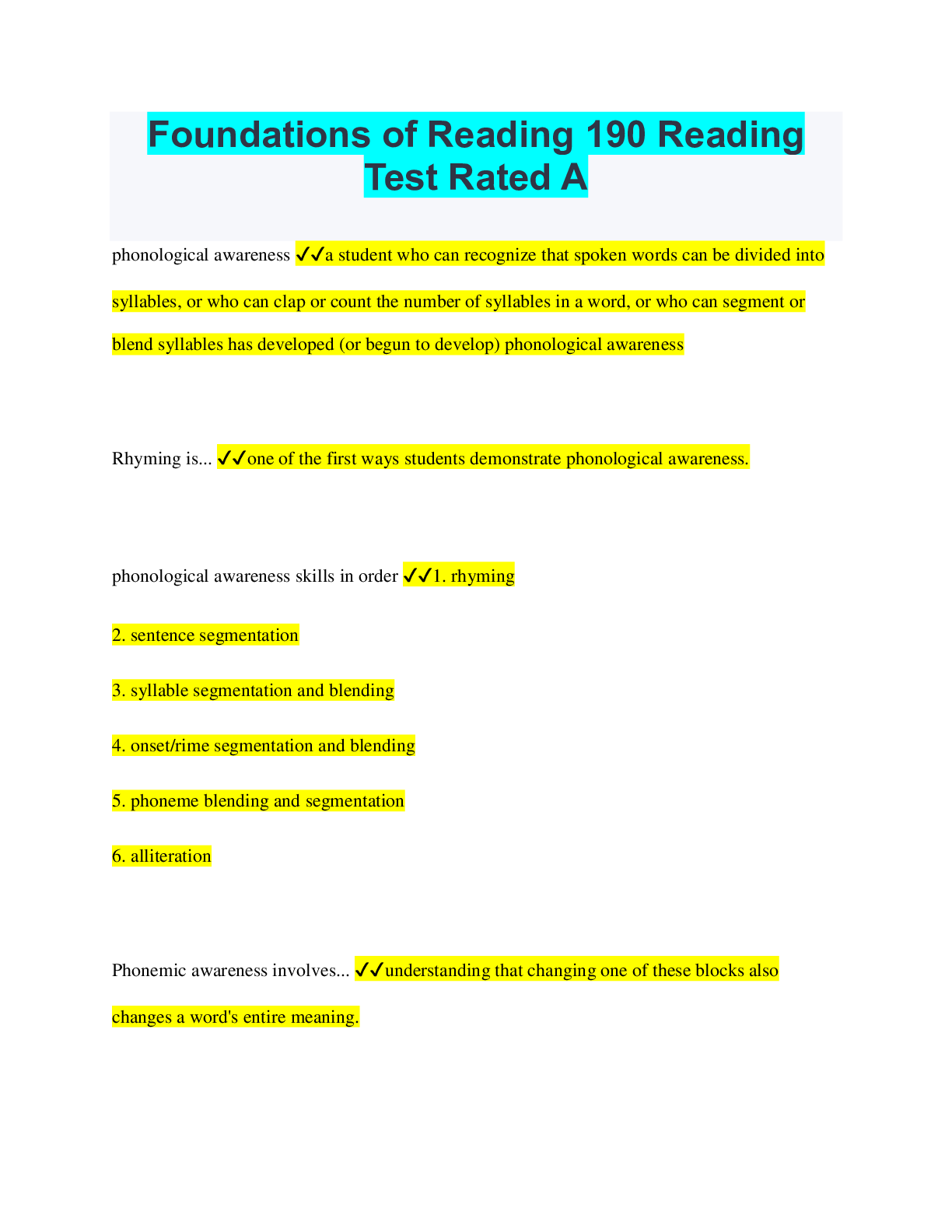
phonological awareness ✔✔a student who can recognize that spoken words can be divided into
syllables, or who can clap or count the number of syllables in a word, or who
...
Foundations of Reading 190 Reading
Test Rated A
phonological awareness ✔✔a student who can recognize that spoken words can be divided into
syllables, or who can clap or count the number of syllables in a word, or who can segment or
blend syllables has developed (or begun to develop) phonological awareness
Rhyming is... ✔✔one of the first ways students demonstrate phonological awareness.
phonological awareness skills in order ✔✔1. rhyming
2. sentence segmentation
3. syllable segmentation and blending
4. onset/rime segmentation and blending
5. phoneme blending and segmentation
6. alliteration
Phonemic awareness involves... ✔✔understanding that changing one of these blocks also
changes a word's entire meaning.
EX: if we replaced /k/ with /f/, the word cat becomes fat. We could then change the /f/ to /r/ and
make it /r/ /a/ /t/, or rat.
Phonemic awareness skills in order from less complex to most ✔✔1. Phoneme Isolation
2. Blending
3. Segmentation
4. Addition
5. Deletion
6. Substitution
Studies have concluded that... ✔✔-phonological awareness strongly indicates a child's ability to
read, and spell.
weak phonological and phonemic awareness levels predict reading difficulty in kindergarten
Explicit instruction means ✔✔a teacher may provide instruction on rhyming, model rhyming,
and then have the students try.
Implicit instruction ✔✔looks at skills in context, without over teaching of a concept. Popular
nursery rhymes like "Row, row, row your boat" may be an implicit instruction strategy for
practicing rhyming.
Activities to help rhyming pt 1 ✔✔Matching Games - Have students match picture cards with
words that rhyme. Play rhyming memory/concentration.
Activities to help rhyming pt 2 ✔✔Rhyming Books — Read rhyming books such as Llama
Llama Red Pajama, Goodnight Moon, or Hop on Pop. (Implicit)
Encourage students to come up with their own rhyming words.
Activities to help Alliteration pt 1 ✔✔Alliteration books (Implicit) - EX: If You Give a Moose a
Muffin
Activities to help Alliteration pt 2 ✔✔Word comparison activities (Explicit) - EX: Say: sit, sip
Ask: Do sit and sip begin with the same sound?
Activities to help Segmenting pt 1 ✔✔Segment using visual clues (explicit).
Show them pictures (books, lamp, chair, plane) Ask: Which picture begins with /l/. Repeat for
other beginning sounds; then increase difficulty to include ending and middle sounds.
Activities to help Segmenting pt 2 ✔✔Clapping nursery rhymes (Implicit)Clap the words of a
common rhyme or song, such as Jack and Jill Went up the Hill.
Activities to help blending ✔✔Stretch Words/Bubble Gum Words: Say a word (example: flat).
Repeat the word slowly, "stretching it out" like bubble gum, (ffff-llll-aaaaa-t). Students can
repeat, saying both the word and the "stretched out" version.
Activities to help deletion pt 1 ✔✔Compound Words: Say mailbox. Now say it again without
saying mail. [box]
Say hotdog. Now say it again without saying hot. [dog]
Activities to help deletion pt 2 ✔✔Deleted soun
[Show More]