Class B water Exam Questions and
Answers Already Passed
Filtration rate for rapid sand filters?
2-6 gpm/ sq ft
List the characteristics of the coagulation process?
Type of reaction ( physical-chemical)
Time require
...
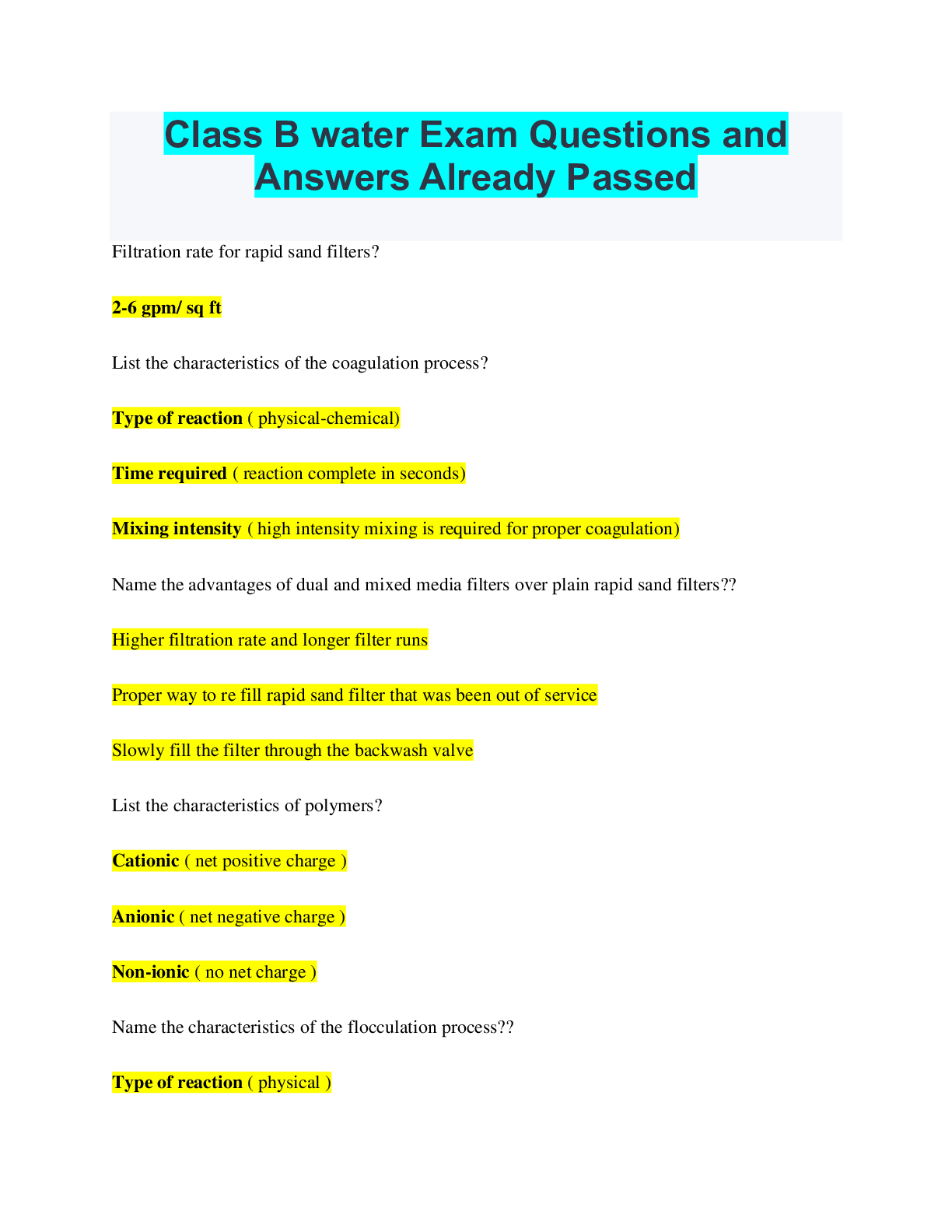
Class B water Exam Questions and
Answers Already Passed
Filtration rate for rapid sand filters?
2-6 gpm/ sq ft
List the characteristics of the coagulation process?
Type of reaction ( physical-chemical)
Time required ( reaction complete in seconds)
Mixing intensity ( high intensity mixing is required for proper coagulation)
Name the advantages of dual and mixed media filters over plain rapid sand filters??
Higher filtration rate and longer filter runs
Proper way to re fill rapid sand filter that was been out of service
Slowly fill the filter through the backwash valve
List the characteristics of polymers?
Cationic ( net positive charge )
Anionic ( net negative charge )
Non-ionic ( no net charge )
Name the characteristics of the flocculation process??
Type of reaction ( physical )
Time required ( 20-30 min )
Mixing intensity ( Controlled slow mixing )
Coagulants typically used in the water treatment industry
Alum or aluminum sulfate Al2(SO4)3
Iron salts: Ferric Chloride (FeCl3), Ferrous Sulfate (FeSO4)
Low molecular weight cationic polymer
What is the optimum pH for coagulation
Alum: pH 5-7
Iron salt: pH 4-11
Cationic polymer: effective over a wide pH range.
Alum or aluminum Sulfate
Al2(SO4)3 : pH 5-7
Ferric chloride
FeCl3 : ph 4-11
Ferrous sulfate
FeSO4 : pH 4-11
Typical rapid sand filter rate??
15 gpm/ sq ft or 24 inch rise/ minute
The overall change on a colloidal particle is determined by measuring what??
Zeta Potential
What may develop as a result of inadequate backwash of rapid sand filter??
Mudball formation
Performance of a sedimentation basin can be improved with the addition of these??
Tube settlers
The formation of bubbles near the bottom of a rapid sand filter is due to what??
Air binding
What can be used to enhance the coagulation/ flocculation process?
Activated silica (coagulation aid) or bentonite clay (weighting agent)
Flocculation-aid polymer
What is activated silica??
Coagulation aid
What is bentonite clay??
weighting agent for coagulation/ floc process
List results of wrong flocculator paddle speed.
Paddle speed to low : Poor floc formation ; turbidity settle out in the flocculation basin.
Paddle speed to high : floc particles break up
Repeated appearance of localized sand boil during backwash indicates this??
disturbance of filter bed support gravel, or displacement of underdrain
This is required for Alum to coagulate turbidity??
Alkalinity
Definition of alkalinity
measure of how much acid or hydrogen ions the water can neutralize. Acts as a buffer if any
changes are made to the water that could raise or lower the pH.
What helps stabilize pH in water
Alkalinity
What are the characteristics of a mixed media filter??
Top Layer: Anthracite coal - 1.4mm diameter - 1.4 spec. gravity
Middle layer: Medium silica sand - 0.8mm diameter - 2.6 spec. gravity
Lower layer: Fine garnet sand - 0.5mm diameter - 4.1 spec. gravity
Top layer of mixed media filter
Anthracite coal - 1.4mm di - 1.4 spec. gravity
Middle layer of media filter
Medium silica sand - 0.8mm di - 2.6 spec. gravity
Lower layer of media filter
Fine garnet sand - 0.5mm di - 4.1 spec. gravity
Cold water temperature has this effect on floc settling
the floc settling rate is slower, due to the slight increase in the density of the water.
Name the physical process that describe the removal of turbidity in a sand filter
-Straining
-Adsorption
- Sedimentation
What causes air binding in filters??
Negative head ( partial vacuum) near the bottom of the filter
Improper dosing of filter aid polymer can cause these problems
Overdose : Shortened filter run, due to rapid increase of headloss
Underdose: Shorted filter run, due to turbidity breakthrough
What is required during filter backwash, to provide equal media expansion at different water
temps?
Backwash rate can be increased slightly as the water temp increases
As water temp ______________ in filter backflush the rate should slightly ___________?
Increase ; Increase
These are used to optimize coagulant dosage??
- Pilot filter
- Streaming current monitor
- Jar test
- Zeta potential
This instrument measures the Zeta Potential of coagulated turbidity particles??
Streaming current monitor
Sedimentation basins are provided with inlet baffles to prevent this??
short circuiting
This is a typical slow sand filtration rate.......
0.05-0.1 gpm/ sq ft
This must develop on the surface of a slow sand filter in order for proper filtration
Schmutzdecke
Define Schmutzdecke
German meaning "dirt covered" is a hypogeal biological layer formed on the surface of a slow
sand filter
these should be monitored continuously during operation of filters
- Flow rate
- Headloss
- Filter effluent turbidity
properly operating filters surface sweeps will accomplish this?
Break-up mudballs and surface mats
What are the functions of the filter underdrain?
- Collect and remove filtered water
- distribute backwash water to filter media
This is the most important for of natural alkalinity in surface water?
Bicarbonate : HCO3
Bicarbonate
HCO3
These chemicals can be added to water as artificial alkalinity
- Hydrated lime : Ca(OH)2
- Soda Ash: Na2CO3
- Caustic Soda: NaOH
NaOH
Caustic Soda
Na2CO3
Soda Ash
Ca(OH)2
Hydrated lime
The function of filter aid polymer is......
Cause turbidity floc particles to bind to filter media
Filter backwash is indicated when this occurs??
Filter head loss reaches critical level. Filters should be backwashed when the headloss reaches 6-
10ft
When should filters be backwashed?
When headloss reaches 6-10ft
Indications of inadequate filter backwash
- Filter mats
- Filter bed cracks
- Mud balls
This is required when the headloss in a slow sand filter become excessive
The filter is taken out of service and the upper most layer of sand and dirt are removed
If settled sludge us left in the sedimentation basin too long, what may occur??
Finished water taste and odor problems may develop
These valves are opened during normal rapid sand filter operation
- Influent valve
- Effluent valve
These valves are open during a backwash cycle of a rapid sand filter?
- Backwash to waste valve
- Surface wash valve
- Backwash valve
The effluent from a freshly backwashed filter should be directed here?
To waste. The first water through the filter is often of inferior quality, and should not be directed
to the finished water clear well.
"Rule of Thumb" ration of Alum to alkalinity for proper coagulation.
Alum : natural alkalinity
Alum : hydrated lime
Alum : natural alkalinity = 2:1 ; 2 parts Alum : 1 part alk.
Alum : Hydrated Lime = 4:1 ; 4 parts Alum : 1 part hydrated lime
Overdose of Alum coagulant can result in this???
Excess Aluminum ion in the finished water and/ or precipitation of Alum floc in the distribution
system
Important control parameters for a solid contact clarifier, it is important to do this?
Maintain optimum solids level in the blanket
What is the purpose of a solid contact clarifier??
Used in water softening and color and turbidity removal
Mud balls can create these problems in a rapid sand filter
"Channeling" of water through the filter media and premature turbidity breakthrough
This may occur if a rapid sand filter is operated at too high head loss.
Filter may experience turbidity breakthrough or air binding
The major advantage of using an iron salt such as ferric chloride instead of Alum as a coagulant
is??
Iron salts are more effective over a broader range of pH
Air binding in a filter can cause this problem??
non-uniform filtration throughout the filter bed
Headloss that indicates need for backwash??
6-10 ft
The positively charged ions are primarily responsible for water hardness
- Calcium : Ca+2
- Magnesium : Mg+2
Permanent hardness is associated with these anions
Chloride and Sulfate
Used to recharge zeolite ion exhange softeners
Sodium Chloride salt brine
This provides Recarbonation during the lime-soda softening process
Carbon dioxide : CO2
This can be used to remove soluble organics, including taste and odor from water.
Activated Carbon :
-Powdered activated carbon : PAC
-Granular activated carbon : GAC
Chlorine that reacts with phenolic compounds in water can produce this problem.
Taste and odor
Chemicals effective in the treatment of taste and odor compounds
- Potassium Permanganate
- Chlorine dioxide
- Ozone
- Free Chlorine
- Activated carbon
Changes in these can reduce the corrosive characteristics of water.
- Increase the alkalinity
- Increase the hardness
- Raise the pH
Special sand used for iron removal
Manganese green sand
Used to control iron "red water" problems??
Metaphosphates
Removal of noncarbonate calcium hardness by chemical precipitation requires the addition of
this
Carbonate, usually in the form of soda ash : Na2CO3
This method of softening also reduces the total dissolved solids (TDS) of the water
Chemical precipitation by the lime-soda process
insufficient recarbonation during the lime-soda process can cause this filter problem.
Incrustation of calcium carbonate on the filter media causing growth in the size of the filter
grains
This ion is added to water during zeolite ion exchange softening
Sodium : Na
Manganese green sand ion removal filters are re-generated with this??
Potassium Permanganate : KMnO4
Metaphosphate added to control iron "red water" should be added to the water BEFORE this.
BEFORE the addition of Cl2
Methods used to remove or destroy hydrogen sulfide
- Aeration
- Oxidation with chlorine
Lists methods used to remove iron from drinking water
- pH adjustment to pH 8-9 and aeration followed by filtration
- Chlorine oxidation followed by filtration
- Permanganate oxidation followed by filtration
- Manganese green sand filtration
- ion exchange softening
This can be used to keep iron and manganese in solution
Metaphosphate
Amount of salt required to regenerate zeolite softener
0.2 - 0.5 lb salt/ 1000 grain capacity
Pink water in the effluent of a permanganate / green sand iron treatment system indicates what?
the permanganate dose is too high
Recarbonation of lime-soda soften water is done for this reason ?
To reduce the scale and incrusting characteristics of the water
Iron in the form causes "red water" problems
Ferric iron
Nitrate can be removed from potable water with these methods??
- Ion exchange
- Reverse osmosis
THM's can be removed from water with this treatment??
Activated carbon adsorption
This occurs during the regeneration of zeolite ion exchange resin
Hardness ions are displaced and sodium ions are replenished on the surface of the resin
Problems that may occur in the operation of an ion exchange softener
- Insoluble iron and manganese deposits on the resin beads
- Clogging of the resin bed.
This softening process does not significantly change the total dissolved solids (TDS) content of
the water
Ion exchange softening. Calcium and Magnesium ion are simply replaced with sodium ions,
which leaves the TDS of the water about the same
Purpose of recarbonation
Stop continued precipitation of calcium carbonate
Replacement of granular activated carbon is required at this point
When removal of soluble organic material is inadequate. The adsorption sites on the carbon
eventually become filled
activated carbon has this effect on chlorine residual
the chlorine residual will be reduced to zero
...
...
this causes water to move across a semipermeable membrane during reverse osmosis treatment
water pressure
define revere osmosis
water purification process that use a permeable membrane to remove ions, unwanted molecules
and larger particles from drinking
Bacteria and other microorganisms can cause these problems for reverse osmosis treatment
equipment
- Membrane fouling
- Membrane breakdown or deterioration
- Module plugging
These may be used to RAISE the pH and/or alkalinity of water
- Quick Lime : CaO
- Hydrated Lime : Ca(OH)2
- Caustic Soda : NaOH
- Soda Ash : Na2CO3
Free or "aggressive" CO2 can cause this problem
Corrosion in the distribution system
These can be used to coat distribution system piping to reduce corrosion
- Silicate compounds
- Phosphate compounds
- Calcium carbonate
Optimum pH for the removal of iron and manganese by aeration
Optimum pH : 8-9
Removes these form of hardness
- Carbonate hardness
- Non-carbonate hardness
- Remvoes carbonate hardness : hydrated lime : Ca(OH)2
- Removes non-carbonate hardness : Soda Ash : NaCO3
When phosphates are used for iron control, and chlorine is used for disinfection, this is the order
to add them to water.
Add the phosphate before the chlorine
[Show More]