GA Life Insurance Latest 2023
Graded A+
Term life ✔✔temporary protection also known as pure death protection
Level term ✔✔Most common, level refers to death benefit does not change
Annually Renewable Term ✔✔ART pures
...
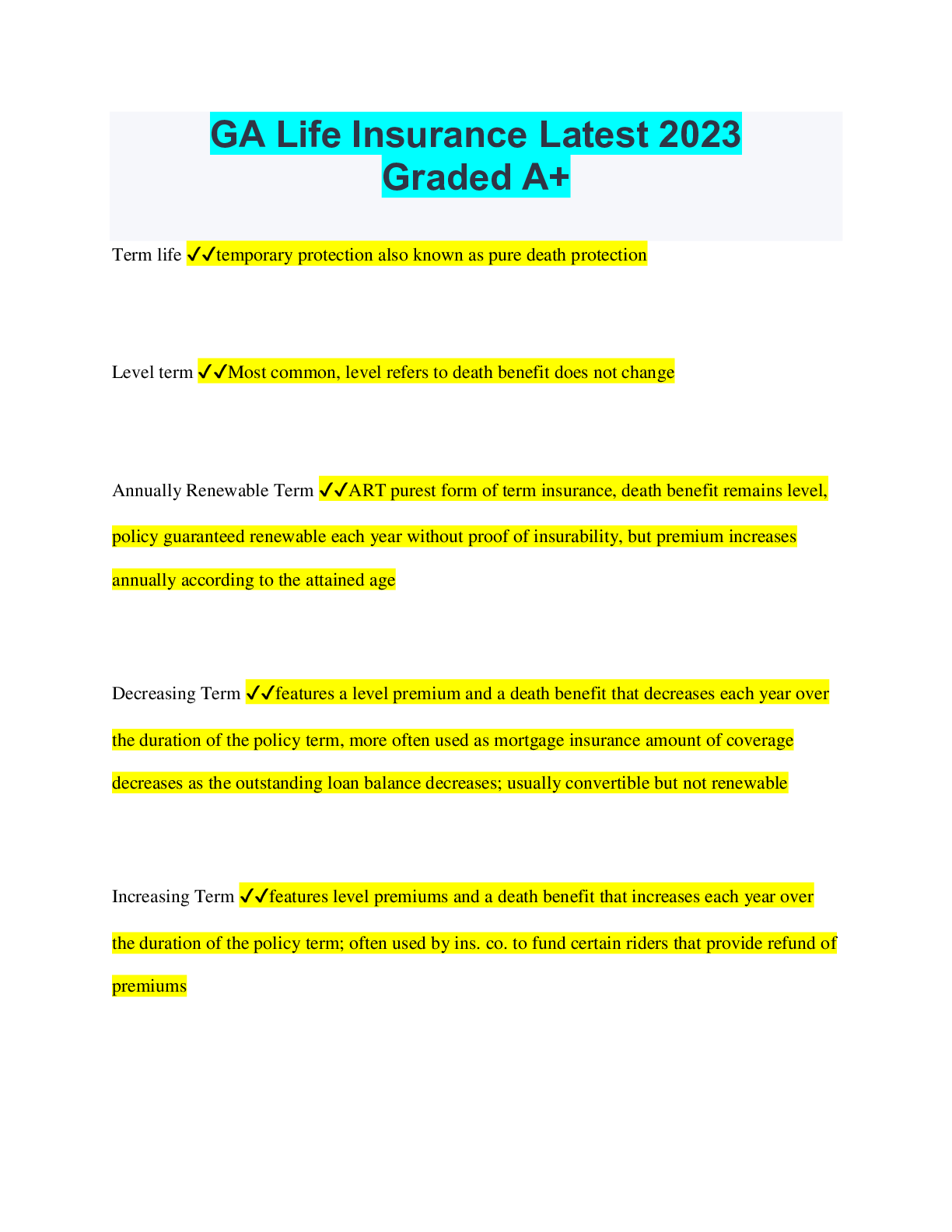
GA Life Insurance Latest 2023
Graded A+
Term life ✔✔temporary protection also known as pure death protection
Level term ✔✔Most common, level refers to death benefit does not change
Annually Renewable Term ✔✔ART purest form of term insurance, death benefit remains level,
policy guaranteed renewable each year without proof of insurability, but premium increases
annually according to the attained age
Decreasing Term ✔✔features a level premium and a death benefit that decreases each year over
the duration of the policy term, more often used as mortgage insurance amount of coverage
decreases as the outstanding loan balance decreases; usually convertible but not renewable
Increasing Term ✔✔features level premiums and a death benefit that increases each year over
the duration of the policy term; often used by ins. co. to fund certain riders that provide refund of
premiums
Renewable ✔✔provision that allows the policyowner the right to renew the coverage at the
expiration date without evidence of insurability; premium will be based on insured's current age
Convertible ✔✔provision provides the policyowner the right to convert the policy to a
permanent insurance policy without evidence of insurability; premium will be based on insured's
attained age at the time of conversion
Permanent Life Insurance ✔✔general term used to refer to various forms of life insurance
policies that build cash value and remain in effect for the entire life of the insured (or until age
100) as long as premiums are paid - the most common is whole life
Whole Life Insurance ✔✔provides lifetime protection and includes a savings element (or cash
value); endowed at the insured's age 100 which means the cash value created by the
accumulation of premium is scheduled to equal the face amount of the policy at age 100
Key characteristics of whole life ✔✔Level Premium - based on issue age, remains the same
throughout the life of the policy
Death Benefit - guaranteed and remains level for life
Cash Value - created by the accumulation of premium, is scheduled to equal the face amount of
the policy when the insured reaches 100 (the policy maturity date) and is paid out to the
policyowner
Living Benefits - policyowner can borrow against the cash value while the policy is in effect, or
can receive the cash value when the policy is surrendered, cash value does not accumulate until
the 3rd policy year and it grows tax deferred
3 basic forms of whole life insurance ✔✔Straight whole life; limited-pay whole life and single
premium whole life
Ordinary straight Life ✔✔referred to as continuous premium whole life - the basic whole life
policy, owner pays premium from the time the policy is issued until the insured death or age 100
(whichever occurs 1st), most common life policy and will have the lowest annual premium
Limited-Pay Life ✔✔Limited pay whole life is designed so that the premiums will be completely
paid-up well before age 100. Some of the more common versions of limited pay life are 20-pay
life; coverage is completely paid for in 20 ears and life paid up at 65 (LP 65), all other factors
being equal, this type policy has a shorter premium paying period than straight life, so the annual
premium will be higher
Suited for those that don't want to pay premiums beyond a certain point in time
Single Premium ✔✔(SPWL) designed to provide a level death benefit to the insured's age 100
for a one time, lump sum payment. the policy is completely paid up after one premium and it
generates immediate cash, most companies require a minimum premium for a single premium
policy
Adjustable Life ✔✔was developed in an effort to provide the policyowner with the best of both
worlds (term and permanent) it can assume the form of either term insurance or permanent,
insured typically determines how much coverage is needed and the affordable amount of
premium - as the owners needs change the following are options
1. increase or decrease the premium or the pay period
2. increase or decrease the face amount
3. change the period of protection
will have the option of converting from term to whole life or vice versa - **increases in the death
benefit or changing to a lower premium type policy will usually require proof of insurability; in
the case of converting from a whole life policy to a term policy, the insurer may adjust the death
benefit. the policyowner may also pay additional premiums above and beyond what is required
under the permanent form in order to accumulate greater cash value or to shorten the premium
paying period
Cash value only develops when the premiums paid are more than the cost of the policy
Universal Life ✔✔also known as flexible premium adjustable life - policyowner has the
flexibility to increase the amount of premium going paid into the policy and to later decrease it
again, policyowner may even skip paying a premium and policy will not lapse as long as there is
sufficient case value at the time to cover the monthly deductions for cost of insurance
Two types of premiums ✔✔company may give the policyowner a choice to pay either of the two
types of premiums
1. Minimum premium is the amount needed to keep the policy in force for the current year - this
will make the policy perform as an annually renewable term
2. Target premium is a recommended amount that should be paid on a policy in order to cover he
cost of insurance protection and to keep the policy in force throughout the lifetime
Universal Life Policy - components ✔✔1. Insurance component - always annually renewable
term insurance
2. Cash Account
Partial Withdrawal (or surrender) ✔✔allowed with a universal life policy - however there may
be a charge for each withdrawal and there are usually limits as to how much or how often
withdrawals may be made, during a withdrawal the interest earned may be subject to taxation
Death Benefit Options ✔✔Option A - the level death benefit which remains level while the cash
value gradually increases, thereby lowering the pure insurance with the insurer in later years
Option B- Increasing death benefit option - death benefit includes the annual increase in case
value so the death benefit gradually increases each year by the amount that the cash value
increases - at any point in time the total death benefit will always be equal to the face amount of
the policy plus any cash value - expenses will be greater than option a, making cash value lesser
in later years
Variable Whole Life ✔✔sometimes referred to as variable whole life insurance is a level, fixed
premium, investment based product. Like traditional forms of life insurance, these policies have
fixed premiums and a guaranteed minimum death benefit. The cash value of the policy, however,
is not guaranteed and fluctuates with the performance of the portfolio. Policyowner bears the
investment risk in variable contracts
Important facts on Variable life Insurance Products ✔✔In a variable whole life policy - because
the insurance company is not sustaining the investment risk of the contract the underlying assets
of the contract cannot be kept in the insurance company's general account. These assets must be
held in a separate account, which invests in stocks, bonds, and other securities investment
options.
Variable insurance products are dually regulated by the State and Federal government. Due to
the element of investment risk - Securities and Exchange Commission (SEC), the Financial
Industry Regulatory Authority (FINRA), and /or federal bodies. Variable insurance is regulated
by the Insurance Department - Agents selling variable life products must be registered with
FINRA (have securities license) and also be licensed by the state to sell life insurance
Variable Universal Life ✔✔Type of insurance that combines may features of the whole life with
the flexible premium of universal life and the investment component of variable life
> a flexible premium that can be increased, decreased or skipped as long as there is enough value
in the policy to fund the death benefit
> increasing and decreasing the amount of insurance
> cash withdrawals or policy loans
> do not guarantee return
Interest Sensitive Whole life ✔✔also referred to as current assumption life, is a fixed premium
whole life policy that provides a guaranteed death benefit to age 100 - this type of policy credits
the cash value with the current (nonguaranteed) interest rate that is usually comparable to money
market rates
Flexible Premium Policies Compared ✔✔see page 23 of Insurance book
[Show More]